Showing posts with label Story Diamond. Show all posts

Tuesday, May 4, 2021

Final Draft 12's Beat Board, Outline, and Script Insertion Function

 
You that follow the Moral Premise know I'm sort of a Story Structure freak. But then my Story and Script consulting clients encourage me. I have been continuously helping writers structure their screenplays, scripts, and novels since 2007... and I still enjoy it. (But then I'm being paid to do it. THANK YOU.) 

If you've rented or purchased lessons from my on-line Storycraft Training you also know how much I rely diagrams (graphic metaphors) for beating out a story and structuring it properly so it will emotionally connect with audiences. 

Over time I've come up with some fairly simply ways of beating out stories (on paper or electronic cards) and then copy-pasting the content of those cards into Final Draft for writing. It has worked well. 

Recently, Final Draft released Version 12 with an updated Beat Board, Outline, and Script Insertion Function that is very exciting. I've spent some time with it, and have begun to turn some of my recent clients onto its functionality. I'm not sure how "smooth" it works on PC's, but I'm on a Power Mac, and in my environment it has a ways to go so the operation and functionality are smooth and easy to use. But the ideas are very good, and I want to encourage writers to encourage Final Draft to keep working on this. 

So, as part of a new addition to my on-line Storycraft Training series, Lesson 11 - Visualizing Story Structure, I included a short video to introduce writers to what Final Draft is doing. You will find it below. I've used a bit of editing (Final Cut) to make this look smoother operating than it currently is, but with some encouragement I hope they get it polished. Please write Final Draft via Feedback and encourage them.

Here's the video.

Tuesday, August 27, 2019

Story Diamond Notes

This description is NOT for the uninitiated. A few lazy folks criticize the appearance of the diamond portrayed right, because (I can only assume) their lives revolve around 128 character solutions. I'm not a Twitter fan, and you should not be either if you want to be a success at anything. If you read just a little of this description, you'll discover perhaps one of the greatest tools for developing stories. And I will not take any credit for it. All I did was take everyone else's great ideas and overlay them, proving we're all talking about the SAME natural law of story telling, just seeing it from different perspectives. 

The Story Diamond continues to hold me in awe as a story brainstorming tool.


While it looks complicated, it's very simple and helpful in holding off writer's block, although it is no substitute for a well-formed and fell-fed imagination. 

Below is the latest edition of the annotated Story Diamond Notes file. You can download this HERE as a PDF. but some may find this browser edition helpful.


STORY DIAMOND NOTES
by Stanley D. Williams, Ph.D.
Introduction to the Story Diamond

The Barebones Diamond
In 2008, I was given a copy of an early version of The Story Diamond while working on a story with Will Smith, Chris Vogler, and Marianne and Cormac Wibberly. With their permission

Tuesday, July 9, 2019

Story Diamond Update FREE DOWNLOAD

The Other Chris Pratt was trying to help me understand John Truby's ambiguous and obscure use of the English language when he gave up and threw me a juicy bone—Michael Arndt's Instructional Video on Insanely Great Endings (IGE).  Arndt wrote Little Miss Sunshine and the screenplay to Toy Story 3.

I'm only one-third the way through IGE, but I'm already a fan. Yeah, you're right, there's a lot of Moral Premise related stuff in it...but no,  don't think Michaels has ever heard of my book.

But having now been exposed to Arndt's theory structure, I couldn't help resist adding it to The Story Diamond (below), or at least my simplified interpretation of it. Watch his tutorial. And I'm looking forward to watching his video on Beginnings.

Anyway, here's the latest version of the Story Diamond. Yeah I know this is getting crazy, but as busy as it is, it's still helpful if you've got a magnifying glass. For a PDF download click the link above. For a link to all my posts on The Story Diamond, click HERE.


Wednesday, November 14, 2018

F16 Moments - Writing Exciting Scene-to-Scene Movies

Things of Value Come in Threes

1. Years ago, I was in a meeting with Will Smith and a few others breaking a story, yet to be made. We were at somewhat of an impasse about a scene when Will gets up and in his animated way pitches the scene something like this:
Naw! That's not how it needs to go down. Imagine instead that the doors to a big warehouse slowly open, and we hear a might roar of a jet engine, and smoke pours out of the doors, and out of the smoke rolls this monstrous F16 Jet fighter, and it comes down this alley, it's wings almost scrapping the brick walls either side, and it turns onto this boulevard,  and then it sits there at the end of this wide road, revving it's engines. It's vibrating something awesome, wanting to take off, and suddenly it gets the okay, and it begins it's roll. And the camera pulls back, and his F16 jet is on Broadway of all places. And it roars down Broadway, fire flying out it's ass, and suddenly the pilot pops the afterburner and that baby jacks up on it's hinny, and catapults into the sky and disappears. Now, that would be cool!
I spoke up.
Ah, Will. A jet couldn't take off down Broadway because of all the lights, and wires crossing the road. You would be a helicopter, a big one of course, but a jet could never do it.
Will looked at me.
No, Stan,  you don't get it. A helicopter is boring. A jet is cool and exciting and L O U D! Forget the wires, it would be a very cool scene to see that jet screaming along in front of those theaters, flashing lights on the marquees, and buildings, and then zoom up into the sky.
It took a minute, but then I realized he was right. I shut up.

2. Yesterday an acquaintance wrote me:
Have you ever read about how Walt Disney used to work with his story crew? They started with a pre-existing story and Walt asked them to come up with entertaining moments. Then they strung them together.
3. Another successful producer was David O. Selznick (GONE WITH THE WIND). Shortly after he released GWTW, he bought the rights to Scarlet Lily, a book by Edward Murphy that I wrote about yesterday on this blog. I'm reading the book with the intent of discovering what Selznick saw in it. I'm halfway through and just read this morning the Moment of Grace scene that totally changes the story's direction for our harlot protagonist, Mary of Magdala. But what has captured my attention is how each chapter is a single scene with a dramatic profile—they are moments, each worthy of remembrance. It goes back to what Will and Disney were saying: Put the story together with a tight sequence of memorable scenes and moments.

But What About Structure?

But a sequence of memorable scenes alone don't a story make, but Will Smith, Disney and Selznick are probably on to something.

The acquaintance that wrote me about Disney also said that there was a tendency of the Disney storywriters (when Walt was out of the room) to string moments together without a clear story or plot. Movie Moment

I'm meeting this week with a screenwriter on a couple of his scripts, and we're going to do this...well, I'm going to suggest he do this....D. are you reading this?

1. Take the Story Diamond and divide the story into 8 short movies or sequences. See my blog post on The Sequence Approach.

2. Conceive of each sequence has building to an exciting movie moment that coincides with the 8 Pinch Points or Turning Points that climaxes each sequence. Make each moment exciting, full of tension, and conflict. If you can't think of such a sequence that ends in such a memorable moment, for the sake of your audience CHANGE YOUR STORY!

3. Ensure that the first 7 pinch points or turning points end with the protagonist's failure to achieve the goal he or she had pursued in that sequence, but opens a door for an escalating challenge in the next sequence. If the movie is redemptive, the 8th "point" is the charm and success is achieved. If the movie is tragic, the 8th "point" is the protagonist's final defeat. (Remember that even in a redemptive movie there is likely an antagonist that has a tragic arc, so you can write a story that has your protagonist succeed and your antagonist defeated (ala DIE HARD).

4. In every other aspect follow the Moral Premise.

In summary:
 Every sequence ends with an "F16 popping the afterburners down Broadway." 

Tuesday, November 22, 2016

Beats - Turning Points - Sequences - Pinch Points

One of my on-going challenges as a story consultant has been to clarify terminology and minimize the equivocation in terms. (Thus the recent post Protagonist vs. Hero with assistance from Chris Volger). Clarifying terms was a motivation behind writing the The Moral Premise regarding what others were calling various things like "the Controlling Idea," "Theme," "Premise," and so on.

The Story Diamond (link to PDF of Diamond) was not original with me, but I saw the opportunity of layering other story  concepts onto it and thus demonstrating how the wide variety of terms used in our niche industry, are really all about the same thing.

So, this post is another attempt at that...with hopefully some nomenclature consistency. It was prompted by the last several posts by Michael Hauge over at StoryMastery.com. Michael has made the turn from calling every sequence and turning point a "beat" to differentiating between the different kind of beats as "turning points" and story "stages".  This solves an on going problem. I would tell my clients that some beats are "moments" (a single scene) and others are "sequences" (numerous scenes.) Yet the connotation of "beats" still sounds  instantaneous...which is confusing since half of the beats are not moments at all.

So, taking this hint from Michael, I offer up the following and the Story Diamond has been updated to reflect this subtle shift in labeling conventions.

As a further update, the 8 stages can also be called Mini-Movies, which reflects the ideas of Paul Gulino (Screenwriting: The Sequence Approach), and Chris Soth of ScreenwritingU.

Recall that our goal is to create an emotional roller coaster effect for our reader/audience. That end goal demands a regular (up and down) progress of scene sequences and turning points (or beats) or pattern over which we can apply our story elements and plot.

The latest PDF of the Story Diamond is HERE.

The latest PDF Annotated NOTES document for The Story Diamond is HERE.


Symmetry

If we refer to the Climax of Act 3 as a turning point (which is clearly is in redemptive stories where the protagonist makes his/her biggest change) we then have a wonderfully symmetrical story system.  There are 4 Turning Points, and 4 Pinch Points, and they alternate, helping to create the roller coaster effect we're after. MORE ABOUT THE IMPORTANCE OF THE ROLLER COASTER AND STRUCTURE AT THESE  POSTS.

Plus, the Sequences alternate with the Points, for a deeper symmetry and a satisfying roller coaster ride.
  1. (Prologue)
  2. Sequence 1
  3. Pinch Point A (Inciting Incident)
  4. Sequence 2
  5. Turning Point 1 (Act 1 Climax)
  6. Sequence 3A
  7. Pinch Pint B
  8. Sequence 3B
  9. Turning Point 2 (MOG)
  10. Sequence 4A
  11. Pinch Point C
  12. Sequence 4B
  13. Turning Point 3 (Act 2 Climax)
  14. Sequence 5
  15. Pinch Point D (Final Incident)
  16. Sequence 6
  17. Turning Point 4 (Act 2 Climax)
  18. Denouement
A full explanation of the Story Diamond is presented in my On-Line Storycraft Training series.

Thursday, August 4, 2016

Orphan, Wanderer, Warrior, Martyr

Jason Holborn is a fan of The Moral Premise and independent filmmaker residing in Toronto, Canada. A while back he came across The Story Diamond on my writing aids page and how it demonstrates the coincidence of various story structures.

[A full explanation of the Story Diamond is presented in my On-Line Storycraft Training series.]

The latest PDF of the Story Diamond is HERE.

The latest PDF Annotated NOTES document for The Story Diamond is HERE.


The structure that caught his fancy was Jeffrey Schechter's interpretation of Carol S. Pearson's archetypes explained in her earlier book THE HERO WITHIN. (Jeffrey's book is MY STORY CAN BEAT UP YOUR STORY! and I discuss Carol's latest effort in a recent blog on AWAKENING THE HEROES WITHIN.)

The structure that Jason vamped on in a blog back in 2013, but which I just came across, is Orphan, Wandered, Warrior, Martyr.

Jeffrey's take, which I have used in The Story Diamond is very simple and yet profound. The four archetypes identify the protagonist's primary mode of operation in each of the four equal acts of the movie.


  1. In Act 1: ORPHAN...lost...needing a quest.
  2. In Act 2A: WANDERER...chose the quest...but unsure how to achieve it.
  3. (stick in here a MOMENT OF GRACE (MOG) where S/He discovers what the story is really about)
  4. In Act 2B: WARRIOR...having discovered through the moral premise how to actually get what he needs.
  5. In Act 3: MARTYR for what he and his village back home needs.


Jason has contributed something very valuable, here. He's analyzed a number of films and described for us the above structure in them. Thank you, Jason, for permission to reprint this.

Immediately in the next paragraph, is Jason's post...

Thursday, November 14, 2013

"The Story Diamond Won't Work For Me"

I have had the pleasure of working as a story consultant with celebrated historical romance writer TAMERA ALEXANDER over the past few years. She's mentioned in a couple earlier posts.

This week she's going over the galleys to her latest book, A BEAUTY SO RARE, which will come out in April, 2014 from Bethany House Publishers.  Tamera has a couple of book series she writing this decade, turns out about one a year, alternating between Bethany and Zondervan (Harper Collins), both Grand Rapids, MI publishers. ABSR is for Bethany and is book 2 of the Belmont mansion series. Zondervan gets the series about the Belle Meade plantation. Both estates are real places, with real historical people, in postbellum Nashville, which is where Tamera calls home.

In a couple of emails we exchanged over the last 24 hours, and then a telephone conversation, Tamera shared the following:
ABSR was, by far, the hardest book I’ve ever written...Thanks again for the brainstorming we did on the front end. One thing I learned this go round…do not work from the white board (story diamond) when trying to write. The left brain and right brain do not mix. Nearly drove me to drink. Which actually might have helped, come to think of it. : )... I was trying to follow the story diamond, filling it in, trying to figure out the Act 1, Act 2, Act 3 thing, and it did not work for me. Doesn’t mean the story diamond won’t ultimately work for me, but doing that while creating is a killer for me. Just can’t mix the two at all.
Now why would I post this criticism of something I promote—The Story Diamond, pictured at left in its recent permutation. Posts about which can be found HERE, and the actual working tool HERE?

Because Tamera's observation is instructive, and allows me to reinforce why we call writing aids like The Story Diamond an "aid" and not a "rule". Indeed, Chapter 4 of The Moral Premise, "Storytelling's Natural Law and Processes" attempts to explain how every successful writer, while they may end up at the same place, cannot use the same method. Just as every protagonist is different in terms of psychological makeup and action, so is every writer in how they must listen to their muse and get the work done.  I remind writers in my workshops that if they follow my "secrets" and suggested rules of successful writing literally, they will marginalize the story's natural dynamic, and output will be a dud. One of the reasons well-written stories connect with human beings so well is that they are all different—meaning both the stories and the humans. The Story Diamond is meant as an invisible guide, to give the writer an underlying structure, not a step-by-step rule.

FREE WILL PANTSING

Saturday, July 13, 2013

Story Diamond

With his permission, here's a snap that friend and client Curt Nickels sent me of a six-foot piece of white board he salvaged from a construction project in order to make a story diamond board. Wish I had one of these. He could even paste post-its on this, or little pieces of computer printouts with Elmer's Repositionable Glue Stick on the back. Very cool, Curt.

A full explanation of the Story Diamond is presented in my On-Line Storycraft Training series.

Thursday, November 8, 2012

Story Diamond 4-ft x 8-ft

Making the Story Diamond work in a practical sense as always been a problem, when you extrapolate or beat out the story and identify all the various scenes that have to be strung together. There just isn't enough room on the computer screen (so you can see everything at once), or on a 6-ft double door wall. Besides, with the doorway, it's hard to read the little cards on the inside with a 100w incandescent bulb, when everything outside is lite by the sun.

So, for a current project I purchased a 4-ft x 8-ft sheet of Masonite, mounted it on 1" PVC pipe, and put fixed position casters on the bottom so it would slide back and forth in front of a bookcase behind my desk, but not fore and aft. (so I can get to the books).

Here's a picture of the entire story beat out with all the major scenes summarized on small pieces of paper or cards. (Don't bother trying to read it. It's for a private client and the resolution is such that nothing is readable.)

I'm now in the process of taking each scene summary and writing out the treatment. The outline of the diamond is string stretched across the front and taped to the PVC pipe behind. The "cards" outside the string are the character goal cards and inner psychological beats, and the cards inside the outline are the actual scene/sequence descriptions. At the top of each scene card is a traditional slug line in reverse type. I realize now that I have this backwards. The inner beats (psychological goals) should be on the INSIDE of the diamond, and the external-physical beats (physical action) should be on the OUTSIDE of the diamond.

In the picture, Act 3 appears to be better developed, and it is when I took this picture. I started with the end in mind, and then worked the foreshadowing structure and beats back into Acts 1 and 2. (Begin with the end in mind.) As I write out the treatment it's clear that things have to changed, so I just move the pieces of paper around.

These scene summaries are written in a table on Word, printed on regular 20# paper or 3x5 card stock, cut down to size, and then I smear the back with Elmer's Repositionable Picture and Poster Stick. If you let the glue dry for a minute before putting the paper or card stock on the Masonite, the scenes are indefinitely repositionable.

I had to take this picture outside my office door wall because I could not get back far enough in my office to photograph the whole thing at once. Now, where to store this baby????


A full explanation of the Story Diamond is presented in my On-Line Storycraft Training series.

Monday, May 10, 2010

The Story Diamond

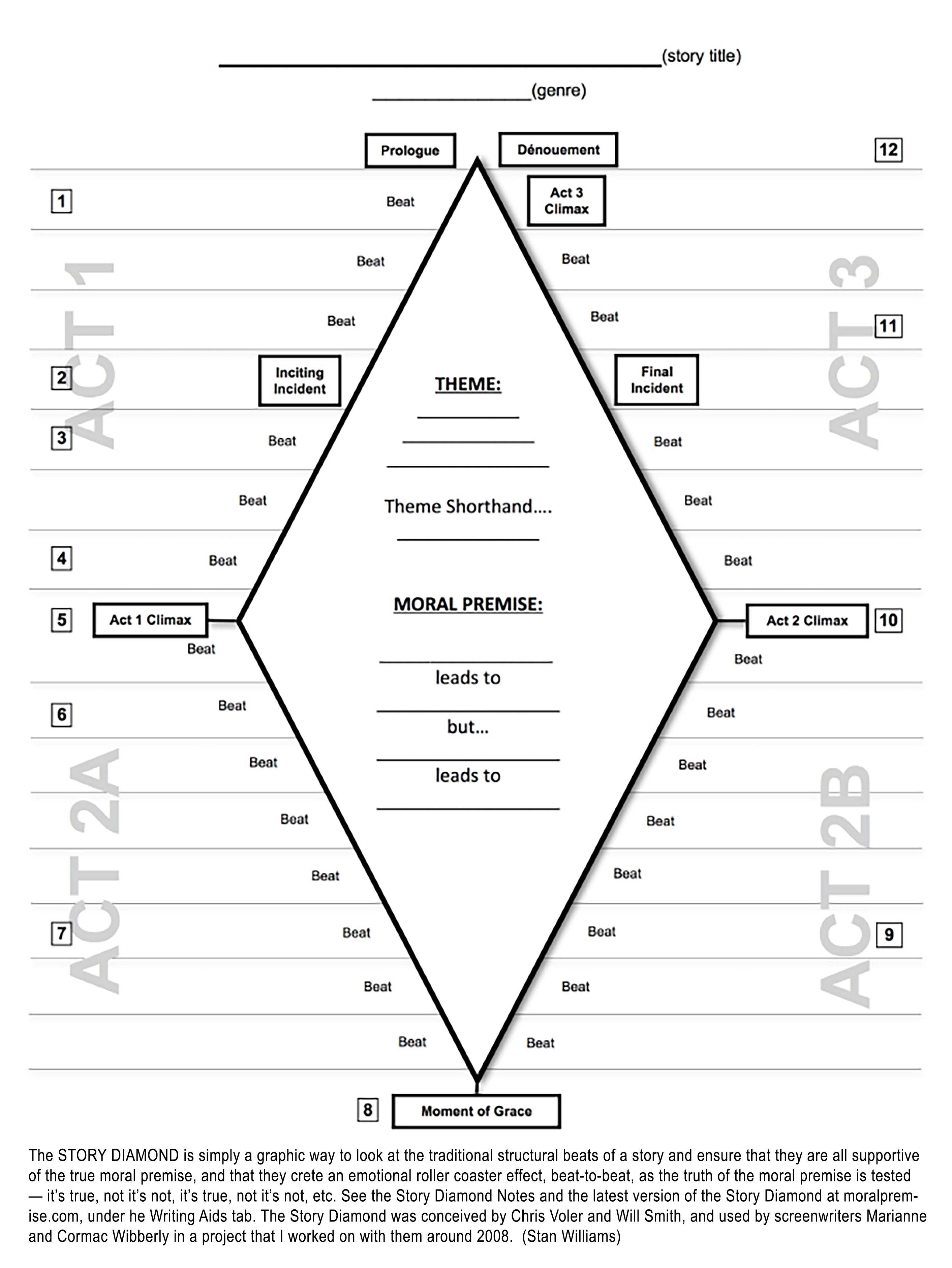
The Story Diamond is a useful diagram in structuring a story or screenplay. It was conceived by Chris Vogler and Will Smith, and then used by screenwriters Marianne & Cormac Wibberley for an upcoming Will Smith project that I was called in on to brainstorm. The image below is close to what they handed out. I've added the ACT 1, 2A images, and the explanation at the bottom. You can download this image HERE.


With their permission I took it and enhanced it by overlaying the various story structures used in the industry. The latest version is linked on the moral premise website in the middle of THIS PAGE... scroll down to find it. 

Here's what it looks like today with a host of other story structure systems overlaid. A full explanation of the Story Diamond is presented in my On-Line Storycraft Training series. You can download the latest version HERE.