Showing posts with label Wizard Clip Haunting. Show all posts

Thursday, May 28, 2026

The Paranormal 60 Interview with Dave Schrader


Spaced Out Radio Live Interview with Dave Scott

 Last night, I was the guest on Dave Scott's "Spaced Out Radio," a live terrestrial radio program out of British Columbia, Canada that is heard on 8 stations around the U.S., and later posted on YouTube. 

The impetus was the new trilogy edition of my historical novel, Wizard Clip Haunting, and its paranormal storyline. We had a great time and talked for 2 hours (with station and commercial breaks) about the juxtaposition of the natural and supernatural, the paranormal and the normal. 


Dave has an avid nightly following talking about American and Canadian Ghost Stories, Paranormal True Encounters, Real History, UFOs, and Big Foot. He's located in the wilderness between the Cascade Mountains and the North Rocky Mountains (God's country).  


Below is the YouTube version of the podcast, complete with off-air chatter and the silence during terrestrial radio station breaks. 


Related to this is my Nineveh's Crossing blog post "Is Christianity Paranormal" which contains links to posts on the same subject from Amanda Arrows, and Fr. Dwight Longenecker.


Friday, October 24, 2025

Adam Livingston Descendants Join Wizard Clip Book Signings

Jeff Livingston and Stan Williams
Several weeks before I left Michigan for a speaking and book signing tour to Florida and West Virginia, I received an email from Jeffrey Livingston, 8th generation grandson of Adam Livingston, the protagonist in my Wizard Clip Haunting historical novel. This excited me; Jeff was the first descendant of any of the real characters in the Wizard Clip Haunting novel to make a connection.

For years, Jeff and several in his cousins, uncles, and brothers have researched their linage, and discovered their relationship to Adam Livingston of the Wizard Clip events, and in past years have visited Priest Field where there stands a shrine to Adam.  Jeff found my historical novel, Wizard Clip Haunting, on Amazon, bought a copy, and then contacted me. I was thrilled to get his email, and I sent him a signed copy of WCH, which he  told me later he stored away for safe keeping.  Jeff finished the long novel before flying to WV to meet up with me.

The picture at right is the two of us before heading into Martinsburg, WV's FIREBOX BBQ for dinner on Oct 8, 2025. Jeff had decided to fly up from Texas and join me for several events leading up to the annual Middleway Day street fair on Oct 11 where I would be giving away and signing copies of Wizard Clip Haunting as well as Eve's Story, the YA adaptation.

The next day Jeff joined me for one of my radio appearances on WRNR with Rob Mario and company, and then that night his cousin, Joel Livingston joined us for a book signing at the historic Martinsburg train station, which today doubles as the For the Kids by George, Children's Museum, directed by Aubry Ervin, assisted by a board of directors which includes an early fan of WCH who has become a close friend, Donald Patthoff, DDS. We were given a grand tour of the historic train round house and then a few people showed up for a talk in the station and book signing my yours truly and the Livingston cousins.


Today the roundhouse is used as a conference and wedding site and even a play or two. 
The turntable, in the middle still works.

Jeff Livingston takes in the expanse of the historical Martinsburg railroad roundhouse.

The next morning we paid a visit to Priest Field, the Catholic retreat center, where a shrine to Adam Livingston still stands on the acreage he donated to the Catholic Church from his farm holdings. The center's first full-time manager, retired Susan Kersey, and the current manager, John Guiney were very happy to visit with the cousins. Jeff, had visited the center in 2017 and Susan remembered the flat tire their golf cart sustained during the tour she had given him eight years earlier. 

(L) Adam Livingston's Shrine and 8th generation grandsons. (R)  Guiney, Susan Kersey, Joel & Jeff Livingston

On Saturday the weather was perfect fall day on East Street along the Middleway cemetery for the annual Middleway Day Fair. The turn out was huge, and I was out of WCH books (both editions) in just two hours.  Jeff and Joel claim they sustained writers' cramp signing over 150 books. Middleway historian Larry Myers, who lives in Middleway and who I interviewed during my original research years ago, and whose ancestors owned property across the street from the Livingstons, paid our booth a visit and continued to share historical insights. 

Joel, Stan, Jeff - the Middleway cemetery behind our booth - Historian Larry Myers.

THE REAL DESCENDANTS OF ADAM LIVINGSTON differ from my novel. I'm quick to admit.
The Adam Livingston family tree is available on Ancestory.com. It reaches back 15 generations to the Livingstons of Switzerland. 

When I researched and wrote WCH I knew that Adam and his two wives had upwards of eight children. Although the family tree on Ancestory.com claims Adam had only one wife, Mary Ann, I favor the account in the novel (based on additional documentation) that his first wife, Esther, died in PA, which in part triggered his move Virginia where he married Mary Ann.  

(L) Jeffrey Livingston, and (R) Joel Livingston at Priest Field October 10, 2025.

I encountered a typical novelist's problem of accounting for eight children and following up their stories, and escalating their subplots plots without diluting the main trust of the Wizard Clip and the family's encounter with Catholic priests. Early on I decided to create an entertaining story that was close to history, and thus I decided NOT to write a history that might be dull. Thus, I compacted the eight children into four, Eve, Henry, Martha and George.

But for the record, as the accuracy of historical records go to date (October 24, 2025), considering that there are various accounts of the family tree on various ancestry websites, here is my current accounts of names and dates of Adam's children.
  1. George (1764–1834)
  2. Agnes (1767–?)
  3. Henry (1762–?)
  4. Eve (1769–?)
  5. Sharlotte (1770–1837)
  6. Mary Ann (1772–?
  7. Jacob (1773–1854)
  8. Catron (?–?) 
Catron is mentioned twice in Adam's last will and testament of which I have a PDF copy. By the ordering of his living children at the time the will was dictated to a scribe (December 28, 1819), Catron is the youngest.  Henry and Eve are NOT mentioned in the will and so I assume they may have died before 1820, as I have suggested (purposely and ambiguously) in the novel.

Adam died in March 1820, only three months after the will was attested. He DID NOT SIGN the will, but placed his mark (X) between his first and last name. The will states that he was of sound mind and memory, but "weak in body." I believe he did not sign the will long hand as the witnesses did, due to his physical health.

Please share your insights in the comments.

BTW: I understand there is a brother of Jeff Livingston living near me, whom I have yet to meet, but am anxious to do so.

Click Image for books' Website


Tuesday, October 14, 2025

WARNING: Wizard Clip Jr is Dangerous for YA Readers

Only 8% the length of the full-length novel.
Available in paperback and ebook editions.
Recently we released the YA adaptation (Eve's Story) of the full-length Wizard Clip Haunting historical novel. 

A Virginian mother who is also a grandmother and author of a YA book or two, was given a copy of Wizard Clip Haunting Jr.—Eve's Story. She didn't like it. She sent me a long and varied critique. She said she would never let her children read it, but perhaps she meant her grandchildren. She feared that readers would copy the behaviors of the priest characters, and that my fictional accounting of the events was not historically accurate. (I saw the woman's books. They were pre-readers for 3-year-olds. Hmmm?)

Therefore, I want to warn the 80 recipients who received a copy of Eve's Story over the past two weeks during my speaking and book-signing tour. Evidently, this YA book is dangerous. Perhaps you should not read it or let children read it. But I'm not giving refunds. Details below.

Of course, these concerns are present (even more so) in the full-length novel. So be careful out there. If you have the same concerns, or not, please comment. 

WARNING LABEL - Eve's Story

  • Sure, it's a historical novel, but it's historically inaccurate.
  • Some behaviors of the Catholic priests are "entirely un-Christian." 
  • Adam Livingston's daughter, Eve, prays to her deceased mother for intercessory help. Christians are forbidden to pray to the dead for help, even if they're in heaven.
  • A faithless Lutheran minister's behavior is exaggerated and in poor taste.
  • Adam Livingston engages in a physical battle to the death with a demon. Christians should never do this.
  • The descriptions are far too graphic for young readers, as are the Goosebump books.
  • A priest would never sin by giving communion to a non-Catholic, even though Pope John Paul II did it several times. 
  • The portrayal of Adam Livingston's frailties will offend living descendants, although one 8th-generation grandson said he "loved it." 
  • Baptisms should be in the church and would never have occurred in a river, even if John the Baptist did it...and there was Naaman. 
  • The evil in the story is pervasive and too strong. 
  • There is much more to dislike since the author's imagination was unnecessary...
...but he wants to keep this post short.
    Full-length novel
    792 pages. 372,000 words
    Available in hard cover, paperback,
    and ebook editions.
You've been warned. 

LINK to endorsements and to buy the books.


Tuesday, February 18, 2025

Why Would an Adult Read Children's Books


Budding painters copy great works of art. Aspiring olympians emulate the regimen of gold medalists. Mathematic students recalculate centuries old proofs. 

Writers read.

My historical novel, Wizard Clip Haunting (WCH), was written for adults and mature teens. But it was long—too long for most—372,000 words. I argued it was shorter than Gone with the Wind (392K), The Road to Reality (490K words), or Atlas Shrugged (690K), but that didn't matter. The new edition from Defiance Press will be a trilogy, the three averaging 126K. Yet, in the age of Twitter (now X) it appears that anything longer than 280 characters is going to be a challenge.

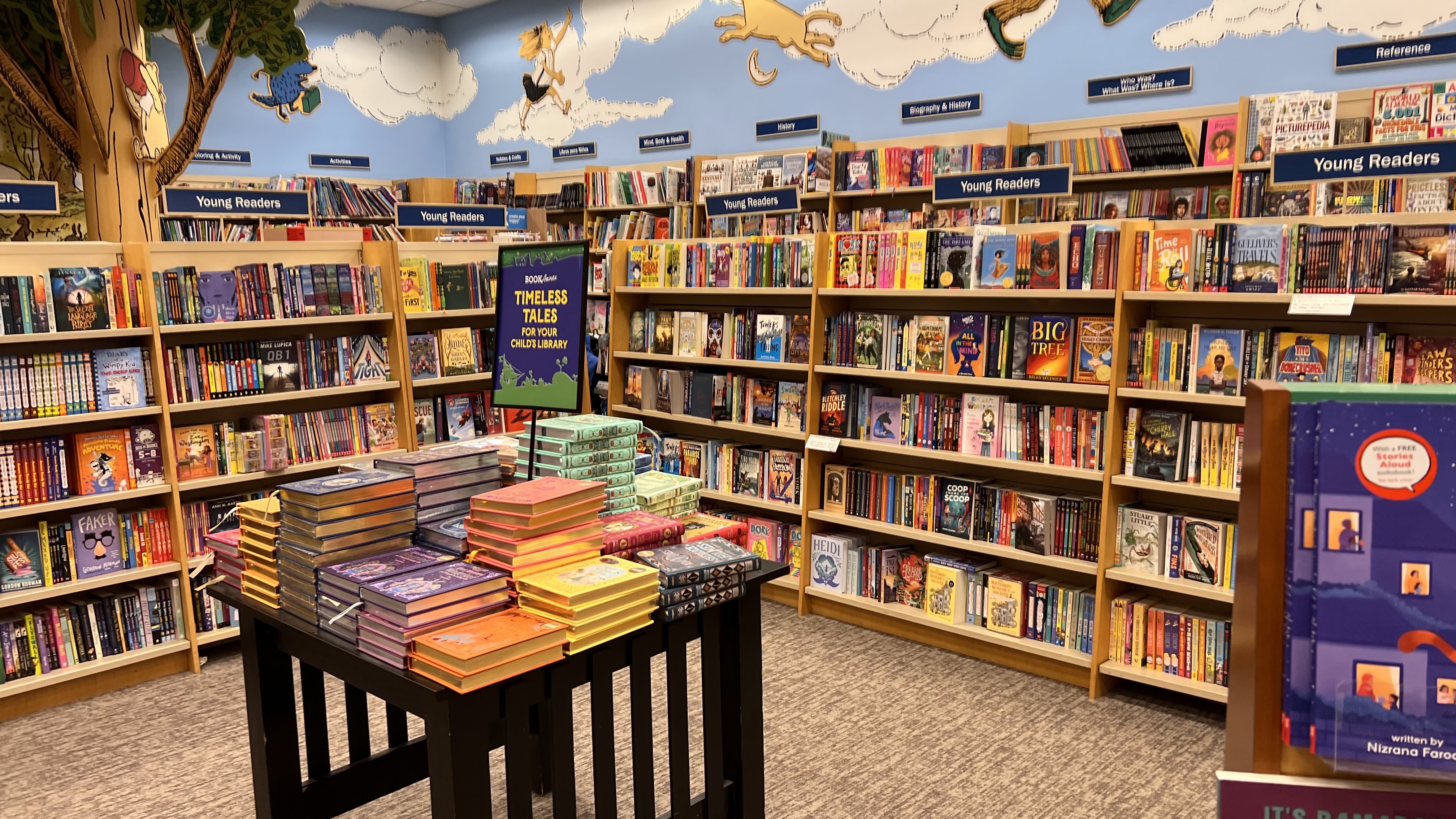
Barnes &  Noble Novi, MI (1/3 of the Young Readers section.)
Another challenge caught my attention: Can Wizard Clip Haunting be told to children? The director of a children's museum in the vicinity of the historic events asked me that. Sure, I said recklessly.  

The local Barnes and Nobel introduced me to the hundreds (okay, thousands) of books for "Young Readers"ages 8-12. 

What was most popular I asked? The clerk led me to the long shelf of the Goosebumps series. I had heard of that, but 300 million printed? I didn't know kids read that much. 

Okay so WCH is about ghosts (thus Goosebumps), but it's also about American History, at least the events in the 1780-1790 era, EarlyAmerica. I was directed to another collection of best selling American History books for Young Readers, the Rush Revere series.

These two successful Young Readers series couldn't be much different. The Goosebumps books (genre: horror & adventure) are 5" x 7.5" x 0.375", paperback, weigh in at 4 oz, printed on ground-wood stock, contain no illustrations, and are about 15K words.  The Rush Revere books (genre: history & humor) are 6" x 8.5" x 0.75", hard cover, weight in a 1 lb, 4 oz, printed on heavy glossy stock, contain many full page color illustrations, and are just under 40K words.  

Yes,  you're guessing right. I've not only committed to writing a Young Readers edition of WCH—15K to 20K with B&W illustrations but also to a pre-school version—2K words with color illustrations perhaps like these:


A close friend who is responsible for getting me into this rabbit hole (hint: he used to do root canals), has already drafted a poetic, 1000 word pre-school reader for the latter. 

Now, all l've got to do is read these source books, learn to think like a kid, and after reading...write, write, write.

Any suggestions? I'm going to need them. Please comment below.

Stan


Saturday, June 15, 2024

POV: An Emotional Suture in Screenplays and Novels like WCH

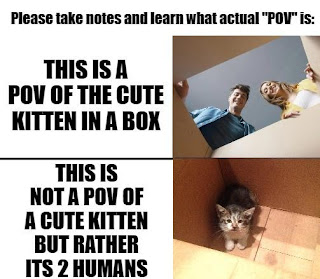
(found on the web)
The most successful stories create deep emotional empathy between readers (or audiences) and the story's characters. A critical skill for writers, therefore, is making and maintaining that emotional connection. One important technique for accomplishing this connection is the clear and consistent use of  POV (Point of View). 

Unfortunately, I continue to see published writing that ignores or incorrectly uses POV. Such misuse leads to cognitive dissonance (which takes the reader out of the story long enough to figure out what the writer intended).

Properly used POV creates a "suture" between the audience and the characters. In medical practice a suture is the stitching together of an open wound that allows separated flesh to fuse and grow back together, hopefully without a scar.  "Suture" therefore, is a good metaphor for the use of POV in narratives as the writer stitches the reader emotionally into the story without leaving a scar.

IN SCREENWRITING a proper POV technique requires three shots.

1. A closeup of the POV character who looks, stares, or glares off screen in wonder, disgust or shock. (CUT TO)

2. What the POV character sees from their perspective, as the character's eyes are replaced by the camera's lens. (CUT TO)

3. Return to the POV character who emotionally and physically reacts to what is seen.

Shots 1 & 3 visually communicate the character's emotion (the effect), which is explained by shot 2 (the cause). 

You've seen this sequence is every film you've watched. BUT what is often missed in the scripts I see is how the writer portrays the sequence. Too often a script will skips shots 1 &  for the sake of supposed efficiency, e.g. "Doug sees Mary wink at Jake and becomes jealous."  Doing this robs the reader of emotional connection with Doug and his wonder, disgust, or shock.  It also confuses the reader as to who is jealous, Doug, Mary or Jake? 

IN PROSE (e.g. novel) establishing the POV character is a bit more involved, but the same three "shots" or lines of text, are necessary if we are to connect with the intended character.  For example, in the following three paragraphs everything is experienced from Peter's perspective (i.e. POV):

1. Peter, hearing Melody's scream, entered the kitchen and was greeted by his irate wife and a pile of chaos on the floor. His heart fell and his knees shook.

2. Stacey, their three-year old daughter sat on the floor in a pool of chocolate syrup she had squeezed from a bottle she held upside down, high over her head. Her blonde hair, face, and romper drooled with the sweet goo. She smiled with pleasure.

3. Peter took a deep breath and stepped carefully backwards, his flailing hands groping for the door handle to the wet mop closet.

Note:  We use 3 paragraphs because each paragraph directs our attention to a different subject in a location different than the one before. Putting these in one paragraph suggests our view is in the same direction for each. But our view changes, thus three paragraphs works better than one, and the white space breaks up the page for easier reading. (Do I follow this rule? Ah...well...not when I'm trying to cut down on the page count.)

Often, however, what I see in prose is this, in one paragraph:

"Come see this mess. Right now!" Stacey, very pleased with herself, was on the kitchen floor in a pool of chocolate syrup. It tasted sweet and yummy. Very disappointed he shook in anger and grabbed a mop.

Now this paragraph is much more efficient. But it involves three points of view and not a little confusion:

"Peter! Come see this mess. Right now!" is someone's POV but we're not sure who. In context we can assume it's Melody, Peter's wife, if Melody was in the kitchen moments before.

Stacey, feeling pleased with herself... it tasted sweet and yummy..." is Stacey's POV. It's telling us what's inside Stacey's head.  

 Very disappointed, he shook in anger and grabbed a mop...is Peter's POV or Universal POV.

This causes the reader, in one short paragraph, to jump between three perspectives and thus dilutes any emotional empathy the reader might have for any one of the three. 

Jumping POVs can also happen across three paragraphs. For example here is an abbreviated and edited cold opening for a book I was recently asked to review:

I will never forget when the father and his young son arrived at the clinic. Both were battered and bloody. The boy's eyes were swollen nearly shut and he had a chest wound from which fluid pumped with every breath he took. 

Nearly dead, Muhammed looked up at the strange medic sticking a tube into his chest. He feared for his life because the medic was white and he had been taught that white people hated him and wanted to kill the children in his tribe.

When not wearing scrubs the medic was a soldier in the U.S. Army who had been warned to avoid contact with the locals.

These abbreviated paragraphs force the reader to disconnect and jump emotionally from the medic's POV, to Muhammed's POV, to a universal POV. Each jump dilutes if not disconnects emotional involvement with the characters, and lessens the impact of the story.

It would be better to write those three paragraphs from one POV and build up the emotional connection.

I will never forget when the father and his young son arrived at the clinic. Both were battered and bloody. The boy was nearly dead. He had a chest wound from which fluid pumped with every breath he took. As I inserted the chest tube into the boy's wound and began pumping fluid from his pleural cavity, he looked up at me from swollen eyes with fear and not a little trembling. I had heard that his tribe had been taught that white people, like me, wanted to kill their children. How sad. I wanted so badly to keep this child and his father alive. What would he think, I wondered, if he discovered I was a soldier in the U.S. Army?

One final hint about POV writing.

In all storytelling I think it's best to write each scene from ONLY one POV. When you change scenes you can change the POVs perhaps to the most ironic and unpredictable character in that scene. And when you do change scenes and POV, the VERY FIRST IMAGE or WORDS should be the IMAGE or NAME of the character that is going to tell the story of that scene—the POV character, thus explicitly shifting the reader's perspective.  Then, stick with that character's POV until the scene ends. 

There is no short cut to clear and consistent communication. 

I follow these rules in all my writing (or so I claim) and have received consistent and congratulatory feedback particularly for my use of POV. It allows readers to get deeply into my characters and understand their motivations and souls. In my historical fiction epic (of a true story) WIZARD CLIP HAUNTING, there are 7 Parts, 54 chapters, and multiple scenes in each chapter. This gave me tremendous flexibility to enter the heads of both heroes and villains (one scene-at-a-time), and explore the motivations for their despicable and noble actions. The results were what I had hoped: 

"...From the very beginning the characters sprung to life. I laughed, celebrated and mourned with the characters. I was there with them, and I cried..."  —Kathy M.

"...The character development is excellent..." — Betty  S. 

"...wonderful character development and page turning plot..." — Hope S.

"...skillful portrayals of the cast of characters whom he brings to life - and for some - to death..." Mike M.

You get the point. POV works, but it takes some work.

Saturday, January 2, 2021

REVISIONS: Your Story's Emotional Roller Coaster & Intellectual Balance

This is really a post about how to plan a REVISION to a manuscript once the first draft is complete. 

Successful storytelling requires that you keep your audience emotionally involved in the story.  Designing an emotional roller coaster and intellectual balance into your story's structure is critical.

Here is an example from a recent first draft novel effort  and what I did to approach the revision. The revision's goal was to ensure that the manuscript reflects a solid emotional roller coaster effect, and an intellectual balance of story elements.

Here are some of the story fundamentals:

Genre/Era: Historial Novel - 1790s

Settings: Maryland, New Orleans, Sailing Barque 

Themes: Persistence, Pride, Supernatural

First Draft Length: 186,000 words / 388 pages / 26 Chapters / 136 Scenes [Final Length: 372,000 / 803 pages / 54 Chapters]

Storylines: 2 Protagonists (Character A and B) 

Conflict of Values/Moral Premise Value Dipoles: Pride and Arrogance vs. Humility and Meekness (where Meekness is the quiet strength and persistence to do what is morally valid in correspondence with natural law). 


Questions for the Author:

1. Where can the draft be shortened?

2. Is there a regular emotional up and down to the story?

3. Is there a reasonable balance between the five elements that the author believes will make the novel interesting, educational, and entertaining? (i.e.) 

(P) Philosophical reasoning

(H) Historical description

(S) Story connections and plot

(A) Action

(D) Disasters

4. Of the four main character groups (A, B, C, D) how many words are given to each storyline?  (There are four storylines that converge at the end.) 

5. Where are the IDEAL turning points (pretending there is only one protagonist) and where are the ACUTAL turning points? Since this story has two major storylines and two significant protagonists, the ACTUAL turning points for each of the two story lines will not likely sit next to the IDEAL.  Which turning points or setups (to the turning points) need to be sharped with respect to the Conflict of Values and the Moral Premise Value Dipoles?

The Process:

There was no attempt for the analysis to be precise (e.g. paragraph by paragraph), but to give the author a general overview of the draft's flow (e.g. page by page). 

1. The draft was printed out without gaps for chapter gaps. (Scrivener thinks this is a 550 page paperback novel. To make the process more manageable for analysis, fonts, page size, and columns were manipulated to get manuscript down to 388 pages. 

2. In a few hours, the pages were manually scanned and the category of content for each page was approximated: (a) Philosophical Reasoning, (b) Historical Description, (c) Story or Plot, (d) Action, or (e) Disaster. A letter (P, H, S, A, D) was written in the margin of each corresponding page for reference in step 4.

3. In Excel a column was numbered from 1-388. (The chart at right has been turned sideways from the original excel plot. The YELLOW row contains the page numbers from 1 on the left to 388 on the far right.)

4. In the adjacent column the letters corresponding to P, H, S, A, or D were manually inserted. (See TAN row at right)

4. Using Excel's formula for "IF (logical test, true, false)" a number was inserted in the next adjacent column whereby P=1, H=2, S=3, A=4, and D=5. The numbers arbitrarily assign emotional levels to the different content, where Philosophical Reasoning pages might be the more boring (=1), and Disaster Descriptions are probably the more exciting (=5). (See GREEN row at right.)

5. Using Excel's "Insert Chart" function a bar chart was generated, and sized to line up with the three columns. (See the BLUE bar columns at right. The shortest blue columns represent pages deemed Philosophical in content. The tallest blue columns represent pages deemed descriptive of a Disaster.) The "Emotional Roller Coaster" we are after is superimposed as a red line atop the blue columns. 

6. In Excel using the "IFCOUNT" function, the number of pages principally deemed portraying each of the five content were summed:

Philosophical (P) = 27

Historical (H) = 43

Story/Plot (S) = 145

Action (A) = 102

Disaster (D) = 71

7. Using Scrivener, in which the novel was drafted, the total number of words in all scenes principally relating to the four principal character groups and storylines are:

Character A = 103,121

Character B = 65,086

Character C = 26,300

Character D = 5,493

8. Identify in the rows of the chart the IDEAL major turning points as if there is only one protagonist for the 388 pages: Inciting Incident: 12.5% = Page 48 // Act 1-2 Break: 25% = Page 97  // Moment of Grace (Mid Point) 50%  = Page 194 // Act 2-3 Break: 75% = Page 291 // Final Incident: 87.5% = Page 339.  (It may be helpful to also identify the ancillary beats between these major turning points.)

9. Label the major events (peaks and valleys of roller coaster) with specific descriptions of the Disaster, Significant Actions, and Internal Decisions by the main characters on the bar chart.

10. For each storyline, identify and label the ACTUAL turning points and ancillary beats IF they exist. (If they don't exist, you're going to have to create them in Item F below.) Hand note on the chart the turning points that need to be sharpened or added.

Action Items for Author to Consider:

A. Where multiple adjacent pages are the same emotional level, break up the flatness with pages that have a different emotional level, e.g. There is one section where Philosophical Reasoning and Historical Descriptions continue for 10 pages. This can be shortened (by deleting pages), or be made more interesting by Action or a Disaster pages. Exception: There is no need to lessen the emotional content of a major disaster that continues for 9 pages (one place), nor the ending which Action and Disaster pages dominate for 19 pages. ACTION REQUIRED. MARK IT IN THE CHART MARGIN.

B. There is one sequence of 30 pages where there are only 6 Action pages, 0 disaster pages, and 9 Philosophy or Historical pages.  P or H pages in this section need to be deleted or A or D pages need to be added. ACTION REQUIRED. MARK IT IN THE CHART MARGIN.

C. Review Story pages and see if many of them can be time compacted to shorten the timeline. ACTION MAYBE REQUIRED. MARK IT IN THE CHART MARGIN.

D. The ratio of PHSAD to each other is not bothersome. It's good that the slower elements (P & H) are by far the fewest. NO ACTION NECESSARY

E. The Character Groups and Storyline lengths (Items 7 above) are appropriate since the word counts depict the relative importance of each character and group, i.e. Character A is the close knit group that is or supports the Protagonist. NO ACTION NECESSARY

F. After the above actions are taken, examine the manuscript at the ACTUAL TURNING POINTS (see Item 10 above). 

(1) If the Actual Turning Points exist, wordsmith the manuscript to reflect the conflict of values with the characters struggle. Remember, all stories must logically follow a natural cause and effect. The causes in a story are the values that motivate the characters; in this story's case those values are PRICE/ARROGANCE vs. HUMILITY/MEEKNESS. The actions are what the characters do physically to fulfill their closely held values.

(2) If the Actual Turning Points DO NOT exist...create them...which will require your story plot to be manipulated. Do not fret about hitting the IDEAL turning points. Follow the organic nature of your storylines and put the actual turning points in the vicinity of the Ideal. 

Here's the chart after doing all the above. 


Next step: Revise the Manuscript accordingly. 

Tuesday, January 14, 2020

How to Plot a Long Historical Novel


I have successfully used this story plotting technique with dozens of my screenwriting clients. Movies, however, are much shorter than (long) novels.  So, to put particulars to the work flow, this post explains the plotting effort used to construct my long historical novel Wizard Clip Haunting (WCH).


THE SIX STEPS IN MY INSTAGRAM POST ABOVE reveals why I haven't been blogging recently. I've written or edited a number of books in my career but I had never written a novel. In  2014, after several drafts of a WCH screenplay I started to think seriously about ditching the screenplay and writing the novel. The research travel I was doing in a bid to improve the screenplay provided fodder that turned out to be much more interesting as a novel. For the movie script I was limited by time and words; and the actual historical events became more interesting the more I traveled and got to know the real-life characters. (The genealogical sites like Ancestry.com and Geni.com were very helpful).

I JOKE that when I have money I make a movie, and when I don't I write or edit a book. While I wait for one screenplay to gain some traction in L.A. (there are things a-foot) and while I wait for the last book to be printed in mass in China, and while the H U G E sailboat refit project is under winter wraps until late March....I dug out the novel effort, last worked on in 2013–2014. Every time I pick it up again, there's were more significant plot points to include.

ONE OF THE IRONIC "OBSTACLES" to completing long projects,  and which I always recommend it to story clients, is to read lots of material similar to what you're trying to write. In that stead, and for his novel project, Pam and I just finished reading aloud to each other Ken Follett's Pillars of the Earth. It was a great read. I felt myself getting emotionally involved with the characters, and even got a mild case of vertigo one night. None of that happens when I watch a movie. Movies are over toooo quickly. But Pillars, due to its length (about 400K words) can last for weeks on end, two hours every night. I was sure  reading and hearing Follett's cadence for words would help when I start revising and reading out loud my own work. (Update 2023 - Follett had an effective on me. The novel is finally done and released, and it's 372,000 words. Agh! Had to self-publish it under my distribution banner since no publisher would touch it. LOL!)

The image above is actually the carded plot of the novel. I've actually written about 50K words of it, but stopped to revisit the plot and fully card it out. Here are the steps I've taken over the last few years, weeks, and days:

1. Researched the historical events. There area a few short books and dozens of articles and references in history books of the period and event itself.

2. Used the Story Diamond to identify the 13 main plot points.

3. Wrote 3 drafts of the movie screenplay.

4. Got some good and some bad notes.

5. Let the story sit for a couple years as I went onto other projects.

6. Took two road trips to research the actual events and my imagined events. One to New Orleans and Pittsburg, and a second trip to Maryland, West Virginia and eastern Pennsylvania. Both trips were immensely rewarding in terms of discovering ironic "true to history" material, which widened the story's scope—fodder I could not include in the screenplay without turning it into a mini-series (a pitch deck for a TV series now exists.)

7. Poured over the hundreds of photographs and documents and books and interview transcripts collected on those two trips. Before I committed to writing the novel, I experienced frustration because all the good stuff I was discovering would not fit into a screenplay. 

8. Made another revision of the screenplay and pitched it a few time. No takers.

9. Let it sit for a few years...went sailing, etc.

10. About 8 years ago, I wrote a few chapters as a test of my novel writing skills. I wasn't satisfied. Put it aside again. Then, last month I read Dwight Swain's "Techniques of $elling Writers" and "Hit Lit" by James Hall (recommended by my friend "The Other Chris Pratt")  Both books revealed that I was doing a lot of things right, and they gave me the courage to take the novel seriously. So,  I re-edited those early chapters and wrote a few more, read them aloud to Pam. We both liked them.

11. The original Story Diamond was not geared for a novel, however, but for a movie. I also realized that the Diamond was not formatted (being in the diamond shape) to track subplots easily. For that I needed a WIDE horizontal surface. I have a vertically mounted 4'x8' Story Diamond on casters that I roll out for clients who come to my office for beating out a story. In that process we use a drawer full of colorful 3"x3" Post-Its. 


Stored behind the Story-Diamond-on-casters are a couple pieces of 3/16" black Foamcor I use for small set lighting (or blocking the light).  I got them out and set them side-by-side behind my desk, and opened the drawer of Post-It's. Now, I was able to break the story according to characters and subplots and keep each on its own colorful row. The picture on the left is 3/4 of the whole thing toward the end of the exercise. (I found the Post-It's stuck better once I dusted off the Foamcor. : )


But I was not going to be able to let this piece of Foamcor sit as a reference in the walkway behind my desk for the year it would take to write. And as more ideas came, I'd need to write out some detail notes that would not fit on the Post-It's. So I opened up Apple's Keynote, which I use for creating the slides for my workshops, and opened a new file that was 4,000 pixels (W) and 1,500 pixels (H) and recreated the Post-It plot board into Keynote. It took me a day to create the file you see here. Click on it to enlage.


Although I work on a Medium speed Mac Pro with two large displays (which I use to edit 2K and 4K videos) Keynote is not designed for such a large file. It claims to be only 451K (not big, really), but with this many cards and objects on a single large "slide" it requires some patience. The app only slowed down, however, toward the end. (I use Keynote as well for creating Story Diamond files but set the Keynote file and my monitor vertical.) Keynote is much better (on the Mac) for this sort of thing than anything else, including Power Point. It's very easy to create, color and align objects, and change the size of both cards and text in them. [BTW: these are TEXT boxes filled with color, not rectangles with text overlaid in them. Thus, there is ONE object per card to move and manipulate, not two.]

12. Once I got all the cards in place (along with a number of story notes (the cards with a lot of text on them), I grouped them with green rectangles to denote preliminary chapter groupings, with each card within a green rectangle being a scene or a sequel (see Scene-Sequel post). The light pink near the top row are my SCENE GOALS, and the dark pink are the SCENE DISASTERS. The SEQUELS are not always individually carded but are implied by the contents. The blue is the antagonist, and the other colors are minor characters. The white boxes at the top represent most of the 13 traditional beats of a story, and the yellow boxes are dates to keep the chronology in order—since this is a historical story that takes place over a 37 year period with both of the story taking place over just 4 years.

13. I write long form projects in Scrivener, as I did the first draft of this project's screenplay (I finish up screenplays in Final Draft and novels in MS Word). I love Scrivener's flexibility for moving text blocks around. I used the old screenplay file for the novel. While I have about 50K already written of the first chapters, I will now populate the Scrivener folders/chapters with the chapters designated by the green rectangles in the Keynote Card file, and identify the doc-files/scenes within each Scrivener chapter by the individual cards in the Card Plot file.

14. Finally, as I write in Scrivener on my right display, the Keynote card file will occupy my left screen, along with other writing aids like my favorite thesaurus: http://www.onelook.com/reverse-dictionary.shtml. Thus, I can keep updating the card plot as I write, and it allows me a bird's-eye view of the story, showing me how the scene I'm currently writing connects to the whole.

Blessings,

stan

Saturday, February 4, 2017

Mistakes: The Mystery of the Wizard Clip Demon

It's confession time.

When I find the time I DO write screenplays....that will probably never get made. Yes, I do write a lot of stuff that does get produced, but generally only for my documentary/corporate clients. (In fact, we just finished a hour long television special in December, but I can't talk about it or even show the trailer until the client gets their release scheduled figured out. It's looking like July if they can four-wall the theater.)

But back to the screenplays I'd love to see made. As much as I consult with filmmakers and storytellers in various genres, it's always surprising to me how I (supposedly the expert at some of this stuff) am totally blind to it.

Case in point. Just below on the left is the poster idea (and on the right the fist edition book cover), log, and synopsis for the seventh major draft (over as many years) of a project I just sent off to The Black List for evaluation and the WGA (again) for registration.


      (Left) the first cover attempt.                  (Right) the final cover of first edition

           GENRE: Historical Haunted House Drama 
LOG LINE: The "true story" of a demonic infestation from Early American history. Refusing last rites to a dying sojourner, an Early American farmer battles a haunting and enterprising demon who destroys the family's home and farm while bargaining for their souls. 
SYNOPSIS: In 1795, Adam Livingston and his family were farmers in the Shenandoah Valley. A visiting stranger became deathly ill and begged his host to find a Catholic priest to come and administer last rites. But the Livingston's, who despised Papists, refused. As he died, the stranger cursed the Livingston homestead. Immediately after, a demonic presence came to haunt. The poltergeist, among other things, made a name for itself by cutting crescent moons out of linens, silks and leather goods  Why crescent moons? They say the demon was the moon god. And since no human would speak a demon's real name, it settled for a nickname—The Wizard Clip. Over 2-3 years the Wizard destroyed the family’s homestead. Admitting that the Haunt had religious intents, Adam begged various preachers to come and exorcise his property. But they could do nothing but run away. Then, after a couple of nightmares, he discovered that to achieve his greatest desire, he would have to embrace what he hated most.

The mistake I warn others often about, but that I've made for the first five drafts on this story was this:

I was loyal to the historical record. 

This is particularly true of life stories. Several times a year a client will come to me and with great excitement tell me the adventurous story of their aunt battling city hall, or their brother who battled the cartel in Texas. Inevitably there's a slow beginning, middle or end so that all the exposition can be crammed in. Or some event cannot be eliminated because the writer's mother-in-law would be offended.

And yet, at the same time these writer's will claim that they want their story to be embraced by main stream audiences who long of the big and regular emotional roller coaster ride of a well-structured story designed to entertain mainstream audiences.

Well folks, you can't have it both ways...usually.

In my Wizard Clip story (above) the historical record tells how Adam Livingston battled the demon tooth and nail for three years, but was unsuccessful in getting it to leave them alone. (SPOILER AHEAD) Then he has a nightmare of a man performing some kind of incantation followed by an otherworldly voice that says, "This is the man who can relieve you." Of course Adam doesn't know what that means, but starts asking around...and some neighbors...whom he had previously despised (because they were Catholics), tell him that the dream was that of a Catholic priest celebrating Mass. So, the McSherry's introduce Adam to Fr. Denis Cahill, who eventually comes (after some earlier failed attempts), celebrates the Mass in the Gathering Hall of their farm house...and the demon never comes to haunt again.

Being a Catholic, the story sounded cool to me. So that's what I wrote and stuck to for the first five drafts. (I was loyal to the historical record.) That is, for Acts 1 and 2 my protagonist/hero is Adam Livingston. And then suddenly in Act 3 I switch heroes to the priest.

DUMB! I would never tell you to do that for your story, but that's what I told myself for five years.

My mistake was made crystal clear to me in a very short review I got back from The Black List two years ago, which pointed out that I had switched protagonists in Act 3, and all the emotional collateral I had built up in Acts 1 and 2 were suddenly, and without explanation, thrown out with the bath water.

I was distressed. So, I decided to write a novel, went on a 10 day research trip to Virginia where the events occurred, and a year later I traced Dennis Cahill's life to his grave in Pittsburgh. You see, I had figured out that the story was really about the priest, BECAUSE he's the one that does the hand-to-hand combat with the demon in Act 3.

EXCEPT... the historical record and a lot of cool scenes and action are about Adam Livingston...not the priest...who still doesn't show up until Act 3.

It takes months, but finally I start to listen to my own advice....resulting in the last two drafts where Adam battles the demon in Act 3...to the excited CHEERS of my wife, Pam, when she reads it.

Ha! Ha! Well, we will see what my anonymous Black List evaluators think.

Such is my advice...(if I'd only listen to it). Write movies for the public, and not ABOUT your family or close friends...or ABOUT a pubic figure that everyone knows everything about (e.g. biopics).

It's for the restructuring reasons that such successful movies being this way:

BASED ON A TRUE STORY
or
INSPIRED BY REAL EVENTS
and my favorite
SOME OF THIS REALLY HAPPENED
(from American Hustle)

Of course,  your opening title could be:

A TRUE STORY.

And because movies are generally understood to be fiction...make everything up...even the opening title.