
I have been
asked (several times) to give examples of narrative motion pictures that failed
at the box office because they lacked a true and consistent moral
premise. And whenever I do, I'm astonished that some movies get made with such obvious structural flaws.
As I watched some of these films I became distressed. The problems are easily avoidable. (I can help folks...make you lots of money... but you gotta listen and follow the rules.)
As I watched some of these films I became distressed. The problems are easily avoidable. (I can help folks...make you lots of money... but you gotta listen and follow the rules.)
While a
motion picture's box office success can never be attributed to one thing but to
a host of accomplishments -- the most bankable attachments, the best acted, best directed, best
art-directed, and the best-marketed efforts -- a movie (story) cannot overcome a false or inconsistent
moral premise, or a true moral premise that is not consistently imbued into the character's arcs. At the same time, many films fail for reasons that have nothing
to do with the moral premise but rather with bad craft, incomprehensible plots,
and wrong or no marketing. But these films had problems at the script level and should never have been greenlighted. Never! All avoidable! And there's a $20 book that will tell them how.
When motion picture stories are built around false or inconsistent moral premises they do not connect with audiences and fail at the box office.
Discussed, in the order of their release year....
ISHTAR (1987), CITY SLICERS 2 (1994), CUTTHROAT ISLAND (1995), THE PLEDGE (2001), HURT LOCKER (2008), SEVEN POUNDS (2008), NARNIA: VOYAGE OF THE DAWN TREADER (2010), MARS NEEDS MOMS (2011), THE FIFTH ESTAGE (2013), BURT WONDERSTONE (2013).
Here, also, is also a longer treatment to the failed movie LITTLE BOY.
ISHTAR (1987), CITY SLICERS 2 (1994), CUTTHROAT ISLAND (1995), THE PLEDGE (2001), HURT LOCKER (2008), SEVEN POUNDS (2008), NARNIA: VOYAGE OF THE DAWN TREADER (2010), MARS NEEDS MOMS (2011), THE FIFTH ESTAGE (2013), BURT WONDERSTONE (2013).
Here, also, is also a longer treatment to the failed movie LITTLE BOY.

Note to Elaine May: I watched the entire movie. My wife wanted to turn it off after 10 minutes. We laughed only during the Keystone cops sequence with the guys in the Hawaiian shirts. Other than that, it was pure professional curiosity (How could anyone, other than a sadist, make this movie?) and discipline that got me through.
For the rest of you, "Ishtar is about two terrible lounge singers, Lyle and Chuck (Beatty and Hoffman), get booked to play a gig in a Moroccan hotel but somehow become pawns in an international power play between the CIA, the Emir of Ishtar, and the rebels trying to overthrow the Emir's regime." (IMBD)
The simplest way to talk about why Ishtar bombed, aside from all the political studio rumors and creative disagreements supposedly between Beatty and May on set, is to describe the obvious structural flaws, of which there are two that are glaring.
1. The story embraces a few characteristics of the co-protagonists while ignoring others. Successful protagonists are suppose to be imperfect, but at their core are redeemable qualities that attract the audience's compassion. Although Bob Parr (The Incredibles) is "teamwork" challenged, he's a very good Super Hero and Dad. So, we root for him to overcome his fault. We like him because he's humble at heart (his essence), and he really is good at what he does. But Lyle and Chuck are not just bad singers, they're bad songwriters. They are bad romantic partners to their ladies. They're bad dressers. They're bad thinkers, they're stupid beyond understanding. And while they are not evil, the extent of their naivety has no logic or reason. Monty Python was funny because the characters were all savant in one way, but blind in another. The humor rose out of the audience trying to figure out the logic of the setup and discover the gap between savant and stupid. Every Python skit was funny because it was a brilliant mystery that followed very precise rules of reasoning. But Lyle and Chuck's characters had no reasoning, no logic, nothing for the audience to stand firmly on a "get it." There was nothing to "get" because none of it made sense.
Good protagonists, although they have an imperfection (a deep and serious one) nonetheless get us to like them because they are people we would like to hang out with and get to know. They skilled, funny, good looking, clever, smart, vulnerable...something that makes our heart want to help them. We identify with them as perhaps being like us... and so, we want to help ... ourselves. But Lyle and Chuck are none of these things. In Dumb and Dumber (Carrey and Daniels) we have clever and numerous sight gags, prat falls, and stunts that continuously surprise us. The dialogue isn't that funny, but many of the jokes are genius at setting up the audience about what to expect and then having the impossible but logical occur. There's a logic that says the audience, "What you see is the opposite of what you'd expect, but it's reasonable." But there is absolutely none of that cleverness in Ishtar after the first 3 minutes of watching and listening to Lyle and Chuck try to write a song. It's a 3 minute gag that's not funny after 4 minutes, let alone funny after 100 minutes. We didn't like them, we didn't want to spend more time with them, there was no skill, no cleverness, no like-ability. We were like their women friends and agent who couldn't wait to leave the bar.
2. The second problem is that the plot was one-big-writer's convenience. One scene did not logically connect to the next, just like their terrible lyrics had no logic behind their "invention." There was no foreshadowing. CIA agents just showed up in the desert with all sorts of technology. The left-wing girl-friend just showed up in the Ishtar airport. The map just showed up. The gun runners just showed up. Plots work because there is a logical cause & effect connection between scenes, characters, props, settings. If A then B, if B then C, if C then D, etc. For instance, after their first audition with a disbelieving agent, there IS logic and humor in the agent's incredulity. But there's no logic to why the agent would book them even in Morocco or ever see them again.
 CITY SLICKERS II: THE LEGEND OF CURLY'S GOLD (1994)
Budget $40M. $44M. WW N/A. Dir. Paul Weiland.
In
CITY SLICERS II, shortly after their first western adventure, Mitch Robbins and
his friends discover a treasure map that belonged to their late trail guide
Curly and set out to discover its secrets.
In
comparison, the trios first adventure, CITY SLICKERS I, is the story of
Manhattan radio advertising salesman, Mitch Robbins (Billy Crystal), who's in
the midst of a mid-life crisis and how he re-discovers his smile. Mitch's wife
Barbara (Patricia Wettig) sends Mitch off with his two buddies Phil (Daniel
Stern) and Ed (Bruno Kirby) to herd cattle for a week out West. There Mitch
rediscovers that his call in life is not chasing women (like his two buddies
insist) but being a father and a husband. The movie's moral premise can be
sated as:
Fidelity to family leads to
happiness;
but
infidelity leads to sadness.
That
is a moral premise statement upon which the entire movie is consistently built;
and it is a true portrayal of natural law. CITY SLICERS was a huge success
grossing $124MM in the US, in 1991.
CITY
SLICKERs II comes along with the same cast and the same setting, and same
writers, except this time around they're looking for lost gold that was stolen
from a stagecoach a hundred years ago. They rationalize that the gold belongs to
whoever finds it, and Mitch believes it's okay to lie to his wife about being
at a radio convention in Las Vegas. It's clear, however, that the gold belongs
to others. And because in the end they find the gold everyone lives happily
ever after. Now, the moral premise can be stated as:
Not pursuing illicit wealth leads to
sadness;
but obtaining illicit wealth leads to happiness.
but obtaining illicit wealth leads to happiness.
Clearly
that is an invalid moral premise which falsely portrays natural law, and CITY
SLICKERS II only grossed $30MM.
Conclusion:
False moral premise.

Budget $95M. US $11M. WW $18M. Dir. Renny Harlin starring Geena Davis
A female pirate and her companion race against their rivals to find a hidden island that contains a fabulous treasure.
I've always appreciated Geena Davis' guts for being feminine and at once taking on the stunts that usually only guys do. And it seems that she does a lot of her own stunts. If you want to see a gutsy woman with the ability to be sexy and get in a bloody fist-fight at once, with harrowing stunt every 7 minutes, this is your movie. It will not disappoint on that level. It's the swashbuckler's swashbuckler movie. The photography by Peter Levy is spectacular (shot in Malta and Thailand), and the orchestration by John Debney and the London Symphony is right up there with John Williams's best.
Many are still wondering how such an over-the-top enterprise have bombed so badly at the box office. There is a moral premise angle on this movie, but there are some other reasons. Recall that while the LACK of a true and consistent moral premise can kill a good film, the PRESENCE of a true and consistent moral premise will not guarantee it's box office success. In this case I think it is all of the above.
Why did this film bomb?
1. Some have suggested there marketing budget and the release schedule were against it. Perhaps, but there are a slew of worldwide distributors attached and MGM handled the domestic theatrical release. However, if everything else was up to par, the film would have had legs.
2. Direction, Acting, and physical training were subpar. Renny Harlin's direction was spotty. There are lines that are delivered as if it was a table read, without conviction and flat. Harlin's direction prowess may have been in working with his practical effects team, which was astonishing, even if some effects were composited. It was also evident that Miss Davis's fitness for some of the physical requirements (leaping up onto the ship's rail) were tough for her. In short he ran and leaped awkwardly. But I don't think this or some of the lame lines killed the movie, although they didn't help.
3. This movie was not about anything important or true. That is, the movie really has no moral premise. It was fun and games for the actors, but no one cared for a moment whether or not the story was about anything noble or meaningful. The stash of gold the good pirates and the bad pirates are after is clearly the booty from other pirating adventures. And the disposition of the gold had no noble end. The ending reminded me of the failed CITY SLICKERS: SEARCH FOR CURLY'S GOLD. The gold belonged to someone else; and in the end Captain Moran (Davis) and her crew decide to go right on pirating...that is, plundering other ships to add to their loot. If there is a moral premise to this film it's:
Greed leads to dangers; but
More greed leads to freedom to be more greedy.
Yes, I'm being factious. But I'm not sure the movie was about much else.
It is possible that this film is a text book example that to audiences movies are suppose to mean something, and when they don't mean anything, or when they try to mean something that isn't universally true, they bomb.

Budget $45M. US $20M. WW N/A. Dir. Sean Penn.
A
retiring police chief, Jerry Black (Jack Nicholson) pledges to catch the killer
of a young child. The film also costars (in mostly cameo roles) Helen Mirren,
Tom Noonan, Benicio Del Toro, Michael O'Keefe, Vanessa Redgrave, Mickey Rourke,
Sam Shepard, and Patricia Clarkson. HOW COULD YOU GO WRONG?
But
here is what's wrong with the movie. Although the killer is killed and no doubt
meets his judgment, he dies in a freak vehicle accident just minutes before
falling into a trap set by Jerry, Jerry doesn't know the killer dies. So, in a
continuing and impossible effort to find the man, who is dead, Jerry drinks
himself insane. Thus, the moral premise could be constructed this way:
Child abuse and murder lead to a
quick end in the fires of hell; but
Keeping your word to find justice
leads to drunken insanity.
You're
right, the virtues and vices are not opposites, and neither is the consequence.
That's because this story was made on an idea that is without a good foundation
in reality.
If
we attempt to construct a moral premise that COULD have been used for this
story it may be:
Child abuse and murder lead to a
quick end in the fires of hell; but
Protecting children from an abuser
and murdered leads to justice.
Had
Jerry and the killer been pitted against each other in a cat and mouse game,
and had Jerry some how, even inadvertently, been responsible for the killer's
just death or imprisoned, this latter moral premise could have saved the movie.
Conclusion:
False moral premise, inconsistency with how a good moral premise should apply
to the film's characters and plot.
A
deeper explanation can be found here: http://moralpremise.blogspot.com/2010/08/all-star-cast-false-moral-premise-sink.html

Budget $15M. US $16M. WW $19M. OSCARS: 6 of 9 Noms. Dir. Kathryn
Bigelow
During
the Iraq War, a Sergeant recently assigned to an army bomb squad is put at odds
with his squad mates due to his maverick way of handling his work. This is a
movie that won six of its nine 2009 Academy Award nominations, including Best
Original Screenplay, Best Direction, and Best Picture. But it did not resonate
with general audiences, doing only $12.6 MM at the box office ($11 MM budget).
Why would such a powerful movie in many respects fail to garner a large
audience?
The
plot of the movie and the character arcs have a true moral premise
significantly portrayed by the characters; it is:
Demanding arrogance leads to
animosity and hatred; but
Competent teamwork leads to respect
and honor.
But
to connect that true moral premise
must connect with audiences consistently through
the various story elements and characters. Yet, the movie begins with this
on-screen quote:
The
Rush of a Battle is often a potent and lethal addiction, for war is a drug.
And
the movie ends with our main character not changing but returning to duty in
Iraq rather than being home with his family—-he's addicted to war and cannot
function at home. But that is not what the moral premise of the story reveals.
Thus, there's a disconnect.
There
is also an issue with the filmmaker's identification of a protagonist, whom
they think is SGT. Williams James (JEREMY RENNER). But protagonists change and
James doesn't. He's the same at the beginning as he is at the end. Instead he's
the antagonist, who often does not change but forces the protagonist to change,
which in this case is Sgt. J.T. Sanborn (ANTHONY MACKIE). It is Sanborn that
arcs from animosity and hatred to respect and honor. And that confuses the
audience.
Conclusion:
True moral premise but inconsistent application to characters and plot,
confusing the audience.
A
longer discussion of HURT LOCKER can be found here:
http://moralpremise.blogspot.com/search/label/Hurt%20Locker
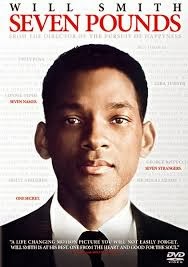
B $55M. US $70M. WW:
$165M. Dir. Gabriele Muccino.
A
man, Tim Thomas (Will Smith), with a fateful secret embarks on an extraordinary
journey of redemption by forever changing the lives of seven strangers.
That's how the producers want you to understand this movie. The secret is that Tim
caused an automotive accident that killed seven people including his wife who
was the passenger in his car. Somehow Tim, as the only survivor, avoids going
to prison for manslaughter--a story beat the movie never deals with.
Tim
goal is to find seven people who are in life-threatening situations due to
illnesses that cannot be cured, and give them something of himself so they can
live. He donates bone marrow, a lung, a kidney, a liver, and his beach house to
give new life to others. Then he arranges to donate his final gifts--his
corneas and his heart, which ironically goes to the young woman with a fatal
heart condition that he has fallen in love with. To consummate his final
donations he commits suicide in such a way that his organs can be quickly
harvested and transplanted.
The
moral premise could be stated like this:
Hating self leads to suicide; but
Loving others (also) leads to
suicide.
The
movie would have worked better as a tragedy, but the producers try to make out
Tim's ultimate sacrifice (of suicide) as redemptive, and self-hatred can never
be redemptive.
Conclusion:
False moral premise, it is contrary to how 99% of humanity is wired, and the
movie (for a Will Smith vehicle) fails at the box office.

B $115M. US $104M. WW $416M. Dir. Michael Apted.
Based
on C.S. Lewis popular youth novels, Lucy and Edmund Pevensie return to Narnia
with their cousin Eustace where they meet up with Prince Caspian for a trip
across the sea aboard the royal ship The Dawn Treader. Along the way they
encounter dragons, dwarves, merfolk, and a band of lost warriors before
reaching the edge of the world.
So,
what is the moral premise for this Christian allegory? Well....I have no idea, at least not a single
moral premise that focuses the actions of the many protagonists or a single
antagonist, which can't be identified. In terms of a conflict of values which
is the basis of a moral premise, there are many: Greedy vs. Generosity
(Eustace); Pride vs. Humility (Susan); and then hints of issues with loyalty
and being valiant. King Caspian wans to find the seven swords but there doesn't
seem to be any consequence or stake if the swords are not found, and there's no
urgency in the task. Thus, nothing is focused. All of the children seem to have
different goals, but not coalesced under a single value. And if there's a
single antagonist that obstructs the various goals, it is not identified not
does it make clear what it wants. Instead there is a spell, black smoke, a
dragon
CONCLUSION:
While we have a high moral tale that hits a lot of good notes, there is nothing
singular around which to unify the story, and there's no clear protagonist or
antagonist with an agenda. This leaves the movie with a lackluster box office
performance and obstructs it's true potential.
For
a deeper explanation see:
NARNIA: THE DAWN TREADER - Without a clear hero and villain how successful will it be?

B $175M. US
$21M. WW $39M. Dir. Simon Wells.
A
young boy named Milo gains a deeper appreciation for his mom after Martians
come to Earth to take her away. On Mars the boy finds that only females run the show and the men are all castaways. There are no families, just robots that require the death of a real Earth mother, know anything about discipline and following rules.
The box office disaster of this movie was made all the more egregious by the decision to use 3D Motion Capture, which elevated the short 80 min family film into the stratosphere of a budget. But the story did not have a large following, although it was based on a book by the same name.
Here are some of the reasons why this movie bombed. I'll save the moral premise, story structure for the last bullet point.
The box office disaster of this movie was made all the more egregious by the decision to use 3D Motion Capture, which elevated the short 80 min family film into the stratosphere of a budget. But the story did not have a large following, although it was based on a book by the same name.
Here are some of the reasons why this movie bombed. I'll save the moral premise, story structure for the last bullet point.
- What 10-12 year old boy wants to go see a movie about mom? He'd be the laughing stock of his friends.
- The slow economy in 2011 prevented many families from taking their whole family to new released movie unless it's something very big. MNM was hardly known.
- A mother's life being threatened may be too scary for little kids. MNM is PG.
- The frequent homage to the 60s and the hippies would be lost on the target audience of kids, and very benign to the parents of those kids, who would not have remembered the time either. It's the grandparents that lived through the 60s.
STORY STRUCTURE PROBLEMS
A story's moral premise and character arcs are tied closely together. We see the vice and virtue of the moral premise, and the physical consequences through the decisions that the character's make and the natural law consequences. The character that audiences gravitate toward and identify with, is the protagonist. As the protagonist makes the major moral decisions that turns the story one way and then another, audiences will follow the natural law consequences and see what happens. When structured right, the audience subliminally understands what the story is really about. Assuming the consequences on a physical level agree with the common understanding of natural law, audiences will embrace the movie and the characters,... especially the main character.
As I said, audiences look first to the protagonist for moral decisions and consequences. Audiences naturally gravitate and try to identify with the protagonist and root for him or her to make the decisions that will send us on a great adventure and learning. Those decisions and arcs describe in an existential way what the story is really about.
So, how do you identify the protagonist? There are several ways that the audience uses to naturally identify the protagonist. Usually ALL these things need to be true for the protagonist, or mostly so, if the movie is to be a success. The protagonist is:
- The character who is on the screen the most.
- The character that demonstrates a unrelenting passion for the main goal.
- The character who's name or essence is found in the movie title.
- The character who makes the moral decisions that changes the course of the story at turning pints like the Act 1/2 Break. Decisions cannot be made by others or happenstance.
- The character that changes the most internally thus empowering the outward journey toward success.
But here is what happens in Mars Needs Moms:
- Milo is on screen the most (fulfilled)
- Milo demonstrates an unrelenting passion for the main goal (fulfilled)
- Mom's name is in the title. But she is unconscious and off screen 95% of the movie, and she makes no decisions that change the direction of the movie. From the title we have no idea the story is about a young boy.
- Milo does not make any decisions at any turning point that changes the direction of the movie. He does not even decide to go to Mars. His trip is happenstance. Gribbles and Ki, who are established as secondary characters, make all the turning point decisions (along with the antagonist, The Supervisor). Milo simply listens and reacts; he is not active. He follows directions. For example, at the perfectly placed Act 1/2 break Milo does enter a special world of where the Martian's live; and his goal is clear and passionate: He wants to rescue his mother. But this threshold crossing is NOT Milo's decision. It is Gribble's, who tricks Milo to take the lift to the Martian's living quarters (underground)and make the journey to rescue his mom. But Gribble's motivations are not in step with Milo, and Milo is a pawn.
- Milo does not change after the 8 minute mark, which is his Moment of Grace (MOG). The MOG should be at the movie's mid-point (39.5 min). And at that place there is a moment where Milo realizes that his mother loves him. It's staged and cut like a Moment of Grace complete with music cue. Up to that moment you might consider that Milo is motivated out of selfish survival needs, not because he loves his mother. The problem is that this moment does not change Milo's decision making process or behavior other than to break away at a run -- and running vs. non-running is not Milo's inner problem. Milo's inner problem, "wishing he didn't have a mom" was solved 8 minutes into the movie, even before the Inciting Incident. This has the effect of a Moment of Grace and his behavior changes. But it is not the pivot pint upon which the plot is based, and it should be. Thus, Milo internal arc is flat. He does not change from 8 minutes to 81 minutes.
- One last thing: Usually the antagonistic character, in this case The Supervisor on Mars, is the agent that instigates the Inciting incident, which confronts the protagonist out of the protagonist's vice or weakness of the moral premise. But while the Inciting Incident is totally initiated by The Supervisor, it has NOTHING to do with Milo's rebellious attitude. Good inciting incidents should be a call to the protagonist to change, which is first rejects, goes on a journey, almost dies, and finally brings by the elixir of truth.
Some of the results of the above problems become evident when the other characters take time to hit beats in their story line that do agree with the moral premise. Ki for instance is learning about the "love thing" and the true concept of parenting. She doesn't hate parents to begin with as The Supervisor does, but he embraces the new concept of two parents, and ends up with Gribbles who seem to be on their way back to Mars to have a family. Gribbles also arcs from disrespecting family to embracing it. At the beginning he would rather play games and watch movies like an adolescent. And he shirks his responsibility to do the right thing. At 67% in to the movie he changes, when he decides to help Milo rescue his mother and not keep rejecting the journey that will threaten Gibble's life.
Indeed, I think Gribbles should have been made the protagonist. He has a clear arc, he has a lot of screen time, and he's interesting. But he's not introduced until 25% into the movie, far too late for the protagonist to be introduced.
The Martians also have a story arc that follows the moral premise.
THE MORAL PREMISE
I think the moral premise for this story is true, but it is not consistently applied, especially in the protagonist's arc.
Disrespecting (and hating) your parents, leads to captivity and trauma; but
Respecting (and loving) your parents, leads to freedom and peace.
Essentially MARS NEEDS MOMS suffers from a lack of a roller coaster arc for the protagonist, which would have allowed the audience to identify and root for the achievement of his goal. The movie would have done better had the title been GRIBBLES and the whole story begin with him on Mars trying to find meaning to his captive life.

Budget $28M. US $3.3M. WW N/A. Dir. Bill Condon.
A longer analysis of THE FIFTH ESTATE can be found HERE. What follows is a summary.
A dramatic thriller based on real events that reveals the quest by super-hacker Julian Assange, to "expose the deceptions and corruptions of power that turned an Internet upstart into the 21st century's most fiercely debated organization" (producer's quote). The movie is based primarily on a book about the events by Daniel Berg, Julian Assange's compatriot who turned on Assange at the end.
A dramatic thriller based on real events that reveals the quest by super-hacker Julian Assange, to "expose the deceptions and corruptions of power that turned an Internet upstart into the 21st century's most fiercely debated organization" (producer's quote). The movie is based primarily on a book about the events by Daniel Berg, Julian Assange's compatriot who turned on Assange at the end.
There are two obvious reasons why this movie was a box office floop, in spite of the stellar production values backed by two studio powers (Dreamworks and Touchstone's Disney). A third reason is given in the longer analysis.
1. FALSE MORAL PREMISE
This is the moral premise that the film espouses:
Keeping any secrets leads to dystopian corruption and tyranny; but
Revealing all secrets leads to utopian justice and freedom.
Although the movie portrays Assange as a manipulative megalomanic, ["a psychopathological disorder characterized by delusional fantasies or power, relevance, or omnipotence characterized by an inflated sense of self-esteem and overestimation of power.(1)], the movie also elevates Assange as a noble and tragic savior that we should all emulate.
This is made clear in a final reflective dialogue scene between Daniel Berg and Guardian reporter Nick Davies, that attempts to explain why Assange, although a manipulative liar, is a hero because his end purpose was justice (under his own terms). (See longer analysis for the dialogue).
This ending THE FIFTH ESTATE dialogue suggests the possibility of a good (although manipulative), utopia, which conveniently avoids the presence of manipulative, dystopian evil. It also excuses Assange's tyranny over those that work for him, as if such manipulation is good if one is sincere and committed. (I understand that love covers a multitude of sins, but I've never heard that sincerity does the same thing.) Thus, Assange comes off like a I.T. Hitler... who believes that sincerity and commitment are virtues that excuse all manner of theft and lies. Why? Because the the people Assange and others were stealing from have no right to possess what they have, and Assange's lies will uncover bigger lies. Yet, the general public is aware (at least subliminally) that the ends never justify the means, and that secrets, when revealed in the raw, are easily misinterpreted and can be used for evil purposes. They are also aware that when theft is justified by each individual for their own desires, the consequence is utter chaos and anarchy, not peace and goodness. Assange's logic is no different than that of an evil tyrant who Assange is trying to take down.
The movie also makes clear that anyone that has a lot of something (secret information or secret money) is corrupt and evil -- an false generalization. Possessions are relative. A poor person in the Chicago slums would be considered rich by standards in some other parts of the world. And audiences recognize this truth, even if they are jealous of their neighbor's stuff.
Each member of the audience knows they have secrets that if revealed would destroy them and their loved ones. This is not so much because of wrong actions but because the debates that occur in their heads (or in parliament) if heard in the raw, would be misconstrued, and manipulated for wrong-headed or misplaced purposes. Privately in our heads, in our homes with family members, and honest debate should allow us to consider all alternatives before acting. The cables released between government officials, while some were damaging and uncomfortable, nonetheless also reflect this debate in search of truth. The debate (even in its extreme propositions) should not be constructed as wrong, but as good. It's the outcome of the debate, the actions that should be judged. While all actions are not good, all secrets are not evil.
But the film portrays the opposing moral premise which rings false, and thus the audience turns away.
2. PROTAGONIST CONFUSION. Although the filmmaker's protagonist (Assange) is passionate, active, and has a physical goal (good things for a protagonist to have), the goal is not universally accepted as a noble one. And although he is imperfect (something all protagonist should be at the beginning of even a redemptive film), he doubles down and embraces his imperfections even more, thus leaving us with a tragedy. Tragedies never do good at the box office because people want redemption...for their own lives...as exampled in the protagonist.
Berg's character, however, does change (an aspect of a successful protagonist), and we are drawn to sympathize with Berg, and root for him to put limits on Assange. But Berg is not a proactive or even passionate character searching for a goal we can root for. He is totally reactive to Assange and to Davies. Thus, both characters violate clear rules of acceptable protagonists, and the target audience rejects them both as unlikeable.
CONCLUSION: False moral premise, protagonist confusion.
Berg's character, however, does change (an aspect of a successful protagonist), and we are drawn to sympathize with Berg, and root for him to put limits on Assange. But Berg is not a proactive or even passionate character searching for a goal we can root for. He is totally reactive to Assange and to Davies. Thus, both characters violate clear rules of acceptable protagonists, and the target audience rejects them both as unlikeable.
CONCLUSION: False moral premise, protagonist confusion.
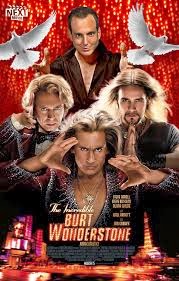
B $30M. US $24M. WW $24M. Dir. Don Scardino.
When Las Vegas superstar magicians, Burt Wonderstone's and Anton Marvelton's act and their 30-year friendship turn stale, a sadistic street showman puts them out of business. Wonderstone's chance meeting with his childhood hero at a retirement center allows him to recover his love of magic and recover his audience.
An all star cast (Steve Carell, Steve Buschemi, Olivia Wilde, Alan Arkin, and Jim Carrey) could not save this disaster of a story due to several fundamental story problems:
a. There is nothing redeeming or noble about the protagonist (Burt Wonderstone played by Steve Carell) until 60 minutes into the 100 minute story. In short we can't like him or root for him, until we've emotionally left the theater. We like him from about 60 minutes to 90 minutes, but at the end we again "wonder" why his character is redeemable.
b. What happens at 60 minutes in is essentially a moment of grace, but structurally it's the first turning point where the protagonist makes a decision that changes the story's direction. Thus it's more like the Act 1 Climax...30 pages too late, and even if it was a Moment of Grace, it'd be 10 minutes late. While Burt's goal is clear early on (reinvent his act and make it entertaining again...supposedly, the act has not changed in 30 years), he does not embrace this need (or goal) until the 60 minute mark....way too late...and well after the audience dislikes the megalomanic character. It's fine to start off with an arrogant character, but no later than 25% into the picture we need to have some hope that he can change. About mid point (50 minutes) into the story my wife turned to me and said, "I don't like this."
c. The antagonist, a sadistic street performer (Steve Gray, played by Jim Carey), begins attracting larger crowds that Burt and Anton, and thus creates pressure on Burt and Anton to fix their show. But Gray is not (in story structure) a real antagonist, even though there's some direct competition at a party late in the movie. The reason is that Gray is not doing magic, illusions or slight-of-hand, but catering to the macabre, grotesque tastes of what would normally be an alternative audience.
The filmmaker's assumption that Wonderstone's audience and Gray's audience are the same demographic is wrongheaded and the movie audience subliminally won't buy the incongruity nor the filmmaker's apparent disrespect for the movie audience's emotional attraction to a character. When Wonderstone is at his best he loves life and his audience. But, Gray clearly hates life and demeans his audience.
The real antagonist is Wonderstone's megalomanic fame and his consequential lost love for magic and entertainment. That is, in terms of story structure, Wonderstone and Gray are not opposites, and Gray's antics would naturally never disrupt Wonderstone if Wonderstone had an act that created wonder. The only wonder involved is on the part of the audience toward the filmmakers.
d. The above three problems shows a general disrespect by the filmmakers toward the intelligence of their audience's expectations of emotionally engaging with the characters, rooting for them, or understanding what makes a story. And if that wasn't enough, the final trick that Burt and Anton come up with, to rejuvenate their act, is dramatically disrespectful to all audiences. At first blush, the trick sounds wonderful.... make their audience disappear. But the way they do it demonstrates disrespect of any audience in three ways: (a) Burt, Anton and their crew threaten the lives of their audience by mass drugging them with a inhalant causing the audience to pass out; (b) the crews carry, drag, and toss the bodies as if they were sacks of trash; (c) the filmmakers somehow think that treating people with such arrogant disrespect is funny.
e. The above conspires (no doubt inadvertently by the filmmakers) to SHOW us that Burt really has not lost any of his arrogance toward his audience. That is, Burt's arc is not just late, but it reverses. Although the Wonderstone character's surface nature changes from a man of harsh and belligerent arrogance to one of kindness and humility, his outward actions reveal no real change. He still highly disrespects his audience.
Thus, the moral premise of this film can be summarized like this:
a. There is nothing redeeming or noble about the protagonist (Burt Wonderstone played by Steve Carell) until 60 minutes into the 100 minute story. In short we can't like him or root for him, until we've emotionally left the theater. We like him from about 60 minutes to 90 minutes, but at the end we again "wonder" why his character is redeemable.
b. What happens at 60 minutes in is essentially a moment of grace, but structurally it's the first turning point where the protagonist makes a decision that changes the story's direction. Thus it's more like the Act 1 Climax...30 pages too late, and even if it was a Moment of Grace, it'd be 10 minutes late. While Burt's goal is clear early on (reinvent his act and make it entertaining again...supposedly, the act has not changed in 30 years), he does not embrace this need (or goal) until the 60 minute mark....way too late...and well after the audience dislikes the megalomanic character. It's fine to start off with an arrogant character, but no later than 25% into the picture we need to have some hope that he can change. About mid point (50 minutes) into the story my wife turned to me and said, "I don't like this."
c. The antagonist, a sadistic street performer (Steve Gray, played by Jim Carey), begins attracting larger crowds that Burt and Anton, and thus creates pressure on Burt and Anton to fix their show. But Gray is not (in story structure) a real antagonist, even though there's some direct competition at a party late in the movie. The reason is that Gray is not doing magic, illusions or slight-of-hand, but catering to the macabre, grotesque tastes of what would normally be an alternative audience.
The filmmaker's assumption that Wonderstone's audience and Gray's audience are the same demographic is wrongheaded and the movie audience subliminally won't buy the incongruity nor the filmmaker's apparent disrespect for the movie audience's emotional attraction to a character. When Wonderstone is at his best he loves life and his audience. But, Gray clearly hates life and demeans his audience.
The real antagonist is Wonderstone's megalomanic fame and his consequential lost love for magic and entertainment. That is, in terms of story structure, Wonderstone and Gray are not opposites, and Gray's antics would naturally never disrupt Wonderstone if Wonderstone had an act that created wonder. The only wonder involved is on the part of the audience toward the filmmakers.
d. The above three problems shows a general disrespect by the filmmakers toward the intelligence of their audience's expectations of emotionally engaging with the characters, rooting for them, or understanding what makes a story. And if that wasn't enough, the final trick that Burt and Anton come up with, to rejuvenate their act, is dramatically disrespectful to all audiences. At first blush, the trick sounds wonderful.... make their audience disappear. But the way they do it demonstrates disrespect of any audience in three ways: (a) Burt, Anton and their crew threaten the lives of their audience by mass drugging them with a inhalant causing the audience to pass out; (b) the crews carry, drag, and toss the bodies as if they were sacks of trash; (c) the filmmakers somehow think that treating people with such arrogant disrespect is funny.
e. The above conspires (no doubt inadvertently by the filmmakers) to SHOW us that Burt really has not lost any of his arrogance toward his audience. That is, Burt's arc is not just late, but it reverses. Although the Wonderstone character's surface nature changes from a man of harsh and belligerent arrogance to one of kindness and humility, his outward actions reveal no real change. He still highly disrespects his audience.
Thus, the moral premise of this film can be summarized like this:
Disrespecting your audience through a stale show and belligerent arrogance
leads to a cancelled act; but
Disrespecting your audience through dangerous invention and kindness
leads to renewed popularity.


