Discussion and analysis of screenplays, scripts, and story structure for filmmakers and novelists, based on the blogger's book: "THE MORAL PREMISE: Harnessing Virtue and Vice for Box Office Success".
Showing posts with label Roller Coaster. Show all posts
Thursday, May 12, 2022
Wednesday, December 20, 2017
Scene-Sequel Roller Coaster
I'm preparing for a story meeting with a client this morning. In the process I created two slides (below) to guide our conversation. My client is not a novelist or screenwriter, but a public speaker. She's wanting to keep her audience engaged as she makes her presentations and tells her story. She's a fairly animated person, and is already engaging to listen to. But she sees the need for more structure to a long series of short talks that would benefit from following a pattern, thus helping her audience over time to see where she's going.
The basis of the slides (which I have used extensively in my workshops and in my Storycraft Training on-line series, http://www.storycraft.stanwilliams.com) came from studying a number of other story gurus, and so I give credit to: Dwight Swain, Randy Ingermason, Jack M. Bickham, and WastedPoet.com....and Ken Follett. Thank you one and all.
The desired roller coaster effect (whether it be physical or psychological) follows the black arrows I've drawn on the diagram. The bird's-eye view of this is that the Scene is generally a downward dread, and the Sequel gives us an upward hope. And, when you string them together in a longer form composition, you end up with an endearing and engaging roller coaster, as seen in the diagram below.
The basis of the slides (which I have used extensively in my workshops and in my Storycraft Training on-line series, http://www.storycraft.stanwilliams.com) came from studying a number of other story gurus, and so I give credit to: Dwight Swain, Randy Ingermason, Jack M. Bickham, and WastedPoet.com....and Ken Follett. Thank you one and all.
SCENE-SEQUEL
Think of the SCENE as an action, external, or physical scene, and the SEQUEL as the mental, internal or psychological scene. Both screenwriters and novelists through their craft SHOW both of these, and a speaker or dramatist does the same, although the minute craft are a little different (which we will not delve into here.)
Each scene or sequel is broken into three parts of unequal lengths.
- In the GOAL your protagonist will physically attempt to attain something.
- In the CONFLICT your protagonist will meet with people who try to stop her.
- In the DISASTER your protagonist will be defeated.
- In EMOTIONAL REACTION your protagonist will internally respond to the defeat.
- In DILEMMA THOUGHT your protagonist naturally transitions into an internal monologue about what to do next. There are various options that create the dilemma, each with a positive or negative consequence, and unfortunately the protagonist will not be able to know what the unintended consequences will be. This creates an increase in anxiety and enhanced dilemma.
- In DECISION your protagonist chooses one of the options thought through in the previous step. And this launches your protagonist in to the next Scene-Sequel duplex with a goal to achieve.
READ MORE about this use in a novel at Randy Ingrermanson's website, Advanced Fiction writing.
Here's the link for his "Writing the Perfect Scene" post.
Monday, March 13, 2017
The Sequence Approach (Paul Gulino)
I recently reviewed Paul Gulino's book "Screenwriting: The Sequence Approach." I found the book a bit obtuse and not clearly written, but Chris Soth (of ScreenwritingU) makes it easier to understand. Soth calls this structure the Mini-Movie Method (MMM).
This method of structuring a movie divides the story into 8 segments where Act 1, 2A, 2B, and 3 are all divided in half by events like the Inciting Incident, Pinch Points and the Final Incident, giving you, theoretically 8 equal parts.
Now, think of those eight segments of a movie, each 12.5% of the whole, as INDIVIDUAL movies or long sequences, each with a beginning, middle and end. Or 8 short movies strung together, each with a climax (the moment or turning point).
The 2016 Best Picture, MOONLIGHT, is constructed with three long sequences. The three parts tell the the coming of age story of a gay-black man raised in a poor, drug invested part of Miami. First, as a boy (called Little); second, as a teenager (called Chiron, his give name); and third, as an adult (called Black). The three sections are each preceded by a title card, simply:
i
Little
ii
Chiron
iii
Black
This simple and direct structure, made explicit to the audience, was one (of many) reasons the screenplay won an Screenwriting Oscar for BEST ADAPTATION.
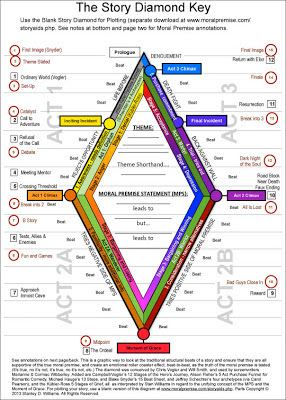
So, what Gulino (and Soth) propose is that you divide your feature into 8 parts, two for each of the major 4 segments: Act 1, Act 2A, Act 2B, and Act 3. These 8 parts are the same segments (less the Prologue and Denouement) you'll see on my StoryDiamond or on the linear representation of a Story's 13-20 Beats --- both represented below in miniature. (Click on the links above for posts that explain. And, click on any diagram for a larger version, that you can actually read.)
[BTW: I have updated the StoryDiamond again, and for the first time in six years edited and updated the Annotation or Notes Document that goes with it. If you use the Story Diamond I encourage you to download the latest at the links herein.]
Now, here's the new thing I came away with. If we think of each of these 8 segments, or sequences, or mini-movies as each having a goal that the protagonist needs to achieve, then it's like you have 8 subplots, which run sequentially, as opposed to most subplots that run in parallel. Here's a diagram I crafted. Below the diagram is a further explanation. (You can click on any image to make it bigger.)
1. One good way to hook your audience is that each of the sequences has a goal. Let's call the first seven, "subgoals," as the end point of each of the subplots. (In the digram, the subgoals are symbolized by the red stars). The story must be constructed in such a way that each subgoal MUST be achieved before the next subplot can be engaged, and the next subgoal be achieved. That is, the first subgoal is logically nested (and its resolution more or less resolved) before the second subgoal can be pursued and achieved. This is very much like a video game (which I don't play) where to get to the end of the game you have to acquire all the earlier magic lanterns, or pots of gold along the way. If you miss one, you stop dead in your tracks.
The trick is to construct a story where the eight subplots and subgoals are logically dependent, nested and chronologically sequential. The later goals all have to be subservient to the earlier goals. (Soth used INDIANA JONES AND THE LOST ARK as an example.) And in movies like THE LOST ARK you can even think of each of the 8 subplots with their attending subgoals as "set pieces" or locations. So, you have a 11 minute adventure in one wilderness location, there's a 1.5 minute climax where the protagonist finds some level of defeat and that propels him or her to the next set piece and the next sequence. Come to think of it the James Bond movies are pretty well structured like that.
2. Of course, each of the subgoals MUST support the final main goal. This is what I teach about subplots (that run in parallel) and their subgoals—e.g. every subplot goal must be related to the single moral premise, and the virtues and vices associated with it. That is, every subplot has to struggle with the same conflict of values, but perhaps in a different way. In Gulino's Sequences (and Soth's Mini-Movies) the subplots are sequential, and logically dependent. This is brilliant.
3. The process suggests that just after each goal is achieved, there is an increasingly terrible and epic failure on the part of the protagonist, which causes his hopes to descend into fear. According to the Moral Premise theology (yeah, I should start a religion), these immediate descends are the consequence of two related forces: (1) the action of the antagonist, and (2) the weakness of the protagonist, which is a milder form of the powerful vice exerted by the antagonist.
Do I need to point out the emotional roller-coaster effect this creates? Alas, one of my bully pulpits.
This perfectly follows an age-old concept of novel writing—in every scene-sequel sequence there is a DISASTER that spurs the action forward (or in a new direction...a mini-turning point). Here's a diagram from my on-line workshop (Storycraft Training). An explanation follows.
![]() |
| Novel Scene-Sequel Sequence (simplified) |
Running from left to right in the above diagram. (1) The protagonist has a physical GOAL to achieve. (2) The protagonist takes action to achieve that goal, and in so doing creates CONFLICT with the antagonist. (3) Because of the conflict, the goal is not fully achieved, resulting in a DISASTER. (4) The protagonist experiences an EMOTIONAL REACTION, which acts as a motivation to keep going. (5) The protagonist spends some time evaluating in his mind (THOUGHT) the DILEMMA faced, until... (6) The protagonist makes a decision about the next goal and takes the fist steps to achieve it. [And the process REPEATS starting with the new goal.]
Now, I've added a couple of things from my other workshop sessions (c.f. Storycraft Training). Let me repeat the diagram for ease of reference.
4. Each sub goal has to be harder to achieved, and the conflict and tension associated with its accession has to be higher than the last subplot and goal. I have gradated the vertical scale into +8 and -8 levels.
5. Likewise the disasters (represented by the black dos) are increasing terrible. Thus, the goals and the disasters, get farther and farther apart, creating an escalating emotional roller coaster. the dipole here is HOPE vs. FEAR—a good way to convey it on an emotional level, which for a story is critical. Of course there are other ways to define the roller coaster, e.g. rationally (Is the protagonist progress toward the goal progressing or retarding?), and/or morally (Is the essential truth of the moral being tested true or false?)
6. Lastly, going back to my earlier description of the 13-20 beats, the Turning Points and the Pinch Points have a characteristic difference in how each of those seven disasters occur. The odd number disasters (above, i.e. 1, 3, 5, 7) are initiated or caused by the antagonist's power, whereas the even number disaster (above, i.e. 2, 4, and 6) are caused by the protagonist's weakness, blindness, and poor judgement.
Comments?
Thursday, March 2, 2017
Roller Coaster Action Scale and How Bad Scale.
I frequently write and talk about the importance of a logical and emotional roller coaster for a story's main spine. (See: http://moralpremise.blogspot.com/2016/12/emotional-journies.html). That is, how does the audience perceive the protagonist's (hero's) progress toward the visible, physical, and highly ironic goal.On a logical level the roller coaster can be evaluated as to whether or not the protagonist is making objective progress or has experienced a set back.
On an emotional level the roller coaster can be evaluated in terms of the audience's fear for the protagonist's safety or eminent demise.
Often the two roller coaster "tracks" coincide.One thing I have not talked or written about that much is how the heights and depths of the roller coaster track should escalate as the story continues, which is just the opposite of an amusement park's coaster, where the tallest hill is at the front. Your story's tallest hill and deepest valley should be at the end, the Climax in Act 3. In my own writing I have taken the threats of the antagonist and listed them on a spreadsheet or scrap of paper and attempted to make sure that each successive threat was greater than the one before.
Here then is a generic list that will help you do that. I don't think I came up with it...found it on a Stickies' Note. Make up your own and create your own for each story, and each subplot (arc) of each character's goal. If you came up with this list and sent it to me, or if I copied it off some other blog, please tell me and I'll give you credit. The higher the number the deeper the valley.
Now here's another list like the above, sent to me by novelist Mary Connealy (http://maryconnealy.com/). Mary writes Romanic Comedy Westerns. Fun reads. Back in 2010 we shared an email thread in which she wrote this to my response after reading her novel, "Petticoat Ranch" (Barbour, 2006). I had complained that she didn't kill off the bad guy. This excerpt from her email will give you an idea of her writing. Love it. (Sorry, Mary, I didn't ask your permission to use this, but I think it's past the statue of limitations...and it's deliciously good.)Action Scale for Roller Coaster Chart
0 establishing
1 transition
2 looks
3 friendly banter
4 debate between friends
5 talk between enemies - walk near enemy
6 threat threshold
7 slow chase - stalking
8 chase / threat of gun or capture
9 bullets fired
10 imminent death
Mary writes:
I'm sorry I didn't kill Judd off, very bloodthirsty of you, but I know what you mean. I did stab a stake through his leg and I PROMISE YOU he was hanged, so rest easy. :)
I've killed a few villains in my day. Read Cowboy Christmas if you want a bad guy who is particularly dead at the end. Deader than dead. I've made two notes of how bad guys die in fiction, movies, books, whatever.
First is the 'Good bad guy' syndrome. The good bad guys tend to die
while the bad bad guys go to prison. The moral there? Prison is worse than
death??? When the bad bad guy DOES die, you can judge how bad he is by the number of times he died.
1. Shot through the heart. Bad.
2. Shot through the heart, stumble back into an electric grid and be
electrocuted, very bad.
3. Shot through the heart, stumble back into an electric grid and be
electrocuted, then fall six stories, very horribly bad.
4. Shot through the heart, stumble back into an electric grid and be
electrocuted, then fall six stories and land on a highway and get
run over by a semi, miserably ugly viciously bad.
5. Shot through the heart, stumble back into an electric grid and be
electrocuted, then fall six stories and land on a highway and get
run over by a semi, which overturns and explodes...well, you get
the progression.
Tuesday, November 22, 2016
Beats - Turning Points - Sequences - Pinch Points
One of my on-going challenges as a story consultant has been to clarify terminology and minimize the equivocation in terms. (Thus the recent post Protagonist vs. Hero with assistance from Chris Volger). Clarifying terms was a motivation behind writing the The Moral Premise regarding what others were calling various things like "the Controlling Idea," "Theme," "Premise," and so on.
The Story Diamond (link to PDF of Diamond) was not original with me, but I saw the opportunity of layering other story concepts onto it and thus demonstrating how the wide variety of terms used in our niche industry, are really all about the same thing.
So, this post is another attempt at that...with hopefully some nomenclature consistency. It was prompted by the last several posts by Michael Hauge over at StoryMastery.com. Michael has made the turn from calling every sequence and turning point a "beat" to differentiating between the different kind of beats as "turning points" and story "stages". This solves an on going problem. I would tell my clients that some beats are "moments" (a single scene) and others are "sequences" (numerous scenes.) Yet the connotation of "beats" still sounds instantaneous...which is confusing since half of the beats are not moments at all.
So, taking this hint from Michael, I offer up the following and the Story Diamond has been updated to reflect this subtle shift in labeling conventions.
As a further update, the 8 stages can also be called Mini-Movies, which reflects the ideas of Paul Gulino (Screenwriting: The Sequence Approach), and Chris Soth of ScreenwritingU.
Recall that our goal is to create an emotional roller coaster effect for our reader/audience. That end goal demands a regular (up and down) progress of scene sequences and turning points (or beats) or pattern over which we can apply our story elements and plot.
The latest PDF of the Story Diamond is HERE.
The latest PDF Annotated NOTES document for The Story Diamond is HERE.
Plus, the Sequences alternate with the Points, for a deeper symmetry and a satisfying roller coaster ride.
The Story Diamond (link to PDF of Diamond) was not original with me, but I saw the opportunity of layering other story concepts onto it and thus demonstrating how the wide variety of terms used in our niche industry, are really all about the same thing.
So, this post is another attempt at that...with hopefully some nomenclature consistency. It was prompted by the last several posts by Michael Hauge over at StoryMastery.com. Michael has made the turn from calling every sequence and turning point a "beat" to differentiating between the different kind of beats as "turning points" and story "stages". This solves an on going problem. I would tell my clients that some beats are "moments" (a single scene) and others are "sequences" (numerous scenes.) Yet the connotation of "beats" still sounds instantaneous...which is confusing since half of the beats are not moments at all.
So, taking this hint from Michael, I offer up the following and the Story Diamond has been updated to reflect this subtle shift in labeling conventions.
As a further update, the 8 stages can also be called Mini-Movies, which reflects the ideas of Paul Gulino (Screenwriting: The Sequence Approach), and Chris Soth of ScreenwritingU.
Recall that our goal is to create an emotional roller coaster effect for our reader/audience. That end goal demands a regular (up and down) progress of scene sequences and turning points (or beats) or pattern over which we can apply our story elements and plot.
The latest PDF of the Story Diamond is HERE.
The latest PDF Annotated NOTES document for The Story Diamond is HERE.
Symmetry
If we refer to the Climax of Act 3 as a turning point (which is clearly is in redemptive stories where the protagonist makes his/her biggest change) we then have a wonderfully symmetrical story system. There are 4 Turning Points, and 4 Pinch Points, and they alternate, helping to create the roller coaster effect we're after. MORE ABOUT THE IMPORTANCE OF THE ROLLER COASTER AND STRUCTURE AT THESE POSTS.Plus, the Sequences alternate with the Points, for a deeper symmetry and a satisfying roller coaster ride.
- (Prologue)
- Sequence 1
- Pinch Point A (Inciting Incident)
- Sequence 2
- Turning Point 1 (Act 1 Climax)
- Sequence 3A
- Pinch Pint B
- Sequence 3B
- Turning Point 2 (MOG)
- Sequence 4A
- Pinch Point C
- Sequence 4B
- Turning Point 3 (Act 2 Climax)
- Sequence 5
- Pinch Point D (Final Incident)
- Sequence 6
- Turning Point 4 (Act 2 Climax)
- Denouement
Friday, March 6, 2009
Purchase Pyramid
On the Amazon.com Moral Premise site one reviewer asked what the Purchase Pyramid story structure was. Here's my short explanation and a couple of graphics, and below the Five Stages of Grief, a.k.a. The Kübler-Ross Model.

The "Inverse Purchase Pyramid" model of story telling is based on Allison Fisher's Purchase Funnel. It is upon this model that most romantic comedies are based. You can use this instead of the three Act model, but most effective screenplays overlay the pyramid model on top of the 3 Act model. Imagine an upside down pyramid with the widest part at the top. Divide the the pyramid into five sections with four horizontal lines. Label each area with the five stages that follow. The pyramid breaks the story into the following sequence segments: (1) AWARENESS during which the buyer needs definition of what's for sale; (2) FAMILIARITY during which the buyer needs additional information peaking interest; (3) CONSIDERATION during which the buyer narrows the alternatives for purchase; (4) TRIAL during which the buyer tries out the product; (5) PURCHASE during which the buyer commits. Now apply that to both the guy and the gal as they go through those stages of romance and you've got a winning structure. Here's an emotional roller coaster diagram of how the "5 Acts" might play out:
Five Stages of Grief
Another useful structural tool is the Kübler-Ross Model of how people typically face grief or undesirable events. In my last workshops I have a slide that lists 7 stages, but I'm going to change that back to 5, because 2 of the 7 are unlike the others. So, 5 it is. Here's a graphic that somewhat demonstrates the story algorithm. I say, "somewhat" because the ups and downs of one story dynamic to the next are never the same.
Where does this apply? Anytime you have a character going through a very difficult life change — death of someone close, divorce, loss of income, professional disappointment -- in short a grieving of any kind.
Technique: I recommend structuring your story into the 3 acts and with the help of the 13-16 turning points and sequences as described in this blog, in The Moral Premise, and in other good story technique books (e.g. Hauge, Snyder). And then, layer on the 4 Steps of Grief, if they apply. This will give you more turning points and twists in your story, hopefully positioned where the story is relatively slow. I have, as of this revised post, updated The Story Diamond Writing Aid, where you'll see the five stages overlapping with everything else. The PDF download is linked below. Click on image.

The "Inverse Purchase Pyramid" model of story telling is based on Allison Fisher's Purchase Funnel. It is upon this model that most romantic comedies are based. You can use this instead of the three Act model, but most effective screenplays overlay the pyramid model on top of the 3 Act model. Imagine an upside down pyramid with the widest part at the top. Divide the the pyramid into five sections with four horizontal lines. Label each area with the five stages that follow. The pyramid breaks the story into the following sequence segments: (1) AWARENESS during which the buyer needs definition of what's for sale; (2) FAMILIARITY during which the buyer needs additional information peaking interest; (3) CONSIDERATION during which the buyer narrows the alternatives for purchase; (4) TRIAL during which the buyer tries out the product; (5) PURCHASE during which the buyer commits. Now apply that to both the guy and the gal as they go through those stages of romance and you've got a winning structure. Here's an emotional roller coaster diagram of how the "5 Acts" might play out:
Five Stages of Grief
Another useful structural tool is the Kübler-Ross Model of how people typically face grief or undesirable events. In my last workshops I have a slide that lists 7 stages, but I'm going to change that back to 5, because 2 of the 7 are unlike the others. So, 5 it is. Here's a graphic that somewhat demonstrates the story algorithm. I say, "somewhat" because the ups and downs of one story dynamic to the next are never the same.
Where does this apply? Anytime you have a character going through a very difficult life change — death of someone close, divorce, loss of income, professional disappointment -- in short a grieving of any kind.
Technique: I recommend structuring your story into the 3 acts and with the help of the 13-16 turning points and sequences as described in this blog, in The Moral Premise, and in other good story technique books (e.g. Hauge, Snyder). And then, layer on the 4 Steps of Grief, if they apply. This will give you more turning points and twists in your story, hopefully positioned where the story is relatively slow. I have, as of this revised post, updated The Story Diamond Writing Aid, where you'll see the five stages overlapping with everything else. The PDF download is linked below. Click on image.
Subscribe to:
Posts (Atom)