Showing posts with label Protagonist. Show all posts

Tuesday, June 25, 2024

ALIENS IN THE ATTIC: Diluted Hero

ALIENS IN THE ATTIC (2009) PG

I would appreciate your telling me of typos or confusing paragraphs. 

A group of kids must protect their vacation home and the world from invading aliens.

Director: John Schultz
Writers: Mark Burton and Adam Goldberg
Producer: Barry Josephson

Budget: $45M
Gross US: $25M
Gross WW: $57M

STARRING
Carter Jenkins (Tom)
Austin Butler (Jake)
Ashley Tisdale (Bethany)
Ashley Boettcher (Hannah)
Doris Roberts (Nana)
Robert Hoffman (Ricky)
Kevin Nealon (Stuart)

A filmmaker friend asked my opinion of Aliens in the Attic (AITA), so Pam and I watched, then I watched it again taking notes and timings.  

First Impressions

AITA was an expensive effort at creating a fun family fare...or flick...a sci-fi comedy that no doubt took inspiration from Close Encounters of the Third Kind, Signs, Teenage Mutant Ninja Turtles, and a host of alien invasion stories. 


I was most amazed at the editing, the shot coverage, the propping and sets. 


Bethany and Hanna hid from Dad, but not really

Thematically, AITA focuses on the importance of family, authority, and teamwork. The film attempted at digs at people who were addicted to computers, game boys, and other electronic devices, but it failed.  The father, Stuart Pearson, wanted to re-establish relationships with his children because computers et al got in the way. So he forces them on a family to leave Illinois for a vacation to Michigan (the movie was shot in New Zealand) to get away from all the electronic garbage. But irony gets in the way. It was his children's and nephew's skills at game controllers that saved his family and the world from invading space aliens. (That is not a spoiler.)


Robert Hoffman, Bethany's egocentric boyfriend was goof-ball amazing—a new Jim Carrey, I suppose. 


But I was at a loss to find a consistently applied moral premise that kept the story together about one thing. 


Why AITA Failed to Connect?


This post goes along with my other critiques of Failed B.O. Movies although it has a lot going for it—budget, interesting characters, good acting (for a comedy), direction, photography, and digital effects and computer animation matched with live action.  But here is the short list of failures that audiences require if word of mouth marketing is to succeed:
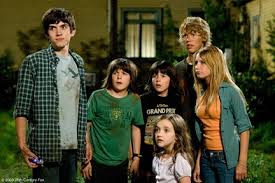

L-R: Tom, Art, Lee, Hannah, Jake, Bethany
1. There is no central protagonist or hero with whom the audience can emotionally invest, although the movie begins from Tom's POV and we are told in dialogue that Tom is the team's leader. Rather the group of kids are promoted as multiple protagonists. And yet they don't transform as protagonists should.


2. But Tom's nature is mostly passive. His goal is often distracted, and Jake takes up the cause. In fact, Jake at times tells Tom what to do. 


3. We are told through action and dialogue that Tom is somewhat of a genius and a mathlete. Early on Tom hacks his school's computer to change his grades, but Tom does not use his skills at math (i.e. higher intelligence) to defeat the aliens. 


4. The actions that prevent the invasion mostly do not originate from Tom (the "brainic,") but come from his proactive cousin Jake, his much younger cousins, twins Art and Lee who master game controllers, his younger sister Hannah who's good at relationships with strangers, and at the very end by the rookie alien (Sparks) who is the one who chases off the invading spaceships. Thus, any emotional investment we make in Tom is diluted by other cast members who often do the heavy lifting and initiate the reversals. The story thirsts for a MacGyver who we can root for.


5. Tom's transformation is sudden at at the very end. From the middle's Moment of Grace we should see Tom struggle with obstructions that slowly transform his attitude, and thus allow him to slowly achieve the goal.


Alien controls Ricky's mind and body

6. The goal is a negative goal...to prevent the aliens from invading the earth. The problem with negative goals is legendary—they are fulfilled at the beginning of the movie, thus movie is over. In the case of AITA, the aliens NEVER invade earth. A positive goal would be to overturn the alien occupation of earth. With a positive goal the audience can see the progress and cheer at every milestone toward the end. But with a negative goal, the audience cannot cheer at any point for there are no milestones as there are clearly evident with positive goals. 


7. The structural staging and turning points are weak (7-14). AITA begins well with a well developed and concise LIFE BEFORE. The INCITING INCIDENT (ideally at 12.5%) is at 17% when the aliens land on the roof of the house and the TV goes "haywire." Shortly there after Tom REJECTS THE JOURNEY to repair the TV dish or defend his siblings or parents from the aliens, whom he meets on the roof. But at 31% into the story, the cross over into Act 2, Tom reasons that the non-adult children (Tom, Jake, Art, Lee, and Hannah) are "the only option, although it is the twins who makes the point that the mind control darts don't work on kids, and it's Jake that concludes: "But we can still fight back."  


8. There may be a Moment of Grace. After that, however, there is not clear Moment of Grace for Tom where he has a revealing awareness of what they're battling (a value that changes their efforts) that is different than what they already know. Although as a gang, Hannah discovers at 54% that Sparks is friendly and that changes her attitude, and eventually everyone else's, and it is Sparks that chases of the invasion. This definitely acts as a MOG but not for the POV character, Tom.


9. There is a weak Act 2 Climax (Near Death or Faux Ending). No one actually is physically near death, but after Nana and Ricky fight and destroy the hall, Stu arrives and reprimands Tom and the kids for destroying the house and sends them upstairs. It's that  that Tom says, "I'm sorry, guys. It's over...an entire fleet of those guys are about to invade." 


Nana Zombie battles with Ricky Zombie

10. The Dark Night of the Soul is all too sort as Hannah, Art, Lee (and Bethany, now) encourage Tom to still be their leader. He agrees with a zoom into his face and a music cue, which establishes a Resurrection Beat. But it's weak because it doesn't come with any NEW revelation that gives them new hope. And it follows with Tom venturing into the basement with Spark's potato gun (not the potato gun that Tom made, but one made by someone smarter, an adolescent alien. No cheers for Tom. )


11. The Final Incident is strong. It's exactly where it should be at 87.5% when the normally small aliens are able to transform into gigantic aliens. 


12. Preparations for the Final Battle and the Final Hand to Hand Combat well occupy the last 12.5% of the movie, except the story and action only partially focuses on Tom. Clearly it was the writers' intent to create an ensemble protagonist, which dilutes our emotional connection to a single personality. 


13. The Act 3 Climax is anything but a climax although it is perfectly situated at 95%. The spaceship fleet arrives and descends to earth. It is distant and just a collection of pretty white lights. The hand-to-hand combat that we might expect is conducted by these distant lights and Spark's small squeaky voice "Retreat. Retreat. The machine is destroyed. We have been outsmarted by the humans." 


14. The Denouement is also perfectly positioned at 97.5% when the adults are clueless about the battle in the backyard and think all the lights in the sky was the meteor shower, and finally Ricky makes a fool of himself at Annie's house, because Tom and Bethany control him from the scrubs. Finally the credits begin with a show reel of Robert Hoffman


15. Deus Ex Machina a la Game Controller.  There was a bit of Deus Ex Machina with the kids manipulating people with the game controllers. As opposed to using human ingenuity. Note the game controllers the kids used were from the aliens, not humans. Thus, the story used electronic gadgetry that was, more improbable than possible. Socrates speaks eloquently about how in stories a probable impossibility is better than an improbable possibility. Of course, there's a fine line between those two options. It's up to the writer's craft to show the depth, cleverness and intelligence of the human species. I thought the movie was missing a great deal of human potential, and while funny at times, it’s improbable that electronic gadgetry is going to save the world. It’s more likely that sacrificial human endeavors using gifts, intuition and values that are inbred in the human DNA is going to save the day. So the game controllers end up being the deus ex machina that drops down out of the sky improbably to save the day. 


AITA's reference to M. Night Shyamala’s  movie Signs and the aliens' weakness in that story of water,  was a weak attempt at giving AITA some gravitas. The gravity of water in 
Signs is the whole idea of "Baptism that saves us" from damnation (1 Peter 3:21)...aliens of a fourth kind. The human element involved in Signs is the Bo's (Abigail Breslin) intuition of putting water glasses around the house because she has a premonition that water is important. [Side Note: the similarity of Bo (Abigail Breslin) in Signs to Hanna (Ashley Boettcher) in AITA, and how Bo discovers the salvation of water, and Hanna discovers the salvation found in her friendship with Sparks.


Of course, Signs is clearly a faith story because Rev. Graham Hess (Mel Gibson) is struggling with a loss of faith. The genesis of Hess's character and the water stems from Shyamalanem’s  Catholic education as a child,  although I am sure he did it unconsciously as few of his other stories make any theological sense. I assert that the simple element of water in a glass (no technology) is more human than a game controller.  It might have helped if Tom were to  reprogram the game controllers (with his math and technology skills) so that his siblings and cousins could operate them to control the aliens, and putting Tom and his human DNA at the behest of the story’s resolution. 


16. No clear oversight of a true and consistently applied Moral Premise.  The Moral Premise of a story is a two-sided statement that explains what the story is about at a motivational level. It assumes that all external, physical action is motivated by internal, moral values. That is, the value motivations of the antagonist and protagonist conflict and create the battle. Often the antagonist's values remain the same or turn to a darker vice, but such vices force the protagonist to change values, and seek something better by the end. In AITA the aliens do not change, except for Spark, but the persistence of the humans, and transformation of Sparks (to see the humans as nice), saves the family and the planet. Thus, Sparks transforms, as does Hannah and the others toward Sparks. But there is no transformation of Tom which aids him (or the others) in defeating the aliens. 

Jake and Tom consider their options
with the potato gun.


Oft times in stories, it's the vice the protagonist embraces at the very beginning of the story, that opens the door for the antagonist to attack at the Inciting Incident.  There's no clear indication that the aliens come as a result of Tom's lame attitude about the vacation. Although, a slightly different script might have portrayed the aliens as a personification of Tom's "lame" attitude, and thus the aliens became a metaphor for changing Tom's attitude. That is the epitome of a vice can repulse a protagonist form the vice toward a more virtuous attitude.  But that is not what happens in AITA. 


Instead, the need for the audience to see Tom's redemption ends up as...


17. Gaslighting the Audience


Another way of looking for the Moral Premise is to ask more specifically, "What could be the virtue and vice conflict in AITA?" and how might they be articulated in a moral premise statement? Or, what transformation is evident in the characters from vice to virtue? There are transformations. 


At the very end Tom tells his father, Stuart, that Father Knows Best ("Dad, let me save you the lecture. You were right and I as wrong," and Tom decides to enjoy fishing with the family. But there is no slow, observable, learning or transformation. Tom's change is sudden with the fixing of the tangled fishing reel (a repeated metaphor motif of the family's situation). 


And there's no logical connection between his father's desire to get Tom away from technology, when in fact it was technology that saved the family and the world. So Stu could not have been right. Stu was in fact wrong. It was the kids' knowledge of technology (and game controllers) that saved the family. By telling Stu he was right, Tom sanitizes the plot, lies to the audience, and patronizes the "family" movie critics. 


Subliminally, audiences are not gullible enough to such a gas pipe (gas lighting, as Jakes makes such the passing reference about Ricky "What a gas pipe.") 


Thus, Tom's sudden transformation at the end rings hollow, and audiences "feel" a cognitive dissonance. It's just not true. Based on the story alone, not reality or natural law, Dad was wrong about technology, Ricky, fixing Ricky's car, the relationship between Ricky and  Bethany, the thermostat, and Tom's guilt at wrecking the hallway. There are times was Stuart and his wife Nina were very aware of what the kids were up to, and were right, but they were ever clueless about the aliens and the battle for what was right.


Based on the first few minutes of the movie, the Moral Premise could have been:

Human technology destroys family relationships; but sanitized human interaction heals relationships.

But that is not what the movie proves. Instead AITA suggests the truth (a false truth) is this:

Human technology destroys family relationships; but alien technology saves it

...or something like that. 

Another theme that might resonate as false with the audience is:

Advanced technology can save the world; but gaslighting can save the family.

You see, at the end, Tom has become like Ricky...the bad boy. Tom is gaslighting his Dad, patronizing Stuart, telling him that Father knows best, when the audience knows just the opposite it true. But the attitude, tone, lighting, music, all other aspects of the Father-Son talk on the steps, give evidence that the filmmakers are gaslighting the audience by sanitizing the ending, and telling a lie.

That's just another reason why AITA failed at the BO.


Thursday, July 12, 2018

How to Emotionally Connect a Protagonist to Your Audience.

 This is an updated post from 2010.


Our full house at EXTRAORDINARY's premiere
A  recent workshop attendee who works with teen filmmakers asked this question:
What are the major events in a story that a protagonist must face and overcome to make sure the audience emotionally connects with the character?
That question tells me the filmmakers believe it's the external (or visible) story EVENTS or ACTIONS that connect the audience to the character. But that's only half the truth.

The action a character takes is valued by the audience only because of said character's motivation to take said action. If the protagonist kills another character, the event will be judged differently by the audience depending on whether the killing is pre-meditated murder or self-defense. That is, what's important to the audience is WHY the character took said action. And that is all about who the character is internally. It's the character's internal values that mostly dictate the emotional connection of the audience.

The way the audience discovers those values is the work of the plot and how the character responds to the beats of the plot. More about the plot beats below, but first let's look at how the audience will come to recognize the character's internal values. This is how it works in real life, too.

This diagram from a workshop I give will help. On the left side of the circle, items 2, 3 and 4 happen internally to a character. In a motion picture the audience does not see these unless the character shares his thinking with another character. In a novel, internal monologue often supplies these points.  But everything on the right side of the circle, items 1, 5, and 6 are in the visible, physical realm which the audience sees.


So, let's begin with No. 1. Here our character observes a situation in the external world.

2. Almost immediately the character compares what he observes to his own value system.

3. Let's assume that there is an internal value conflict between what he observes and his own value system. That leads to:

4. The character deciding upon a course of action to remediate the situation, and try to change the external situation to be more in line with his own internal values.

5. The character's thoughts morph into the physical realm and he takes some action.

6. As a direct consequence of the action some natural consequence occurs that is totally outside the character's control. Nature has the upper hand now, and some physical conflict may occur.  This physical conflict is a metaphor of the internal conflict from step 3.

And the cycle repeats itself, as the character...

1. Observes the new situation created by his intervening action, and

2. Evaluates....

If the Natural Consequence is evaluated as good in the character's mind, then his original internal value is reinforced. If the Natural Consequence is evaluated as bad, then the character may revisit and revise their original internal value....and transform.

TURNING  POINTS AND BEATS

Now this sort of logic appears most dramatically at a story's TURNING POINT or at Major Beats of a story. I discuss these beats in various places in this blog. But here's a starting point: 13 Major Beats.

So, this goes back to the original question.
What are the major events in a story that a protagonist must face and overcome to make sure the audience emotionally connects with the character?
The answer in an external sense are the dramatic story beats reflected in the 13 Major Beats link above. But the key to those beats emotionally connecting with audiences all depends on whether or not the internal value arc of the character's transformation coincides with or diverges from the audience's values.

And that is where the Moral Premise comes in. The decisions and actions that the character makes, if you're going to have a successful story, must all coincide with the moral and physical arc described by the moral premise statement, which we are assuming is true and in compliance with Natural Law.

    Thursday, November 10, 2016

    Hero vs. Protagonist

    Thanks to Christopher Vogler for his contributions to this post.

    What's the difference between a hero and protagonist; or for that matter the anti-hero, villain, antagonist, main character or POV character?  Like many concepts it's easy to lapse into equivocation because of the varied way these terms are used.

    While I have no serious issue with using "hero" and "protagonist" interchangeably, it can make sense to use them differently. Below are a few suggestions for all these terms.

    An underlying assumption (and a big one) is that the audience has a working moral compass and knows what behaviors are to be rooted for or deplored. This may not work in a morally ambiguous universe, but for general audiences that comprise a cross section of society, a movie's popularity will correlate to natural law, which is a fair basis for moral certainty.


    MAIN (POV) CHARACTER...

    ...is the character with the most screen time. This may or may not be the hero, anti-hero, one of two kinds of protagonists, anti-hero, antagonist, or villain. It is almost always the Point of View (POV) character, or the perspective of the storyteller.


    HERO... is the character that
    • nearly epitomizes the virtues or strengths of the moral premise, but still 
    • is subtly flawed
    • will change (arc), but subtly and always in the same direction. The hero's values will not change direction or polarity, but at the Moment of Grace will get stronger and deeper. 
    • actively pursues a physical and visible goal that audience can root for.
    • will be a good guy with desirable traits.
    • may often give up his life to achieve the goal.
    Example: Captain Miller in SAVING PRIVATE RYAN. See detailed post at link.

    ANTI-HERO... is that character that:
    • epitomizes the vices or weaknesses of the moral premise, and thus 
    • is significantly flawed.
    • will change (arc), but subtly and always in the same direction. That is, the anti-hero's values will not change direction or polarity, but at the Moment of Grace will get stronger and deeper. This is the same as the HERO.
    • actively pursues a physical and visible goal that audience can root for, just like the HERO.
    • will be a good guy with undesirable traits
    Example: Travis Bickle in TAXI DRIVER


    VILLAIN... is that character that:

    • epitomizes the vices or weaknesses of the moral premise, and thus
    • is significantly flawed
    • will change (arc), but subtly and always more dark. 
    • actively attempts to prevent the hero or protagonist from reaching the goal.
    • will always be the bad guy.
    Example: Hans Gruber in DIE HARD


    PROTAGONIST (Redemptive)... is that character that:

    • at first, embraces vices or weaknesses of the moral premise, and is therefore,
    • clearly flawed, but
    • will change (arc) clearly toward the virtue or strengths of the moral premise.
    • actively pursues a physical and visible goal that audience roots for.
    • is usually a good guy in the end.
    • and lives to see another day, even better.
    Example: Bob Parr in THE INCREDIBLES


    PROTAGONIST (Tragic)... is that character that:

    • at first, embraces vices or weaknesses of the moral premise, and is therefore 
    • clearly flawed, but
    • will change (arc) clearly toward darker vices or greater weaknesses of the moral premise.
    • actively pursues a physical and visible goal that audience roots against
    • is usually a bad guy in the end. 
    Examples: Charles Foster Kane in CITIZEN KANE, and
    Tony Soprano in THE SOPRANOS

    Test Question: Do tragic protagonists always sit at table with a wine glass half-full, chin down, eyes up, and glare off screen camera right...."as if the answer to their dilemma were over there" (CV).


    ANTAGONIST... is that character that:

    • embraces either vices/weaknesses or (not both) virtues/strengths of the moral premise, and is therefore 
    • clearly flawed, or clearly virtuous,
    • may or may not (arc) clearly toward the opposing value, but if arc occurs will be cogent with the moral premise
    • actively opposes the physical and visible goal of the hero, anti-hero, or protagonist becoming the catalyst for change (arc) in the hero, anti-hero or protagonist.   
    • may be the good guy or the bad guy
    Example: The Angels in "Touched By An Angel"


    Wednesday, October 2, 2013

    Antagonists, Settings, Protagonists, and Environments

    Theory: In successful stories Antagonists are the product of their environment or setting, while Protagonists are the change-agents of their environment or setting. IOW: Antagonists are the out growth of their own status quo, while Protagonists challenge the status quo of others. Is that a rule that is always true of successful stories?

    Sunday, July 10, 2011

    Good Stories Require Aggression

    I've been doing a little sailing with the family, trying to get away from the computer, etc. But stories are always close at hand. In our pursuit of "sailing" from Detroit, MI to Lexington, MI we encountered a number of nemeses: sweltering hot weather (>100), big freighters that take up the channel, a midnight encounter with a foreign freighter on the St. Clair River that sent out a rouge wake that put my wife in the hospital for a few hours (they kept asking her: "Madam, are you in a safe environment?"), a late night dock security guard on a Segway, and "no wind"... a terrible thing for a "sail" boat. But we (the protagonists) were aggressive and overcame the obstacles, and achieved our goal: a quiet anchorage in Lexington, MI.

    Stories require aggressive, resourceful heroes. No movie goer is interested in a hero who is only passively interested in the goal, or an antagonist who simply behaves contrary. Both characters need to pursue their goal with passion, diligence, and aggression. My workshop now begins with a slide saying you need two key ingredients for a successful story: The WRITER'S PASSION and the PROTAGONIST'S PASSION — both for achieving their goals. The actual slide form the workshop says it this way:

    1. A good story originates from a writer's inexplicable INSPIRATION. Nothing can replace it.

    2. A good story is about an imperfect hero's unrelenting DESIRE for achieving a goal against insurmountable odds. Nothing can supplant that.

    3. For a good story to be well told the writer's INSPIRATION, and the hero's DESIRE must have one thing in common — STRUCTURE. Everything needs it.

    Oh, yeah, here's a picture of an obstacle, and the boat getting to the goal:

    Saturday, April 9, 2011

    Questions Answered about RomComs

    Janet asked some questions in the previous post's com box. I'll answer them here.
    Janet Asks: Do all the other main characters struggle with the same MP, but in regard to their own issues?

    Answer: Yes. that is how the movie can have multiple story lines but still be about one thing. the principles are the same for a novel or a screenplay.
    Janet Asks: I've just bought and read The Moral Premise and learned a huge amount from it. But I'm writing a short romance novel rather than a screenplay...The type of romance novel I'm writing needs two main characters (hero and heroine) but there's no room for an additional significant secondary characters or antagonist. (Each acts as the others' antagonist along with the characters' psychological flaws.) Both hero and heroine have different lessons to learn, so I'm struggling to form the vice and virtue sides of the moral premise.

    Answer: Good romantic comedies have two protagonists, the man and woman, who are the antagonists for the other. But there are other characters. Each will have a "reflection" character, and each with have a "nemesis" character. These are like the good and bad angels on their shoulders creating scenes that push the characters one way or the other. Each of these minor characters will have arcs that deal with the same moral premise as the main characters do, but obviously just not in as much depth.

    When you say the hero and heroine have different lessons to learn, if those lessons are different sets of virtue and vices, then you have two different stories. Your story will connect better with audiences if the virtue and vice set are along the same continuum for both. See the posts on this blog under the topic of "values" (below and to the right under the Movies & Topics list.)

    It is not always possible to squeeze a moral premise into an existing story that violates some of the natural laws of storytelling. I frequently guide students to change their story so it's about one thing, and not dilute the core psychological and moral principle which the story is REALLY about.
    Janet Asks: Both characters' lives are out of balance. The heroine focuses on work and has no social life, whereas the hero has made play his priority and isn't into serous relationships. (He's successful in his work so he has no lesson to learn about needing to work harder.) She needs to learn how to have fun while he needs to learn that fun flings won't make him happy. If the story was just the heroine's, then the moral premise would be easier, e.g.: A life totally focused on work brings yearning and and sadness but balancing work with fun brings fulfillment and happiness.' But this doesn't include the hero's issues.
    Answer: For this to work, you need to change elements of your story. See the posts on Nicomachean Ethics — "Mean Virtue.  If your heroine is into work and not play, then the hero would be into play and not work. Don't make them too extreme in those areas, but the bias has thrown their lives (with everything in their lives) out of balance. The purpose of the antagonist in a story is to change the protagonist by obstructing the protagonist's goal. Thus your characters are like iron-sharping-iron.  

    Janet Asks: Does the the moral premise in story with two main characters (who are both heading towards a happy ending) need to incorporate both arcs?--something along the lines of: 'Both an excessively serious approach to life and an excessively playful attitude lead to unhappiness, but a healthy balance between the two leads to fulfillment and happiness.' Often in romance novels the hero and heroine have similarly opposite flaws as the ones above such as Risk/caution/ or using others/helping others, so I'd love to be able to get the moral premise right for 2 protagonists dealing with opposite issues.
    Answer: Yes, you got it. This is the Nicomachean Ethic post, precisely.

    Tuesday, July 6, 2010

    LICENSE TO WED

    You want a bad example of a moral premise that seems to be right, but fails at the box office? Okay, here you go.

    Pam and I are catching up on some Netflix DVDs that have been laying around. (We really should go see ToyStory 3 and a few others...but we were tired.)

    Interesting premise, this film. Ben (John Krasinksi) and Sadie (Mandy Moore) "fall in love" and start living with each other. Six months later they decide to get married. Her family are lapsed church goers to what evidently is an Episcopal Church called St. Augustine where Rev. Frank (not FATHER Frank, is played by Robin Williams) has been the pastor for 20 years. Rev. Frank's specialty is pre-marital counseling. Of the hundreds of couples that have passed his "course" and that he has agreed to marry, none of gotten a divorce. The ticking clock is that there is only one opening in the church's schedule for the next two years, and that's in 3 1/2 weeks. Thus, the ticking clock, so to speak. But in the end we discover that is is of no consequence. False ticking clock — weak story beat.

    As typical romantic comedies go, this story seems to have the physical and moral premise elements all in place to be really true and funny—the most dominant premise being that Robin Williams promises to "open" the movie. I should also say that Many Moore is a good draw, but John Krasinski seems to be out of his skin and awkward. But I'm not a reviewer postulating my preferences.

    What makes this movie noteworthy for this blog is that while all the elements seem to be there, the movie was barely noteworthy at the box office. From a $35MM budget it did only $43.8MM in its opening domestic frame. Now Robin Williams is not truly an opener, as you might think. He's definitely the best at getting and delivering a joke. He can recite the Yellow Pages and make you laugh; but he's never been known for opening in a protagonist role and carrying the story.

    Here are some bullet points that were obvious during the first viewing of LICENSE TO WED.
    1. The protagonist seems to be Rev. Frank, insofar as Robin Williams gets star billing, gets a great deal of screen time, AND the title of the movie LICENSE TO WED is about him. 
    2. True to form for a protagonist, Rev. Frank makes 80% of the decisions that drive the story forward, as he creates intriguing situations for the young couple to navigate as they prepare for marriage. ("No more sex until the wedding," "write your own vows," "learn to be a good back-seat driver",  "learn how to argue." etc.)
    3. But front to back, beginning to end, Rev. Frank, although a bit wacky, has no vice, only a sense of virtue that is wacky but not disordered. One key is that he is exactly the same at the end of the movie as he was at the beginning. No arc. What? A protagonist with no arc?
    4. O, but the young man or lady must be the co-protagonists. Well, that would seem like a good idea for a romantic comedy. Duh! But if you plot out the major moral decisions Ben and Sadie make on their own, you discover that there are about only two, one in Act 1 (when they decide to get married BEFORE taking Rev. Frank's course) and one in Act 3 (when they decide to get married AFTER Rev. Frank's gauntlet.) That would suggest they are the antagonists. What!?
    Yep, things are a little backward here. Entertaining. Some good laughs. A nice ending. The young couple learn some valuable lessons (which hint at one of a number of true moral premises.) But ultimately the story disregards many of the natural laws of story telling, see points above, and the moral lessons are not consistently about one thing. Instead there's a pleasant potpourri of moral truths about "being friends before being lovers," "be dependent on your spouse more than others," "show deference to your spouse's needs," "respect and be gracious to your in-laws," and "don't agree to participate in stunts that are funny but have no purpose" (that last one was for the actors). The "argument lesson" and the "driving lesson" and the "one-on-one lesson" were cute scenes that did not reinforce any single story concept about Ben or Sadie other than Rev. Frank is crazy and this might be a funny movie to let Robin Williams ad lib. 

    The truth of what I'm writing here was made clear when you watch the DELETED SCENE commented on by the director, Ken Kwapis. In each he tells you that these fully shot and edited scenes (many of them clever) had nothing at all to do with Rev. Frank's intervention in Ben and Sadie's relationship. Thus, they seemed out of place. The scenes were more traditional romantic comedy fair where the co-protagonist's false identity and true essence battle it out. But, Ken, tells us that in his mind the Rev. Frank interventions were what the movie was about, and thus the movie was about Rev. Frank... the minister ... who had no "ark".  And without an ark one sinks in deep water.

    Wednesday, June 2, 2010

    Romance Writers & The Moral Premise

    A few blogs ago I wrote about Myra Johnson and her "gang" of romance writers. Well, I didn't know they were a gang then, just a few I thought. Then she asked  me to be a guest blogger for Seekerville, the blog site for The Seekers, "a group of fifteen unpublished and newly published Christian writers."

    The first writer on their bio list, Mary Connealy, "writes romantic comedy with cowboys."  She's married to a Nebraska rancher. Yep, they sure do sound like a posse out hunting for .... romance. This should be fun, a few are sending me romance novels they've published, for me to read before I write for them.

    Myra was kind enough to send along a couple of links to Seekerville Blog posts that referenced The Moral Premise. One was a Guest Post by their agent Natasha Kern where she shares her critical understanding of novel story structure and elements. It's a very enlightening read, and about mid way she has some nice things to say about TMP.

    Aside from TMP, however, she gives stellar advice to all writers about lessons that need repeatedly to be learned.

    Wednesday, June 18, 2008

    Why Are Stories Necessary? Part 2

    What follows is George Chatzigeorgiou's response (who writes from Greece) to my June 10, 2008 post, which was my (long) answer to his question "Why Are Stories Necessary?"

    George's insight into the cultural importance of stories and narrative is inspiring. Yes, he's a kindred soul. But he goes beyond where I've been, and sees things I don't, and that's exciting. His writings, which I'm happy to post below, are like good myths which are retold by following generations, taking the old story and adapting it to the current times and making it again meaningful and infused with truth for the reader. Being from Greece, George speaks, reads, and writes Greek and I suspect he has a classical education -- all of which adds to the discussion.

    If you want to read this thread in order, read the Feb. 10 post first, wherein he poses the question and I answer. That link is HERE (Why Are Stories Necessary?) and at the bottom of that post, there's a like to this post so you can read in order.

    Herrree's George!

    ----------------

    Hi Stan,

    Thank you for giving such an extensive and thorough answer, and for taking the time to explain that process, the whole thing really makes sense to me now.

    So, it's through this whole process of simulation, identification, cause and effect, and use of time that good stories can give us not simply wisdom, but the kind of wisdom that only first-hand experience can provide. So the reason a good story is so precious, is cause it basically gives us the opportunity to become wiser without having to pay the price of wisdom, without having to make mistakes again and again until we finally wise up, and without having to invest the tremendous time it takes for us to reach that point. (many lifetimes in my case!)

    All this seems to lead me to another conclusion: A boring story, even with a solid moral premise, isn't enough; it won't work nearly as much as a story that is truly engaging. A good story has emotional effect, the proverbial "thrills and chills", and that emotional effect is absolutely essential for this whole process you describe to work. Maybe that's a deeper reason why we're searching for good movies. ('Seen any good movie lately?') Because an emotionally engaging story is much more effective in giving us the "adrenaline rush that sensitives the synapses in our brain to remember the consequence when it occurs." A boring, poor movie, however, simply won't do the job, even if it has a perfectly executed moral premise. Turns out Hitchcock had the right idea when he said, 'A movie should not be a slice of life, it should be a slice of cake.'

    Still, all the attempts at creating emotional effect and all the storytelling craft in the world doesn't mean much if a moral premise isn't there to support the story's drama. It just leaves us empty and unsatisfied. I remember when as a teenager me and my brother went to see the 'Matrix'. It was one of the coolest things I'd ever seen, and we were so excited watching those fantastic action scenes, it was unreal how excited I was! But the funny thing is, when I watched the sequels I didn't like them at all, and in fact I was very put off... How strange! The concept was still the same, the story world was the same, the amazing action scenes were even better than the first movie, heck, even the stars were the same! Later, of course, I understood that the only thing missing was the most crucial one: The moral crossroads, the conflict of values which supported the first film's physical conflict wasn't there anymore. Everything was there, everything but the foundation. There was no meaning, no substance. And ultimately, no emotional effect, no 'adrenaline rush'.

    The idea that part of the reason movies are so popular is cause they allow us to glimpse our divine destiny and to experience things from the perspective of God, is so simple and obvious, and yet so stunning and mind-blowing! I never thought of such a thing and I still can't say I have fully grasped it, much less its deeper implications (which I suspect are plenty). 'Going to the movies' is so much a part of our pop culture, that one hardly thinks of it as a mystical experience. And yet, that's exactly what it is! When the lights slowly go out and we watch the screen in anticipation, at that moment, right then, you can tell it's not just a feeling of 'let's have a nice time'; it's a deeper feeling, the expectation for something far more profound. And that feeling I've noticed, sometimes it spreads through the room; sometimes it's even as if I can almost touch it. We really do experience divine attributes when we watch a movie. To the five divine attributes you mention I would add one more, the attribute of IDENTIFICATION. Just as in a really good movie we deeply identify with the characters, feel what they're going through and root for them, maybe God also identifies with us (which maybe explains why He's so passionately interested in our salvation)

    You write:
    It is only in reliving the lives of others (from true history, or metaphor, and parables) that we have hope of that change, BECAUSE IT HAS ALREADY HAPPENED TO OTHERS... in short - PROOF.
    That's probably why we're so fond of having role models and need people to look up to. It's not just an interest for those people, we essentially aspire to have similar lives with them. That's why in our teenage years we desperately search for idols. What we're really searching for is some hope for our future. It's a way of saying, 'Look, this guy did it'. It is proof that we can change our lives also, and a platform of inspiration. (It just struck me,so weird, that the word "idol" comes from the Greek word "ειδωλον", which means -you won't believe this- "reflection"!
    But at the heart of all morality is the INDIVIDUAL and SELF-DETERMINATION... Our choice of our future and our own self-determination is a fundamental truth about the human condition.
    Curiously, that's a theme that is inherent in the structure of pretty much every story: The hero changing his own fate as well as the fate of other people, of a community, of the galaxy etc, all because he makes a choice and he's gritty enough to stick with it (self-determination). And everything hinges on the protagonist's choice... I've been reading the Proverbs lately, and there's a brilliant verse which I think conveys exactly that: "Guard your heart above all else, for it determines the course of your life."(Proverbs 4:23)

    Thanks again Stan, that was extremely helpful!

    George Chatzigeorgiou