Showing posts with label Emotional Roller Coaster. Show all posts

Saturday, January 2, 2021

REVISIONS: Your Story's Emotional Roller Coaster & Intellectual Balance

This is really a post about how to plan a REVISION to a manuscript once the first draft is complete. 

Successful storytelling requires that you keep your audience emotionally involved in the story.  Designing an emotional roller coaster and intellectual balance into your story's structure is critical.

Here is an example from a recent first draft novel effort  and what I did to approach the revision. The revision's goal was to ensure that the manuscript reflects a solid emotional roller coaster effect, and an intellectual balance of story elements.

Here are some of the story fundamentals:

Genre/Era: Historial Novel - 1790s

Settings: Maryland, New Orleans, Sailing Barque 

Themes: Persistence, Pride, Supernatural

First Draft Length: 186,000 words / 388 pages / 26 Chapters / 136 Scenes [Final Length: 372,000 / 803 pages / 54 Chapters]

Storylines: 2 Protagonists (Character A and B) 

Conflict of Values/Moral Premise Value Dipoles: Pride and Arrogance vs. Humility and Meekness (where Meekness is the quiet strength and persistence to do what is morally valid in correspondence with natural law). 


Questions for the Author:

1. Where can the draft be shortened?

2. Is there a regular emotional up and down to the story?

3. Is there a reasonable balance between the five elements that the author believes will make the novel interesting, educational, and entertaining? (i.e.) 

(P) Philosophical reasoning

(H) Historical description

(S) Story connections and plot

(A) Action

(D) Disasters

4. Of the four main character groups (A, B, C, D) how many words are given to each storyline?  (There are four storylines that converge at the end.) 

5. Where are the IDEAL turning points (pretending there is only one protagonist) and where are the ACUTAL turning points? Since this story has two major storylines and two significant protagonists, the ACTUAL turning points for each of the two story lines will not likely sit next to the IDEAL.  Which turning points or setups (to the turning points) need to be sharped with respect to the Conflict of Values and the Moral Premise Value Dipoles?

The Process:

There was no attempt for the analysis to be precise (e.g. paragraph by paragraph), but to give the author a general overview of the draft's flow (e.g. page by page). 

1. The draft was printed out without gaps for chapter gaps. (Scrivener thinks this is a 550 page paperback novel. To make the process more manageable for analysis, fonts, page size, and columns were manipulated to get manuscript down to 388 pages. 

2. In a few hours, the pages were manually scanned and the category of content for each page was approximated: (a) Philosophical Reasoning, (b) Historical Description, (c) Story or Plot, (d) Action, or (e) Disaster. A letter (P, H, S, A, D) was written in the margin of each corresponding page for reference in step 4.

3. In Excel a column was numbered from 1-388. (The chart at right has been turned sideways from the original excel plot. The YELLOW row contains the page numbers from 1 on the left to 388 on the far right.)

4. In the adjacent column the letters corresponding to P, H, S, A, or D were manually inserted. (See TAN row at right)

4. Using Excel's formula for "IF (logical test, true, false)" a number was inserted in the next adjacent column whereby P=1, H=2, S=3, A=4, and D=5. The numbers arbitrarily assign emotional levels to the different content, where Philosophical Reasoning pages might be the more boring (=1), and Disaster Descriptions are probably the more exciting (=5). (See GREEN row at right.)

5. Using Excel's "Insert Chart" function a bar chart was generated, and sized to line up with the three columns. (See the BLUE bar columns at right. The shortest blue columns represent pages deemed Philosophical in content. The tallest blue columns represent pages deemed descriptive of a Disaster.) The "Emotional Roller Coaster" we are after is superimposed as a red line atop the blue columns. 

6. In Excel using the "IFCOUNT" function, the number of pages principally deemed portraying each of the five content were summed:

Philosophical (P) = 27

Historical (H) = 43

Story/Plot (S) = 145

Action (A) = 102

Disaster (D) = 71

7. Using Scrivener, in which the novel was drafted, the total number of words in all scenes principally relating to the four principal character groups and storylines are:

Character A = 103,121

Character B = 65,086

Character C = 26,300

Character D = 5,493

8. Identify in the rows of the chart the IDEAL major turning points as if there is only one protagonist for the 388 pages: Inciting Incident: 12.5% = Page 48 // Act 1-2 Break: 25% = Page 97  // Moment of Grace (Mid Point) 50%  = Page 194 // Act 2-3 Break: 75% = Page 291 // Final Incident: 87.5% = Page 339.  (It may be helpful to also identify the ancillary beats between these major turning points.)

9. Label the major events (peaks and valleys of roller coaster) with specific descriptions of the Disaster, Significant Actions, and Internal Decisions by the main characters on the bar chart.

10. For each storyline, identify and label the ACTUAL turning points and ancillary beats IF they exist. (If they don't exist, you're going to have to create them in Item F below.) Hand note on the chart the turning points that need to be sharpened or added.

Action Items for Author to Consider:

A. Where multiple adjacent pages are the same emotional level, break up the flatness with pages that have a different emotional level, e.g. There is one section where Philosophical Reasoning and Historical Descriptions continue for 10 pages. This can be shortened (by deleting pages), or be made more interesting by Action or a Disaster pages. Exception: There is no need to lessen the emotional content of a major disaster that continues for 9 pages (one place), nor the ending which Action and Disaster pages dominate for 19 pages. ACTION REQUIRED. MARK IT IN THE CHART MARGIN.

B. There is one sequence of 30 pages where there are only 6 Action pages, 0 disaster pages, and 9 Philosophy or Historical pages.  P or H pages in this section need to be deleted or A or D pages need to be added. ACTION REQUIRED. MARK IT IN THE CHART MARGIN.

C. Review Story pages and see if many of them can be time compacted to shorten the timeline. ACTION MAYBE REQUIRED. MARK IT IN THE CHART MARGIN.

D. The ratio of PHSAD to each other is not bothersome. It's good that the slower elements (P & H) are by far the fewest. NO ACTION NECESSARY

E. The Character Groups and Storyline lengths (Items 7 above) are appropriate since the word counts depict the relative importance of each character and group, i.e. Character A is the close knit group that is or supports the Protagonist. NO ACTION NECESSARY

F. After the above actions are taken, examine the manuscript at the ACTUAL TURNING POINTS (see Item 10 above). 

(1) If the Actual Turning Points exist, wordsmith the manuscript to reflect the conflict of values with the characters struggle. Remember, all stories must logically follow a natural cause and effect. The causes in a story are the values that motivate the characters; in this story's case those values are PRICE/ARROGANCE vs. HUMILITY/MEEKNESS. The actions are what the characters do physically to fulfill their closely held values.

(2) If the Actual Turning Points DO NOT exist...create them...which will require your story plot to be manipulated. Do not fret about hitting the IDEAL turning points. Follow the organic nature of your storylines and put the actual turning points in the vicinity of the Ideal. 

Here's the chart after doing all the above. 


Next step: Revise the Manuscript accordingly. 

Friday, July 20, 2018

How to Change the World at Bedtime - The Art of Storytelling - Didactic vs Narrative

There are many ways of trying to convince someone that something is true. There is the "BOP!" method, frequently employed by our parents and school teachers.

"I'll tell you what you're suppose to believe, and if you don't repeat it faithfully I'll bop you on the head with this here book."

Such is the method currently being used in segments of our political sub-culture. Either you toe the party line or I'll kick you off my Facebook page, out of my store, or the safe zone at the local university. So much for the pursuit of truth through dialogue and tolerance.

Many of us grew up in such fascist environments. But I don't think those who think much, think much of the effectiveness of such methods. In a pedagogical sense we might describe the BOP method with terms like rote, punishment, telling, didactic, or tyrannic. But most of us more likely appreciate learning through personal experience, discovery, experiment, showing, and simulation. Oh, yes, I should add the verbal pedagogies like dialogue, debate, and argument (as long as the arguments are the logical, not the yelling kind).

To those in the communication professions these two styles of communication can be identified simply as "TELLING" or "SHOWING."  Or, I could use more esoteric terms "DIDACTIC" and "NARRATIVE."  Experience is the best teacher, of course, but TELLING a little boy not to touch the hot stove is safer than actually letting him touch it. And yet, telling him may only elicit the question, "Why?" And that's where SHOWING or perhaps a simulation through a story is better.
Jeremy, you're too young to remember, but one time your Auntie Francine touched the stove when it was turned on, and her hand went up in flames. She screamed and hollered, and cried so hard. We took her hand and put it on ice, but that was so cold she cried even harder. Then the doctor came and took her hand completely off her arm and kept it a bandage for 2 months way up there on the shelf, and she couldn't reach it, or use it, even to pick her nose. How would you like that? Wouldn't it be sad if you couldn't pick your nose?"
Stories are like simulations if you can get your audience to emotionally identify with your protagonist and internally make decisions for the protagonist as the story goes along. There are many techniques for getting your audience to identify with the characters in a story...but we have not the space in this blog. See the on-line training. Yet, when you do it right, your audience will make the transition to believe that THEY are IN the story, and that THEY can HELP the protagonist toward the goal.
Oh, Daisy, don't open that door, there's a monster on the other side and he might eat you and it would really be ugly and I don't want to see that.
But of course, Daisy, being immortalized on the celluloid, can't hear you, so she walks through the door and is eaten by the monster. Blood everywhere. Quit memorable. Next time she'll listen. Oh, right, there won't be a next time. But the "Daisys" in the audience who are living through the simulation WILL remember...which is the point.
[Where does preaching fall into the above lists? Well, it depends on whether the preaching primarily involves didactic or narrative techniques. A good rule of thumb based on research of best selling books is 75% narrative and 25% didactic. Hook the heart, imagination and memory with the story, and then sum up the message with a short didactic explanation. Now, I've heard preachers who will a tell a story that has nothing to do with their message...which only hinders and create cognitive dissonance. The assumption is that that story embodies the applicable moral premise. ]

What Happens When We Tell Stories


I so much want to tell a story here, but your time is valuable. So let me NOT practice what I'm trying to preach and just share with you (e.g. tell you) what happens when you rightly use a story to communicate a particular truth, assuming you're using the Audience Identification Techniques described below.

When you tell a story correctly your audience will:
  • Work mentally to fill in the narrative gaps, and figure out what is going on and why. (Narrative communication is inductive. It provides information but the audience has to figure out the premise that holds it all together. That "figuring it out" requires mental engagement.)
  • Follow the narrative hook created by the story and try to answer the "story question." Listening to narrative communication is thus very active and engaging.
  • Identify with the flawed character, because they (the audience) are flawed.
  • Be intrigued about how the protagonist will successfully achieve his/her goal.
  • Be held in suspense as the protagonist overcomes obstacles.
  • Root for the protagonist at turning points to make the right decision and progress.
  • Be sad when the protagonist makes the wrong decision and falls back.
  • See themselves in the protagonist's journey.
  • Learn with the protagonist what to do and what not to do to have a good life themselves.
  • Subliminally recognize the moral truth, even though the outward story may be fictional.
  • Ride the emotional roller coaster of the story's ups and downs. This creates adrenalin rushes that burn memories into the brain. 
  • Remember the story and its subliminal message because it's visual and a simulation of a life experience. 
Now granted, I'm short-handing a lot of theory and practice here, but perhaps this blog will encourage you to learn how to tell better stories and change the world. ...Now, onward and upward!

What Happens With Didactic Communication


Let me contrast Didactics with Narratives. Unfortunately this will be a lot of propositional pronouncements...the very thing I'm preaching against:
  • Didactic communication tugs on the brain. Narrative stories, properly told, tug on the heart.
  • Didactic communication involves precisely defined propositional statements, logic, and syllogisms -- (think theology). Narrative communication involves suspense, intrigue, irony, conflict, and metaphors (think bedtime stories).
  • Didactics use abstract formulas that pertain to all time, all places and all persons. They are thus impersonal and objective. Narratives pertain to one time, one place, one person and are thus personal and subjective. 
  • Didactics make intellectual connections but generally produce no adrenaline rush to burn-in memories. Narratives make emotional connections by producing adrenaline rushes that do burn-in memories.
  • Didactics are void of emotional cantharis and are easily forgotten. Narratives, properly told, lead to emotional catharsis and are easily remembered.
  • Didactics frequently require rhetorical embellishment (volume, gestures, and pacing)  to keep an audience awake. Narratives can benefit from rhetorical techniques but don't require it. The audience's imagination supplies the embellishment to keep tuned. 
  • Didactics require deductive thinking where the conclusion is pronounced up front by the presenter and assumed to be true. Narratives require inductive thinking where the conclusion is derived by the audience through assimilation of the character's experiences. Thus, the conclusion is owned by the audience, not the presenter, and is thus remembered longer.
  • Didactics offer theoretical and general descriptions of life leading to the embrace of ideologies that may not  have practical meaning to the audience. Narratives offer visceral and specific portrays of life leading to personal verisimilitude. 
  • Didactics treat "cause and effect" intellectually and philosophically. Narrative treat "cause and effect" emotionally and practically.
  • Didactics explains truth. Narrative imbues truth.
  • Didactics tell audiences what to think, so they leave believing, "It's the presenter's idea, I'm skeptical." Narrative leads audiences to discover for themselves, so they leave believing, "It's my idea. Ah-ha!"
Audience Identification Techniques - How to Tell a Story That Connects with Your Audience

There are numerous ways to get your audience to emotionally identify with your characters and thus learn through your character's successes and failures how to make their lives better, which is the subliminal reason people loves stories...they're like safe simulations of life that teach what is good, true, and beautiful.  But there are "catches" to telling successful stories. Here are some of them. They apply to short and long form stories. If you learn more about these and use them, you'll connect with your audience and they'll learn what you're trying to teach them through the experiences of your characters.
  • Imbue in your story a true and consistently applied moral premise. This means that the underlying moral truth of your story must not conflict with Natural Law, although the outward physical story may be a fairytale.  This is the definition of a myth—a story vehicle, which may be true or fictional, but nonetheless communicates a universal moral truth. Much of my book, "The Moral Premise," the on-line "Storycraft Training," and this blog is about this.
  • Start with a strong, ironic physical hook.  e.g. your protagonist's goal is out of his or her league and sounds impossible to achieve.
  • Articulate an engaging log line. There is a good blog post on this.
  • Be sure the conflict of inner values is universal to your audience and not parochial. (That is, don't beg your message and assume something is true your audience may think is false.)
  • Your hero or protagonist must be flawed but wanting to be better.
  • Your hero must pursue a physical and visible goal that may metaphor a deep moral goal.
  • Your hero must be passionate and active, not passive or slothful.
  • Structure your story's emotional ups and downs so that there is a regular emotional roller coaster with ever increasing risks. Using the technique in the Moral Premise book, the Storycraft Training, and this blog you can learn that every other scene or sentence must be an ironic, nearly impossible journey for your hero.
Well, there is more!!!  ...and if you're familiar with all of this stuff, you will have recognized this last list as some of the "Secrets of Successful Story Structure" from my free bookmark.

Monday, March 13, 2017

The Sequence Approach (Paul Gulino)

[UPDATE: Please see Christopher Pratt's (the Other Chris Pratt, not the actor) comment at the bottom of this post. It's instructive.]

I recently reviewed Paul Gulino's book "Screenwriting: The Sequence Approach." I found the book a bit obtuse and not clearly written, but Chris Soth (of ScreenwritingU) makes it easier to understand. Soth calls this structure the Mini-Movie Method (MMM).

This method of structuring a movie divides the story into 8 segments where Act 1, 2A, 2B, and 3 are all divided in half by events like the  Inciting Incident, Pinch Points and the Final Incident, giving you, theoretically 8 equal parts.

Now, think of those eight segments of a movie, each 12.5% of the whole, as INDIVIDUAL movies or long sequences, each with a beginning, middle and end. Or 8 short movies strung together, each with a climax (the moment or turning point).

The 2016 Best Picture, MOONLIGHT, is constructed with three long sequences. The three parts tell the the coming of age story of a gay-black man raised in a poor, drug invested part of Miami. First, as a boy (called Little); second, as a teenager (called Chiron, his give name); and third, as an adult (called Black). The three sections are each preceded by a title card, simply:


i
Little

ii
Chiron

iii
Black

This simple and direct structure, made explicit to the audience, was one (of many) reasons the screenplay won an Screenwriting Oscar for BEST ADAPTATION.

So, what Gulino (and Soth) propose is that you divide your feature into 8 parts, two for each of the major 4 segments: Act 1, Act 2A, Act 2B, and Act 3. These 8 parts are the same segments (less the Prologue and Denouement) you'll see on my StoryDiamond or on the linear representation of a Story's 13-20 Beats --- both represented below in miniature. (Click on the links above for posts that explain. And, click on any diagram for a larger version, that you can actually read.)

  
[BTW: I have updated the StoryDiamond again, and for the first time in six years edited and updated the Annotation or Notes Document that goes with it. If you use the Story Diamond I encourage you to download the latest at the links herein.]

Now, here's the new thing I came away with. If we think of each of these 8 segments, or sequences, or mini-movies as each having a goal that the protagonist needs to achieve, then it's like you have 8 subplots, which run sequentially, as opposed to most subplots that run in parallel.  Here's a diagram I crafted. Below the diagram is a further explanation. (You can click on any image to make it bigger.)


1. One good way to hook your audience is that each of the sequences has a goal. Let's call the first seven, "subgoals," as the end point of each of the subplots. (In the digram, the subgoals are symbolized by the red stars). The story must be constructed in such a way that each subgoal MUST be achieved before the next subplot can be engaged, and the next subgoal be achieved. That is, the first subgoal is logically nested (and its resolution more or less resolved) before the second subgoal can be pursued and achieved. This is very much like a video game (which I don't play) where to get to the end of the game you have to acquire all the earlier magic lanterns, or pots of gold along the way. If you miss one, you stop dead in your tracks. 

The trick is to construct a story where the eight subplots and subgoals are logically dependent, nested and chronologically sequential. The later goals all have to be subservient to the earlier goals. (Soth used INDIANA JONES AND THE LOST ARK as an example.) And in movies like THE LOST ARK you can even think of each of the 8 subplots with their attending subgoals as "set pieces" or locations. So, you have a 11 minute adventure in one wilderness location, there's a 1.5 minute climax where the protagonist finds some level of defeat and that propels him or her to the next set piece and the next sequence. Come to think of it the James Bond movies are pretty well structured like that. 

2. Of course, each of the subgoals MUST support the final main goal. This is what I teach about subplots (that run in parallel) and their subgoals—e.g. every subplot goal must be related to the single moral premise, and the virtues and vices associated with it. That is, every subplot has to struggle with the same conflict of values, but perhaps in a different way.  In Gulino's Sequences (and Soth's Mini-Movies) the subplots are sequential, and logically dependent. This is brilliant. 

3. The process suggests that just after each goal is achieved, there is an increasingly terrible and epic failure on the part of the protagonist, which causes his hopes to descend into fear. According to the Moral Premise theology (yeah, I should start a religion), these immediate descends are the consequence of two related forces: (1) the action of the antagonist, and (2) the weakness of the protagonist, which is a milder form of the powerful vice exerted by the antagonist.

Do I need to point out the emotional roller-coaster effect this creates? Alas, one of my bully pulpits. 

This perfectly follows an age-old concept of novel writing—in every scene-sequel sequence there is a DISASTER that spurs the action forward (or in a new direction...a mini-turning point). Here's a diagram from my on-line workshop (Storycraft Training). An explanation follows.

Novel Scene-Sequel Sequence (simplified)
Running from left to right in the above diagram. (1) The protagonist has a physical GOAL to achieve. (2) The protagonist takes action to achieve that goal, and in so doing creates CONFLICT with the antagonist. (3) Because of the conflict, the goal is not fully achieved, resulting in a DISASTER. (4) The protagonist experiences an EMOTIONAL REACTION, which acts as a motivation to keep going. (5) The protagonist spends some time evaluating in his mind (THOUGHT) the DILEMMA faced, until... (6) The protagonist makes a decision about the next goal and takes the fist steps to achieve it. [And the process REPEATS starting with the new goal.]
Now, I've added a couple of things from my other workshop sessions (c.f. Storycraft Training). Let me repeat the diagram for ease of reference.

4. Each sub goal has to be harder to achieved, and the conflict and tension associated with its accession has to be higher than the last subplot and goal. I have gradated the vertical scale into +8 and -8 levels. 

5. Likewise the disasters (represented by the black dos) are increasing terrible. Thus, the goals and the disasters, get farther and farther apart, creating an escalating emotional roller coaster. the dipole here is HOPE vs. FEAR—a good way to convey it on an emotional level, which for a story is critical. Of course there are other ways to define the roller coaster, e.g. rationally (Is the protagonist progress toward the goal progressing or retarding?), and/or morally (Is the essential truth of the moral being tested true or false?

6. Lastly, going back to my earlier description of the 13-20 beats, the Turning Points and the Pinch Points have a characteristic difference in how each of those seven disasters occur. The odd number disasters (above, i.e. 1, 3, 5, 7) are initiated or caused by the antagonist's power, whereas the even number disaster (above, i.e. 2, 4, and 6) are caused by the protagonist's weakness, blindness, and poor judgement. 

Comments?

Thursday, March 2, 2017

Roller Coaster Action Scale and How Bad Scale.

I frequently write and talk about the importance of a logical and emotional roller coaster for a story's main spine. (See: http://moralpremise.blogspot.com/2016/12/emotional-journies.html). That is, how does the audience perceive the protagonist's (hero's) progress toward the visible, physical, and highly ironic goal.

On a logical level the roller coaster can be evaluated as to whether or not the protagonist is making objective progress or has experienced a set back.

On an emotional level the roller coaster can be evaluated in terms of the audience's fear for the protagonist's safety or eminent demise.

Often the two roller coaster "tracks" coincide.

One thing I have not talked or written about that much is how the heights and depths of the roller coaster track should escalate as the story continues, which is just the opposite of an amusement park's coaster, where the tallest hill is at the front. Your story's tallest hill and deepest valley should be at the end, the Climax in Act 3.  In my own writing I have taken the threats of the antagonist and listed them on a spreadsheet or scrap of paper and attempted to make sure that each successive threat was greater than the one before.

Here then is a generic list that will help you do that. I don't think I came up with it...found it on a Stickies' Note. Make up your own and create  your own for each story, and each subplot (arc) of each character's goal. If you came up with this list and sent it to me, or if I copied it off some other blog, please tell me and I'll give you credit. The higher the number the deeper the valley.
Action Scale for Roller Coaster Chart
0 establishing
1 transition
2 looks
3 friendly banter
4 debate between friends
5 talk between enemies - walk near enemy
6 threat threshold
7 slow chase - stalking
8 chase / threat of gun or capture
9 bullets fired
10 imminent death
Now here's another list like the above, sent to me by novelist Mary Connealy (http://maryconnealy.com/). Mary writes Romanic Comedy Westerns. Fun reads. Back in 2010 we shared an email thread in which she wrote this to my response after reading her novel, "Petticoat Ranch" (Barbour, 2006). I had complained that she didn't kill off the bad guy. This excerpt from her email will give you an idea of her writing. Love it. (Sorry, Mary, I didn't ask your permission to use this, but I think it's past the statue of limitations...and it's deliciously good.)
Mary writes: 
I'm sorry I didn't kill Judd off, very bloodthirsty of you, but I know what you mean. I did stab a stake through his leg and I PROMISE YOU he was hanged, so rest easy. :) 
I've killed a few villains in my day. Read  Cowboy Christmas if you want a bad guy who is particularly dead at the end.  Deader than dead. I've made two notes of how bad guys die in fiction, movies, books,  whatever. 
First is the 'Good bad guy' syndrome. The good bad guys tend to die
while the bad bad guys go to prison. The moral there? Prison is worse than
death???  When the bad bad guy DOES die, you can judge how bad he is by the number of times he died.
1. Shot through the heart. Bad. 
2. Shot through the heart, stumble back into an electric grid and be
electrocuted, very bad. 
3. Shot through the heart, stumble back into an electric grid and be
electrocuted, then fall six stories, very horribly bad. 
4. Shot through the heart, stumble back into an electric grid and be
electrocuted, then fall six stories and land on a highway and get
run over by a semi, miserably ugly viciously bad. 
5. Shot through the heart, stumble back into an electric grid and be
electrocuted, then fall six stories and land on a highway and get
run  over by a semi, which overturns and explodes...well, you get
the progression.


Tuesday, December 27, 2016

Emotional Journies

Merry Christmas and Happy New Year.  Have you been keeping up with all the new films. I have NOT, but will try over the next few weeks.   Here are some some holiday catch-up notes that may be of interest....on three topics:


"Emotional Journeys"
PASSENGERS
12 DATES OF CHRISTMAS


Emotional Journeys
Creating an emotional roller coaster for your story is important because it is what your audience experiences every day in nearly every aspect of their lives.

Not only should a writer "write what he/she knows" but "write what his/her audiences knows."

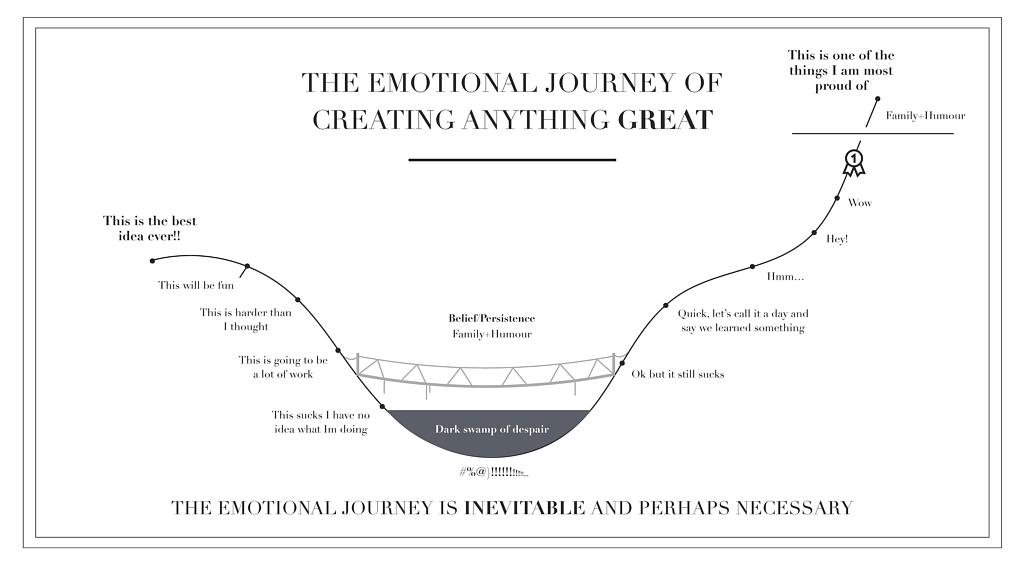
As I continue to work on my own screenplays and help others with theirs, this important value was reinforced this morning when I came across this interesting image depicting "The Emotional Journey of Creating Anything Great. "


Then I came across the following emotional journey maps.


They all look pretty similar to this, don't they? 

They all looked very similar to slides from my on-line Storycraft Training module 5A and 5B on "The Evolution of Story Structure," where we explain how to create story with a great emotional roller coaster.


The point is, write what both YOU and YOUR AUDIENCE knows. 

12 DATES OF CHRISTMAS - SUBPLOTS


In a fit of weakness I sat down with Pam and Netflix to watch ABC Family's 2011 TV Movie, 12 DATES OF CHRISTMAS. It's about, Kate (Amy Smart), a young woman on the rebound who, in a homage to Groundhog Day, relives a blind date on Christmas Eve 12 times before she learn to be less self-centered, turn her attention to the needs of others, and lands Miles (Mark-Paul Gosselaar).  The main plot is predictable, but the sub-plots are wonderfully creative...to say nothing of the elaborate and festive art and prop direction. What makes this movie worth a second and third look, however, is the sub-plotting of secondary characters, their goals and a number of props that have their own three beat motifs. Every time Kate relives her Christmas Eve date, she not only makes progress in her transformational arc (which gives us opportunity to see how the writer's developed it), but she meets new people, and encounters new obstructions...all of which have their own arcs and get resolved by the end. It's really an amazing piece of holiday writing...and a movie to be dissected and studied. Highly recommended.

PASSENGERS - Metaphors, Love, and Jennifer Lawrence


Pam and I also risked a very busy night at the local multiplex (Emagine Entertainment in Novi, MI) to see PASSENGERS. The parking lot was jammed, but the staff at Emagine had done a great job staggering show times, and staffing the ticket booths. Even though we were in a large 80% capacity theater, there were no long lines.

The critics that pan PASSENGERS are stupidity wrong. PASSENGERS is noteworthy on several points. But, first, in summary, it's the story of a spacecraft ferrying 5,200 or so humans to a new planet some 100 light years from earth. With all those people on board, it's fascinating that only 3 of those humans are awake and have speaking parts...Okay, 4 if you count Arthur (Michael Sheen) the robot bartender. For Moral Premise followers here are things to appreciate:

A. The big physical premise (a for profit company populating planets far from earth) is totally over the top, stupid, unbelievable, and preposterous...although the filmmakers make it seem all plausible and beautiful. We are drawn to the awe of the universe and this hi-tech spaceship on auto-pilot as its cargo hibernates for a couple hundred years, and the ship navigates on its own through asteroid fields and whips past stars for gravity assists.


B. BUT, as in many GREAT stories, THAT IS NOT WHAT THE MOVIE IS REALLY ABOUT. It IS about how love can grow and develop between a man and a woman in any situation. And THAT is the connection this story has with audiences.  Yes, the visual digital effects are stunning, the art direction and sets really amazing.  (The list of digital artists is almost longer than the movie...I challenge anyone to count them as they go by in the credits.) But PASSENGERS is a love story that suggests we are all passengers, on a sometimes lonely journey where we have a choice to make the best of our life, regardless of the odds we're handed.

C. What kept me deeply intrigued, however, was the rich metaphors about love between a man and a woman. The kernel of the idea seemed to come from the Garden of Eden and Adam longing for a mate. Eve comes along and together the two encounter great tragedies but manage to create a life together...and alone.

D. And then there is Jennifer Lawrence. She makes any film worth going to. One of the few real actresses today.

But so see it for the metaphors and to understand a bit more about what love is really all about.

Tuesday, November 22, 2016

Beats - Turning Points - Sequences - Pinch Points

One of my on-going challenges as a story consultant has been to clarify terminology and minimize the equivocation in terms. (Thus the recent post Protagonist vs. Hero with assistance from Chris Volger). Clarifying terms was a motivation behind writing the The Moral Premise regarding what others were calling various things like "the Controlling Idea," "Theme," "Premise," and so on.

The Story Diamond (link to PDF of Diamond) was not original with me, but I saw the opportunity of layering other story  concepts onto it and thus demonstrating how the wide variety of terms used in our niche industry, are really all about the same thing.

So, this post is another attempt at that...with hopefully some nomenclature consistency. It was prompted by the last several posts by Michael Hauge over at StoryMastery.com. Michael has made the turn from calling every sequence and turning point a "beat" to differentiating between the different kind of beats as "turning points" and story "stages".  This solves an on going problem. I would tell my clients that some beats are "moments" (a single scene) and others are "sequences" (numerous scenes.) Yet the connotation of "beats" still sounds  instantaneous...which is confusing since half of the beats are not moments at all.

So, taking this hint from Michael, I offer up the following and the Story Diamond has been updated to reflect this subtle shift in labeling conventions.

As a further update, the 8 stages can also be called Mini-Movies, which reflects the ideas of Paul Gulino (Screenwriting: The Sequence Approach), and Chris Soth of ScreenwritingU.

Recall that our goal is to create an emotional roller coaster effect for our reader/audience. That end goal demands a regular (up and down) progress of scene sequences and turning points (or beats) or pattern over which we can apply our story elements and plot.

The latest PDF of the Story Diamond is HERE.

The latest PDF Annotated NOTES document for The Story Diamond is HERE.


Symmetry

If we refer to the Climax of Act 3 as a turning point (which is clearly is in redemptive stories where the protagonist makes his/her biggest change) we then have a wonderfully symmetrical story system.  There are 4 Turning Points, and 4 Pinch Points, and they alternate, helping to create the roller coaster effect we're after. MORE ABOUT THE IMPORTANCE OF THE ROLLER COASTER AND STRUCTURE AT THESE  POSTS.

Plus, the Sequences alternate with the Points, for a deeper symmetry and a satisfying roller coaster ride.
  1. (Prologue)
  2. Sequence 1
  3. Pinch Point A (Inciting Incident)
  4. Sequence 2
  5. Turning Point 1 (Act 1 Climax)
  6. Sequence 3A
  7. Pinch Pint B
  8. Sequence 3B
  9. Turning Point 2 (MOG)
  10. Sequence 4A
  11. Pinch Point C
  12. Sequence 4B
  13. Turning Point 3 (Act 2 Climax)
  14. Sequence 5
  15. Pinch Point D (Final Incident)
  16. Sequence 6
  17. Turning Point 4 (Act 2 Climax)
  18. Denouement
A full explanation of the Story Diamond is presented in my On-Line Storycraft Training series.

Thursday, January 14, 2016

EMOTIONAL ROLLER COASTER - THE REVENANT

This is a long post written over several weeks and three different posts. If you see a typo, please tell me. Thanks. stan@moralpremise.com

I've taken this long to post this long analysis because the movie demonstrates a perfect structure that resulted in a visible roller-coaster effect, thanks to LIGHTWAVE. It is, therefore, worthy of study. The turning points match the idea perfectly and yet are portrayed in several ironic ways. In terms of structure THE REVENANT, is the "same thing only different."

Dir: Alejandro González Iñárritu
Writers: Mark L. Smith, Alejandro González Iñárritu,  based book by Michael Punke

HG - Hugh Glass (LEONARDO DICAPRIO)
FITZ - John Fitzgerald (TOM HARDY)
CA - Capt. Andrew Henry: DOMHNALL GLEESON
JB - Jim Bridger (WILL POULTER)
HK - Hawk (FORREST GOODLUCK)
PO - Powaqa (MELAW NAKEHK'O)
TO - Toussaint (FABRICE ADDE)
Hikuc (ARTHUR RED CLOUD)
HG's Wife (GRACE DOVE)

LENGTH: 106 minutes.

DISCLAIMER: The controversy swirls about what to call indigenous Native Americans, and whether to capitalize the term referring to them. There are arguments and interest groups on at least a dozen fronts. I don't pretend to have an opinion on the topic. In this post I've taken the common term "indian" to refer generically to these "first nation" peoples. 

Post 1-14-16: 
Here is the proof of what a number of us story gurus have been preaching for years. LIGHTWAVE (TM) has measured the emotional response of an audience watching THE REVENANT. I've been able to talk with Rana June, Lightwave's CEO. She supplied the higher resolution image below than was first disseminated to the news bureaus (click on it), and I'm attempting to get more information so I can correlate my forthcoming beat analysis of THE REVENANT to this chart. The wrist band that LIGHTWAVE has come up with to collect the biometric data and the data manipulating that they do will change how movies are written.

I predict that this wristband will be worn at table reads, or silent individual reads of the script. The analysis effort some of us provide can ensure this emotional response so the "slow middle" and other problems with stories, can be effectively eliminated. Just compare the structure of THE REVENANT biometrics with the chart I've been using for years, below.


Here is the chart we try to get filmmakers and novelists to follow. Look at the similarities. And I can tell you how to get there.


Post 1-30-16:  
Prompted by the Northville Screenwriter's Meetup Group I started in on analyzing the beats of REVENANT. I watched the movie for a second time from the back row, my iPhone's stopwatch giving me timings and a light to take many pages of notes of scene breaks and action. I then overlaid my notes on Lightwave's charts, here overlapped.

I've turned the chart below on it's side so the action/scene/sequence descriptions can be easily read, and I've put in the far right margin the traditional major story beats. They line up very closely if you have an idea about what the story is really about....there's a hint in my notes. I'll write a blog about this in the future, and on April 23, 2016 I will present a workshop on this at the Rochester Writer's Conference at Oakland University

BEAT ROLLER COASTER CHART

In the meantime, (1) click on the image for a larger size, and then (2) download it for your own study. Again, a major hit movie follows the moral premise beats, whether or not the writer and director knew anything about them from my book or work. This doesn't prove anything about me, but rather about the natural law of good stories. As one Pixar writer/director told a friend of mine recently who was exposed to this stuff..."We didn't know any of that. We just kept working at it until it felt right." Exactly. Perseverance will get you there if you have enough smart people in the room and put in the time to do it. But knowing what makes good stories work...can get you there faster. I love this stuff. Writer better, write faster. Know the Moral Premise of your story and apply it to everything. 


13+ MAJOR BEATS EXPLAINED

Post 2-15-16
For a generic explanation of the major beats (explained below for THE REVENANT) see my post on StoryStructure Basics. I'll try to avoid duplication below and assume you understand that earlier post. 

While each of the major beat labels below work best in a general sense, in some instances there are other names for these beats used by other story gurus, (as well as beats within these beats). A good guide to what other structuralists term these major, accidental, and minor beats can be found on my expanded Story Diamond Key PDF.

The beats below focus on the protagonist, Hugh Glass (HG), his main arc, and the movie's major plot. HG has subplots, which also have beats, but not as many as the main plot described below. Other main characters also have beats and an arc, but not as many as HG's main plot. 

ACT 1 BEGINS
1. LIFE BEFORE
HG avoids conflict where possible. When given a choice between fight or flight he chooses flight. He is not seeking to confront the French who ravaged his wife's village and killed her (flight). When the indians attacks the American trappers he guides through the NW wilderness, he runs for the boats. When Fitz verbally attacks him for marrying a Pawnee woman and expresses his hate for Hawk, their son, Hawk wants to defend himself, but HG tells his son that to survive he must be silent.  

2. INCITING INCIDENT (Ideally 12.5%)
At 12% Fitz verbally attacks Hawk and HG. This is the challenge to HG not to take a neutral, Laissez-faire, avoid all conflict worldview. HG's best retort to Fitz is that he holds the "smart end of the gun," the barrel of which is pointed at Fitz's gut.  

At 16% the bear attack is the inciting incident for HG's "moral wound" sub plot (see THE GOAL below), but it is not the I.I. for the main plot. However, there's a rich connection. See 3, below).


3. REJECTION OF THE JOURNEY
HG tells his son, Hawk, to be silent and not confront Fitz's hatred.
Although Fitz never stops in his condemnation of HG, Hawk and such, HG avoids putting the confrontation front and center and dealing with it. HG lets the hatred ferment. 

The bear attack is a clear metaphor for Fitz's hatred. Consider: (a) the bear attack is more visible than Fitz's verbal taunts. (b) the bear's vicious attack of HG SHOWS us what Fitz would like to do to HG. (c) When faced with the bear, HG is on the "smart end of the gun" but he AVOIDS the confrontation at first and does not fire fast enough, and the mother bear (attempting to protect her cubs) attacks. (d) When his fellow trappers find HG and try to save his life, Fitz goes off and smokes his pipe commenting that they ought to let HG die. At one side of the screen is a passive (dead) bear; on the other side of the screen is a passive Fitz, but who is very much alive and is every bit the threat to HG that the bear was. It's like a WWF tag team. The first bear is defeated and the other bear jumps into the ring. In this case, dramatically, the bear and Fitz are allies, and Fritz takes this into account and his action coming up.

If I recall the scene correctly, also notice that just before HG goes off early morning to hunt and during which he encounters the bear, he consoles Hawk, who is grieving Fitz's hatred, his mother's death, and HG's insistence that he stay silent. If HG and Hawk were not in conflict over how to deal with Fitz, Hawk would not be grieving, and he would be capable and willing to go hunting with his father as he has done before. Had Hawk gone with HG, it is unlikely that HG would have been mauled by the bear because Hawk would have protected HG's flank. Thus, the bear attack is the  indirect consequence of HG's rejection of the journey to confront his oppressors.

4. ACT 1 CLIMAX - ACCEPTS NEED FOR JOURNEY (Ideally 25%)
At 25%, after difficulty carrying HG's litter through the wilderness, HG's litter slides down the rocky, ice covered embankment, announcing the litter's occupants silent decision to stay behind and not endanger the rest of the party's lives by being a burden to their ability to get quickly out of the wilderness and survive. 

This normally would be a clear choice of the protagonist to cross the threshold and go on the journey, but in this scene is it implied and not explicit. 

Another unique aspect to this turning point is that the protagonist STAYS IN PLACE while the rest of his "world" crosses the hill and continues on their physical journey. HG's journey begins with him staying put, thus endangering his life in multiple ways....but also forcing him to deal with his weakness of non-confrontation. 

ACT 2 BEGINS: CROSSES THRESHOLD
"Crossing the Threshold" is counted as part of the Act 1 Climax, and not usually a separate beat, although it is usually a separate scene. It is here, nonetheless, that the protagonist's goal is revealed. So, let's take this moment to highlight three things: HG's goal(s), the Hook, and the Moral Premise.

1. THE GOAL. HG's Goal is to survive against all odds. To do that he must overcome various threats to his life and those he loves.  Each of these threats forms a subplot; one is the main plot. If you've taken my Storycraft Training Series or workshops you know that EACH subplot for each character must have a physical and visible goal. For HG, his goals for the various sub plots are:
  1. Overcome the extreme cold and wilderness.
  2. Avoid indians who war against the American and French trappers.
  3. Neutralize John Fitzgerald's hatred and bigotry (the main plot)
  4. Heal from his mortal wounds from a bear attack
  5. Defend and befriend his Pawnee in-law indian family
  6. Bring justice to and neutralize the French trappers who have killed HG's wife and ravaged her village

2. THE HOOK. A good hook pits an under achieving protagonist against impossible odds. While HG is a capable mountain guide and trapper, his weakness from non-confrontation, makes him an under achiever in the beginning of this story. And while any of the above threats to his life would be enough for most stories, THE REVENANT thrives on having all six. 

3. THE MORAL PREMISE
We have a Nicomachean Value Conflict (Continuum) upon which the moral premise is based. Here's the diagram. (If you can improve on this PLEASE let me know. These things always challenge me.) Remember the values (or virtues and vices) on these continuums are the MOTIVATIONS of the characters. You can't have action without a logical motivation for it.)


Embracing neutrality (absence of self-respect) or practicing
despotism (the extreme of self-respect), leads to death; but
seeking self-respect and justice for self and others leads to life.


5. ACT 2A: MAKES POOR PROGRESS TOWARD GOAL 
(Motivated by Negative Side of Moral Premise)
Now the journey begins, with the purpose of achieving HG's six goals for the six plots listed above. This is an extreme of the David vs. Goliath tale. Here Goliath has almost slain David, who lies helpless on a litter. And this helpless shepherd (which HG is by shepherding the trappers through the wilderness) can't even pick up a sling or a small stone. He's immobile on a litter, and in a moment will be tied down to it, no less.....as Goliath attempts for a second time to kill HG the shepard.

At the beginning of Act 2, HG is thinking of just surviving his wounds. But (out of necessity) he's taking the epitome of avoidance. He's staying in bed. He's NOT trying to get out. He's trusting in OTHERS, even his enemy, to take care of him. This is HG's weakness. You may think that HG is incapable of doing anything but just lie there in the litter. But notice he is capable of action, as will be evident soon after Fitz leaves HG to die, and takes off with JB for the fort. So, in retrospect, Act 2 starts off just like a well structured movie should, with the protagonist pursuing the goal, but using the negative side of the moral premise. (Read those motivating values again on the left side of the diagram above, and see if they don't apply to HG as he lies on his litter.)

This avoidance results in HG not just making SLOW progress, but when Fitz tries to kill him and does kill Hawk, HG experiences NEGATIVE progress. 

Fitz's attempted murder of HG and his murder of Hawk is PINCH POINT A—the antagonist's presence in obstructing the protagonist from reaching his goal. Such points accelerate the plot. Avoiding them in a story slows down the middle. (Pinch Points are terms novelists use, but to keep the roller coaster going, screenwriters need to embrace them, as THE REVENANT DOES SO WELL. 

Three other moments in Act 2A that indicate not slow progress include:

1.  HG crawling out of his grave to mourn his son. This is NOT progress for HG's plots, although it is a Dark Night of the Soul for Hawk, and it does explain some of HG's motivation for going after Fitz. But notice he crawls screen left, and Fitz and safety is screen right. It's NEGATIVE progress, yet again.  This may be subtle, but it signals to the audience that the filmmakers are increasing the stakes. Every step back is one that has to be recovered in going forward. 

2. Cauterizing the hole in his neck with gunpowder knocks him out.

3. After hiding in a cave with a fire to keep him warm, he flights from some indians that try to kill him. But notice they don't try to kill him until he tries to get away from them. This is important in terms of storytelling because it's just the opposite of what is about to happen.  (Notice this is the skill of the storyteller to make scenes seem reasonable, even if in retrospect they could have happened differently. It seems entirely reasonable for HG to run from these indians and slip into the river to AVOID them.)

6. MID POINT MOMENT OF GRACE (Ideally 50%)
At 49%-50% HG passes from one part of the diegesis (or world of the story) to another. We do not see an explicit Moment of Grace as we do in more typical movies when the protagonist has a revelation—the camera zooms in, there's a musical cue, and the character says something revealing. But there is clearly here a "rebirth." THE REVENANT uses "baptism" (in both forms) as the metaphor. When first escaping the indians and their arrows HG immerses himself under the water, and moments later he passes over a waterfall which reminds us of the baptismal water that is poured over a converts head. And then, having been cleansed of his sin, he floats through a beatific vision — a beautiful scenic river as he holds onto a floating log (the tree of the cross?) It's as if he is floating away from a bad past and into a beautiful, hopeful future.  At 50% HG climbs out of the river a new man, and the first sign we see of his newness is when he casts off the bearskin, his old nature. (Although in a practical sense it was the bearskin that kept him from hypothermia in the cold river.) In terms of semiotics (or the significance of signs and symbols), the bearskin is a sign of the bear attack, which is the consequence of HG's avoidance of conflict and confrontation (explained earlier). And we are going to see in the next scenes a totally different HG as he pursues his goal.) Again, baptism and the removal of the old nature are classic metaphoric ways of communicating a turning point. 

As a further sign that something is new, HG witnesses a falling meteor, even as part of it (a meteorite) falls into the river from which he climbed. The falling star is a mythic sign of the Wisemen following a star of hope and salvation.

But the filmmakers do not let us forget the antagonistic forces that HG must still face, and with the falling meteor HG remembers the slaughter of his wife's village and his wife's death.

Altogether, this is a significant MOG right at the 50% mark in the movie.

7. ACT 2 B: MAKES GOOD PROGRESS TOWARD GOAL 
(Motivated by Positive Side of Moral Premise)
And now HG makes progress, through providence and his own decisions. 

He hears a stampede of bison. He climbs out of the river valley to see this glorious sight and wolves carving out a calf for food. Notice he does not AVOID this wilderness danger, the stampede or the wolves, who might have attacked him, a wounded human. He stays nearby, and at night is awakened by another sound and flashes of firelight. 

Hikuc, a Pawnee warrior, chases the wolves away with fire, and kneels beside the ripped open bison and begins to feast on the raw flesh. 

Now, notice what HG does. He approaches the warrior and begs for food. This was not entirely necessary because HG had just hours earlier eaten fish he had trapped from the river. Yes, red meat would be a plentiful source of energy and more sustaining than fish. But what's important here, from a story structure standpoint, is that HG does not avoid the indian, but approaches him and after a tense standoff during which we think HG may get killed with an arrow at point-blank range, Hikuc throws HG the bison's liver, which Leonardo DiCapro actually tires to eat...the raw, bison liver. (His non-acting reaction is left in the film. Later he said it is something he will never do again.)

This event, meeting Hikuc, saves HG's life. It is is Salvation. If the baptism (a Catholic sacrament) is not salvation, then drinking Christ's blood in the Eucharist after baptism is. And it is Hikuc who acts as the priest who serves up the "Eucharistic" sustenance of body and blood. 

After hearing HG's story, Hikuc says he is traveling south to find other Pawnee rather that find the killers of his own son who was murdered as well. He tells HG: "But revenge is in the creator's hands. Travel with me." 

They travel together, with HG riding Hikuc's horse, and then Hikuc builds HG a healing shelter and cares for his "rotting" wounds. This is a metaphor for Christ healing the sick, even in the midst of a storm.

To reinforce that meaning, the filmmakers shows us HG's dream as he is being healed. The dream involves him in the ruin of a Catholic Chapel where he meets his deceased son...consolation that Hawk is in heaven...and on the wall behind where the altar once stood is a fresco of a crucifix—Christ on his crucifixion tree.  Don't miss what happens next, as HG makes both physical and spiritual progress toward his six goals. 

When the storm is over, HG comes out from his chrysalis a new man. At PINCH POINT B, moments later HG (like the Roman centurion in the Gospels and like Brad Whitlock's centurion character [George Clooney] in HAIL, CAESAR), finds Hikuc (his Christ) hanging lynched on a tree.  And like Pontius Pilate had a signed nailed to the cross above Christ's head mocking who he was ("The King of the Jews"), so Hikuc's crucifiers hang a mocking sign around Hikuc's neck, which in French reads, "We Are All Savages."

Now, comes the big test for HG. Has he been changed by his Moment of Grace? Has he learned his lesson about avoiding conflict and confronting it? Just beyond Hikuc's lynching HG sees the French trapper's camp. This is represented in the movie at least, by a group of men who are associated with the French that killed his wife and destroyed her village and another village that Fitz and JB come upon during their trek to the fort. But notice what HG does. HG does not avoid the camp, he steals into it, to steal supplies and Hikuc's horse. And as he does, he witnesses their leader (TO) raping the indian chief's daughter (PO) which the trappers have captured as their sex slave. PO's kidnapped disappearance from her tribe is one reason the local indians are on the warpath, and the indians suspect every white man they come across. 

HG gets supplies, Hikuc's horse, and frees PO, directing her to take TO's knife and kill him. Which she does, and in so doing scares off the French trappers, and after which she walks to freedom. This is a big turning point for HG as it frees him, eventually, form the indian's wrath.  This invading of the French camp also provides a climax of sorts for neutralizing the French threat against the indians and it finds justice for HG's wife's death. The implication is that it was TO that was responsible, and it is an indian, like HG's wife, who kills TO. 

But all the indians don't get the message, and soon HG is running for his life from indians on horses with guns, and as Hikuc's horse is shot by the pursuing indians, HG and the horse jump over a clip to what is certain death. Their dive into white oblivion is broken by a tree, but the horse dies and HG almost does so. 

8. ACT 2 CLIMAX - NEAR DEATH, FAUX ENDING (Ideally 75%)
At 75% is where HG and Hikuc's horse take their death dive.  HG came near being killed by the indians. The horse indeed dies, but HG, whose fall is broken by the tree, lives, barely.  

ACT 3 BEGINS
9. DARK NIGHT OF THE SOUL
Here again the filmmakers take the beat to the extreme. It's not enough that there is a near death experience, or that he must mourn his horse's death, but they put HG, naked, into the dead corpse of the horse, ironically to survive in the cold weather. Thus, HG spends the "night" not "near" death, but in "IN" death, in the darkness of the horse.  

THE RESURRECTION BEAT (Ideally either 85% or 90%)
At 82%.  This is not one of the 13 beats, but I see it more and more in good movies. It's step 11 in Chris Vogler's The Writer's Journey. In THE REVENANT it comes when a survivor from the French camp reports to the fort and CA and they discover that HG is in fact alive, and not dead as Fitz (who is now with CA) has reported. CA rushes out with a team and at night finds HG slogging through a dark forest. 

HG is brought back to the fort where he is fed, bathed, and his wounds are further treated. 

Meanwhile Fitz has escaped, having stolen money from CA's safe. Fitz knows that HG is coming after him, mostly for killing Hawk.  

10. FINAL INCIDENT (Ideally 87.5%)
At 89% as CA and HG track Fitz, Fitz ambushes and kills CA. 

11. PREPARING TO DIE TO ACHIEVE GOAL 
HG gives chase, now willing to die for the cause of justice and revenge. HG and Fitz battle hand-to-hand in the snow near a small stream.

12. ACT 3 CLIMAX - FIGHT TO THE DEATH (Ideally 98%)
At 97% HG shoves an nearly dead Fitz into the stream saying, "Revenge is in God's hands not mine." Waiting down stream is the indian chief and a small war party who have been searching for PO, who, now, is with them on horseback.  The chief pulls Fitz off out of the river and finishes him off.  

Now it appears that there is one last hand-to-hand battle, between HG and the indians...who cross the stream and come toward HG. Now, not afraid of conflict as he's faced death many times, HG does not run from the indians. It's tense, but they pass him by, looking down on him with disgust, but letting him live. This is because PO is with them, and she has told them what HG did for her. 

13. DENOUEMENT (LIFE AFTER)
HG struggles up a hill and sees a vision of his wife. She smiles at him and walks away. As she does we are left with a image of thin forest with crooked branches.  They trees stand, but not tall. They are frail and not strong. But they stand nonetheless.

This is in contrast to the many images we've seen throughout the movie of very tall trees and forests bending in the winds of mighty storms. And with each beautiful shot (perhaps 12-18 of them) we're reminded of the parable HG tells his then small son during the opening montage as we peruse the destruction of his wife's village:  
When there is a storm, and you stand in front of a tree. If you look at its branches, you swear it will fall. But if you watch the trunk,  you will see its stability...it's roots grow deep.
The final shot is a Reverse CU of HG looking off-camera toward where his wife's vision was. He's cold, weak, shivering. Then, slowly he turns his head and his eyes gaze directly into ours.

Fade Out.