Showing posts with label Failed BO Movies. Show all posts

Tuesday, June 25, 2024

ALIENS IN THE ATTIC: Diluted Hero

ALIENS IN THE ATTIC (2009) PG

I would appreciate your telling me of typos or confusing paragraphs. 

A group of kids must protect their vacation home and the world from invading aliens.

Director: John Schultz
Writers: Mark Burton and Adam Goldberg
Producer: Barry Josephson

Budget: $45M
Gross US: $25M
Gross WW: $57M

STARRING
Carter Jenkins (Tom)
Austin Butler (Jake)
Ashley Tisdale (Bethany)
Ashley Boettcher (Hannah)
Doris Roberts (Nana)
Robert Hoffman (Ricky)
Kevin Nealon (Stuart)

A filmmaker friend asked my opinion of Aliens in the Attic (AITA), so Pam and I watched, then I watched it again taking notes and timings.  

First Impressions

AITA was an expensive effort at creating a fun family fare...or flick...a sci-fi comedy that no doubt took inspiration from Close Encounters of the Third Kind, Signs, Teenage Mutant Ninja Turtles, and a host of alien invasion stories. 


I was most amazed at the editing, the shot coverage, the propping and sets. 


Bethany and Hanna hid from Dad, but not really

Thematically, AITA focuses on the importance of family, authority, and teamwork. The film attempted at digs at people who were addicted to computers, game boys, and other electronic devices, but it failed.  The father, Stuart Pearson, wanted to re-establish relationships with his children because computers et al got in the way. So he forces them on a family to leave Illinois for a vacation to Michigan (the movie was shot in New Zealand) to get away from all the electronic garbage. But irony gets in the way. It was his children's and nephew's skills at game controllers that saved his family and the world from invading space aliens. (That is not a spoiler.)


Robert Hoffman, Bethany's egocentric boyfriend was goof-ball amazing—a new Jim Carrey, I suppose. 


But I was at a loss to find a consistently applied moral premise that kept the story together about one thing. 


Why AITA Failed to Connect?


This post goes along with my other critiques of Failed B.O. Movies although it has a lot going for it—budget, interesting characters, good acting (for a comedy), direction, photography, and digital effects and computer animation matched with live action.  But here is the short list of failures that audiences require if word of mouth marketing is to succeed:
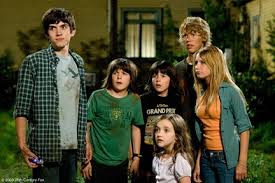

L-R: Tom, Art, Lee, Hannah, Jake, Bethany
1. There is no central protagonist or hero with whom the audience can emotionally invest, although the movie begins from Tom's POV and we are told in dialogue that Tom is the team's leader. Rather the group of kids are promoted as multiple protagonists. And yet they don't transform as protagonists should.


2. But Tom's nature is mostly passive. His goal is often distracted, and Jake takes up the cause. In fact, Jake at times tells Tom what to do. 


3. We are told through action and dialogue that Tom is somewhat of a genius and a mathlete. Early on Tom hacks his school's computer to change his grades, but Tom does not use his skills at math (i.e. higher intelligence) to defeat the aliens. 


4. The actions that prevent the invasion mostly do not originate from Tom (the "brainic,") but come from his proactive cousin Jake, his much younger cousins, twins Art and Lee who master game controllers, his younger sister Hannah who's good at relationships with strangers, and at the very end by the rookie alien (Sparks) who is the one who chases off the invading spaceships. Thus, any emotional investment we make in Tom is diluted by other cast members who often do the heavy lifting and initiate the reversals. The story thirsts for a MacGyver who we can root for.


5. Tom's transformation is sudden at at the very end. From the middle's Moment of Grace we should see Tom struggle with obstructions that slowly transform his attitude, and thus allow him to slowly achieve the goal.


Alien controls Ricky's mind and body

6. The goal is a negative goal...to prevent the aliens from invading the earth. The problem with negative goals is legendary—they are fulfilled at the beginning of the movie, thus movie is over. In the case of AITA, the aliens NEVER invade earth. A positive goal would be to overturn the alien occupation of earth. With a positive goal the audience can see the progress and cheer at every milestone toward the end. But with a negative goal, the audience cannot cheer at any point for there are no milestones as there are clearly evident with positive goals. 


7. The structural staging and turning points are weak (7-14). AITA begins well with a well developed and concise LIFE BEFORE. The INCITING INCIDENT (ideally at 12.5%) is at 17% when the aliens land on the roof of the house and the TV goes "haywire." Shortly there after Tom REJECTS THE JOURNEY to repair the TV dish or defend his siblings or parents from the aliens, whom he meets on the roof. But at 31% into the story, the cross over into Act 2, Tom reasons that the non-adult children (Tom, Jake, Art, Lee, and Hannah) are "the only option, although it is the twins who makes the point that the mind control darts don't work on kids, and it's Jake that concludes: "But we can still fight back."  


8. There may be a Moment of Grace. After that, however, there is not clear Moment of Grace for Tom where he has a revealing awareness of what they're battling (a value that changes their efforts) that is different than what they already know. Although as a gang, Hannah discovers at 54% that Sparks is friendly and that changes her attitude, and eventually everyone else's, and it is Sparks that chases of the invasion. This definitely acts as a MOG but not for the POV character, Tom.


9. There is a weak Act 2 Climax (Near Death or Faux Ending). No one actually is physically near death, but after Nana and Ricky fight and destroy the hall, Stu arrives and reprimands Tom and the kids for destroying the house and sends them upstairs. It's that  that Tom says, "I'm sorry, guys. It's over...an entire fleet of those guys are about to invade." 


Nana Zombie battles with Ricky Zombie

10. The Dark Night of the Soul is all too sort as Hannah, Art, Lee (and Bethany, now) encourage Tom to still be their leader. He agrees with a zoom into his face and a music cue, which establishes a Resurrection Beat. But it's weak because it doesn't come with any NEW revelation that gives them new hope. And it follows with Tom venturing into the basement with Spark's potato gun (not the potato gun that Tom made, but one made by someone smarter, an adolescent alien. No cheers for Tom. )


11. The Final Incident is strong. It's exactly where it should be at 87.5% when the normally small aliens are able to transform into gigantic aliens. 


12. Preparations for the Final Battle and the Final Hand to Hand Combat well occupy the last 12.5% of the movie, except the story and action only partially focuses on Tom. Clearly it was the writers' intent to create an ensemble protagonist, which dilutes our emotional connection to a single personality. 


13. The Act 3 Climax is anything but a climax although it is perfectly situated at 95%. The spaceship fleet arrives and descends to earth. It is distant and just a collection of pretty white lights. The hand-to-hand combat that we might expect is conducted by these distant lights and Spark's small squeaky voice "Retreat. Retreat. The machine is destroyed. We have been outsmarted by the humans." 


14. The Denouement is also perfectly positioned at 97.5% when the adults are clueless about the battle in the backyard and think all the lights in the sky was the meteor shower, and finally Ricky makes a fool of himself at Annie's house, because Tom and Bethany control him from the scrubs. Finally the credits begin with a show reel of Robert Hoffman


15. Deus Ex Machina a la Game Controller.  There was a bit of Deus Ex Machina with the kids manipulating people with the game controllers. As opposed to using human ingenuity. Note the game controllers the kids used were from the aliens, not humans. Thus, the story used electronic gadgetry that was, more improbable than possible. Socrates speaks eloquently about how in stories a probable impossibility is better than an improbable possibility. Of course, there's a fine line between those two options. It's up to the writer's craft to show the depth, cleverness and intelligence of the human species. I thought the movie was missing a great deal of human potential, and while funny at times, it’s improbable that electronic gadgetry is going to save the world. It’s more likely that sacrificial human endeavors using gifts, intuition and values that are inbred in the human DNA is going to save the day. So the game controllers end up being the deus ex machina that drops down out of the sky improbably to save the day. 


AITA's reference to M. Night Shyamala’s  movie Signs and the aliens' weakness in that story of water,  was a weak attempt at giving AITA some gravitas. The gravity of water in 
Signs is the whole idea of "Baptism that saves us" from damnation (1 Peter 3:21)...aliens of a fourth kind. The human element involved in Signs is the Bo's (Abigail Breslin) intuition of putting water glasses around the house because she has a premonition that water is important. [Side Note: the similarity of Bo (Abigail Breslin) in Signs to Hanna (Ashley Boettcher) in AITA, and how Bo discovers the salvation of water, and Hanna discovers the salvation found in her friendship with Sparks.


Of course, Signs is clearly a faith story because Rev. Graham Hess (Mel Gibson) is struggling with a loss of faith. The genesis of Hess's character and the water stems from Shyamalanem’s  Catholic education as a child,  although I am sure he did it unconsciously as few of his other stories make any theological sense. I assert that the simple element of water in a glass (no technology) is more human than a game controller.  It might have helped if Tom were to  reprogram the game controllers (with his math and technology skills) so that his siblings and cousins could operate them to control the aliens, and putting Tom and his human DNA at the behest of the story’s resolution. 


16. No clear oversight of a true and consistently applied Moral Premise.  The Moral Premise of a story is a two-sided statement that explains what the story is about at a motivational level. It assumes that all external, physical action is motivated by internal, moral values. That is, the value motivations of the antagonist and protagonist conflict and create the battle. Often the antagonist's values remain the same or turn to a darker vice, but such vices force the protagonist to change values, and seek something better by the end. In AITA the aliens do not change, except for Spark, but the persistence of the humans, and transformation of Sparks (to see the humans as nice), saves the family and the planet. Thus, Sparks transforms, as does Hannah and the others toward Sparks. But there is no transformation of Tom which aids him (or the others) in defeating the aliens. 

Jake and Tom consider their options
with the potato gun.


Oft times in stories, it's the vice the protagonist embraces at the very beginning of the story, that opens the door for the antagonist to attack at the Inciting Incident.  There's no clear indication that the aliens come as a result of Tom's lame attitude about the vacation. Although, a slightly different script might have portrayed the aliens as a personification of Tom's "lame" attitude, and thus the aliens became a metaphor for changing Tom's attitude. That is the epitome of a vice can repulse a protagonist form the vice toward a more virtuous attitude.  But that is not what happens in AITA. 


Instead, the need for the audience to see Tom's redemption ends up as...


17. Gaslighting the Audience


Another way of looking for the Moral Premise is to ask more specifically, "What could be the virtue and vice conflict in AITA?" and how might they be articulated in a moral premise statement? Or, what transformation is evident in the characters from vice to virtue? There are transformations. 


At the very end Tom tells his father, Stuart, that Father Knows Best ("Dad, let me save you the lecture. You were right and I as wrong," and Tom decides to enjoy fishing with the family. But there is no slow, observable, learning or transformation. Tom's change is sudden with the fixing of the tangled fishing reel (a repeated metaphor motif of the family's situation). 


And there's no logical connection between his father's desire to get Tom away from technology, when in fact it was technology that saved the family and the world. So Stu could not have been right. Stu was in fact wrong. It was the kids' knowledge of technology (and game controllers) that saved the family. By telling Stu he was right, Tom sanitizes the plot, lies to the audience, and patronizes the "family" movie critics. 


Subliminally, audiences are not gullible enough to such a gas pipe (gas lighting, as Jakes makes such the passing reference about Ricky "What a gas pipe.") 


Thus, Tom's sudden transformation at the end rings hollow, and audiences "feel" a cognitive dissonance. It's just not true. Based on the story alone, not reality or natural law, Dad was wrong about technology, Ricky, fixing Ricky's car, the relationship between Ricky and  Bethany, the thermostat, and Tom's guilt at wrecking the hallway. There are times was Stuart and his wife Nina were very aware of what the kids were up to, and were right, but they were ever clueless about the aliens and the battle for what was right.


Based on the first few minutes of the movie, the Moral Premise could have been:

Human technology destroys family relationships; but sanitized human interaction heals relationships.

But that is not what the movie proves. Instead AITA suggests the truth (a false truth) is this:

Human technology destroys family relationships; but alien technology saves it

...or something like that. 

Another theme that might resonate as false with the audience is:

Advanced technology can save the world; but gaslighting can save the family.

You see, at the end, Tom has become like Ricky...the bad boy. Tom is gaslighting his Dad, patronizing Stuart, telling him that Father knows best, when the audience knows just the opposite it true. But the attitude, tone, lighting, music, all other aspects of the Father-Son talk on the steps, give evidence that the filmmakers are gaslighting the audience by sanitizing the ending, and telling a lie.

That's just another reason why AITA failed at the BO.


Thursday, February 4, 2016

Why LITTLE BOY Was a Bomb

LITTLE BOY (2015) PG-13

DIRECTOR: Alejandro Gómex Monteverde
PRODUCER: Leo Severino (Metanoia Films)
EX PRODUCER: Eduardo Verastegui, Sean Wolfington, Mark Burnett, Roma Downey

STARRING
Tom Wilkinson (Fr. Oliver)
Cary-Hioyuki Tagawa (Hashimoto)
Emily Watson (Emma Busbee)
David Henrie (London Busbee)
Kevin James (Dr. Fox)
Jakob Salvati (Pepper Busbee / Little Boy)

(SPOILERS AHEAD)

I am asked now and then to talk more about movies that fail because of a false or misguided moral premise.

So, a couple years back, I girded up my loins and analyzed and blogged about some big MOVIES THAT FAILED. It was hard work, looking at all that money and talent being wasted. Terrible storytelling. Clear, obvious, universal, common sense story rules were just thrown out the window by filmmakers and studios alike... because, it seems, they come up with an ironic hook. But irony has to support the story, not just be ironic for entertainment's sake. Ionic stories (with good hooks) yet without the proper story foundation will always fail.

Tonight, in order to test out a new hearing aid...I've lost a lot of my high frequencies...I turned on our Apple TV, Netflix, and New Releases (for Netflix, not in the theaters). The first movie on the list was Metanoia Films' LITTLE BOY. Metanoia is run by some talented devout, Catholic filmmakers that I've had the opportunity to meet and talk to a few times.  But I had not seen LITTLE BOY, so, Pam and I settled down to watch and listen (as long my new hearing aid worked...and it did.)

As a period piece, the production values on LITTLE BOY are fantastic. The art direction, prop department and carpenters all deserve some sort of award. The photography and editing are eye-popping good.  The supporting actors are wonderful, and the overall direction is tight and purposeful, and who can deny that watching Tom Wilkinson, Emily Watson, David Henrie, and Kevin James is anything but a joy. And Jakob Salvati, as Pepper, the  Little Boy, held his own as the protagonist.
There are scenes that will make you cry...my wife was taken numerous times with heavy tears. The movie is just plain captivating.

But at the end, I was left with this awful empty, contradictory feeling. Why, I wondered? I couldn't put my finger on it for a while. I ran to the computer and checked what I had remembered about the box office being mediocre. BAM!!!  Yes, something was seriously wrong.

With an estimated budget of $20M-$30M (in Mexico no less where things are a lot cheaper to shoot), the U.S. Domestic Box office was a trifle $6.5M (rounding it up) with apparently no International distribution.

Folks, this is horrible. For a movie that has so much going for it in terms of production value, and scene value—there are wonderful sequences with deft parallel editing, scene-after-scene are just fabulously made—why would this film not connect?  First weekend it opened in 1,000 plus theaters and does a modest $3.3M. Not great, but if the movie was really as good as it looks, it would have dropped only 30% by the next week. But it dropped 62.3%. Fatal. Word of mouth was tepid at best. In later weeks it dropped three successive weeks by 50% and in 8-weeks it was history.

ANALYSIS

The reason this movie about Christian faith did not connect, even with it's Christian/Catholic target audience, has everything to do with the Moral Premise and common sense storytelling's black and white rules.

THE STORY, on the surface is about a little boy who is learning about how faith as small as a mustard seed, can movie mountains. In the movie, he tries and sort of succeeds to move a mountain. It's also about the hateful prejudice some Americans showed American Japanese during WWII. The little boy's father is called off to war and Pepper, with the astute help of Fr. Oliver (Wilkinson), passionately and actively pursues an increase in his faith (through good works) so that his father will return from the war safe and sound. THAT IS, THE PHYSICAL GOAL OF THE PROTAGONIST (Pepper / Little Boy)....is TO GET DADDY HOME ALIVE. Making that goal tangible and visible is well executed in the film. Pepper's family lives in a town on the West Coast of California and there are scenes where Pepper holds up his arms toward the setting sun over Japan (which at that moment may be the Rising Sun of Japan), grunting and shaking in a Star Wars'esque effort to morph "Christian faith" into "The Force." The atheistic Mr. Hashimoto challenges Fr. Oliver to stop the charade and protect the boy psychologically. But Fr. Oliver...is having his own crisis of faith, and doesn't know what to tell the kid...because to Fr. Oliver it seems like the kid does have faith (alas, the kid is demonstrating faith in his own selfishness not in God's power to save...so what we have here is really poor understanding of fundamental theology.) Admittedly, the movie makes no attempt to suggest that what Pepper is doing is Christian faith. But neither does the movie define Christian faith, otherwise. So the audience is left to believe what is shown. And what is shown is logically invalid and subliminally the audience figures that out. (BTW: The Coen Brother's HAIL, CAESAR! does a better job of presenting the Gospel.)

Thus, when the first atomic bomb lands on Japan (shortly after one of Pepper's arm shaking episodes aimed at Japan) the town wildly celebrates because they believe that is was Pepper who was responsible. Why? Because his nick name around town is "Little Boy" and the nickname of the atom bomb that was dropped on Hiroshima was "Little Boy."  Immediately thereafter and for solid minute there is great rejoicing. The film suddenly shifts to the somber destruction and the celebration stops. To make things worse, the family hears that Dad is taken as a POW, and then that he is killed. But through mistaken identity, the soldier that is killed is not Dad. And Dad returns home at war's end shell shocked but reunited with family.

IT'S A HORRIBLE MISTAKE for a movie that tries to battle prejudice to turn to celebration the killing of hundreds of thousands of Japanese in the shadow of what the little, smiling and celebrating Pepper believe is "Christian Faith." Even when, moments later, the movie puts on the appropriate somber moral mood for the bomb, a bitter taste is left in the mouth. A scene like that in any film, least of all a purported Christian film, is like a moral sin. It's nearly unforgivable. It's abhorrent. As one commenter on IMBD wrote "Christian Faith Nukes Hiroshima"  Of course the filmmakers don't say that...but (Damn It!) they SHOW it.

As bad as that scene was conceived, it is not what kills the movie...although the movie deserves to die because of it.

What kills the movie is something more subtle and at once obvious. To explain that I have to take a stab at the moral premise....that sentence that should be controlling everything about the story and it's presence on screen.

[NOTE TO FILMMAKERS OF ALL STRIPES: If you understand an apply the moral premise, your films won't go bust, assuming everything else is well done But when you screw this up, money will never save your investment.]

MORAL PREMISES

There are two possible moral premise statements for LITTLE BOY based on the explicit issues portrayed:

Moral Premise A
Racial hatred and lack of faith leads to hatred, separation and death; but
Brotherly love and faith leads to friendship, family and life.

Moral Premise B
Racial hatred and lack of faith leads to Daddy not coming home; but
Brotherly love and faith leads to Daddy coming home.

Moral Premise A would be a good statement if the movie had a protagonist with some goal that related to life and friendship within the community and physical efforts were put to that end.

But LITTLE BOY is about a little boy who wants his father to come back from war. The kid is not motivated to make the town better. 

Having made that clear (I hope)...

All successful stories MUST follow a few simple rules. Let me mention one of the most important:

  1. The inner transformation of values that the protagonist experiences, logically motivates the action that causes the physical transformation.  Psychological Motivation ALWAYS leads Physical Action...and the connection better be logical. 
  2. The protagonist's physical action toward the goal, logically causes the goal to be achieved. The goal cannot be achieved by any other action than that of the protagonist. 
If you need to understand this, take my Storycraft Training Online. There's not the room here.

A story cannot succeed if at the end of the plot, the protagonist steps aside and someone else saves the day. The protagonist must do the hand-to-hand combat, not another less important character. Thus LITTLE BOY fails due to three violations of these Natural Laws of Story Structure.

1. THERE IS NO LOGICAL PHYSICAL CONNECTION BETWEEN PEPPER'S ACTIONS AND GETTING HIS DAD HOME.

There is no direct acton that Pepper takes that remotely effects the return of his dad.  It's as if all though the movie Pepper pursues his goal with various actions, but at the end, a superhero swoops in and rescues Dad. The superhero being the guys on the Manhattan Project...some would say, far from innocent lads. Audiences subliminal are left dissatisfied. The catharsis is cut short and quick, if there's any at all. (Bad word of mouth #1.) - This is similar to the story error Hollywood calls DEUS EX MACHINA — an unexpected power or event saving a seemingly hopeless situation, especially as a contrived plot device in a play or novel. Wikipedia explains Deus Ex Machina well.

2. PEPPER'S LEARNED VIRTUE IS ACTUALLY A VICE

There is a hidden theme in the story that "innocence trumps reality." In other words, as the audience, we want the kid's wishes to come true BECAUSE and only because he's an innocent kid. If an adult acted like Pepper we'd call the character selfish, narcissistic and self-absorbed. Pepper's not wanting his Dad to come home for a selfless noble purpose. This is not A WONDERFUL LIFE where George Bailey's presence in the community benefits the good of all. Yes, we can see that Mom (Emily Watson) is sad and that she's being stalked by the friendly doctor in town (Kevin James). And we recognize that Pepper's older brother is getting in trouble because Dad is gone. BUT NONE OF THOSE have anything to do with Pepper's motivation for wanting his Dad back. That is, Pepper doesn't want Dad back because the Savings and Loan has to be saved for the sake of the town's livelihood. He wants Dad back for himself, alone. And we buy it because the kid is young, and sweet and innocent. But the kid's motivations are not pure, they are filled with vice.  Subliminally, audiences see that. (Bad word of mouth #2.) 

3. THERE'S NO LOGICAL CONNECTION BETWEEN PEPPER'S INNER TRANSFORMATION AND THE OUTER PROGRESS OF RETURNING DAD.

The moral premise also demands that it's the vice or weakness in the protagonist that creates the bad consequences, and that a transformation of that inner value to a virtue or strength will bring about the good consequence. But what does this movie do? Pepper achieves his goal, and we're led to believe in some way that it was his Christian faith that brought his Daddy home. But that's not true and Christians and non-Christians subconsciously know such an idea is fable and heresy. (Bad word of mouth #3.)

And ironically, I'll bet almost no one leaving the theater could explain any of this. It's a feeling, a sense, that something isn't quite right, and quite right they are.

Consequently, Little Boy was a Bomb.

Come on guys and gals out there making movies. READ MY BOOK at least, and try to understand this stuff. I'm not making money off these books, but you could. 


Wednesday, February 12, 2014

Movies That Failed

I have been asked (several times) to give examples of narrative motion pictures that failed at the box office because they lacked a true and consistent moral premise. And whenever I do, I'm astonished that some movies get made with such obvious structural flaws. 

As I watched some of these films I became distressed. The problems are easily avoidable. (I can help folks...make you lots of money... but you gotta listen and follow the rules.)

While a motion picture's box office success can never be attributed to one thing but to a host of accomplishments -- the most bankable attachments, the best acted, best directed, best art-directed, and the best-marketed efforts -- a movie (story) cannot overcome a false or inconsistent moral premise, or a true moral premise that is not consistently imbued into the character's arcs.  At the same time, many films fail for reasons that have nothing to do with the moral premise but rather with bad craft, incomprehensible plots, and wrong or no marketing. But these films had problems at the script level and should never have been greenlighted. Never! All avoidable! And there's a $20 book that will tell them how. 

When motion picture stories are built around false or inconsistent moral premises they do not connect with audiences and fail at the box office.

Discussed, in the order of their release year....

ISHTAR (1987), CITY SLICERS 2 (1994),  CUTTHROAT ISLAND (1995), THE PLEDGE (2001), HURT LOCKER (2008), SEVEN POUNDS (2008), NARNIA: VOYAGE OF THE DAWN TREADER (2010), MARS NEEDS MOMS (2011), THE FIFTH ESTAGE (2013), BURT WONDERSTONE (2013).

Here, also, is also a longer treatment to the failed movie LITTLE BOY.


ISHTAR (1987) B $51M. US $14M. WW N/A. Dir. Elaine May.

Note to Elaine May: I watched the entire movie. My wife wanted to turn it off after 10 minutes. We laughed only during the Keystone cops sequence with the guys in the Hawaiian shirts. Other than that, it was pure professional curiosity (How could anyone, other than a sadist, make this movie?) and discipline that got me through.

For the rest of you, "Ishtar is about two terrible lounge singers, Lyle and Chuck (Beatty and Hoffman), get booked to play a gig in a Moroccan hotel but somehow become pawns in an international power play between the CIA, the Emir of Ishtar, and the rebels trying to overthrow the Emir's regime." (IMBD)
The simplest way to talk about why Ishtar bombed, aside from all the political studio rumors and creative disagreements supposedly between Beatty and May on set, is to describe the obvious structural flaws, of which there are two that are glaring.
 1. The story embraces a few characteristics of the co-protagonists while ignoring others. Successful protagonists are suppose to be imperfect, but at their core are redeemable qualities that attract the audience's compassion. Although Bob Parr (The Incredibles) is "teamwork" challenged, he's a very good Super Hero and Dad. So, we root for him to overcome his fault. We like him because he's humble at heart (his essence), and he really is good at what he does. But Lyle and Chuck are not just bad singers, they're bad songwriters. They are bad romantic partners to their ladies. They're bad dressers. They're bad thinkers, they're stupid beyond understanding. And while they are not evil, the extent of their naivety has no logic or reason. Monty Python was funny because the characters were all savant in one way, but blind in another. The humor rose out of the audience trying to figure out the logic of the setup and discover the gap between savant and stupid. Every Python skit was funny because it was a brilliant mystery that followed very precise rules of reasoning. But Lyle and Chuck's characters had no reasoning, no logic, nothing for the audience to stand firmly on a "get it." There was nothing to "get" because none of it made sense.  
Good protagonists, although they have an imperfection (a deep and serious one) nonetheless get us to like them because they are people we would like to hang out with and get to know. They skilled, funny, good looking, clever, smart, vulnerable...something that makes our heart want to help them. We identify with them as perhaps being like us... and so, we want to help ... ourselves. But Lyle and Chuck are none of these things. In Dumb and Dumber (Carrey and Daniels) we have clever and numerous sight gags, prat falls, and stunts that continuously surprise us. The dialogue isn't that funny, but many of the jokes are genius at setting up the audience about what to expect and then having the impossible but logical occur. There's a logic that says the audience, "What you see is the opposite of what you'd expect, but it's reasonable." But there is absolutely none of that cleverness in Ishtar after the first 3 minutes of watching and listening to Lyle and Chuck try to write a song. It's a 3 minute gag that's not funny after 4 minutes, let alone funny after 100 minutes. We didn't like them, we didn't want to spend more time with them, there was no skill, no cleverness, no like-ability. We were like their women friends and agent who couldn't wait to leave the bar. 
2. The second problem is that the plot was one-big-writer's convenience. One scene did not logically connect to the next, just like their terrible lyrics had no logic behind their "invention."  There was no foreshadowing. CIA agents just showed up in the desert with all sorts of technology. The left-wing girl-friend just showed up in the Ishtar airport. The map just showed up. The gun runners just showed up. Plots work because there is a logical cause & effect connection between scenes, characters, props, settings. If A then B, if B then C, if C then D, etc. For instance, after their first audition with a disbelieving agent, there IS logic and humor in the agent's incredulity. But there's no logic to why the agent would book them even in Morocco or ever see them again. 


CITY SLICKERS II: THE LEGEND OF CURLY'S GOLD (1994)
Budget $40M.  $44M. WW N/A. Dir.  Paul Weiland.

In CITY SLICERS II, shortly after their first western adventure, Mitch Robbins and his friends discover a treasure map that belonged to their late trail guide Curly and set out to discover its secrets.

In comparison, the trios first adventure, CITY SLICKERS I, is the story of Manhattan radio advertising salesman, Mitch Robbins (Billy Crystal), who's in the midst of a mid-life crisis and how he re-discovers his smile. Mitch's wife Barbara (Patricia Wettig) sends Mitch off with his two buddies Phil (Daniel Stern) and Ed (Bruno Kirby) to herd cattle for a week out West. There Mitch rediscovers that his call in life is not chasing women (like his two buddies insist) but being a father and a husband. The movie's moral premise can be sated as:

Fidelity to family leads to happiness;
but
infidelity leads to sadness.

That is a moral premise statement upon which the entire movie is consistently built; and it is a true portrayal of natural law. CITY SLICERS was a huge success grossing $124MM in the US, in 1991.

CITY SLICKERs II comes along with the same cast and the same setting, and same writers, except this time around they're looking for lost gold that was stolen from a stagecoach a hundred years ago. They rationalize that the gold belongs to whoever finds it, and Mitch believes it's okay to lie to his wife about being at a radio convention in Las Vegas. It's clear, however, that the gold belongs to others. And because in the end they find the gold everyone lives happily ever after. Now, the moral premise can be stated as:

Not pursuing illicit wealth leads to sadness;
but
 obtaining illicit wealth leads to happiness.

Clearly that is an invalid moral premise which falsely portrays natural law, and CITY SLICKERS II only grossed $30MM.

Conclusion: False moral premise.


CUTTHROAT ISLAND (1995)
Budget $95M. US $11M.  WW $18M.  Dir.  Renny Harlin starring Geena Davis
A female pirate and her companion race against their rivals to find a hidden island that contains a fabulous treasure.
I've always appreciated Geena Davis' guts for being feminine and at once taking on the stunts that usually only guys do. And it seems that she does a lot of her own stunts. If you want to see a gutsy woman with the ability to be sexy and get in a bloody fist-fight at once, with harrowing stunt every 7 minutes, this is your movie. It will not disappoint on that level. It's the swashbuckler's swashbuckler movie. The photography by Peter Levy is spectacular (shot in Malta and Thailand), and the orchestration by John Debney and the London Symphony is right up there with John Williams's best. 
Many are still wondering how such an over-the-top enterprise have bombed so badly at the box office.  There is a moral premise angle on this movie, but there are some other reasons. Recall that while the LACK of a true and consistent moral premise can kill a good film, the PRESENCE of a true and consistent moral premise will not guarantee it's box office success. In this case I think it is all of the above.
Why did this film bomb? 
1. Some have suggested there marketing budget and the release schedule were against it.  Perhaps, but there are a slew of worldwide distributors attached and MGM handled the domestic theatrical release. However, if everything else was up to par, the film would have had legs. 
2. Direction, Acting, and physical training were subpar. Renny Harlin's direction was spotty. There are lines that are delivered as if it was a table read, without conviction and flat. Harlin's direction prowess may have been in working with his practical effects team, which was astonishing, even if some effects were composited. It was also evident that Miss Davis's fitness for some of the physical requirements (leaping up onto the ship's rail) were tough for her. In short he ran and leaped awkwardly. But I don't think this or some of the lame lines  killed the movie, although they didn't help.
3. This movie was not about anything important or true. That is, the movie really has no moral premise. It was fun and games for the actors, but no one cared for a moment whether or not the story was about anything noble or meaningful. The stash of gold the good pirates and the bad pirates are after  is clearly the booty from other pirating adventures. And the disposition of the gold had no noble end. The ending reminded me of the failed CITY SLICKERS: SEARCH FOR CURLY'S GOLD. The gold belonged to someone else; and in the end Captain Moran (Davis) and her crew decide to go right on pirating...that is, plundering other ships to add to their loot. If there is a moral premise to this film it's:
Greed leads to dangers; but
More greed leads to freedom to be more greedy.

Yes, I'm being factious. But I'm not sure the movie was about much else. 

It is possible that this film is a text book example that to audiences movies are suppose to mean something, and when they don't mean anything, or when they try to mean something that isn't universally true, they bomb.

THE PLEDGE (2001)
Budget $45M. US $20M. WW N/A. Dir.  Sean Penn.

A retiring police chief, Jerry Black (Jack Nicholson) pledges to catch the killer of a young child. The film also costars (in mostly cameo roles) Helen Mirren, Tom Noonan, Benicio Del Toro, Michael O'Keefe, Vanessa Redgrave, Mickey Rourke, Sam Shepard, and Patricia Clarkson. HOW COULD YOU GO WRONG?

But here is what's wrong with the movie. Although the killer is killed and no doubt meets his judgment, he dies in a freak vehicle accident just minutes before falling into a trap set by Jerry, Jerry doesn't know the killer dies. So, in a continuing and impossible effort to find the man, who is dead, Jerry drinks himself insane. Thus, the moral premise could be constructed this way:


Child abuse and murder lead to a quick end in the fires of hell; but
Keeping your word to find justice leads to drunken insanity. 

You're right, the virtues and vices are not opposites, and neither is the consequence. That's because this story was made on an idea that is without a good foundation in reality.

If we attempt to construct a moral premise that COULD have been used for this story it may be:

Child abuse and murder lead to a quick end in the fires of hell; but
Protecting children from an abuser and murdered leads to justice. 

Had Jerry and the killer been pitted against each other in a cat and mouse game, and had Jerry some how, even inadvertently, been responsible for the killer's just death or imprisoned, this latter moral premise could have saved the movie.

Conclusion: False moral premise, inconsistency with how a good moral premise should apply to the film's characters and plot.

A deeper explanation can be found here: http://moralpremise.blogspot.com/2010/08/all-star-cast-false-moral-premise-sink.html

HURT LOCKER (Oct, 2008)
Budget $15M. US $16M. WW $19M. OSCARS: 6 of 9 Noms. Dir.  Kathryn Bigelow

During the Iraq War, a Sergeant recently assigned to an army bomb squad is put at odds with his squad mates due to his maverick way of handling his work. This is a movie that won six of its nine 2009 Academy Award nominations, including Best Original Screenplay, Best Direction, and Best Picture. But it did not resonate with general audiences, doing only $12.6 MM at the box office ($11 MM budget). Why would such a powerful movie in many respects fail to garner a large audience?

The plot of the movie and the character arcs have a true moral premise significantly portrayed by the characters; it is:  

Demanding arrogance leads to animosity and hatred; but
Competent teamwork leads to respect and honor.

But to connect that true moral premise must connect with audiences consistently through the various story elements and characters. Yet, the movie begins with this on-screen quote:

The Rush of a Battle is often a potent and lethal addiction, for war is a drug.

And the movie ends with our main character not changing but returning to duty in Iraq rather than being home with his family—-he's addicted to war and cannot function at home. But that is not what the moral premise of the story reveals. Thus, there's a disconnect.

There is also an issue with the filmmaker's identification of a protagonist, whom they think is SGT. Williams James (JEREMY RENNER). But protagonists change and James doesn't. He's the same at the beginning as he is at the end. Instead he's the antagonist, who often does not change but forces the protagonist to change, which in this case is Sgt. J.T. Sanborn (ANTHONY MACKIE). It is Sanborn that arcs from animosity and hatred to respect and honor. And that confuses the audience.

Conclusion: True moral premise but inconsistent application to characters and plot, confusing the audience.

A longer discussion of HURT LOCKER can be found here: http://moralpremise.blogspot.com/search/label/Hurt%20Locker

SEVEN POUNDS (Dec, 2008)
B $55M. US $70M.  WW: $165M. Dir. Gabriele Muccino.

A man, Tim Thomas (Will Smith), with a fateful secret embarks on an extraordinary journey of redemption by forever changing the lives of seven strangers. That's how the producers want you to understand this movie. The secret is that Tim caused an automotive accident that killed seven people including his wife who was the passenger in his car. Somehow Tim, as the only survivor, avoids going to prison for manslaughter--a story beat the movie never deals with.

Tim goal is to find seven people who are in life-threatening situations due to illnesses that cannot be cured, and give them something of himself so they can live. He donates bone marrow, a lung, a kidney, a liver, and his beach house to give new life to others. Then he arranges to donate his final gifts--his corneas and his heart, which ironically goes to the young woman with a fatal heart condition that he has fallen in love with. To consummate his final donations he commits suicide in such a way that his organs can be quickly harvested and transplanted.

The moral premise could be stated like this:

Hating self leads to suicide; but
Loving others (also) leads to suicide.

The movie would have worked better as a tragedy, but the producers try to make out Tim's ultimate sacrifice (of suicide) as redemptive, and self-hatred can never be redemptive.

Conclusion: False moral premise, it is contrary to how 99% of humanity is wired, and the movie (for a Will Smith vehicle) fails at the box office.

NARNIA: VOYAGE OF THE DAWN TREADER (2010)
B $115M. US $104M.  WW $416M. Dir.  Michael Apted.

Based on C.S. Lewis popular youth novels, Lucy and Edmund Pevensie return to Narnia with their cousin Eustace where they meet up with Prince Caspian for a trip across the sea aboard the royal ship The Dawn Treader. Along the way they encounter dragons, dwarves, merfolk, and a band of lost warriors before reaching the edge of the world.

So, what is the moral premise for this Christian allegory?  Well....I have no idea, at least not a single moral premise that focuses the actions of the many protagonists or a single antagonist, which can't be identified. In terms of a conflict of values which is the basis of a moral premise, there are many: Greedy vs. Generosity (Eustace); Pride vs. Humility (Susan); and then hints of issues with loyalty and being valiant. King Caspian wans to find the seven swords but there doesn't seem to be any consequence or stake if the swords are not found, and there's no urgency in the task. Thus, nothing is focused. All of the children seem to have different goals, but not coalesced under a single value. And if there's a single antagonist that obstructs the various goals, it is not identified not does it make clear what it wants. Instead there is a spell, black smoke, a dragon

CONCLUSION: While we have a high moral tale that hits a lot of good notes, there is nothing singular around which to unify the story, and there's no clear protagonist or antagonist with an agenda. This leaves the movie with a lackluster box office performance and obstructs it's true potential.


MARS NEEDS MOMS (2011)
B $175M. US $21M.  WW $39M. Dir.  Simon Wells.

A young boy named Milo gains a deeper appreciation for his mom after Martians come to Earth to take her away. On Mars the boy finds that only females run the show and the men are all castaways. There are no families, just robots that require the death of a real Earth mother, know anything about discipline and following rules. 

The box office disaster of this movie was made all the more egregious by the decision to use 3D Motion Capture, which elevated the short 80 min family film into the stratosphere of a budget. But the story did not have a large following, although it was based on a book by the same name. 

Here are some of the reasons why this movie bombed. I'll save the moral premise, story structure for the last bullet point. 
  1. What 10-12 year old boy wants to go see a movie about mom? He'd be the laughing stock of his friends.
  2. The slow economy in 2011 prevented many families from taking their whole family to new released movie unless it's something very big. MNM was hardly known.
  3. A mother's life being threatened may be too scary for little kids. MNM is PG.
  4. The frequent homage to the 60s and the hippies would be lost on the target audience of kids, and very benign to the parents of those kids, who would not have remembered the time either. It's the grandparents that lived through the 60s.
STORY STRUCTURE PROBLEMS
A story's moral premise and character arcs are tied closely together. We see the vice and virtue of the moral premise, and the physical consequences through the decisions that the character's make and the natural law consequences. The character that audiences gravitate toward and identify with, is the protagonist. As the protagonist makes the major moral decisions that turns the story one way and then another, audiences will follow the natural law consequences and see what happens. When structured right, the audience subliminally understands what the story is really about.   Assuming the consequences on a physical level agree with the common understanding of natural law, audiences will embrace the movie and the characters,... especially the main character. 
As I said, audiences look first to the protagonist for moral decisions and consequences. Audiences naturally gravitate and try to identify with the protagonist and root for him or her to make the decisions that will send us on a great adventure and learning. Those decisions and arcs describe in an existential way what the story is really about.   
So, how do you identify the protagonist? There are several ways that the audience uses to naturally identify the protagonist. Usually ALL these things need to be true for the protagonist, or mostly so, if the movie is to be a success. The protagonist is:
  1. The character who is on the screen the most.
  2. The character that demonstrates a unrelenting passion for the main goal.
  3. The character who's name or essence is found in the movie title.
  4. The character who makes the moral decisions that changes the course of the story at turning pints like the Act 1/2 Break. Decisions cannot be made by others or happenstance.
  5. The character that changes the most internally thus empowering the outward journey toward success. 
But here is what happens in Mars Needs Moms:
  1. Milo is on screen the most (fulfilled)
  2. Milo demonstrates an unrelenting passion for the main goal (fulfilled)
  3. Mom's name is in the title. But she is unconscious and off screen 95% of the movie, and she makes no decisions that change the direction of the movie. From the title we have no idea the story is about a young boy. 
  4. Milo does not make any decisions at any turning point that changes the direction of the movie. He does not even decide to go to Mars. His trip is happenstance. Gribbles and Ki, who are established as secondary characters, make all the turning point decisions (along with the antagonist, The Supervisor). Milo simply listens and reacts; he is not active. He follows directions. For example, at the perfectly placed Act 1/2 break Milo does enter a special world of where the Martian's live; and his goal is clear and passionate: He wants to rescue his mother. But this threshold crossing is NOT Milo's decision. It is Gribble's, who tricks Milo to take the lift to the Martian's living quarters (underground)and make the journey to rescue his mom. But Gribble's motivations are not in step with Milo, and Milo is a pawn. 
  5. Milo does not change after the 8 minute mark, which is his Moment of Grace (MOG). The MOG should be at the movie's mid-point (39.5 min). And at that place there is a moment where Milo realizes that his mother loves him. It's staged and cut like a Moment of Grace complete with music cue. Up to that moment you might consider that Milo is motivated out of selfish survival needs, not because he loves his mother. The problem is that this moment does not change Milo's decision making process or behavior other than to break away at a run -- and running vs. non-running is not Milo's inner problem. Milo's inner problem, "wishing he didn't have a mom" was solved 8 minutes into the movie, even before the Inciting Incident. This has the effect of a Moment of Grace and his behavior changes. But it is not the pivot pint upon which the plot is based, and it should be. Thus, Milo internal arc is flat. He does not change from 8 minutes to 81 minutes. 
  6. One last thing: Usually the antagonistic character, in this case The Supervisor on Mars, is the agent that instigates the Inciting incident, which confronts the protagonist out of the protagonist's vice or weakness of the moral premise. But while the Inciting Incident is totally initiated by The Supervisor, it has NOTHING to do with Milo's rebellious attitude. Good inciting incidents should be a call to the protagonist to change, which is first rejects, goes on a journey, almost dies, and finally brings by the elixir of truth.
Some of the results of the above problems become evident when the other characters take time to hit beats in their story line that do agree with the moral premise. Ki for instance is learning about the "love thing" and the true concept of parenting. She doesn't hate parents to begin with as The Supervisor does, but he embraces the new concept of two parents, and ends up with Gribbles who seem to be on their way back to Mars to have a family. Gribbles also arcs from disrespecting family to embracing it. At the beginning he would rather play games and watch movies like an adolescent. And he shirks his responsibility to do the right thing. At 67% in to the movie he changes, when he decides to help Milo rescue his mother and not keep rejecting the journey that will threaten Gibble's life.  
Indeed, I think Gribbles should have been made the protagonist. He has a clear arc, he has a lot of screen time, and he's interesting. But he's not introduced until 25% into the movie, far too late for the protagonist to be introduced. 
The Martians also have a story arc that follows the moral premise. 
THE MORAL PREMISE 
I think the moral premise for this story is true, but it is not consistently applied, especially in the protagonist's arc.
Disrespecting (and hating) your parents, leads to captivity and trauma; but
Respecting (and loving) your parents, leads to freedom and peace.

Essentially MARS NEEDS MOMS suffers from a lack of a roller coaster arc for the protagonist, which would have allowed the audience to identify and root for the achievement of his goal. The movie would have done better had the title been GRIBBLES and the whole story begin with him on Mars trying to find meaning to his captive life.

THE FIFTH ESTATE (2013)
Budget $28M. US $3.3M.  WW N/A. Dir. Bill Condon.

A longer analysis of THE FIFTH ESTATE can be found HERE. What follows is a summary.

A dramatic thriller based on real events that reveals the quest by super-hacker Julian Assange, to "expose the deceptions and corruptions of power that turned an Internet upstart into the 21st century's most fiercely debated organization" (producer's quote). The movie is based primarily on a book about the events by Daniel Berg, Julian Assange's compatriot who turned on Assange at the end.

There are two obvious reasons why this movie was a box office floop, in spite of the stellar production values backed by two studio powers (Dreamworks and Touchstone's Disney).  A third reason is given in the longer analysis.

1. FALSE MORAL PREMISE

This is the moral premise that the film espouses:

Keeping any secrets leads to dystopian corruption and tyranny; but
Revealing all secrets leads to utopian justice and freedom.

Although the movie portrays Assange as a manipulative megalomanic, ["a psychopathological disorder characterized by delusional fantasies or power, relevance,  or omnipotence  characterized by an inflated sense of self-esteem and overestimation of power.(1)], the movie also elevates Assange as a noble and tragic savior that we should all emulate. 

This is made clear in a final reflective dialogue scene between Daniel Berg and Guardian reporter Nick Davies, that attempts to explain why Assange, although a manipulative liar, is a hero because his end purpose was justice (under his own terms). (See longer analysis for the dialogue). 

This ending THE FIFTH ESTATE dialogue suggests the possibility of a good (although manipulative), utopia, which conveniently avoids the presence of manipulative, dystopian evil. It also excuses Assange's tyranny over those that work for him, as if such manipulation is good if one is sincere and committed. (I understand that love covers a multitude of sins, but I've never heard that sincerity does the same thing.)  Thus, Assange comes off like a I.T. Hitler... who believes that sincerity and commitment are virtues that excuse all manner of theft and lies. Why? Because the the people Assange and others were stealing from have no right to possess what they have, and Assange's lies will uncover bigger lies. Yet, the general public is aware (at least subliminally) that the ends never justify the means, and that secrets, when revealed in the raw, are easily misinterpreted and can be used for evil purposes. They are also aware that when theft is justified by each individual for their own desires, the consequence is utter chaos and anarchy, not peace and goodness. Assange's logic is no different than that of an evil tyrant who Assange is trying to take down

The movie also makes clear that anyone that has a lot of something (secret information or secret money) is corrupt and evil -- an false generalization. Possessions are relative. A poor person in the Chicago slums would be considered rich by standards in some other parts of the world. And audiences recognize this truth, even if they are jealous of their neighbor's stuff. 

Each  member of the audience knows they have secrets that if revealed would destroy them and their loved ones. This is not so much because of wrong actions but because the debates that occur in their heads (or in parliament) if heard in the raw, would be misconstrued, and manipulated for wrong-headed or misplaced purposes. Privately in our heads, in our homes with family members, and honest debate should allow us to consider all alternatives before acting. The cables released between government officials, while some were damaging and uncomfortable, nonetheless also reflect this debate in search of truth. The debate (even in its extreme propositions) should not be constructed as wrong, but as good. It's the outcome of the debate, the actions that should be judged.  While all actions are not good, all secrets are not evil. 

But the film portrays the opposing moral premise which rings false, and thus the audience turns away. 


2. PROTAGONIST CONFUSION. Although the filmmaker's protagonist (Assange) is passionate, active, and has a physical goal (good things for a protagonist to have), the goal is not universally accepted as a noble one. And although he is imperfect (something all protagonist should be at the beginning of even a redemptive film), he doubles down and embraces his imperfections even more, thus leaving us with a tragedy.  Tragedies never do good at the box office because people want redemption...for their own lives...as exampled in the protagonist.

Berg's character, however, does change (an aspect of a successful protagonist), and we are drawn to sympathize with Berg, and root for him to put limits on Assange. But Berg is not a proactive or even passionate character searching for a goal we can root for.  He is totally reactive to Assange and to Davies. Thus, both characters violate clear rules of acceptable protagonists, and the target audience rejects them both as unlikeable.

CONCLUSION: False moral premise, protagonist confusion.


THE INCREDIBLE BURT WONDERSTONE (March 2013)
B $30M. US $24M. WW $24M. Dir. Don Scardino.

When Las Vegas superstar magicians, Burt Wonderstone's and Anton Marvelton's act and their 30-year friendship turn stale, a sadistic street showman puts them out of business. Wonderstone's chance meeting with his childhood hero at a retirement center allows him to recover his love of magic and recover his audience.

An all star cast (Steve Carell, Steve Buschemi, Olivia Wilde, Alan Arkin, and Jim Carrey) could not save this disaster of a story due to several fundamental story problems:

a. There is nothing redeeming or noble about the protagonist (Burt Wonderstone played by Steve Carell) until 60 minutes into the 100 minute story. In short we can't like him or root for him, until we've emotionally left the theater. We like him from about 60 minutes to 90 minutes, but at the end we again "wonder" why his character is redeemable. 

b. What happens at 60 minutes in is essentially a moment of grace, but structurally it's the first turning point where the protagonist makes a decision that changes the story's direction. Thus it's more like the Act 1 Climax...30 pages too late, and even if it was a Moment of Grace, it'd be 10 minutes late.  While Burt's goal is clear early on (reinvent his act and make it entertaining again...supposedly, the act has not changed in 30 years), he does not embrace this need (or goal) until the 60 minute mark....way too late...and well after the audience dislikes the megalomanic character. It's fine to start off with an arrogant character, but no later than 25% into the picture we need to have some hope that he can change. About mid point (50 minutes) into the story my wife turned to me and said, "I don't like this."

c. The antagonist, a sadistic street performer (Steve Gray, played by Jim Carey), begins attracting larger crowds that Burt and Anton, and thus creates pressure on Burt and Anton to fix their show. But Gray is not (in story structure) a real antagonist, even though there's some direct competition at a party late in the movie. The reason is that Gray is not doing magic, illusions or slight-of-hand, but catering to the macabre, grotesque tastes of what would normally be an alternative audience.

The filmmaker's assumption that Wonderstone's audience and Gray's audience are the same demographic is wrongheaded and the movie audience subliminally won't buy the incongruity nor the filmmaker's apparent disrespect for the movie audience's emotional attraction to a character. When Wonderstone is at his best he loves life and his audience. But, Gray clearly hates life and demeans his audience.

The real antagonist is Wonderstone's megalomanic fame and his consequential lost love for magic and entertainment. That is, in terms of story structure, Wonderstone and Gray are not opposites, and Gray's antics would naturally never disrupt Wonderstone if Wonderstone had an act that created wonder. The only wonder involved is on the part of the audience toward the filmmakers.

d. The above three problems shows a general disrespect by the filmmakers toward the intelligence of their audience's expectations of emotionally engaging with the characters, rooting for them, or understanding what makes a story. And if that wasn't enough, the final trick that Burt and Anton come up with, to rejuvenate their act, is dramatically disrespectful to all audiences. At first blush, the trick sounds wonderful.... make their audience disappear. But the way they do it demonstrates disrespect of any audience in three ways: (a) Burt, Anton and their crew threaten the lives of their audience by mass drugging them with a inhalant causing the audience to pass out; (b) the crews carry, drag, and toss the bodies as if they were sacks of trash; (c) the filmmakers somehow think that treating people with such arrogant disrespect is funny.

e. The above conspires (no doubt inadvertently by the filmmakers) to SHOW us that Burt really has not lost any of his arrogance toward his audience. That is, Burt's arc is not just late, but it reverses. Although the Wonderstone character's surface nature changes from a man of harsh and belligerent arrogance to one of kindness and humility, his outward actions reveal no real change. He still highly disrespects his audience.

Thus, the moral premise of this film can be summarized like this:

Disrespecting your audience through a stale show and belligerent arrogance
 leads to a cancelled act; but
Disrespecting your audience through dangerous invention and kindness
leads to renewed popularity.