Showing posts with label Will Smith. Show all posts

Wednesday, November 14, 2018

F16 Moments - Writing Exciting Scene-to-Scene Movies

Things of Value Come in Threes

1. Years ago, I was in a meeting with Will Smith and a few others breaking a story, yet to be made. We were at somewhat of an impasse about a scene when Will gets up and in his animated way pitches the scene something like this:
Naw! That's not how it needs to go down. Imagine instead that the doors to a big warehouse slowly open, and we hear a might roar of a jet engine, and smoke pours out of the doors, and out of the smoke rolls this monstrous F16 Jet fighter, and it comes down this alley, it's wings almost scrapping the brick walls either side, and it turns onto this boulevard,  and then it sits there at the end of this wide road, revving it's engines. It's vibrating something awesome, wanting to take off, and suddenly it gets the okay, and it begins it's roll. And the camera pulls back, and his F16 jet is on Broadway of all places. And it roars down Broadway, fire flying out it's ass, and suddenly the pilot pops the afterburner and that baby jacks up on it's hinny, and catapults into the sky and disappears. Now, that would be cool!
I spoke up.
Ah, Will. A jet couldn't take off down Broadway because of all the lights, and wires crossing the road. You would be a helicopter, a big one of course, but a jet could never do it.
Will looked at me.
No, Stan,  you don't get it. A helicopter is boring. A jet is cool and exciting and L O U D! Forget the wires, it would be a very cool scene to see that jet screaming along in front of those theaters, flashing lights on the marquees, and buildings, and then zoom up into the sky.
It took a minute, but then I realized he was right. I shut up.

2. Yesterday an acquaintance wrote me:
Have you ever read about how Walt Disney used to work with his story crew? They started with a pre-existing story and Walt asked them to come up with entertaining moments. Then they strung them together.
3. Another successful producer was David O. Selznick (GONE WITH THE WIND). Shortly after he released GWTW, he bought the rights to Scarlet Lily, a book by Edward Murphy that I wrote about yesterday on this blog. I'm reading the book with the intent of discovering what Selznick saw in it. I'm halfway through and just read this morning the Moment of Grace scene that totally changes the story's direction for our harlot protagonist, Mary of Magdala. But what has captured my attention is how each chapter is a single scene with a dramatic profile—they are moments, each worthy of remembrance. It goes back to what Will and Disney were saying: Put the story together with a tight sequence of memorable scenes and moments.

But What About Structure?

But a sequence of memorable scenes alone don't a story make, but Will Smith, Disney and Selznick are probably on to something.

The acquaintance that wrote me about Disney also said that there was a tendency of the Disney storywriters (when Walt was out of the room) to string moments together without a clear story or plot. Movie Moment

I'm meeting this week with a screenwriter on a couple of his scripts, and we're going to do this...well, I'm going to suggest he do this....D. are you reading this?

1. Take the Story Diamond and divide the story into 8 short movies or sequences. See my blog post on The Sequence Approach.

2. Conceive of each sequence has building to an exciting movie moment that coincides with the 8 Pinch Points or Turning Points that climaxes each sequence. Make each moment exciting, full of tension, and conflict. If you can't think of such a sequence that ends in such a memorable moment, for the sake of your audience CHANGE YOUR STORY!

3. Ensure that the first 7 pinch points or turning points end with the protagonist's failure to achieve the goal he or she had pursued in that sequence, but opens a door for an escalating challenge in the next sequence. If the movie is redemptive, the 8th "point" is the charm and success is achieved. If the movie is tragic, the 8th "point" is the protagonist's final defeat. (Remember that even in a redemptive movie there is likely an antagonist that has a tragic arc, so you can write a story that has your protagonist succeed and your antagonist defeated (ala DIE HARD).

4. In every other aspect follow the Moral Premise.

In summary:
 Every sequence ends with an "F16 popping the afterburners down Broadway." 

Wednesday, October 24, 2018

Will Smith Mentors His Brother-in-Law, Caleeb Pinkett

I guess I'm posting the YouTube video below, because there is a half-second mention in it of me and The Moral Premise.

But there are two important lessons this video conveys that have nothing to do with The Moral Premise.

1. Breaking into the film-industry is not easy, even if you're Will Smith's brother-in-law. Notice the metaphors Caleeb describes. They're apropos.

2. Getting your story made into a movie in Hollywood is hard work, and very unlikely, even if you're Will Smith or his brother-in-law.

Now and then I'll have someone approach me who has heard that I worked with Will on a number of projects, and these folk ask (and sometimes beg) me to pitch their idea to Will. (Sorry, folks it doesn't work like that.)  What these dear souls don't realize is that even Will Smith can't get his projects made. And if Will Smith can't, why would anyone else that knows someone, who knows someone, who once road in a Taxi that Will rode in years earlier, be able to get it made? You might read that sentence again.

That's why I keep suggesting to such dear souls: "Make the movie yourself."

The story and script that Caleeb and Will mention in this video, conceived and written by Caleeb, "The Redemption of Cain," is more than familiar to me and some of my story students who were privileged enough to have Caleeb pitch the developed story to them during a visit to the set of AFTER EARTH. But, as good as Caleeb's story is, and even through Will is attached to star in it, they've yet to get it made. That is the reality of Hollywood. And anyone wanting to get into the film industry needs to understand how hard it is. Caleeb in this video explains quite well just how hard it is. It's a good lessons to all those who are NOT Will Smith's brother-in-law. Can I see hands?

Blessings to all.

Stan

Monday, December 22, 2014

ANNIE - Go See It!

ANNIE (2014)
An Overbrook Production
Producers: WILL SMITH, JADA PINKETT SMITH, CALEEB PINKETT, JAMES LASSITER

Directed by WILL GLUCK
Screenplay by WILL GLUCK and ALINE BROSH MCKENNA

Starring
JAMIE FOXX (Will Stacks)
QUVENZHANE WALLIS (Annie)
ROSE BYRNE (Grace)
BOBBY CANNAVALE (Guy)
CAMERON DIAZ (Hannigan)


Pam and I saw ANNIE (PG) this afternoon and loved it. It is not only faithful to the story and the spirit of the original films, but with adds some insightful lines and good kicks.

Of course what I liked the best was the consistency of the moral premise portrayed in the various character arcs, the casting, the art direction, and the songs.

The title song, "Opportunity" by Sia, which Quvenzhané sings in Act 3, is a great example of taking the moral premise and putting it in lyrics. Watch the video embedded here, with the lyrics written out below, although this will not be as meaningful until you see the movie, so...

STOP! GO SEE THE MOVIE FIRST...TAKE THE WHOLE FAMILY. 
Then come back here...I'll save a place for you in line.


OPPORTUNITY, by Sia, performed by Quvenzhané Wallis 
Under the glow of the very bright lights
I turn my face towards the warm night sky
And I...I'm not afraid of a thousand eyes [the stars]
When they're above Five hundred smiles [the stars of hope seem far away]
Oh, I used to think (she used to)
What wouldn't I give (what wouldn't she give)
For a Moment like this.
This Moment, this gift
Now look at me and this opportunity
It's standing right in front of me
But one thing I know it's only part luck, and so
I'm putting on my best show
Under the spot light I'm starting my life
Big dreams becoming real tonight
So look at me & this Opportunity
You're witnessing my Moment
You see
I find myself here & it's time
This is real and it's a Gold...mine
I'm not afraid to fly
When it's above five-hundred smiles
I used to think (she used to think)
What I wouldn't give (what wouldn't she give)
For a Moment like this
This Moment, this Gift.
Now look at me and this opportunity
It's standing right in front of me
But one thing I know
It's only part luck
I'm putting on my best show
Under the spotlight I"m starting my life
Big dreams becoming real tonight
So look at me and this opportunity
You're witnessing my Moment, you see
My big opportunity
I won't waste it
I Guarantee

Those of you familiar with the Moral Premise concept know that it's a simple concept that universally relates opposing motivational values and their natural law consequences. Humans cannot escape these, and so when fictional characters reflect the organic and naturally true relationships (between values and consequences) the audience is sure to identify with the characters on a deep, moral level. This enhances the box office.

ANNIE (2014) is thus an elegant expression of the adage:
Luck is when preparation meets opportunity.
Little orphan Annie exudes optimism and hope although she has every reason (it would seem) to be pessimistic and despaired, like some of the other characters. But in Act 1 we notice how her optimism prepares her for the opportunity. As the song says "It's only part luck" and so when the opportunity stands in front of her, she puts on her best show.  (Watch for this in other characters, too.)

There are some good permutations of the moral premise that I'll expand on later, but for now try this:

Pessimism leads to rejection of your Moment (of Grace) 
and squandering what's in front of you; but
Optimism leads to the acceptance of your Moment (of Grace) 
and not wasting a golden opportunity.  

Now the consistent application of this concept is played out in ALL the subplots and even in one character's name. It's beautiful to see. But I'll not spoil it now by blogging all the beats and metaphors, and reinforcements.  Go see the movie, and after the DVD comes out (or if Overbrook wants to get me a copy sooner....hint!) I'll be PREPARED.

I will blog on this later, but I don't want to spoil it by telling you. Let the movie SHOW YOU. 

Friday, March 15, 2013

Will Smith and James Lassiter TV Script Contest


I just found out about this. Not much time left. Yet, regardless, some nice insight about writing for TV or movies.
http://www.scriptwritercontest.com/

Sunday, June 3, 2012

HITCH - A Moral Premise Analysis


Director: Andy Tennant
Writer: Kevin Bisch
Budget: 70MM, Domestic Gross 177MM
Gene: Romantic Comedy
LogLine: A secretive "date doctor," Hitch, struggles to find his game when smitten by a gossip columnist, Sara.

WILL SMITH - Alex 'Hitch" Hitchens
EVA MENDES - Sara Melas
KEVIN JAMES - Albert Brennaman
AMBER VALLETTA - Allegra Cole
JULIE ANN EMERY - Casey Sedgewick (Sara's friend)
ADAM ARKIN - Max (Sara's boss)

As in road stories and buddy movies, Romantic Comedies match-up a man and a woman as both protagonist (of their own story) and antagonist to the other's story. Usually one or the other ends up being the lead, but in HITCH things are well matched. In the interest of space and time, this analysis will focus mostly on Hitch and the 13 MAJOR BEATS discussed elsewhere in this blog and various other books, including The Moral Premise.

1. Life Before:
We begin with Hitch lecturing us on the principles behind male-female relationships. He's telling us the secrets of his success as a date doctor.

And, we discover that Hitch and Sara are happily single and that they have their reasons. Notice that neither of them think they WANT a significant other in their lives. Yet, we can see they both do need someone in their lives. They're incomplete. Notice also that their jobs are as opposed to any union as are their personalities. She tells secrets (she's a gossip columnist with a name to promote), he keeps secrets (he's a date doctor with no name). This sets up the Nicomachean moral premise for HITCH:

(The vice) Keeping too many secrets or exposing too many secrets
leads to
(The negative consequence) distrust and isolation; but
(The virtue) Sharing the truth in confidence
leads to
(the positive consequence) trust and companionship.

Hitch lives at the absence of the virtue (he doesn't share much of anything). Sara lives at the excess of the virtue (she shares everything). She spills the beans; he hides them. She thinks men hate women, he only works with men who love women. Hitch is trying to get men and women together, Sara is excited about helping them to split up.

Notice also during this sequence of Act 1A it's made clear to us that they are two people that have "convinced" themselves that they don't need another. Hitch is wrapped up in helping guys succeed with girls while telling his brother-in-law that such relationships are not "meant of everybody." And Sara makes it clear "I don't have time for a boyfriend."

2. Inciting Incident
Hitch discovers is challenged to hit on a girl in a bar. He goes home without her, however.  (Ideal 14 min. Actual 12)

3. Hitch Rejects the Journey...
...of going after a girl (the journey he's called to at 2.) He embraces the idea that with "no guile, and no game, there's no girl." But we sense he's unhappy about that. Yet he helps Albert, who is born without a game. (At 19 min Hitch decides to help Albert on his journey, and in that process we hear arguments that suggest Hitch should go on a journey for himself. One such line that reflects that happened at the Inciting Incident is Albert telling Hitch, "You know what it's like getting up every morning feeling hopeless?"

As soon as Hitch gets Albert to first base (and a first date with Allegra) we can now introduce Sara to Hitch. It begins at 26 minutes when Hitch notices Sara in the bar.

4. Act 1 Climax. 
Hitch crosses the bar (foreshadowing the threshold of the following scene) and approaches Sara with drinks in hand, only to be beaten by an amateur pickup artist that Hitch confronts and dismisses. He gets to know Sara a little bit (that she's a "gossip columnist at the Standard" but he keeps his real job ("consultant") a secret. (Ideal 28 min, Actual 28 when he first speaks to Sara. We see Hitch's game on in this scene, and a very different game that he uses on Sara in Act 3.  

5. Act 2A - Using the Negative side of the Moral Premise but Not Getting Anywhere.
Hitch goes after Sara, crossing the courtship threshold for real, using the negative side of the moral premise... keeping from Sara who he is or what he does. But he gives Munson his business card, which eventually will break open the veil of secrecy and doom him at the end of Act 2.) He pursues Sara, but there are secrets that don't make their courtship that successful, like who Sara's Great, great, great grandfather was "The Butcher" (it's a reverse of the secret he kept from her and she returns the favor by revealing a bit ore about her family secrets. Bummer!) Had Hitch told Sara where they were going, she might have mentioned ahead of time her relative The Butcher and who he really was, thus saving Hitch's game plan from grand embarrassment on the island. Nonetheless, Hitch assumes his principles of male-female relationships are still true, and he pursues a second date, to make up for the first one.

6. Moment of Grace. Hitch is confronted by Sara's boss at the Food Rave about his relationship to Allegra Cole and Albert Brennaman. Hitch dodges at first, but now recognizes what's going on. Max's next question has to do with what Hitch does, to which the chef's assistant comes by to serve them oysters. Hitch has an allergic reaction to the oysters and, as he's choking to death, manages to say: "You think that I’m in a stressful state...because I’m trying to make a good impression...while also dealing with my commitment issues...trying to avoid all these awkward conversations." Upon which Max's wife (the psychiatrist) says: "I think you're having an allergic reaction, which is exactly right, in two ways, physically to the oysters, and psychologically he's having an allergic reaction to Max's questions. Thus, a beautiful metaphor is made. Notice also that the allergic reaction to the Oyster throws Hitch off his game (as they trot off to the drug store to buy on the story's supply of Benadryl), and it reminds us of the first time Hitch's game was thrown a curve on Oyster Island (Ellis Island) when Hitch introduced Sara to her relative "The Butcher" (whom Hitch thought was like a cook, not dissimilar from the chef at the Food Rave that brings Hitch an Oyster). And finally notice that the allergic reaction has something to do with a woman named Allegra. None of this is coincidence, but 99.8% of the audience will only connect this stuff subliminally. The net result of all this is the Hitch realizes that keeping secrets is NOT getting him anywhere fast. In fact it's thrown him off his name TWICE.  (Ideal 56 min. Actual about 61.5 he knows something is up.)


7. Act 2B, the Protagonist makes progress using the positive side of the moral premise
On the way from the drug store, while drinking the store dry of Benadryl, they have this conversation:
SARA: I bet I can ask you just about anything right now.
HITCH: No. I'm a vault, baby. Locked down.
SARA: What is an heiress doing with a CPA?
HITCH: They're going to the Knicks game.
SARA: Yep, Fort Knox.
HITCH: He loves her so much!
SARA: I'm sure he does.
HITCH: I'm telling you, people search their whole lives trying to find the...reasons that we're here.
SARA: I wouldn't know.
HITCH: You would if you saw it.
SARA: Sometimes it's really hard to see the forest through the sleaze.

And that is Hitch (although he's partially drunk) using the positive side of the moral premise and revealing information in confidence. Does it work?

You bet. She invites him to her apartment and puts him to sleep on the couch. Ta! Da!

Later they begin to share more personal information, in confidence... although Sara, remember is a gossip columnist and he's going to be tempted to not stay too long near the center of the Nicomachean virtue... and reap the negative consequences as we'll see.

But at this point they both have turned the corner in their relationship and their romance takes positive steps.  

Later in this part of Act 2, Sara get's Hitch's business card from Munson, although she doesn't know that the card belongs to Hitch (there's no name....secrets...ah, the antagonistic force of keeping secrets is closing in for the Act 2 climax.) In other scenes, Albert kisses Allegra. Hitch gets third date with Sara lined up. In the meantime Sara has her gay co-worker call the "date doctor" and set up a meeting at the zoo, at which Sara watches from hiding to see who the "Date Doctor" is.

8. Act 2 Climax. Defeat at the Hand of the Antagonistic Force.  
At the zoo, Sara discovers that the Date Doctor is Hitch. She looses it.  Sara's boss tells her not to expose Hitch. Their third date is dinner at his place, and she ends up throwing vegetables at him and storms out. He's clueless. She does as front page story on Allegra, Albert, and Hitch; "Coach of the Year: Can this man get you in bed with Allegra Cole? A Sara Melas exclusive."  But she does and destroys the relationship between Allegra and Albert. This is a perfect example of the two vices of the moral premise that slam together and cause the end of Act 2--a near death experience. She leaves Hitch's place at 87 min. Her expose' story appears at 88 min, essentially killing several relationships. Ideal for this Act 2 Climax is 88 min. Actual Act 3 Climax ends at 88.4 min.

9. Act 3 Begins. Dark night of the soul.  
Sara is sad. She doesn't heed her boss' advice. Albert trashes newsstand when he sees Sara's article, and gets arrested. Hitch and Sara go at it at the speed-dating event that he crashes. It's all about "secrets" or trying to unravel them. It's "Hand to Hand combat".

SIDEBAR: Romantic Comedies (as in most comedies) set up an inappropriate goal. The inappropriate goal is the physical hook -- secretive date doctor chases gossip columnist. The hook is the lie that forces everything else in the story to seriously be truthful. This is "the lie that tells the truth". It's "the impossibility convincing told." The hook is the humorous situation, which, when everybody else in the story takes serious, creates humor. I LOVE LUCY worked totally on this premise. Lucy was always trying things with Ethel that we all knew were impossible -- and Ricky told her so. Seeing Lucy taking herself seriously in a stupid situation, and seeing Ricky reacting like we were, was what was funny, especially when Lucy get the last laugh through something that was always there but we didn't see. And the surprise ending was never the hook. It was just kept secret from the audience, and usually from Lucy, too.

This speed-dating scene is a perfect example. Both Sara and Hitch are so serious, they're mad. But the situation is hilarious, because the filmmakers surrounded Sara and Hitch with a naturally funny setting--speed dating for the inept, the insecure and the dating-invalids. It's also a good example of foreground and background action, both reinforcing the moral premise while advancing the story on two levels. Essentially the background chatter is either the inner dialogue of the foreground actors, or an explanation of the metaphors taking place. Example:

BACKGROUND MAN: "I did ice climbing once."
(a metaphor for what is going on in the foreground as Hitch is climbing an iceberg named Sara)

BACKGROUND MAN: "The sun comes up, the ice really starts to fall apart."
(when the truth be told relationships fall apart).

BACKGROUND MAN: "Basically, I like outdoors sports; but indoor sports have their place, too."
(Sara and Hitch's first date was an outside sport on personal watercrafts on the Hudson. What they're doing now uses personal attack-crafts in a small room.)

BACKGROUND MATRON: "This is really kind of distracting. And I haven't gotten laid in a year!"
(Actually, that's true of most everyone in this room. Thank you for that insight.)

END SIDEBAR

Moving along. Part of Act 3A is a Chris Vogler beat called "Resurrection." In HITCH this beat occurs when Sara comes to Hitch to apologize. But he's leaving town. Albert comes to commiserate and challenges Hitch to walk the talk. Albert is in love and he challenges Hitch to that same goal.
ALBERT: "You're selling this stuff, but you don't believe in your own product."
HITCH: Love is my life.
ALBERT: No. Love is your job. (99.7min)
This is something that Hitch began to learn back at his MOG, but now he sees it more deeply. And so, Hitch springs into action.

On Allegra's yacht, Hitch confesses all to Allegra and then Albert and Allegra make up.

10. Final Incident. 
Hitch goes to Sara's apartment and at her front door his game is way off. She enjoys seeing him that way. He asks her to close the door, when he really fumbles. But then she opens it and he see's there's another man in her apartment helping Sara leave her apartment for a trip. This is the final attack by the antagonistic force (KEEPING SECRETS) that Sara doesn't immediately share the truth with Hitch about. (Ideal about 102 min. Actual begins at 104 min.)

11. Final Battle.
Hitch chases after Sara in the street, and almost gets himself killed jumping on the car.
SARA: Are you trying to get yourself killed?
HITCH: If that's what it takes....because that's what people do. They leap and hope to God they can fly. Because otherwise we just drop like a rock wondering the whole way down: "Why in the hell did I jump?" But here I am, Sara, falling. And there's only one person that makes me feel like I can fly. That's you.

12. Victory.  (GAME ON) The kiss...
 And then (and only then) does Sara introduce the man... Tom, her sister's husband. Sara and Hitch kiss again, for real.  

13. Denouement: Allegra and Albert's wedding. Hitch: "The basic principles? There are none."  (see he started out telling us there were secret principles. now he admits that the best policy is not to keep secrets.)  End song, "Now that we've found love, what will we do with it." 


Friday, December 9, 2011

HANCOCK


You can learn the principles of story structure discussed in this post by taking the on-line Storycraft Training workshop linked to in the right column of his blog.
-------------------------------------------------------

HANCOCK Structural Analysis based on The Moral Premise

Director: Peter Berg
Writers: Vincent Ngo, Vince Gilligan

John Hancock – WILL SMITH
Mary – CHARLIZE THERON
Ray – JASON BATEMAN
Aaron – JAE HEAD
Red – EDDIE MARSAN

Released: July 2, 2008
Budget: $150MM
Domestic: $228MM
World Wide: $624MM

THIS ANALYSIS CONTAINS A MAJOR SPOILER. If you have not watched HANCOCK yet, please stop reading and go watch it first. It’s worth the effort. For me this film contains the most surprising audience sting in the history of cinema. So wonderful is it, that I didn’t tell my wife for 3 years until I finally got her to watch it the other night on BlueRay. At 54 minutes I was glued, not on the screen, but to Pam’s face. Her reaction was priceless. She about fell off the coach. END OF WARNING.


HANCOCK is the story of an immortal “superhero” who has lost his identity to alcohol, his memory to amnesia, and the respect of the public who don’t hesitate to call him an “a--hole.” And although his deeds bring criminals to justice, they’re also a huge financial burden the city of Los Angeles inasmuch as his crime fighting has resulted in over 600 warrants for felony destruction of property. When Hancock rescues well-meaning trapped-in-his car-Ray from being killed by a train, Ray asks Hancock to “drop” him at home where he invites the “super” for dinner. It’s then that Hancock meets Ray’s wife, Mary, and son, Aaron.

Suffice it to say, Hancock redeems himself with Ray’s help. Ray is perhaps the biggest heart in Public Relations, and demonstrates an altruistic effort to change the world, with Hancock as Ray’s latest project. We should all have managers like Ray. As Mary, his wife says to Ray: “You see good in everybody, Ray -- even when the good is not there.” 

PHYSICAL GOALS
Here briefly are the physical goals for the main characters:

Hancock
-->To physically find himself and his true identity, and to act on his physical purpose in life. This sounds ambiguous but the portrayal makes it visceral. This is also well-crafted insofar as his physical want is clearly the consequence of neglecting his psychological need—to pursue with dignity his in-born identity. It is clear that the reason he lost his physical knowledge and ability to fully act on his identity (when he was mugged in Miami) because he purposely ignored his identity as a super and tried to live a normal life with Mary.
Hancock has subplot goals as well, as do the other characters:
a) Public: To be respected again. (Redeem his character.)
b) Personal: To get out of prison.
c) Professional: To stop crime and save lives.
d) Family: To have a woman in his life.

Mary: To get Hancock out of her familiy's life, so she can life a normal life as Ray's wife and mother to Aaron.

Ray: To help the world be a better place by getting corporations to embrace his charitable "All Heart" logo and terms. And related to that, use  Hancock to prove his philosophy to the world, that the world can indeed be a better place with love and respect.

Red: To kill Hancock out of revenge for taking his power away, (and his hand).

These physical goals are important because they become metaphors in each character's life for what the movie is really about — the moral premise. To the extent that each character psychologically embraces the vitreous or vice side of the moral premise we will see the metaphor lived out on the physical side of their life.

MORAL PREMISE

HANCOCK is an action movie involving mythic gods a.k.a. superheroes. The movie references Greek mythology as its antecedent. In Greek myths the heavenly action is motivated by the moral choices and soap opera behavior of the characters. Likewise, the action in HANCOCK, while eye-candy to be sure, is entirely motivated by the moral choices of Hancock and his co-protagonists and belligerents, to accept or reject who they are called to be. If they accept their in-born identity with grace and dignity they are successful, if they reject who they are by a faux self-rationalization or through self-loathing, they fail, or come to a diseased demise.

Thus, Moral-Physical Premise Statements that apply to HANCOCK are:

Ignoring our in-born identity through excuse or self-loathing
leads to
an unhealthy and aimless life;
but
Pursuing our in-born identity with dignity and perseverance
leads to
a healthy and purposeful life.

Short-handing that a bit:

Rejecting our God-given identity
leads to an aimless life;
but
Embracing our God-given identity
leads to a purposeful life.

Or, in the vernacular of the movie:

Choosing to avoid what we were created to be
leads to being an a--hole;
but
Choosing to pursue our calling
leads to being a “super” hero.


Looks look briefly how this effects the arcs of our three main characters:

Ray accepts his calling perfectly. He’s the perfect public relations manager, who sees the good in everyone even if there’s no good to be seen. He is faithful, loving, and kind. He demonstrates mastery of this virtue with fat-cat executives who arrogantly are unwilling to give away 1% of their wealth in order to help change the world. And he demonstrates the embrace of his calling with belligerent, superhero, self-loathing drunks -- that would be Hancock.

Hancock is the opposite. He does not know who he is (something brought on by an attempted mugging 80 years ago). But even before the mugging Hancock had rejected his calling. He was created to save the world, and gave it up to live a “normal life" and in the process screws up his life.  I can’t help but contrast Hancock’s backstory beats of his rejection to embrace his superhero status, with the climactic beats of Scorsese’ THE LAST TEMPTATION OF CHRIST. In that movie, Christ is tempted to come down off the cross, live a normal life by getting married and have kids — e.g. not die on the cross for humanity. But Christ refuses the temptation to be normal and chooses to embrace what he was on earth to do — die on the cross. Christ’s calling was to choose to be a superhero and save the world. He did. And in that way Scoresese is faithful to the Biblical portrayle of Christ.

On the other hand... the mythic Hancock is also sent to earth to protect it. Ray says, “You have a calling, you’re a hero...” Hancock can choose to be who he was created to be. But, 80 years ago, in the backstory, Hancock rejects that calling, gives into the temptation to be “normal,” opens himself up to the susceptibility of mortality, and while walking home from the theater (Boris Karloff’s FRANKENSTEIN) with Mary (his superhero "wife") he’s mugged, forgets who he is, and seems destined to live the rest of his life in a drunken stupor. Thus, in the backstory, by rejecting the truth of the moral premise, Hancock chooses to lead his life down a deeper, tragic path, further rejecting his natural gifts as the world’s crime stopper.

Now, this arc is also true of Mary, in a mythic, historical sense Hancock’s goddess wife. Sometime before the backstory they chose to dismiss their calling as mythic gods or angels to protect humankind and pair-up to live normal lives. As the diegesis rules go, when the “pair” are physically close they become morals and lose their super strength, but also end up being able to love and die. In living so, 80 years ago, they’re mugged and Hancock is seriously injured. He suffers amnesia and can’t remember who he is.

Mary, in a moral dilemma over her calling (and his), leaves him. Her intentions are partly noble. She hopes Hancock will regain his strength (with her away from him). There’s a suggestion that she also wants to assuage her guilt at turning away from their created calling. When Hancock tells this story to Ray and Mary at dinner, watch the multiple takes of Mary and her eyes; at this time Hancock does not remember who Mary is and she's not willing to tell him. Hancock laments that nobody claimed him at the hospital after the mugging, and since then he has had no clue about his past. Mary's guilt is palatable. But there is something special about Hancock; she says to him late in the movie:
MARY
You’re built to save people, more than the rest of us. That’s who you are. You’re a hero. The insurance policy of the gods. Keep one alive. You. To protect this world.
She further explains that “they” (implying their super enemies) always try to destroy Hancock by coming through her. Thus, to keep Hancock alive, Mary has tried to say away and keep them apart. But Hancock always seems to “find” her, as if by fate, although she’s quick to point out that fate doesn’t control all our lives, sometimes we can choose.

[A LITTLE CATHOLIC SIDEBAR. Probably unintended by the filmmakers, but if you have some Catholic sensibility you'll notice that this piece of story exposition parallels the Catholic teaching that that you can't come to Christ without coming to him through his mother, Mary. It was her choice (not fate) to obey her created calling to be his mother that allowed Christ to come into the world as its savior. Thus, you'll often hear in Catholic circles that we come to Christ through Mary, or we come to the Church through Mary. This was why, at the Council of Ephesus in 431 in order to protect Christ's identity as God incarnate, the Church proclaimed Mary "the Mother of God." The enemies of Christ were attacking Mary to get at Christ. The proclamation by the Council of Ephesus wasn't to elevate Mary, but was designed to protect Christ's identity. Thus in HANCOCK we see Mary trying to protect Hancock's identity as the mythic savior, and the bad guys using Mary to get at Hancock. On second thought, the parallels are pretty strong... wonder if they were intended allegorically???]

TURNING POINTS

Movie Story Length: 84 min

Inciting Incident (Ideal: 12:5% or 10.5 minutes. Actual: Begins at 10.5 minutes.)

The inciting incident is that moment or scene where the protagonist is reminded that his life is not perfect, and yet it could be, if he would just go on a journey of redemption.

In HANCOCK, our protagonist rescues Ray from a train. When Hancock first taps on Ray’s hood to announce his arrival, we’re about 10:15 into the movie. Hancock lifts the car off the tracks at 10:30. But the rescue doesn’t sit well with the many people watching. Hancock has destroyed a few automobiles, a locomotive, and derailed a long train. As the people remind him, he could have chosen to do the rescue differently and not destroyed any property. They all call him to change, to go on a journey. But he calls them all idiots.

Ray then steps to Hancock's defense: “I’m alive. I get to go home and see my family.” The scene ends with Ray asking Hancock if he’s flying by the valley and could he (Hancock) “drop” him (Ray) off. Indeed, Hancock “drops” Ray and his car at his house. Ray invites Hancock to dinner, where he meets Mary and Aaron. After dinner, as Hancock leaves the house, Ray INVITES Hancock to go on a journey of change and redemption. Ray becomes Hancock’s mentor. These beats are perfect in terms of story structure. And as all protagonists should do, Hancock rejects the journey -- at first – only to return to go on the journey.


Notice that just after the train rescue, Hancock is also encouraged to go on a journey of change by the public who demand that he should have rescued Ray differently. But Hancock just ridicules them and rejects their invitation.

Crossing the Journey’s Threshold or End of Act 1 Climax (Ideal 25% or 21 minutes. Actual: 21 minutes.)

It’s Hancock's return to Ray’s house (around 21:00) that signals Hancock’s wiliness to be guided on the journey, but he has reservations, and doesn’t really cross a physical threshold until he agrees to go to prison for the past warrants for felony destruction of property (at 26:58). Thus, we see two thresholds crossed. First is Ray's doorstep and willingness to talk about what he has to change, but the second is the admission of his faults at a press conference and then entering prison.

While the threshold can be thought of as either or both of those two moments, I prefer to think of it as the first because: (a) he makes a conscious effort to consider the explicit offer, and (b) it fits with an audience’s need for a bump or beat to see the story advance. Indeed, at 20 minutes, just before Hancock greets Ray outside the house, there is a foreshadowing of Hancock’s arc when Hancock meets Michel, the neighborhood French bully of Aaron. When Michel calls Hancock an a--hole for the third time, Hancock throws Michel skyward and is caught moments later. Michel has traveled one of the faster arcs in cinema, literally, and emotionally. He leaves the street (aiming for the stars) as an arrogant bully, and returns to Earth a humble crybaby. The arc is similar to what we’ll see Hancock travel, from arrogant, dismissive, destructive “god” to humble, accountable, and constructive superhero.

Thus, the first half of Act 2 is in two sequences. The first sequence is at Ray’s house where Ray tries to convince Hancock that he can change and he needs to change, and that in changing, Hancock will better know who he is and (re)discover his purpose in life. The second sequence is Hancock in prison, where he comes to accept his need to do public penance and deal with his anger issues. Indeed, it works. After only a few weeks of an 8-year sentence, with crime on the rise in the city, Hancock is called out of prison by the Chief of Police. And we have a MOG.

Moment of Grace (MOG). (Ideal 50% or 42 minutes. Actual 40 minutes, with Hancock actually showing up at the bank robbery scene at 41 minutes.).

I’ve written somewhere before that MOG’s are essentially the time when a character figuratively looks in a mirror and sees a different person. Filmmakers sometimes, at the MOG, have the character literally look into a mirror. HANCOCK offers us a perfect example. At 40 minutes into the film, shortly after Hancock gets a call from the Chief of Police, there are several shots of Hancock looking into his prison cell’s tin mirror and then saving off his scruffy beard (with his fingers). Thus, every shot of Hancock before the MOG he wears a scruffy beard and a belligerent expression. Afterward the MOG he’s clean-shaven and accommodating.

Hancock shows up at the robbery scene at 41 minutes. For the first time he walks among the police and with a clean-shaven demeanor says to the cops in a staid silly way, “Good job.”(the actor playing the cop, by the way, is Will Smith's personal trainer.)  It’s a line that Ray rehearsed with Hancock during their PR training sessions in the prison visiting room. Needless to say, Hancock gets the job done in super heroic style and is rewarded with grand applause from the by-standers and the reinstatement of his popular hero status.

Near Death/Act 2 Climax: (Ideal: 75% or 63 minutes.) Actual: 63 minutes.

If mythic gods are going to fight in the heavenlies, then movie “gods” must do battle on the streets of Los Angeles (makes sense -- I guess.) The battle here is between Hancock and Mary, who is determined to keep Hancock from ruining her happy life as a mother and wife, and is likewise determined that he live his life apart from her so he can continue to be a superhero. After a bit of exposition at Hancock’s hilltop “trailer complex” she tells him they were (before) "brother and sister," But, he knows better and calls her a liar and flies off to tell Ray. Afraid that Hancock will ruin her marriage, she’s determined to stop him.

After an aerial chase that ricochets off a few hills they do battle on a street in downtown L.A. -- as Ray watches from a presentation boardroom in an office building, of which Mary and Hancock have stripped of its windows in a super sideswipe. The whole battle is the climax of Act 2 where Hancock battles Mary to discover who he really is, his goal. Her goal is to keep her "normal" life intact. She holds a secret and in an effort to reject HER created purpose and live a normal life, she wants to keep Hancock’s relationship with her and his past a secret as well. But Hancock is determined to not let that happen. It’s at 62:50 that Hancock calls her “crazy” to which Mary responds, “Call me crazy – one more time.” He says: “Cuckoo! Cuckoo!”  And at precisely 63 minutes she picks up a truck and slams him into the pavement. It's near death for most of us, and super eye candy for the rest.

Following the street battle, Hancock and Mary fly back to her home, just after Ray shows up. And the “Dark Night of the Soul” scenes commence with all three of them none too happy about the revelations and their tangled relationships.

Final Incident (Ideal: 87.5% or 73.5 minutes.) Actual: 75.5 minutes.
(followed by hand-to-hand combat to the death)

Red and his escaped cons attack Mary and then Hancock in hospital and would kill them both if it wasn’t for Ray who comes to Hancock’s rescue. Hancock is vulnerable becasue of his close proximity to Mary, who lies in a hosptial bed from a gunshot wound... something she sustained because she was so close to Hancock.

Final Climax/Act 3 (Ideal: 95-98%/ 80 min-82 minutes.) Actual: 81 minutes.
Hancock struggles to get away from the hospital so that Mary and he will both live -- and so he can live to fight crime another day, e.g. live to be who he was created to be.

The Dénouement finds Ray and Mary at a county fair as he drills her about the  men in her life and what they were like. He:" Attila the Hun?" She: "Cross-eyed." etc. Meanwhile, Hancock has relocated to the peak of the Empire State Building in Manhattan, where he stands guard with an Eagle at his side.

What’s next?

Rumor has it that HANCOCK 2 is in development.

Do you want to know more about how movies connect with audiences? You can get more out of the movies you watch if you understand how good stories are constructed. The Moral Premise: Harnessing Virtue and Vice for Box Office Success is a book that will explain it to you, and make watching movies more enjoyable. Order it at the link above and the author of the book and this blog will be happy to autograph it for you.

Wednesday, May 18, 2011

Produced by Faith

I just finished reading Produced by Faith: Enjoy Real Success Without Losing Your True Self, by DeVon Franklin, VP Production at Sony Entertainment. I picked up the book because DeVon was the studio executive from Sony/Columbia on Will and Jadden Smith's KARATE KID (2010). DeVon also worked with Will Smith as an intern some years back during his USC days.

If you're a regular reader of this blog you know that I'm a fan of metaphors, and all successful movies use them. Produced by Faith uses the creation of a successful movie as a metaphor for creating a successful life. DeVon also recounts some of his experiences during his rise to VP Exec. at Sony Entertainment.

But the reason I'm blogging about it here is because he spends a whole page (70) talking about The Moral Premise.  In part he writes:

FINALLY, AS YOU'RE WORKING on your script, you must know your moral premise and live by it. In his book The Moral Premise: Harnessing Virtue & Vice for Box Office Success, Stanley D. Williams, Ph.D., says that a popular movie always contains a moral premise that we all hold to be true. In The Karate Kid, it might be "Live in fear and you will die, but face your fear and you will triumph."

Most good movie scripts feature a powerful, universal moral premise that audience members can identify with. Your story must be built on a similar bedrock. What virtue do you extol in your work and what vice do you condemn? What do you stand for and what do you stand against? The moral premise of your faith should be the arbiter of how you act in business.

I'd like to point out that the Karate Kid (2010) MPPS statement he articulates works for the movie quite well, although it's not one of the several possible that I mentioned in my other post on the movie, nor is it one that came up during the multiple times I interfaced with Will and his team about the movie. DeVon's insight in what the movie is about adds an understanding that successful movies are true on various levels allowing them to connect with multiple sensitivities of broad audiences. 

I highly recommend this book.... and not because it mentions TMP... although that always helps.

Sunday, April 24, 2011

Men in Black 1 & 2: Knowing and Pretending

 This post contains comments from both MIB (1997) and MIB II (2002). After MIB III comes out, I'll add to the post again.

MEN IN BLACK (1997) 98min PG-13
Budget $90M Est
Domestic BO: $250M
Worldwide: $326M

Director: BARRY SONNENFELD
Writers: ED SOLOMON, based on a LOWELL CUNNINGHAM comic.

TOMMY LEE JONES: Agent Kay
WILL SMITH: Agent Jay (James Edwards)
RIP TORN: Chief Agent Zed
LINDA FIORENTINO: Dr. Laurel Weaver
VINCENT D'ONOFRIO: Edgar
TONY SHALHOUB: Jack Jeebs
SIOBHAN FALLON: Beatrice


IMDB LINK

Men in Black's antecedent is a 1990 comic. (The Men In Black at Wikipedia.)  Not as deep or celebrated as other well-known superheros (Superman, 1939).  In many classic super hero comics, the "super" refers generally to the good guys who

Monday, December 6, 2010

THE KARATE KID (2010) - Can a Kid "Get" any Respect?

All photographs and clip in this blog are Copyrighted by Columbia/Sony. They are used in this blog under the educational use provision. 

Directed by: Harald Zwart
Written by: Christopher Murphey (screenplay), Robert Mark Kamen (story)
Revisions (uncredited: Mike Rich, Mike Soccio, Will Smith)

CAST

DRE PARKER (Jaden Smith)
MR. HAN (Jackie Chan)
SHERRY PARKER (Taraji P. Henson)
MEI YING (Wenwen Han)
MASTER LI (Rongguang Yu)
CHENG (Zhenwei Wang)

Training a top the Great Wall of China.
STORY LINE (Columbia Pictures)

12-year-old Dre Parker could've been the most popular kid in Detroit, but his mother's latest career move has landed him in China. Dre immediately falls for his classmate Mei Ying - and the feeling is mutual - but cultural differences make such a friendship impossible. Even worse, Dre's feelings make an enemy of the class bully, Cheng. In the land of kung fu, Dre knows only a little karate, and Cheng puts "the karate kid" on the floor with ease. With no friends in a strange land, Dre has nowhere to turn but maintenance man Mr. Han, who is secretly a master of kung fu. As Han teaches Dre that kung fu is not about punches and parries, but maturity and calm, Dre realizes that facing down the bullies will be the fight of his life.

BOX OFFICE

As the subtitle of The Moral Premise expresses, (Harnessing Virtue and Vice for Box Office Success) a movie's financial success is tied directly to a consistent application of a true moral premise, which gives the character's purposeful motivation in all the

Sunday, June 6, 2010

The Karate (Kung Fu) Kid

In August of 2008 I was asked to review the then current screenplay for the KARATE KID V, in which Jaden Smith would star. At the time I didn't understand how an a boy Jaden's age and size could pull off a movie with so many physical demands. But based on the TRAILERS on the movie's YouTube page, there is no doubt that Jaden Smith is not your typical 11-year old. On both an emotional and physical level he appears to carry the role with a weight that redefines his otherwise small stature. He is, after all, the off spring of Will and Jada Smith and the star quality DNA is clearly present. I will write more about the film's moral premise after I see it a few times.  Check it out this weekend and let me know what you think.

UPDATE: Just got back from a sold out screening in Novi, MI. This movie is better than the original. It's 140 minutes (with credits) and it has you for the whole ride. Jaden's performance is remarkable. The moral premise is about "respect"... more later. Highly recommended. Loved it.

My moral premise analysis of Karate Kid (2010) is HERE.

Monday, May 10, 2010

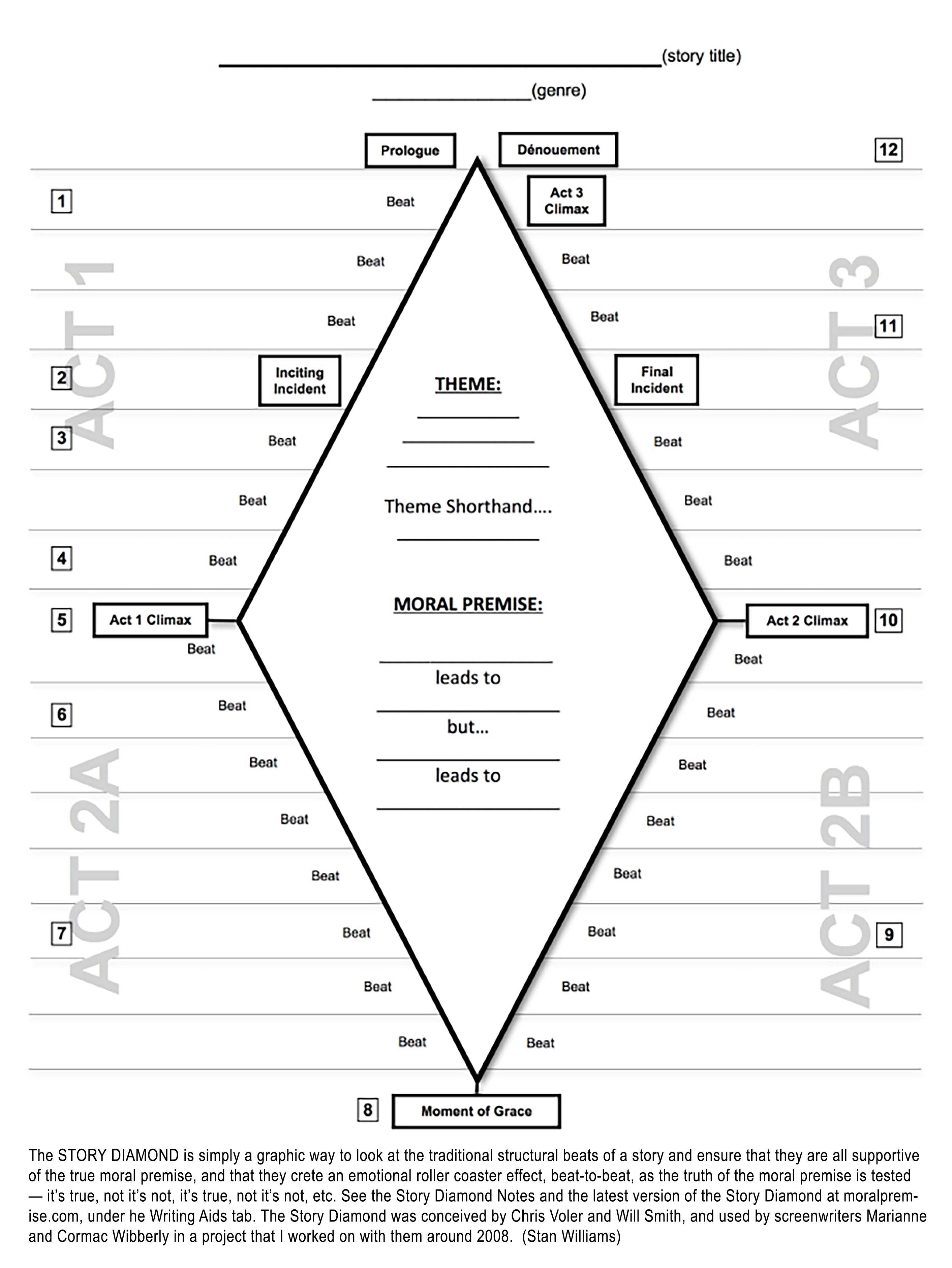
The Story Diamond

The Story Diamond is a useful diagram in structuring a story or screenplay. It was conceived by Chris Vogler and Will Smith, and then used by screenwriters Marianne & Cormac Wibberley for an upcoming Will Smith project that I was called in on to brainstorm. The image below is close to what they handed out. I've added the ACT 1, 2A images, and the explanation at the bottom. You can download this image HERE.


With their permission I took it and enhanced it by overlaying the various story structures used in the industry. The latest version is linked on the moral premise website in the middle of THIS PAGE... scroll down to find it. 

Here's what it looks like today with a host of other story structure systems overlaid. A full explanation of the Story Diamond is presented in my On-Line Storycraft Training series. You can download the latest version HERE.


Monday, February 15, 2010

Expanded Conflict of Values and The Moral Premise

UPDATE: What is discussed in this post is not some new discovery. Not much is new under a billion year old sun, even if it's continually being rediscovered. See end of this post for link to another post that reaches back a few years to something called Nicomachean Ethics.

During a recent story meeting in L.A. our well-known host and producer solved a story problem we were having by introducing a brilliant expansion of the moral premise concept as it pertains to the conflict of values. I'm sure it applies to other well-known stories once we have time to think more about it. Perhaps readers will have some suggestions.

To introduce this expanded conflict of values idea let me first review some basics from the book and my workshops.  I'll use some old and new workshop slides to illustrate.

[Clicking on any slide opens a larger vision in a new window.]

Slide A
 
All drama requires a conflict of values, principally between the protagonist and the antagonist. The values can be identified by a virtue and it's opposite vice. For instance, generosity (a virtue) is related to greed (the contrary vice).  Both of these values (generosity and greed) can be depicted in different characters to different degrees. And both protagonist and antagonist, in the telling of the story, will move along a continuum of pure greed at one end (black) and pure generosity at the other end (white.) In a redemptive story the protagonist may be a little greedy at the beginning of the story, but by the end, he will have moved toward the virtue end of the scale and become somewhat generous. 

I've made the point, illustrated by the color arrows in Slide A, that if the "greed" and the "generosity" are too far apart, the story may come off as unrealistic and artificial. In 2 hours, it's hard to envision a protagonist going from a greedy crook to a generous social worker. Some movement, please, but not too much. Keep it real. At the end of a redemptive movie, a protagonist will still be imperfect, just not as as imperfect as he or she was at the beginning. 

Slide B

So, a good movie will deal with a Vice and a Virtue that are modestly separated in degree from each other.  The antagonist will try to pull the protagonist to the dark side, and the protagonist will pull the antagonist to the light side by defending herself against the antagonist's attacks. Depending on who wins, the movie becomes a comedy or a tragedy.

Slide C
Thus, for a movie with the moral premise:
A deceptive heart leads to rejection; but
A truthful heart leads to acceptance....
...our protagonist may start somewhere in the middle of the vice-to-virtue continuum,  then during Act 1 and the first half of Act 2, move toward the vice in an effort to achieve his or her goal. But in the second half of Act 2 and Act 3, she will move to the virtue side as the goal is achieved. In the example in Slide C, the character slides toward deception before she learns to tell the truth and moves toward success. This, of course, is story with a "redemptive" end, or what I call in the book a "classic comedy" as opposed to a "tragic drama."

Slide D
The scene where our character changes tactics or methods in their pursuit of the goal is halfway through Act 2 and is called the Moment of Grace. All main characters should have moment's of grace, and they should be plotted out before the script is written.

Slide E
In a typical comedy or drama the protagonist is opposed by the antagonist and while the protagonist makes a turn for the good at her Moment of Grace, the antagonist, likewise, has a Moment of Grace, where he turns deeper to the dark side. With respect to the example in Slide E, the moral premise for the antagonist might be something like this:
A deceptive heart leads to rejection; but
A habitual lying heart leads to isolation and despair.
Slide F
In a buddy drama or romantic comedy with a redemptive ending, the two main characters are co-protagonists, and each becomes the antagonist for the other. Perhaps they are both deceiving each other at the beginning of the story, and through a singular moment of grace they both learn that it's better to tell the truth. Of course, they don't learn that lesson real quick else the movie would be over in a flash; and since none of us learn anything very quick, we are able to identify with the slow learning protagonist(s) and the movie becomes more realistic. The "A (P)" and the "P (A)" designations in the diagram reminds us that each character is both a Protagonist to themselves and an Antagonist to the other.  While each character deals with the same dipole of values, the specifics of the plot for each particular story is different.  Jane may be deceiving Jack about where she lives, and Jack may be deceiving Jane about his education.

Slide G
In a similar vein (but in the opposite direction) a story could have both characters reject the moral premise's truth, and lie to each other more at the end of the story than at the beginning. Neither would achieve the redemptive goal, but rather a goal that is tragic.

THE SMITH OBSERVATION

Now, here's the expanded concept of how the conflict of values works in an expanded way. Credit goes to Will Smith for recognizing this and how is can be used effectively in story telling. Like other natural laws of story telling this has probably been used many times, but I have not seen it artiuclated or documented until Will brought it up in our meeting. It was pretty exciting and will definitely make the movie we were working on all that much better. (Note: The examples I use below do NOT refer to the project in development.)
 
Slide H
It's common knowledge that any virtue when taken to an extreme becomes a vice. We see such characters all the time in movies, like a mother who becomes so kind that she intrudes far longer and deeper into her adult son's life than a mother should; or religious sanctity that results in delusion; or generosity that goes so far as to discard personal responsibility in the giver's life or creates slothfulness in the life of the recipient; or over protection that creates debilitating co-dependencies.

Notice that in the graphic the tradition vice (to the left) is the abandonment of the virtue, while the other end is the virtue taken to the extreme by a manic, obsessive, or repressive disorder. Where the absence of the virtue is the result of some degree of evil, the other end is the result of an extreme effort to be good.  So, how does this work when we apply them to character arcs?

Slide I

Consider the expanded moral premise statement in Slide I:
A deceptive OR scrupulous heart leads to rejection; but
A truthful and compassionate heart leads to acceptance.
Notice the whole continuum deals with the values of deception and truth-telling, either truth-telling in its absence or to the point of being repressive and hurtful.  The Bible asks us to speak the truth in love, which suggests that we can speak the truth in a way that is either hateful or harmful.

Slide H
Thus, in a buddy film or romantic comedy or drama, our co-protagonists and co-antagonists may struggle with the values either side of the virtue. Each tugs on the other to move toward the middle and toward the virtue. One character is untrustworthy because he is always lying, and the other is untrustworthy because they are being so scrupulous and manic that the truth is contaminated. (Again, as a reminder, in films of these genres each co-protagonist is the antagonist to the other. )

Slide J
Finally, Slide J suggests a structure I've not considered before, but one that probably exists in many films. A tragic film where the characters, at their moments of grace, let their pride get the best of them, and refuse to move toward truth, manically displacing themselves toward their respective vices of deception and scrupulosity. Could be a comedy... I guess.

Comments? And again, thanks to Will Smith and his constant pursuit of excellence.

(See posts on: Nicomachean Ethics, especially the advanced use of this concept that I explain in my review of THE KITE RUNNER.)