Friday, February 26, 2016

Does "Catholic" get in the way of "catholic" Storytelling

The Four Cardinal Virtues and their Contrary Elements
(copied from http://csermelyblog.tehetsegpont.hu/node/25)

Today a story client asked a good question that I've never breached on this blog. She asked if my deeply held Roman Catholic values would get in the way of helping her with a screenplay that had some elements that were contrary to Roman Catholic teaching.

While this possible conundrum may be on the minds of some that have not worked with me (yet), the question offers me an opportunity to expound, again, on a universal truth: All successful stories connect with audiences BECAUSE they are universal, or "catholic" -- notice the lower case "c."

Here's how I responded, which I've edited for clarity.
Dear C: 
I’m not bothered by story elements that run counter to Roman Catholic teaching (or counter to perceived Roman Catholic teaching, which is more often the case). 
Here’s my standard on such matters: 
In order to connect with mainstream audiences you’ll face something called Natural Law. What you must realize is that audiences subliminally recognize what is natural to the universe (and their lives) and what is not. That your story resonate with such natural elements is what helps your audience connect or "get" your story. When you try to legislate a reality that is not natural to your audience, you will distance yourself from them. One of my tasks in consulting is to help you connect with a target audience, and thus be aware of Natural Law and how you represent it in your story. 
Drama stems from the conflict between what is universally natural and what is not.  The “universe” of which I write is both physical and psychological, but I focus on the psychological because that is what motivates the physical.   
Long before there was a Roman Catholic Church (or any other religion's set of propositional statements), there was nature, and the rules of such are written on all human hearts and consciences. Now, it is true that many people (or story characters) can and do harden their consciences to those natural truths....but again that's one of the sources of drama. But generally and universally human conscience is very stable…and that’s the realm in which I work.  
In my work I refer to these natural forces as "virtues (or strengthens)."  And the rejection of those truths I refer to as "vices (or weaknesses)."  
Yes, there is an alignment between Roman Catholic teaching and "catholic" universal vices and virtues.  The Roman Church claims that it's teachings are not arbitrary but are a careful articulation of how the universe and nature work, and that the development of correct theology is the consequence of thousands of years of human observation about both the physical and the psychological universe in which the human condition lives
Thus, for proper dramatic conflict that general audiences will recognize there must be catholic vices/weaknesses and catholic virtues/strengths (contrary elements), or you will not have conflict and thus you will not have drama that anyone will connect with.
That last paragraph also reads correctly this way:

Thus, for proper dramatic conflict that general audiences will recognize there must be UNIVERSAL vices/weaknesses and UNIVERSAL virtues/strengths (contrary elements), or you will not have conflict and thus you will not have drama that anyone will connect with.


Monday, February 22, 2016

Visual Storytelling

Here's a good example of visual storytelling with intersecting arcs from a filmmaker I've admired from the past. Good job, Chuck.

Word of Mouth from Charles Kinnane on Vimeo.

Tuesday, February 9, 2016

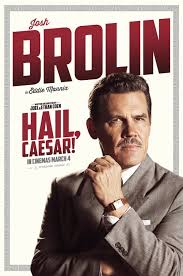
Hail! .... HAIL CAESAR. Brilliant!

HAIL, CAESAR! (2016)

Writers/Directors: ETHAN COEN, JOEL COEN
Eddie Mannix: JOSH BROLIN
Baird Whitlock: GEORGE CLOONEY
Hobie Doyle: ALDEN EHRENREICH
Laurence Laurentz: RALPH FIENNES
DeeAnna Moran: SCARLETT JOHANSSON
Thora & Thessaly Thacker: TILDA SWINTON

I went for a lark.

I thought I'd go to the movies just this once for fun. No analysis, no timings in the back of the theater with my iPhone taking notes and risking getting kicked out. Pam was gone for the night, so I ate a Wendy's Apple Pecan Salad in the Emagine Theater parking lot as it started to snow. Went in, bought my Senior Discount ticket, got some chocolate covered almonds (Hey, Lent starts tomorrow), and sitting in my seat put in my new hearing aid so I could understand the dialogue.

I was expecting a brainless, escapism, night at the movies.

WELL!

Here's a hint.

Hail, Caesar! is (at the same time) all about the fragility and splendor of being human. It is about the inability of humans to do what is right and their perseverance in trying to be better. It's about the darkness of life and the candles we can ignite to bring light into that darkness.  And, it's about how incompetent Hollywood can be and how, at the same time, utterly brilliant and talented the people there are. It's about the difficult of doing what is right and not what is easy.  And all of that under the mercy of our creator. It is a pure movie about the human condition and how we help each other in this dark valley of tears.

HAIL, CAESAR! was entertaining (after a while). I cringed at first...it took a while to figure out what was going on. Hey, it's the Coen brothers and they are two smart directors, but you have to stick with them—they will make you work. There were moments of profound seriousness and scenes that seemed obscure at best. And yet, there were scenes I could not stop laughing, although many of the jokes for me were filmmaking inside jokes. I've directed actors enough and been in editing rooms enough (even with upright Moviolas), that the moments were gut busters...with many homages to the greats of the industry.   There were repeated sends-up of Hollywood and it's ridiculous attempts to get things right but didn't. (The rear view of Jesus on the Cross is not satire of Christianity, it's satire at Hollywood trying to tell the
story of Christ....big difference....don't be confused). There is a dance number that puts Gene Kelly to shame, and Esther Williams's grand water choreography makes an appearance. Enjoy the respites of talent, they're there to remind you of humanity's goodness and how the struggle is worth it.

Thus, I identified easily with the protagonist and his arc....Eddie Mannix, the CAPITAL studio head played by Josh Brolin. Watch him carefully. The movie is NOT about George Clooney's character Baird Whitlock, although Baird's predicament is what drives Eddie's primary, physical goal.

I'll watch it again and do a little amendment on the Moral Premise later. Let me know what you think.

March 20, 2016 (1 AM) in response to James Shiels in the comments below. Readers of this blog wold be served well to read James's criticism of the film before reading my response. 

James, I wish more people would push back like you did. I've been involved in pre-prep on one shoot while supporting the production of another and so haven't had time to write more about HAIL, CEASAR, although I did see it a second time and took good notes which are now opened before me.

It's late at night...I've got 10 hours of production tomorrow...but I'll hack this out and clean it up later. Sorry for the typos. Hope they're not too bad.

Thank you for taking note of one of my "rules" that if a movie is popular it probably has a valid moral premise. But what I have also claimed is that a valid moral premise is no guarantee of success... because so much else is involved...like marketing, and...in the case of HAIL, CEASER (HC).... not telling a story that is hard to understand at a moral level because the surface artifacts are so thick.

I promise to write about this when I have time, but for now here's a brief explanation of what I saw...even more the second time.

First, I did not know much about the real Eddie Mannix, upon which Josh Brolin's character is based--I guess loosely. Supposedly, from the little I've read about him, he was an interesting but not a very redeemable person --- and for a comedy with a redemptive ending you need a protagonist that is likable in a very broad sense. You have to make him both flawed and have him seek the higher human good.  So, my evaluation if of the HAIL, CEASER Mannix, not the real one.

Second, while the HC Mannix is clearly the main character, and by some definitions the protagonist, he plays more of the antagonist character in relationship to his studio charges. Did you ever see any television episodes of the series TOUCHED BY AN ANGEL. In that series, at first glance, one would think the protagonist(s) are the angels. If you have not seen it here's the premise. Some person on Earth has got their life all screwed up and God sends three angels to help him or her get straightened out. The protagonist is the "guest star" with the problem. And in that way the guest star arcs from living a life that is messed up, to getting it fixed...BECAUSE of the angel's interventions in his or her life. The angels do not have control over the protagonist's free will, but they try to find a way to manipulate situations and provide counseling to the  person so they choose to do better and fix their own life. Thus, the angels are the antagonists to the protagonists. Antagonists create situations that motivate the protagonist to change. That's true especially with the antagonist is also the villain. 

In that way, Mannix (in HC) is the antagonist, but he's also the main character and the POV character. The protagonists are the various studio characters for which Mannix has some responsibility. Now, Mannix does have an arc, and he is clearly better off at the end of the movie than at the beginning, but the deeper arcs are played by the protagonists of the various sub plots. Another way of thinking about Mannix is that he's a heroic lead; he changes little but forces others to change. See also my post with Christopher Vogler on the difference between a Hero and a Protagonist. 

Third, here are some of the obvious arcs.

Baird Whitlock (Clooney) changes from taking his job for granted to taking it seriously. He plays the vacuous, Hollywood star who lets others do his thinking for him and gets dragged into the foolery of the writers who really are Communist Sympathizers. His last soliloquy at the foot of the cross is the opposite of his attitude earlier. He's still flawed (and can't remember the more important word of the speech ("faith") but by his forgetting it, the writers of HC get to emphasize it when everyone remembers the word Baird can't. In fact, the whole movie is about faith. Baird moves from skepticism to faith (in multiple areas). And yet, skepticism and faith are the two key values of the moral premise.

Hobie Doyle (Alden Ehrenrich) also moves through this same arc. He's skeptical of his ability to be in a talkie. But he get's his talkie legs. And the same time he's able to translate his "on-screen hero skills" to the real world and rescue Whitlock and bring him back to the studio.

This is also reinforced by the Lockheed recruiter who is stuck on the negative side of the moral premise (skepticism) and refers to Hollywood as make believe and a useless vocation for Mannix to be involved with. The recruiter stays permanently on the skeptical side of the moral premise.

DeeAnna Moran (Scarlette Johansson) arcs from skepticism about marriage (because of her failed marriages and relationships in the past) to marrying the studio attorney who adopts her kid.

The Thacker sisters arc likewise from skepticism about anything Mannix or the studio does to realizing they were wrong about a great many things; and perhaps gossip isn't always the best for their readers. Thus, they move from skepticism about Mannix to faith in him.

Burt Gurney (Channing Tatum), on the other hand at his Moment of Grace turns to the dark side, rather than embracing the truth, and hops on a Russian sub and leaves his recruited writers to fend for themselves. You can say that in a Nicomachen way, Gurney arcs from skepticism to treason. (Here's a link to 6 posts on Nicomachen Ethics, the Moral Premise on steroids. My thanks to Will Smith for introducing me to "Nic.")

And finally, Mannix moves from skepticism about the difficulty of running production at the studio to realizing it's what he's really good at doing, and so his career calling is reinforced. The subplot with the Lockheed recruiter reveals that Mannix is skeptical about his job in several ways. But by the end he has rejected that skepticism in favor of faith in his calling.  Mannix's goal, in the life of every one of his charges is to help them achieve human dignity. His "stars" are very talented...and in that talent they each have a lot of faith to do their work good. But they are not faithful to that dignity when confronted with things off camera. Their lives are a mess, and they are unsure and lost, often times giving The Thacker sisters something to write about. Yes, on the surface you might understand that Mannix is just trying to make a buck for the studio. But such a superficial goal is questioned when Mannix so quickly tries to pay off Gurney with a $100,000 ransom for Whitlock. From the very beginning to the end, Mannix's goal with EVERY character is to save their dignity from their own stupid decisions. He is their agent of mercy. He takes on himself their grief, and tries to cover it up by getting them to do what is good. (To Christians this is a familiar theme.)

The most obvious motif that Mannix plays are the movie's bookends....his sessions in the confessional with his priest. His issue with cigarette smoking is both a red herring for the audience....and also a metaphor for everything he does. Notice he's skeptical about his ability to please and provide for his wife and family. That is why he's trying to stop  smoking, and get a more stable job that would provide for retirement for his missus.  In the confessional at the end, what the movie is really about is talked about explicitly. He says to his priest, "If there's something that's easy is that wrong?"  He's not sure if the job is what he should be doing, but it seems that protecting the dignity and trying to straighten out his charge's lives ..."it's hard...but it seems right." And the priest says, "God wants us to do what is right."

And with that Mannix, through his secretary tells the Lockheed recruiter "Thanks, but no thanks."

Now, there is a pretty heavy dose of religious overtones in the whole movie that is consistent with Christian themes, especially in this particular year for Catholics. It's the "Year of Mercy." Mannix's job is one of showing mercy to those under the studio's employ...and avoiding scandal. But the Cohen brother's Mannix really cares more for the lives of his charges than he does money. He is also deeply concerned about what he's doing in everything he does. He goes to confession every day...and he takes it seriously. Notice, he's very Skeptical about his ability to be the man he was called to be. Notice also toward the end he goes to the set of HAIL, CEASER and prays at the foot of the cross. We don't hear his prayer. But we know he struggles with every subplot thrown at him. And while he's at the cross (much the way Brad Whitlock is at the end of the movie delivering his soliloquy,) Mannix finds his faith...and things work out...and he realizes he's where he should be at the studio. Brad says "faith" (or forgets it), but it's Mannix that finds it.

In the same way that Jesus Christ was skeptical in the garden as to whether or not he should allow himself to be crucified, he comes out of the garden prayer with faith and goes through the very hard time of submitting to his death. And why does Christ give up the "security" of a life on earth?  To be merciful to those in his charge. So, that, also is what Mannix goes through. He realizes that his very hard life has noble value, and he willing moves forward out of skepticism into faith that he was called to bring mercy (like Christ) to those under his care.

The moral premise:
Skepticism about one's life leads to trial, disillusionment and treason; but
Faith about one's life leads to purpose, vision, and fidelity. 

I don't think there's a character in the movie with at least a three beat subplot that doesn't reinforce that moral premise.

James, thanks for asking.

Stan

Thursday, February 4, 2016

Why LITTLE BOY Was a Bomb

LITTLE BOY (2015) PG-13

DIRECTOR: Alejandro Gómex Monteverde
PRODUCER: Leo Severino (Metanoia Films)
EX PRODUCER: Eduardo Verastegui, Sean Wolfington, Mark Burnett, Roma Downey

STARRING
Tom Wilkinson (Fr. Oliver)
Cary-Hioyuki Tagawa (Hashimoto)
Emily Watson (Emma Busbee)
David Henrie (London Busbee)
Kevin James (Dr. Fox)
Jakob Salvati (Pepper Busbee / Little Boy)

(SPOILERS AHEAD)

I am asked now and then to talk more about movies that fail because of a false or misguided moral premise.

So, a couple years back, I girded up my loins and analyzed and blogged about some big MOVIES THAT FAILED. It was hard work, looking at all that money and talent being wasted. Terrible storytelling. Clear, obvious, universal, common sense story rules were just thrown out the window by filmmakers and studios alike... because, it seems, they come up with an ironic hook. But irony has to support the story, not just be ironic for entertainment's sake. Ionic stories (with good hooks) yet without the proper story foundation will always fail.

Tonight, in order to test out a new hearing aid...I've lost a lot of my high frequencies...I turned on our Apple TV, Netflix, and New Releases (for Netflix, not in the theaters). The first movie on the list was Metanoia Films' LITTLE BOY. Metanoia is run by some talented devout, Catholic filmmakers that I've had the opportunity to meet and talk to a few times.  But I had not seen LITTLE BOY, so, Pam and I settled down to watch and listen (as long my new hearing aid worked...and it did.)

As a period piece, the production values on LITTLE BOY are fantastic. The art direction, prop department and carpenters all deserve some sort of award. The photography and editing are eye-popping good.  The supporting actors are wonderful, and the overall direction is tight and purposeful, and who can deny that watching Tom Wilkinson, Emily Watson, David Henrie, and Kevin James is anything but a joy. And Jakob Salvati, as Pepper, the  Little Boy, held his own as the protagonist.
There are scenes that will make you cry...my wife was taken numerous times with heavy tears. The movie is just plain captivating.

But at the end, I was left with this awful empty, contradictory feeling. Why, I wondered? I couldn't put my finger on it for a while. I ran to the computer and checked what I had remembered about the box office being mediocre. BAM!!!  Yes, something was seriously wrong.

With an estimated budget of $20M-$30M (in Mexico no less where things are a lot cheaper to shoot), the U.S. Domestic Box office was a trifle $6.5M (rounding it up) with apparently no International distribution.

Folks, this is horrible. For a movie that has so much going for it in terms of production value, and scene value—there are wonderful sequences with deft parallel editing, scene-after-scene are just fabulously made—why would this film not connect?  First weekend it opened in 1,000 plus theaters and does a modest $3.3M. Not great, but if the movie was really as good as it looks, it would have dropped only 30% by the next week. But it dropped 62.3%. Fatal. Word of mouth was tepid at best. In later weeks it dropped three successive weeks by 50% and in 8-weeks it was history.

ANALYSIS

The reason this movie about Christian faith did not connect, even with it's Christian/Catholic target audience, has everything to do with the Moral Premise and common sense storytelling's black and white rules.

THE STORY, on the surface is about a little boy who is learning about how faith as small as a mustard seed, can movie mountains. In the movie, he tries and sort of succeeds to move a mountain. It's also about the hateful prejudice some Americans showed American Japanese during WWII. The little boy's father is called off to war and Pepper, with the astute help of Fr. Oliver (Wilkinson), passionately and actively pursues an increase in his faith (through good works) so that his father will return from the war safe and sound. THAT IS, THE PHYSICAL GOAL OF THE PROTAGONIST (Pepper / Little Boy)....is TO GET DADDY HOME ALIVE. Making that goal tangible and visible is well executed in the film. Pepper's family lives in a town on the West Coast of California and there are scenes where Pepper holds up his arms toward the setting sun over Japan (which at that moment may be the Rising Sun of Japan), grunting and shaking in a Star Wars'esque effort to morph "Christian faith" into "The Force." The atheistic Mr. Hashimoto challenges Fr. Oliver to stop the charade and protect the boy psychologically. But Fr. Oliver...is having his own crisis of faith, and doesn't know what to tell the kid...because to Fr. Oliver it seems like the kid does have faith (alas, the kid is demonstrating faith in his own selfishness not in God's power to save...so what we have here is really poor understanding of fundamental theology.) Admittedly, the movie makes no attempt to suggest that what Pepper is doing is Christian faith. But neither does the movie define Christian faith, otherwise. So the audience is left to believe what is shown. And what is shown is logically invalid and subliminally the audience figures that out. (BTW: The Coen Brother's HAIL, CAESAR! does a better job of presenting the Gospel.)

Thus, when the first atomic bomb lands on Japan (shortly after one of Pepper's arm shaking episodes aimed at Japan) the town wildly celebrates because they believe that is was Pepper who was responsible. Why? Because his nick name around town is "Little Boy" and the nickname of the atom bomb that was dropped on Hiroshima was "Little Boy."  Immediately thereafter and for solid minute there is great rejoicing. The film suddenly shifts to the somber destruction and the celebration stops. To make things worse, the family hears that Dad is taken as a POW, and then that he is killed. But through mistaken identity, the soldier that is killed is not Dad. And Dad returns home at war's end shell shocked but reunited with family.

IT'S A HORRIBLE MISTAKE for a movie that tries to battle prejudice to turn to celebration the killing of hundreds of thousands of Japanese in the shadow of what the little, smiling and celebrating Pepper believe is "Christian Faith." Even when, moments later, the movie puts on the appropriate somber moral mood for the bomb, a bitter taste is left in the mouth. A scene like that in any film, least of all a purported Christian film, is like a moral sin. It's nearly unforgivable. It's abhorrent. As one commenter on IMBD wrote "Christian Faith Nukes Hiroshima"  Of course the filmmakers don't say that...but (Damn It!) they SHOW it.

As bad as that scene was conceived, it is not what kills the movie...although the movie deserves to die because of it.

What kills the movie is something more subtle and at once obvious. To explain that I have to take a stab at the moral premise....that sentence that should be controlling everything about the story and it's presence on screen.

[NOTE TO FILMMAKERS OF ALL STRIPES: If you understand an apply the moral premise, your films won't go bust, assuming everything else is well done But when you screw this up, money will never save your investment.]

MORAL PREMISES

There are two possible moral premise statements for LITTLE BOY based on the explicit issues portrayed:

Moral Premise A
Racial hatred and lack of faith leads to hatred, separation and death; but
Brotherly love and faith leads to friendship, family and life.

Moral Premise B
Racial hatred and lack of faith leads to Daddy not coming home; but
Brotherly love and faith leads to Daddy coming home.

Moral Premise A would be a good statement if the movie had a protagonist with some goal that related to life and friendship within the community and physical efforts were put to that end.

But LITTLE BOY is about a little boy who wants his father to come back from war. The kid is not motivated to make the town better. 

Having made that clear (I hope)...

All successful stories MUST follow a few simple rules. Let me mention one of the most important:

  1. The inner transformation of values that the protagonist experiences, logically motivates the action that causes the physical transformation.  Psychological Motivation ALWAYS leads Physical Action...and the connection better be logical. 
  2. The protagonist's physical action toward the goal, logically causes the goal to be achieved. The goal cannot be achieved by any other action than that of the protagonist. 
If you need to understand this, take my Storycraft Training Online. There's not the room here.

A story cannot succeed if at the end of the plot, the protagonist steps aside and someone else saves the day. The protagonist must do the hand-to-hand combat, not another less important character. Thus LITTLE BOY fails due to three violations of these Natural Laws of Story Structure.

1. THERE IS NO LOGICAL PHYSICAL CONNECTION BETWEEN PEPPER'S ACTIONS AND GETTING HIS DAD HOME.

There is no direct acton that Pepper takes that remotely effects the return of his dad.  It's as if all though the movie Pepper pursues his goal with various actions, but at the end, a superhero swoops in and rescues Dad. The superhero being the guys on the Manhattan Project...some would say, far from innocent lads. Audiences subliminal are left dissatisfied. The catharsis is cut short and quick, if there's any at all. (Bad word of mouth #1.) - This is similar to the story error Hollywood calls DEUS EX MACHINA — an unexpected power or event saving a seemingly hopeless situation, especially as a contrived plot device in a play or novel. Wikipedia explains Deus Ex Machina well.

2. PEPPER'S LEARNED VIRTUE IS ACTUALLY A VICE

There is a hidden theme in the story that "innocence trumps reality." In other words, as the audience, we want the kid's wishes to come true BECAUSE and only because he's an innocent kid. If an adult acted like Pepper we'd call the character selfish, narcissistic and self-absorbed. Pepper's not wanting his Dad to come home for a selfless noble purpose. This is not A WONDERFUL LIFE where George Bailey's presence in the community benefits the good of all. Yes, we can see that Mom (Emily Watson) is sad and that she's being stalked by the friendly doctor in town (Kevin James). And we recognize that Pepper's older brother is getting in trouble because Dad is gone. BUT NONE OF THOSE have anything to do with Pepper's motivation for wanting his Dad back. That is, Pepper doesn't want Dad back because the Savings and Loan has to be saved for the sake of the town's livelihood. He wants Dad back for himself, alone. And we buy it because the kid is young, and sweet and innocent. But the kid's motivations are not pure, they are filled with vice.  Subliminally, audiences see that. (Bad word of mouth #2.) 

3. THERE'S NO LOGICAL CONNECTION BETWEEN PEPPER'S INNER TRANSFORMATION AND THE OUTER PROGRESS OF RETURNING DAD.

The moral premise also demands that it's the vice or weakness in the protagonist that creates the bad consequences, and that a transformation of that inner value to a virtue or strength will bring about the good consequence. But what does this movie do? Pepper achieves his goal, and we're led to believe in some way that it was his Christian faith that brought his Daddy home. But that's not true and Christians and non-Christians subconsciously know such an idea is fable and heresy. (Bad word of mouth #3.)

And ironically, I'll bet almost no one leaving the theater could explain any of this. It's a feeling, a sense, that something isn't quite right, and quite right they are.

Consequently, Little Boy was a Bomb.

Come on guys and gals out there making movies. READ MY BOOK at least, and try to understand this stuff. I'm not making money off these books, but you could. 


Monday, January 18, 2016

Eunice Cofie and Nuekie...a Good Story

Here's a good story.

Today I was contacted by EUNICE COFIE the founder of  a cosmetic company in Florida. She  is President and Chief Cosmetic chemist of  NUEKIE, which provides innovative dermatological products for women and men with skin of color. Eunice and her company have been cited repeatedly as a model startup businesses by both state and national organizations including Forbes Magazine. 

She asked me if the principles of the Moral Premise "can be applied to developing stories for TV commercials as well as developing stories for medical textbooks?" She wrote that she wants "to find innovative ways in using storytelling through TV commercials for my company as well as through medical textbooks."

Of course, I told her "Yes," since the moral premise effects all aspects of all stories' structure to guarantee it will connect emotionally with audiences.  But the storytelling rules that relate to the crux of a story (the moral premise) are layered. The more of them that are followed, the more successful the story and communication will be.

Ironically, there is a story about Eunice on Nuekie's website and how she happened to start NUEKIE in 2013. With her permission I've shared it below. It follows the core principles of the moral premise very well. It's worth watching. In fact, I couldn't help but think a narrative movie about Eunice and Nuekie founding might find an audience. The elements are all there.

Enjoy! Learn! Stories are so great.


Thursday, January 14, 2016

EMOTIONAL ROLLER COASTER - THE REVENANT

This is a long post written over several weeks and three different posts. If you see a typo, please tell me. Thanks. stan@moralpremise.com

I've taken this long to post this long analysis because the movie demonstrates a perfect structure that resulted in a visible roller-coaster effect, thanks to LIGHTWAVE. It is, therefore, worthy of study. The turning points match the idea perfectly and yet are portrayed in several ironic ways. In terms of structure THE REVENANT, is the "same thing only different."

Dir: Alejandro González Iñárritu
Writers: Mark L. Smith, Alejandro González Iñárritu,  based book by Michael Punke

HG - Hugh Glass (LEONARDO DICAPRIO)
FITZ - John Fitzgerald (TOM HARDY)
CA - Capt. Andrew Henry: DOMHNALL GLEESON
JB - Jim Bridger (WILL POULTER)
HK - Hawk (FORREST GOODLUCK)
PO - Powaqa (MELAW NAKEHK'O)
TO - Toussaint (FABRICE ADDE)
Hikuc (ARTHUR RED CLOUD)
HG's Wife (GRACE DOVE)

LENGTH: 106 minutes.

DISCLAIMER: The controversy swirls about what to call indigenous Native Americans, and whether to capitalize the term referring to them. There are arguments and interest groups on at least a dozen fronts. I don't pretend to have an opinion on the topic. In this post I've taken the common term "indian" to refer generically to these "first nation" peoples. 

Post 1-14-16: 
Here is the proof of what a number of us story gurus have been preaching for years. LIGHTWAVE (TM) has measured the emotional response of an audience watching THE REVENANT. I've been able to talk with Rana June, Lightwave's CEO. She supplied the higher resolution image below than was first disseminated to the news bureaus (click on it), and I'm attempting to get more information so I can correlate my forthcoming beat analysis of THE REVENANT to this chart. The wrist band that LIGHTWAVE has come up with to collect the biometric data and the data manipulating that they do will change how movies are written.

I predict that this wristband will be worn at table reads, or silent individual reads of the script. The analysis effort some of us provide can ensure this emotional response so the "slow middle" and other problems with stories, can be effectively eliminated. Just compare the structure of THE REVENANT biometrics with the chart I've been using for years, below.


Here is the chart we try to get filmmakers and novelists to follow. Look at the similarities. And I can tell you how to get there.


Post 1-30-16:  
Prompted by the Northville Screenwriter's Meetup Group I started in on analyzing the beats of REVENANT. I watched the movie for a second time from the back row, my iPhone's stopwatch giving me timings and a light to take many pages of notes of scene breaks and action. I then overlaid my notes on Lightwave's charts, here overlapped.

I've turned the chart below on it's side so the action/scene/sequence descriptions can be easily read, and I've put in the far right margin the traditional major story beats. They line up very closely if you have an idea about what the story is really about....there's a hint in my notes. I'll write a blog about this in the future, and on April 23, 2016 I will present a workshop on this at the Rochester Writer's Conference at Oakland University

BEAT ROLLER COASTER CHART

In the meantime, (1) click on the image for a larger size, and then (2) download it for your own study. Again, a major hit movie follows the moral premise beats, whether or not the writer and director knew anything about them from my book or work. This doesn't prove anything about me, but rather about the natural law of good stories. As one Pixar writer/director told a friend of mine recently who was exposed to this stuff..."We didn't know any of that. We just kept working at it until it felt right." Exactly. Perseverance will get you there if you have enough smart people in the room and put in the time to do it. But knowing what makes good stories work...can get you there faster. I love this stuff. Writer better, write faster. Know the Moral Premise of your story and apply it to everything. 


13+ MAJOR BEATS EXPLAINED

Post 2-15-16
For a generic explanation of the major beats (explained below for THE REVENANT) see my post on StoryStructure Basics. I'll try to avoid duplication below and assume you understand that earlier post. 

While each of the major beat labels below work best in a general sense, in some instances there are other names for these beats used by other story gurus, (as well as beats within these beats). A good guide to what other structuralists term these major, accidental, and minor beats can be found on my expanded Story Diamond Key PDF.

The beats below focus on the protagonist, Hugh Glass (HG), his main arc, and the movie's major plot. HG has subplots, which also have beats, but not as many as the main plot described below. Other main characters also have beats and an arc, but not as many as HG's main plot. 

ACT 1 BEGINS
1. LIFE BEFORE
HG avoids conflict where possible. When given a choice between fight or flight he chooses flight. He is not seeking to confront the French who ravaged his wife's village and killed her (flight). When the indians attacks the American trappers he guides through the NW wilderness, he runs for the boats. When Fitz verbally attacks him for marrying a Pawnee woman and expresses his hate for Hawk, their son, Hawk wants to defend himself, but HG tells his son that to survive he must be silent.  

2. INCITING INCIDENT (Ideally 12.5%)
At 12% Fitz verbally attacks Hawk and HG. This is the challenge to HG not to take a neutral, Laissez-faire, avoid all conflict worldview. HG's best retort to Fitz is that he holds the "smart end of the gun," the barrel of which is pointed at Fitz's gut.  

At 16% the bear attack is the inciting incident for HG's "moral wound" sub plot (see THE GOAL below), but it is not the I.I. for the main plot. However, there's a rich connection. See 3, below).


3. REJECTION OF THE JOURNEY
HG tells his son, Hawk, to be silent and not confront Fitz's hatred.
Although Fitz never stops in his condemnation of HG, Hawk and such, HG avoids putting the confrontation front and center and dealing with it. HG lets the hatred ferment. 

The bear attack is a clear metaphor for Fitz's hatred. Consider: (a) the bear attack is more visible than Fitz's verbal taunts. (b) the bear's vicious attack of HG SHOWS us what Fitz would like to do to HG. (c) When faced with the bear, HG is on the "smart end of the gun" but he AVOIDS the confrontation at first and does not fire fast enough, and the mother bear (attempting to protect her cubs) attacks. (d) When his fellow trappers find HG and try to save his life, Fitz goes off and smokes his pipe commenting that they ought to let HG die. At one side of the screen is a passive (dead) bear; on the other side of the screen is a passive Fitz, but who is very much alive and is every bit the threat to HG that the bear was. It's like a WWF tag team. The first bear is defeated and the other bear jumps into the ring. In this case, dramatically, the bear and Fitz are allies, and Fritz takes this into account and his action coming up.

If I recall the scene correctly, also notice that just before HG goes off early morning to hunt and during which he encounters the bear, he consoles Hawk, who is grieving Fitz's hatred, his mother's death, and HG's insistence that he stay silent. If HG and Hawk were not in conflict over how to deal with Fitz, Hawk would not be grieving, and he would be capable and willing to go hunting with his father as he has done before. Had Hawk gone with HG, it is unlikely that HG would have been mauled by the bear because Hawk would have protected HG's flank. Thus, the bear attack is the  indirect consequence of HG's rejection of the journey to confront his oppressors.

4. ACT 1 CLIMAX - ACCEPTS NEED FOR JOURNEY (Ideally 25%)
At 25%, after difficulty carrying HG's litter through the wilderness, HG's litter slides down the rocky, ice covered embankment, announcing the litter's occupants silent decision to stay behind and not endanger the rest of the party's lives by being a burden to their ability to get quickly out of the wilderness and survive. 

This normally would be a clear choice of the protagonist to cross the threshold and go on the journey, but in this scene is it implied and not explicit. 

Another unique aspect to this turning point is that the protagonist STAYS IN PLACE while the rest of his "world" crosses the hill and continues on their physical journey. HG's journey begins with him staying put, thus endangering his life in multiple ways....but also forcing him to deal with his weakness of non-confrontation. 

ACT 2 BEGINS: CROSSES THRESHOLD
"Crossing the Threshold" is counted as part of the Act 1 Climax, and not usually a separate beat, although it is usually a separate scene. It is here, nonetheless, that the protagonist's goal is revealed. So, let's take this moment to highlight three things: HG's goal(s), the Hook, and the Moral Premise.

1. THE GOAL. HG's Goal is to survive against all odds. To do that he must overcome various threats to his life and those he loves.  Each of these threats forms a subplot; one is the main plot. If you've taken my Storycraft Training Series or workshops you know that EACH subplot for each character must have a physical and visible goal. For HG, his goals for the various sub plots are:
  1. Overcome the extreme cold and wilderness.
  2. Avoid indians who war against the American and French trappers.
  3. Neutralize John Fitzgerald's hatred and bigotry (the main plot)
  4. Heal from his mortal wounds from a bear attack
  5. Defend and befriend his Pawnee in-law indian family
  6. Bring justice to and neutralize the French trappers who have killed HG's wife and ravaged her village

2. THE HOOK. A good hook pits an under achieving protagonist against impossible odds. While HG is a capable mountain guide and trapper, his weakness from non-confrontation, makes him an under achiever in the beginning of this story. And while any of the above threats to his life would be enough for most stories, THE REVENANT thrives on having all six. 

3. THE MORAL PREMISE
We have a Nicomachean Value Conflict (Continuum) upon which the moral premise is based. Here's the diagram. (If you can improve on this PLEASE let me know. These things always challenge me.) Remember the values (or virtues and vices) on these continuums are the MOTIVATIONS of the characters. You can't have action without a logical motivation for it.)


Embracing neutrality (absence of self-respect) or practicing
despotism (the extreme of self-respect), leads to death; but
seeking self-respect and justice for self and others leads to life.


5. ACT 2A: MAKES POOR PROGRESS TOWARD GOAL 
(Motivated by Negative Side of Moral Premise)
Now the journey begins, with the purpose of achieving HG's six goals for the six plots listed above. This is an extreme of the David vs. Goliath tale. Here Goliath has almost slain David, who lies helpless on a litter. And this helpless shepherd (which HG is by shepherding the trappers through the wilderness) can't even pick up a sling or a small stone. He's immobile on a litter, and in a moment will be tied down to it, no less.....as Goliath attempts for a second time to kill HG the shepard.

At the beginning of Act 2, HG is thinking of just surviving his wounds. But (out of necessity) he's taking the epitome of avoidance. He's staying in bed. He's NOT trying to get out. He's trusting in OTHERS, even his enemy, to take care of him. This is HG's weakness. You may think that HG is incapable of doing anything but just lie there in the litter. But notice he is capable of action, as will be evident soon after Fitz leaves HG to die, and takes off with JB for the fort. So, in retrospect, Act 2 starts off just like a well structured movie should, with the protagonist pursuing the goal, but using the negative side of the moral premise. (Read those motivating values again on the left side of the diagram above, and see if they don't apply to HG as he lies on his litter.)

This avoidance results in HG not just making SLOW progress, but when Fitz tries to kill him and does kill Hawk, HG experiences NEGATIVE progress. 

Fitz's attempted murder of HG and his murder of Hawk is PINCH POINT A—the antagonist's presence in obstructing the protagonist from reaching his goal. Such points accelerate the plot. Avoiding them in a story slows down the middle. (Pinch Points are terms novelists use, but to keep the roller coaster going, screenwriters need to embrace them, as THE REVENANT DOES SO WELL. 

Three other moments in Act 2A that indicate not slow progress include:

1.  HG crawling out of his grave to mourn his son. This is NOT progress for HG's plots, although it is a Dark Night of the Soul for Hawk, and it does explain some of HG's motivation for going after Fitz. But notice he crawls screen left, and Fitz and safety is screen right. It's NEGATIVE progress, yet again.  This may be subtle, but it signals to the audience that the filmmakers are increasing the stakes. Every step back is one that has to be recovered in going forward. 

2. Cauterizing the hole in his neck with gunpowder knocks him out.

3. After hiding in a cave with a fire to keep him warm, he flights from some indians that try to kill him. But notice they don't try to kill him until he tries to get away from them. This is important in terms of storytelling because it's just the opposite of what is about to happen.  (Notice this is the skill of the storyteller to make scenes seem reasonable, even if in retrospect they could have happened differently. It seems entirely reasonable for HG to run from these indians and slip into the river to AVOID them.)

6. MID POINT MOMENT OF GRACE (Ideally 50%)
At 49%-50% HG passes from one part of the diegesis (or world of the story) to another. We do not see an explicit Moment of Grace as we do in more typical movies when the protagonist has a revelation—the camera zooms in, there's a musical cue, and the character says something revealing. But there is clearly here a "rebirth." THE REVENANT uses "baptism" (in both forms) as the metaphor. When first escaping the indians and their arrows HG immerses himself under the water, and moments later he passes over a waterfall which reminds us of the baptismal water that is poured over a converts head. And then, having been cleansed of his sin, he floats through a beatific vision — a beautiful scenic river as he holds onto a floating log (the tree of the cross?) It's as if he is floating away from a bad past and into a beautiful, hopeful future.  At 50% HG climbs out of the river a new man, and the first sign we see of his newness is when he casts off the bearskin, his old nature. (Although in a practical sense it was the bearskin that kept him from hypothermia in the cold river.) In terms of semiotics (or the significance of signs and symbols), the bearskin is a sign of the bear attack, which is the consequence of HG's avoidance of conflict and confrontation (explained earlier). And we are going to see in the next scenes a totally different HG as he pursues his goal.) Again, baptism and the removal of the old nature are classic metaphoric ways of communicating a turning point. 

As a further sign that something is new, HG witnesses a falling meteor, even as part of it (a meteorite) falls into the river from which he climbed. The falling star is a mythic sign of the Wisemen following a star of hope and salvation.

But the filmmakers do not let us forget the antagonistic forces that HG must still face, and with the falling meteor HG remembers the slaughter of his wife's village and his wife's death.

Altogether, this is a significant MOG right at the 50% mark in the movie.

7. ACT 2 B: MAKES GOOD PROGRESS TOWARD GOAL 
(Motivated by Positive Side of Moral Premise)
And now HG makes progress, through providence and his own decisions. 

He hears a stampede of bison. He climbs out of the river valley to see this glorious sight and wolves carving out a calf for food. Notice he does not AVOID this wilderness danger, the stampede or the wolves, who might have attacked him, a wounded human. He stays nearby, and at night is awakened by another sound and flashes of firelight. 

Hikuc, a Pawnee warrior, chases the wolves away with fire, and kneels beside the ripped open bison and begins to feast on the raw flesh. 

Now, notice what HG does. He approaches the warrior and begs for food. This was not entirely necessary because HG had just hours earlier eaten fish he had trapped from the river. Yes, red meat would be a plentiful source of energy and more sustaining than fish. But what's important here, from a story structure standpoint, is that HG does not avoid the indian, but approaches him and after a tense standoff during which we think HG may get killed with an arrow at point-blank range, Hikuc throws HG the bison's liver, which Leonardo DiCapro actually tires to eat...the raw, bison liver. (His non-acting reaction is left in the film. Later he said it is something he will never do again.)

This event, meeting Hikuc, saves HG's life. It is is Salvation. If the baptism (a Catholic sacrament) is not salvation, then drinking Christ's blood in the Eucharist after baptism is. And it is Hikuc who acts as the priest who serves up the "Eucharistic" sustenance of body and blood. 

After hearing HG's story, Hikuc says he is traveling south to find other Pawnee rather that find the killers of his own son who was murdered as well. He tells HG: "But revenge is in the creator's hands. Travel with me." 

They travel together, with HG riding Hikuc's horse, and then Hikuc builds HG a healing shelter and cares for his "rotting" wounds. This is a metaphor for Christ healing the sick, even in the midst of a storm.

To reinforce that meaning, the filmmakers shows us HG's dream as he is being healed. The dream involves him in the ruin of a Catholic Chapel where he meets his deceased son...consolation that Hawk is in heaven...and on the wall behind where the altar once stood is a fresco of a crucifix—Christ on his crucifixion tree.  Don't miss what happens next, as HG makes both physical and spiritual progress toward his six goals. 

When the storm is over, HG comes out from his chrysalis a new man. At PINCH POINT B, moments later HG (like the Roman centurion in the Gospels and like Brad Whitlock's centurion character [George Clooney] in HAIL, CAESAR), finds Hikuc (his Christ) hanging lynched on a tree.  And like Pontius Pilate had a signed nailed to the cross above Christ's head mocking who he was ("The King of the Jews"), so Hikuc's crucifiers hang a mocking sign around Hikuc's neck, which in French reads, "We Are All Savages."

Now, comes the big test for HG. Has he been changed by his Moment of Grace? Has he learned his lesson about avoiding conflict and confronting it? Just beyond Hikuc's lynching HG sees the French trapper's camp. This is represented in the movie at least, by a group of men who are associated with the French that killed his wife and destroyed her village and another village that Fitz and JB come upon during their trek to the fort. But notice what HG does. HG does not avoid the camp, he steals into it, to steal supplies and Hikuc's horse. And as he does, he witnesses their leader (TO) raping the indian chief's daughter (PO) which the trappers have captured as their sex slave. PO's kidnapped disappearance from her tribe is one reason the local indians are on the warpath, and the indians suspect every white man they come across. 

HG gets supplies, Hikuc's horse, and frees PO, directing her to take TO's knife and kill him. Which she does, and in so doing scares off the French trappers, and after which she walks to freedom. This is a big turning point for HG as it frees him, eventually, form the indian's wrath.  This invading of the French camp also provides a climax of sorts for neutralizing the French threat against the indians and it finds justice for HG's wife's death. The implication is that it was TO that was responsible, and it is an indian, like HG's wife, who kills TO. 

But all the indians don't get the message, and soon HG is running for his life from indians on horses with guns, and as Hikuc's horse is shot by the pursuing indians, HG and the horse jump over a clip to what is certain death. Their dive into white oblivion is broken by a tree, but the horse dies and HG almost does so. 

8. ACT 2 CLIMAX - NEAR DEATH, FAUX ENDING (Ideally 75%)
At 75% is where HG and Hikuc's horse take their death dive.  HG came near being killed by the indians. The horse indeed dies, but HG, whose fall is broken by the tree, lives, barely.  

ACT 3 BEGINS
9. DARK NIGHT OF THE SOUL
Here again the filmmakers take the beat to the extreme. It's not enough that there is a near death experience, or that he must mourn his horse's death, but they put HG, naked, into the dead corpse of the horse, ironically to survive in the cold weather. Thus, HG spends the "night" not "near" death, but in "IN" death, in the darkness of the horse.  

THE RESURRECTION BEAT (Ideally either 85% or 90%)
At 82%.  This is not one of the 13 beats, but I see it more and more in good movies. It's step 11 in Chris Vogler's The Writer's Journey. In THE REVENANT it comes when a survivor from the French camp reports to the fort and CA and they discover that HG is in fact alive, and not dead as Fitz (who is now with CA) has reported. CA rushes out with a team and at night finds HG slogging through a dark forest. 

HG is brought back to the fort where he is fed, bathed, and his wounds are further treated. 

Meanwhile Fitz has escaped, having stolen money from CA's safe. Fitz knows that HG is coming after him, mostly for killing Hawk.  

10. FINAL INCIDENT (Ideally 87.5%)
At 89% as CA and HG track Fitz, Fitz ambushes and kills CA. 

11. PREPARING TO DIE TO ACHIEVE GOAL 
HG gives chase, now willing to die for the cause of justice and revenge. HG and Fitz battle hand-to-hand in the snow near a small stream.

12. ACT 3 CLIMAX - FIGHT TO THE DEATH (Ideally 98%)
At 97% HG shoves an nearly dead Fitz into the stream saying, "Revenge is in God's hands not mine." Waiting down stream is the indian chief and a small war party who have been searching for PO, who, now, is with them on horseback.  The chief pulls Fitz off out of the river and finishes him off.  

Now it appears that there is one last hand-to-hand battle, between HG and the indians...who cross the stream and come toward HG. Now, not afraid of conflict as he's faced death many times, HG does not run from the indians. It's tense, but they pass him by, looking down on him with disgust, but letting him live. This is because PO is with them, and she has told them what HG did for her. 

13. DENOUEMENT (LIFE AFTER)
HG struggles up a hill and sees a vision of his wife. She smiles at him and walks away. As she does we are left with a image of thin forest with crooked branches.  They trees stand, but not tall. They are frail and not strong. But they stand nonetheless.

This is in contrast to the many images we've seen throughout the movie of very tall trees and forests bending in the winds of mighty storms. And with each beautiful shot (perhaps 12-18 of them) we're reminded of the parable HG tells his then small son during the opening montage as we peruse the destruction of his wife's village:  
When there is a storm, and you stand in front of a tree. If you look at its branches, you swear it will fall. But if you watch the trunk,  you will see its stability...it's roots grow deep.
The final shot is a Reverse CU of HG looking off-camera toward where his wife's vision was. He's cold, weak, shivering. Then, slowly he turns his head and his eyes gaze directly into ours.

Fade Out. 

Thursday, December 3, 2015

Storycraft Training Christmas Sale


CHRISTMAS 2015 TRAINING SALE

50% OFF PACKAGE ON-LINE TRAINING

THROUGH DECEMBER 31, 2015

USE CODE "CMASS15"'


10  EPISODES (20 Videos)   LENGTH: 408-min.   SLIDES: 268   CLIPS: 32

The Moral Premise Storycraft Training series provides practical understanding of the Natural Laws of Story Telling as they pertain to structure and how audiences emotionally connect with a story's characters. The training applies to any media type and genre, although for illustration purposes motion pictures are used for examples.

The series is based on Stan Williams' book THE MORAL PREMISE: HARNESSING VIRTUE AND VICE FOR BOX OFFICE SUCCESS, as well as Stan's workshops and story and script consulting work in Hollywood since 2006. The series is composed of 10 programs or Episodes that link 20 separate videos. Together they deliver the core content from Stan's two-day workshop, but condense the material into about 7-hours of content delivery.

Consistently structuring a story around a true moral premise is the crux of all successful stories. In these ten episodes (and 20 videos) Dr. Williams explains how irony, hooks, log lines, a conflict of values, character traits, dramatic beats, over all structure, a moment of grace, and character transformation are designed into the arcs of characters, plots and subplots.

Thursday, October 15, 2015

No Limits: Ubiquitous Irony

IRONY—THE SPICE OF LIFE

Irony is the most important ingredient in all successful stories. It must be present in the story's setting, plot, character arcs, theme, style and tone.
I do not want people to be very agreeable, as it saves me the trouble of liking them a great deal.  (Jane Austen)
Irony must be obvious in the hook, the conflict of values, the moral premise, dialogue, wardrobe, landscape, and attitudes. Irony is the ever present dilemma in the heroine's mind as she can't decide to marry the guy or kill him.
Would you like me to press the wrinkles out of this shirt or burn it?  
There is situational irony, verbal irony, dramatic irony. In short there has got to be conflict in everything you write. Irony provides the emotional roller coaster that gives your reader (and you) the thrill of reading (and writing).
The meal was scrumptious. For desert let's put strawberry drool on shortcake and watch Silence of the Lambs. 
Irony supplies tension, suspense, intrigue without which you have no story.   In short, there is no limit to where irony must be used in your writing.

MULTI-LEVEL IRONY

Like multilevel marketing you can make irony work at every turn. It works to engender interest at the level of WORDS with TURNS OF A PHRASE:
Clearly Confused * Pretty Ugly * Living Dead * Great Depression * Honest Politician
Or, on the level of SENTENCES, as exampled in my opening salvo, and here:
His compliment felt and smelled like an elephant sitting on my head.
It was the best of times, it was the worst of times, it was the age of wisdom, it was the age of foolishness... (Charles Dickens) 
Or, on the level of PARAGRAPHS:
Fearful that God would cast me into utter darkness or subject me to dismemberment, I frequently ran ahead too quickly. I often scribbled my first name in a rush...then recognize my error.  To me it looked like I had spelled SAINT...but then friends pointed out that I had scrawled STAIN. I could only hope that the errors in my life would be overlooked as typos. But alas, all too often they were real mistakes. (from the Preface of the writer's memoir, Growing up Christian.)
Or, on the level of chapters and entire books where the characters are struggling to overcome a weakness or some vice in order to achieve some noble goal. Such techniques make use of an ironic hook and a consistently applied moral premise. Here's one from my host's 2009 novel AUTUMN RAINS (Myra Johnson):
Trusting in one's own wisdom and knowledge leads to a dreadful imprisonment; but
Trusting in God's wisdom and knowledge leads to a pleasant freedom.
I have many examples of moral premise statements that guide the writing process on a page devoted to  the listing of Moral Premise Statements.

For me one of the great proofs of the importance of irony in stories is the public's obsession with the real lives of Hollywood Stars and celebrities. The irony is their glamorous on-screen persona juxtaposed to the tragedy of their off-screen and real lives. On screen we adore Ben Affleck and Jennifer Garner, but we're engaged in their real life battle to keep their marriage together.

IRONY: REALTY vs EXPECTATION

The key to understanding and using irony in our writing is the ability to see it in everything around us. Back on November 17, 2014 I posted a pictorial essay on IRONY and NATURAL LAW, INSEPARABLE.

The point of the five (5) illustrated juxtapositions (in that post) was to show how, in just a few hours of careful observance what I expected and what actually happened were much different. When reality conflicts with expectations we end  up with drama, intrigue, suspense and the stuff of good stories—ta da—irony.

I'll let you visit that post later, but for now I want to get more mundane to demonstrate common every day drama and irony that literally surrounds us. What I'm going to next describe and SHOW YOU (I'm trying not to just TELL you), you can do everyday of your life. The more you do this, the more you'll find you can write ironic material that intrigues and engages your readers. So, here's what I did. On the morning I was scheduled to first start thinking about this blog post, I took a camera and walked around my house looking or irony in nature.  I was looking for things we normally think are normal, but finding in them or near them the abnormal, the juxtaposed irony, the conflict that creates tension and motivates us to action. My point is that these are mundane, nearly inconsequential. If there's irony in such lower-caste things, imagine the irony waiting to be tapped in the stuff that really matters, like people's lives.


The rose at left was probably prettier a few days before, but soon it would end up like its sisters on the right. The beautiful and the bald, part of the same plant. What character's are like that? I expect beautiful roses, but I find something else. Timing is everything,.

The patio outside my office door wall. Looks nice until you look close. Then, grime, moss, and cracks appear. Are their characters that seem good until you look close? 

Brown "Bunny Tail" plant looks attractive in my wife's front yard circular garden, until you look close and see the dreaded wrap-weed invading the plant. Do you have a character that is very attractive until you discover he or she's overly involved in another's life and willing to inhibit their growth?

Our backyard brick paver patio. It can look inviting, if I were to clean it up and blow off the leaves. But not obvious are the dangers: a tangled hose ready to trip, the lid to the septic tank which isn't so bad until during an patio lunch a guest asks what the blue lid is for—"It's where we put guests who are too inquisitive," And, the edge of the bench that is ready to tear-up your pants or scratch your leg. These are all juxtapositions that create tension and lurking drama. Do you have welcoming families that have hidden drama in every corner of their lives. 

There are good things too. On the left is the hostas plant that's been taking up space under our front window for years. Suddenly, we're surprised to find this red fruit hiding under several leaves. Perhaps you have a character that has a hidden gift, or a forgotten treasure in that storage unit about to be auctioned off on reality TV. BEtter get over there and look inside. (On the other hand, this red thing that appeared this summer may be extremely poisonous.) 

Ah, and then there's the irony of golden rod and their daily visitors. Don't get too close to smell the flowers, your nose may never smell again. Do you see it? Irony is like that. You don't see danger until it flies up your nose. 


ARISTOTLE'S PILLARS OF IRONY


This is so important it is the subject of the very first episode of my on-line Storycraft Training Series, described at the end of his blog with a code you can use for 30% PFF the regular price.

Aristotle, in POETICS, is known for his insights on narrative theory. For me the most important is his challenge to write stories that are PROBABLE IMPOSSIBILITIES, not improbable possibilities. The Probable Impossibility (of the main plot) is the story HOOK that maintains the interest of your reader and even maintains YOUR interest was you write.

But the concept of a probable impossibility, or ironic hook, should pervade every aspect of the story. In successful stories you'll find irony in the setting, plot, character arcs, theme (the moral premise) style, and tone. It is well worth your time to think and study this so much that it becomes automatic. When you get this down, it will be hard to write any sentence without juxtaposing opposite concepts.
The wolf looked so dainty in grandma's bonnet.  

HOW A PROPER MORAL PREMISE ENSURES NARRATIVE IRONY

The following two slides (from my workshop on Goals, Subplots and Irony) illustrate how a proper moral premise statement can keep your writing ironic, on all levels.

Dramatic Irony (whether it's found in a word, sentence, paragraph, chapter or novel) involves a goal that a character is trying to achieve. The successful author will set up the story so that the goal seems impossible to achieve. Imagine the hook for the story of David and Goliath: Near naked shepherd boy meets war-hardened, armored giant. Applying natural law and removing the cleverness of the author (or the grace of God), the natural expectation is that David will be quickly dismembered.


But through the cleverness of the author and the grace of God, that is not what happens. 


David slays Goliath and cuts off his head. The opposite of the expectation is achieved.

The moral premise sets up this expectation and the path to unexpected success:

Egotism leads to death and a rout; but
Meekness leads to victory and pursuit. 

The moral premise, of course, articulates inner values and outer consequences. Meekness is metaphored in David's physical appearance. Egotism is metaphored in Goliath's appearance.

Here's a tip: In your writing don't set up the irony by telling your reader what the the inner values are (Egotism and Meekness), that would be TELLING your reader what is going on. Instead, make your reader work by describing the physical appearance of the setting, character, etc, and ensuring that you're establishing a metaphor for the inner values that drive the drama. Juxtaposing egotism and meekness is ironic, but you SHOW the personification of those values in your descriptions of appearance and actions...and of course consequences.   

IRONY IN ACTION
A final reminder of the potential and on-going irony in your stories is this cyclic model.


In achieving our goals, all humans (and all your characters), will continually follow this cyclical sequence:
1. VALUES you hold, will lead you to a...
2. DECISION, that when mature causes you to take an...
3. ACTION, which results in a...
4. CONSEQUENCE. 
In pursuit of a goal you, or your character, will repeat this cycle over-and-over again, until your goal is achieved, or the goal is given up for lost.  You can start anywhere in the cycle, but I like to explain it by starting with an inherent value the character holds. The VALUE and the DECISION are mental processes. They are invisible. (In a novel you still have to SHOW values and decisions through description of physical metaphors or effects—a tense forehead, tight lips, nervous shaking, speechlessness, mismatched socks, or an askew wig.) The Decision causes your character to take an ACTION, which results in some CONSEQUENCE, which are both physical and visible.

Notice that the Value, Decision and Action are ALL under the control of the character (or you). But that the consequence is NOT under the character's control. It is solely determined by Natural Law.

Now, the cycle repeats. The Natural Law consequence informs the person's value by reaffirming the original value (making it stronger), or challenging the value (making it weaker or different). If the consequence is good, the value will be reinforced, if the consequence is bad, the value is devaluated or changed.

The irony occurs on two levels.
  • The action may have been meant to change something outside of the character, but the consequence made it worse. That's irony.   
  • The action may have been meant to change another person, but the consequence changed the person who took the action. That's irony. 
  • The consequence is not controlled by the action. This is the opposite of what we expect. That's irony. 

This cycle is also very present in the Scene part of the Scene-Sequel Model where a character begins with a goal in mind, takes action and pursues the goal, then natural law takes over and a conflict results ending in some disaster. That disaster (which keeps the reader turning pages to find out what happens) is the irony that the character did not expect when the goal was first embraced.

DISCOUNTED OFFER....and Final Example


STORYCRAFT TRAINING DISCOUNT
Last year I posted a 10-Episode (7-hour) Video On Demand training series at Vimeo called Storycraft Training.  It's the equivalent of a 2-day workshop. The very first episode deals with IRONY and expands on Aristoteles's 6 PILLARS OF A GREAT STORY. Visitors to this blog may Buy or Rent the Entire Package of 10, for 30% of the regular price. This offer is good from October 15, 2015 through November 14, 2015. You can purchase the sessions and download them to your computer to have forever. Or you can rent and stream them. You may share the promotional code with your friends. The code is "SEEKERVILLE" and the readers of this Seekerville blog are the only ones to know it…so far.


THE FINAL EXAMPLE

Now, there's a contextual reason I mention the memoir. It's really about irony. And I'm using irony in its marketing. One would think that a memoir about a guy's journey of faith would be a serious didactic tome on theology and religion. Well, it is a tome, and it is about religion and theology...but I knew I had to make the journey and the writing ironic. So, let's just say I had some fun. Here's the back cover copy. These are the hooks...also known as early promotional blurbs.

“Thanks, Stan. I now have work for the rest of my life.” (His libel Attorney)
“We'd excommunicate him, but we're not Catholic.”  (His former Pastors)
“We had an accident...and I can’t remember a thing.” (His Nephew)
“None of this is true, and I have the scars to prove it.”  (His Sister)
“I had no part in it. It’s a comma disaster.” (His exhausted Editor)
“I tried to put him in jail, but he was too young.”  (His cop Aunt)
“Just goes to prove that he's just uneducated.”  (His Mom)
“I had no idea what to do. He was beyond me.”  (His Dad)
“Where do they bury the survivors?”  (His Wife)

If that copy is interesting to you, then the use of irony has NO LIMIT.

Blessings

Stan Williams