Saturday, June 1, 2013

RYAN COOGLER and DESTIN CRETTON Interview

Dr. Stan Williams with directors Ryan Coogler & Destin Cretton
Biola Media Conference, Morning General Session, May 4, 2013
Stan Williams interviews up and coming film directors Ryan Coogler and Destin Cretton

[edited for print]

STAN WILLIAMS: With us today are 2 young acclaimed filmmakers.

Destin Daniel Cretton has written and directed four award-winning short films including SHORT TERM 12 (http://shortterm12.com), which won the Jury Prize at the 2009 Sundance
Film Festival and made the short list for the 2010 Academy Awards. We should all be jealous. His featured script, Short Term Twelve, developed from the same material, was awarded a Nicole Fellowship from the Academy of Motion Picture Arts and Sciences. The film went into production last year in September, 2012, and premiered then at the 2013 South by Southwest Festival (SXSW), where… now get this… Short Term Twelve won both the Grand Jury Award and the Audience Award, an unprecedented achievement. Destin’s feature film debut, I AM NOT A HIPSTER, also premiered at Sundance in 2012.

(A trailer plays of Destin's work)

Please help me welcome Destin Cretton.

(Audience Applause as Destin takes a seat on stage)

Ryan Coogler recently wrote and directed FRUITVALE STATION (http://www.fruitvalefilm.com), co-starring Octavia Spencer—you’ll remember her from THE HELP, which won her an Academy Award for Best Performance by an Actress in a Supporting Role. Ryan developed FRUITVALE at the Sundance screenwriters lab and at the 2013 Sundance Film Festival the completed film was awarded—here we go again—the Grand Jury Award and the Audience Award. The first time that’s ever happened at Sundance. He has written and directed several award-winning short films, including FIG, which won the HBO short film-making award and LOCKS, which appeared at the Tri-Beca Film Festival. Ryan is a Fellow in the Disney ABC directing program and a recent graduate of USC’s School of Cinematic Arts.

(A trailer plays of Ryan's work)

Please help me welcome Ryan Coogler.

(Audience Applause as Ryan takes a seat on stage)

STAN WILLIAMS: Ryan and Destin, because most of us have not seen the films that have brought you here today, please tell us what they are about? Destin, how would you explain SHORT TERM 12, and where does the name come from?

DESTIN CRETTON: SHORT TERM 12 is the name of a foster care facility where probably eighty-percent of the movie takes place. It follows the story of Grace, who’s a mid-twenty year old supervisor the facility, and she’s in charge of about 16 or so teenagers. The story just tracks her through a piece of her life where she significantly has some issues that she’s dealing with both personally and with the kids. It’s at a point in her life where she’s figuring out how to finally deal with the stuff from her own past that she’s been avoiding.

STAN WILLIAMS: And, who have you signed with distribution-wise?

DESTIN CRETTON: Cinedigm is going to be distributing it...in August (2013).

STAN WILLIAMS: Ryan, what is FRUITVALE? Where does the name come from and what’s it about?

RYAN COOGLER: Fruitvale, comes from the name of a district in Oakland, CA. It’s also the name of a BART [Bay Area Rail Transit] Station. The movie deals with the 2009 BART police officer involved shooting of Oscar Grant, who was a 22-year old male in the Bay Area. The story follows Oscar and reimagines his day leading up to him being shot. He was shot on New Year’s Day, 2009, so the film follows him on New Year’s Eve, which so happens to be his mom’s birthday.

STAN WILLIAMS: Who plays the title roles?

RYAN COOGLER: Michael B. Jordan plays Oscar Grant, and Octavia Spencer plays his mom.

[FRUITVALE STATION is being distributed by The Weinstein Company.]

STAN WILLIAMS: Gentlemen, as you’ve experienced many times before, interviews like this are opportunities to talk about craft. How did you do that? How did you get that performance? How did you land Octavia, you know, attach her? How did you find the funding, is a question we all want to know, right? And, obviously you guys have mastered a great deal of this craft, otherwise you wouldn’t have gotten the awards and the acclaim that you’ve both gotten, and you’re to be commended for that obviously, that goes without saying.

But, we think there’s some deeper reason why you guys are being successful, …and why people are being just totally obsessed and attracted to your film. And, that’s why we want to ask the question “Why?” Why are you picking the films that you’re picking? Why are you going after these stories and—we talk about filmmaking being an obsessive affair, an affair with obsession, because it’s so all-encompassing, especially as the film-maker and the director. But, why do you… how do you… I guess the question I should ask first

What criteria do you use to figure out what project you're going to pursue and be obsessed about the next year of your life?

RYAN COOGLER: In all the films I’ve had a chance to make, I have always tried to make something that was about something that was important to me, something that I was passionate about, personally -- things that I had questions about in society -- things that I’m struggling with, in myself. If you have a personal passion about something or a personal question about something, or something has effected you on a gut level, either an experience or something that you’ve seen, you can use that energy to drive you through the process of making a film -- and, staying true to that can always be a source of confidence.

DESTIN CRETTON: I think the best things I write are the things that I’m feeling as my fingers are on the keys. When I’m writing a scene about a character who is making a mistake or a character who is doing something so frustrating -- when I’m writing those scenes -- I’m pissed. Or, sometimes, and it’s strange personally, when I step back and I look at the things that I’m doing, I have no idea …I don’t think I have that great of an idea. But, there are times when I make myself cry when I’m writing. And, it’s because I think it feels similar to writing in a diary or writing in a journal where I’m processing my thoughts through these other people’s lives that I’m writing about. For some reason that [personalization] helps me process things better than if I’m just thinking about it all by myself.

STAN WILLIAMS: So, you’re starting from within. You’re not starting from without. Interesting. Because most of the people in this room — sorry for the generalization if it's not true, and perhaps I’m speaking just for myself — want to make films that are going to touch society, change the world, because we have a message, supposedly. But, you guys have just said is that is not how you first approach your films. Is that right?

DESTIN CRETTON: I thought like that for a long time. And this is just completely personal, it's my personality, but I get stressed out easily. I grew up on an island, Maui, where things are slow. Consequently, I get intimidated really easily and I can freeze. Like when I was going through college, I was operating under the idea that “I want to make movies that change the world!” That won’t change just one person, but that are going to go down in history as the thing that changed society. That pressure was way too much for this guy to handle, and it would paralyze my writing.

My first screenplay was… well, I will never show it to another human being, although my intentions were really wonderful. I wanted to write a screenplay that was going to be the commentary on the state of homelessness in America. And, I tried to write this thing. But it is so pretentious and so forced… that it was actually really depressing when I was done and when I started getting feedback. So, I quit for a while. Now, I write for myself. Like, I have no idea what other people are going to connect with. I have no idea what society needs in a story. But I do know the emotions and things that I’m going through in a certain period of my life...and for me, whether or not anyone else likes it, at least I’ll have gained something through the process -- I think.

RYAN COOGLER: What you’re talking about here is how people are connecting with your films. It’s honesty. You’re being honest with yourself when you write, as oppose to going from the outside-in, e.g. your homelessness script. Now, you’re going from the inside-out. You’re being honest with yourself to the point where you make yourself cry when you write. You’re burying yourself into your script, through being specific and honest with yourself as an artist. Human beings [audiences] recognize honesty. They recognize when something is being truthful… in any language.

I come from the Bay area. We’re super diverse; there are a lot of languages spoken by the Bay area. I’m ashamed to admit that English is the only language I know. Sometimes you see a Pilipino couple arguing in Tugaloo, and I don’t understand a word they’re saying, but I know they’re arguing. I know she’s pissed at that guy for something he did, and that’s what I recognize. The situation is specific to the couple, but through their honesty and their
specificity, others can relate to them and recognize and be moved by their situation. So, I think that that’s why your films (both of them) affect people the way they do. Because, you (Destin) were being honest; you were cutting out the pretention and all of that stuff, and people recognize that and are moved.

STAN WILLIAMS: Both of you have this desire for honesty, and for it to come from you interiorly; it’s moving you emotionally, and so you’re not worried about what message you have for the world. And while the end products will change the world in some small way, that is not how you've oriented your motivation for the project. Yet, from that interior orientation, as directors you now have the task to translate and transfer those ideas to the set, to your crew, to your cast... and ultimately to your audience. What do you do on the set to make sure that that interior honesty is communicated externally in your film?

DESTIN CRETTON: A lot of it has to do with before you get on the set. For instance, it’s who you choose to be working with and whether your actors really get what you’re doing -- and whether they are connecting on an honest level. You want to make sure your actors actually want to do the character and the film and not just perform. I mean certain actors will look at a role and just see that they can kill it in this performance and further their career. And, other actors will want to do this because they are in love with the material and really get something about that character. And, the same goes with your DP. (Director of Photography) and everyone on your crew and your producers.

If there is a sour apple in that barrel, it’s going to just start spreading and there’ll be maggots everywhere. It’ll be disgusting and smell really bad. So, for me, it’s making sure everybody is very clear about what the story is, and how the serious moments of it are part of the tone of the set -- in those moments. And then, there are the fun moments where you want things to be sporadic and you want people smiling. When you hit “cut” and you want people joking around, and having a crew that’s willing to go through that with you.

I think [hiring people that are in sync with you in these ways] -- the most important part. And, then once you get on set, it’s just making sure that the environment outside of the actually shooting, when you’re not rolling the cameras, that the environment is the best type of environment for what you’re trying to capture on film. [Other than that kind of preparation,] I have no rules for anybody.

STAN WILLIAMS: Destin, your producer told me that you try to leave the set in such a way that your hand, the film-maker’s hand it not seen? Can you explain what that means in terms of honesty?
START HERE

DESTIN CRETTON: For SHORT TERM 12 we came up with an aesthetic that we all agreed on, which was that we all did not want our personal, obvious fingerprints on every frame of the movie. Which means basically that we didn’t want to show off. Nobody wanted to show off. I mean, as an artist, I think there is something inside of everybody that wants to show off. Like, when I show you a movie of mine, there’s something inside me that wants you to be like, “Whoa, he thought of that cool shot? My gosh, like he’s so cool!” But, we knew that would harm this particular story. Some movies you’re supposed to do that; so, just go for it. But for this particular movie, the aesthetic that we came up with was we didn’t want to see too much of ourselves flauntingly in the direction, in my DP, in the shots that we were choosing and the set decoration. We wanted it to at least get as close to feeling like it’s just there, as opposed to perfectly created.

STAN WILLIAMS: Ryan, what do you do on the set to bring honesty and truth forward, and transfer it to your crew and cast?

RYAN COOGLER: I only made one feature. And it was FRUITVALE. With this situation, it was more about making sure the film was shot in the Bay Area where the event happened. And then, once we crewed up, making sure the crew knew how important the film was not only to me as a film-maker but to the community where I was involved -- both the film-making community and the community at large. I think that helped us a lot in terms of dealing with all that adversity that you deal with on a film set. You know how it is, especially making films for small budgets, where the days are long, there’s not a lot of people for everything that you need, and the talent doesn’t have as many amenities as they may be used to on larger projects. It was that spirit of doing something for something greater than everybody individually that helped to bring us through.

STAN WILLIAMS: What impressed me about the honesty of this film is how the community got behind it. Here you have a BART Station police officer [who is Caucasian], shoot and kill an unarmed black man and it caused chaos in the community at the time. And now [just a few years later] you come back and you get the BART people to help you recreate this event on film in the actual station. Is that true?

RYAN COOGLER: Yeah. I guess so. Yeah, …(chuckles)

STAN WILLIAMS: Talk about honesty, credibility and just authenticity… was it difficult to get to that point?

RYAN COOGLER: It wasn’t easy, but I wouldn’t say it was difficult either. The film itself isn’t really about the shooting or the trial. It doesn’t really sensationalize those things. The film is really about Oscar and about the community, and I presented it to them like that. I met with BART officials and sat down and talked with them about how we weren’t going to film or record anything that happened [in the shooting] but we would like to film in the actual locations to be honest. And, I told them what the film would be about and how we like to do it, and they agreed to treat us like any other project.

STAN WILLIAMS: That’s really great, Ryan. Destin, Grace, your 20-something supervisor, why do we care or what's important about her character that we would be interested in her?

DESTIN CRETTON: I don’t know why anyone else should care about Grace, but I know why I care about Grace. (chuckles)  I think most people can personally identify with things that she’s going through --very basic things that she avoids dealing with -- something that you have to deal with at some point, just something inside you that you just [put off] because you know it’s going to be long and hard and really difficult to even think about. And, so you just keep putting it off and putting it off, and that’s basically the struggle of Grace. So, regardless of whether or not you are dealing with something as specific as she is -- and I am personally both close to people who do that and I do that quite a bit myself -- she’s also just a really a nice person. She’s cool!

We were really careful with the way she is portrayed, because she is a character who always has something on her mind. Even when she’s laughing at a joke or smiling or having a decent moment, she always has this thing in the back of her mind that’s a little more brooding, so it was a careful balance to not show somebody on screen who is depressing to watch. But, yeah, I think she’s a cool person.

STAN WILLIAMS: I think Grace exemplifies a well-rounded character, which we always try to get in a film. One of the ways to do that is by telling not just one story about Grace, but several. Grace has multiple facets in her life. She has her romance life. She has her supervisory life. But, then she also has several subplots exampled in the different teenagers she’s trying to care for. And, so there’s a number of story lines there that remind us of ourselves. Like you said, “We’re never thinking about just one thing.” There’re things that are conflicting, and I think that’s why we identify easy with Grace and why we care about her, because she’s very much like us.

Ryan, why do we care about Oscar Grant? Now, I want to ask that, not in terms of the headlines and his killing, but before that. And, that’s what most of your film is about, the life before the headline event. Why do we care? And can you tell us a little bit about how you make us care about Oscar Grant?

RYAN COOGLER: I think it’s a lot like what Destin says about Grace. I think that for me, a big reason to get involved in the project was because I was in the Bay Area when Oscar was killed, and I’m originally from the area. The crazy thing about him is we were basically the same age. He got killed when he was 22. And, I was 22 at the time.

What happened in the media was that the story got sensationalized. People who were on one side of politics basically dragged his name through the mud and said all the bad things that he had done in his life, almost saying he deserved it [to be killed]. People on the other side, made him out to be a saint, said he had never done anything wrong, and said he was this perfect guy and he just stepped off the train and was shot for no reason.

And I knew that the tragedy in what had happened -- was that his humanity, who he was as a person, and all of the gray areas-- were completely lost. So he became this kind of make-believe guy. Like this kind of face that you see in a paper and you just walk past.

I think that when you know someone personally, that the things about them that make them human are the things that are very gray -- the good things and the bad things and they’re never completely one or the other. So, I think that we tried to show those aspects of Oscar, those aspects of him that everyone can relate to. We tried to show what he was struggling with, showing him with his family, showing what he cared about, showing him with his friends. Everybody has those things, and they can relate to that. So, one of the reasons that people care about him in the film is that we see all sides of him and we get to hang out with him on his day.

STAN WILLIAMS: And, that’s the other interesting thing about getting a well-rounded character with which audiences can really identify. One aspect is investigating the different facets of the character’s life [the various subplots of their interests and friends]. But the other is realizing that our characters are not perfect and they cannot be purely evil. They’re imperfect individuals who are trying to do better. We, as audiences, identify with that because we know that we’re imperfect. We have problems in our lives, and we’re constantly striving to do better with what we’ve got. And from what I’ve read, that’s exactly what Oscar Grant is.

RYAN COOGLER: Yes. It was interesting because the day that he lost his life was New Year’s Eve. That’s usually a time when everybody has a holiday, everybody celebrates, it's everybody's time of celebration. It’s a time where people tend to be optimistic. They look forward to a clean slate, a new year. So, it’s interesting that that day would be the day [he would be killed]. We see him on a day where he’s struggling. Imagine that somebody on New Year’s Eve is hungry for cupcakes, [or something bad for them]. They're tempted to eat cupcakes, but they don't because they know they would struggle if they gave in to the temptation. In a lot of ways, Oscar is like that. He’s trying to do better, at least for a day. And, I think everybody can identify with that, trying to break habits and doing that first day, whether it’s cigarettes or food or the Internet, which I think all filmmakers are probably are addicted to (chuckle). But characters like that -- I think people relate to.

STAN WILLIAMS: We’ve been talking about how audiences relate to your protagonists and your characters, in your movies. But, most of us in this room are filmmakers, and you guys are like protagonists, of your own story, and we’re watching your story. We’re reading about it in the press, we’re up here talking it out, and we’re talking about the different facets of your lives as a director, and I'm sure this interview is touching on some of the things those of us in this room want to improve on as filmmakers.

With that in mind, would you talk to us a little bit about how as protagonists of your own story -- what do you hope to improve? What are the different facets of your life, and how are you struggling as a protagonist toward your goals? What can we learn from you in terms of what you hope to overcome and improve as you go on your journey?

DESTIN CRETTON: Yeah. I can talk for like a full day about things I want to improve.

STAN WILLIAMS: But, you see yourselves as protagonists in your own stories, though. You must.

DESTIN CRETTON: It’s a great question… I mean, every film that I’ve done, every short that I’ve done, every documentary that I’ve done has been -- when I’ve decided to start working on it, it’s because there’s something about it that I want to get better at or learn more about. And, the really cool thing about that is, there’s no end. There’s no end! I mean it goes from practical things, like SHORT TERM 12, the short, which was my first exploration of writing dialogue and writing something that was a dialect in a movie.

I did another short because I specifically wanted to build sets. It could be really practical or it could be subject-wise. Right now I’m writing something about that moment in a mother’s life when all the kids leave and she’s redefining herself again because I saw my mom go through it and I’m kind of curious about it, and I want an excuse to go and interview my mom and my grandparents. So, yeah, I don’t think that ever ends. But, I don’t ever think I’ll ever get to a place when I think, yeah, I’m here, where I want to be.

STAN WILLIAMS: This goes back to asking the right questions, not coming up with the right answers.

RYAN & DESTIN: Yes!

STAN WILLIAMS: What you’ve described to me, is that you’re both constantly asking, you’re constantly curious. You’re not here with an agenda. We hear this all the time, that movies are great at asking questions, but they’re not great at providing answers. You want answers? You go listen to the Bishop. The Bishop will give you the answers, right? This afternoon, we’re getting answers. [Pastor (Bishop) Kenneth Ulmer, who delivered the closing keynote, was sitting in front.]

Ryan, what about you? What do you hope to overcome and improve on your journey?

RYAN COOGLER: As soon as I came out of grad school, I started making this film, and I’m still making it. It’s funny, I was talking with Destin backstage, and we are concerned about about the same things -- like trying to figure out our trailers and working with our distributors. So, I still feel like I’m making the film, at this point. I’m still very new to it. What I hope is that I can find a way to continue to make projects that make me uncomfortable that put me in a position of fear. Like each project I’ve ever made, has been about something -- yes, a story that I wanted to tell, but also something that terrified me as a person, and something that I didn’t fully understand. I think through making the film and exploring what those questions are, it’s kind of a way of venting.

I feel like I grow a little bit each time, even though I don’t figure anything out. I leave with even more questions. I hope that I’m able to make a career for myself that enables me to continue to ask those questions, as I continue to explore those things each time. I think that…  [turns to Destin] it’s kind of what you’re speaking to, is always to be learning. Always be learning something from the projects and the people that you’re involved with and the subject matter that you’re dealing with. [turns to Destin] You said you wanted to do a short working with dialogue; the same thing here. It’s like I want to do something where I can learn this facet of the craft more and move on to something else once you feel you’ve got an understanding of that. So, that’s what I hope to be able to do. I hope to continue growing as a filmmaker and as a person.

STAN WILLIAMS: One last question for both of you. You’re two humble guys with a lot of talent. But just for a moment, step out of the humility. I know, this is going to be hard, but you do know something William Goldman famously wrote in his book Adventures in the Screenplay, “Nobody knows anything.” Well, obviously, if you drive through Beverly Hills, some people know something! Right? Obviously, you guys know something, for all your graciousness and awards. So, please, would you tell us ... tell the filmmakers in this room, what is the one thing, or the two or three things, that are most important to know about how to make a good film?

DESTIN & RYAN: (Silence)

STAN WILLIAMS: Awww, come on, guys!

DESTIN CRETTON: Okay. For me personally, the thing that I keep having to remind myself of, almost daily, is that for me -- (and there’s not big difference between being a good person and being a good film-maker) -- I don’t want my film-making to wreck any relationships I have, and if so, I want everything to be a balance. I’ve learned that the hard way. I’ve quit filmmaking so many times. I haven’t been doing it that long, and I’ve quit a lot of times already, so… (chuckles)

I found that for me to continue to move forward in this industry, I just have to constantly remind myself that other people’s opinions. When I go into a room and I’m talking to executives or whatever, and telling them ideas that I have -- I’m not there to please them, and if they don’t like what I’m saying then it’s fine. It’s not a big deal. We’re not going to work together, and it’s perfectly fine.

I’m also fine working at the pace that I’m working. I feel that I am nearly the opposite of how people in this industry expect you to be: I just move slower than most people. Yet, when I’m on set, we move really quickly. I talk slow, so people think I’m going to write slow and work slow.

But, anyway, all that to say that, the thing that I tell myself is that it’s okay to be exactly who you are in this industry, or in any industry, whatever you’re doing. I teach students sometimes, and some of my students who are really hyper, love like going into a room and working it. And that’s who they are. I’m like, that’s awesome. Do that, if that’s who you are. Other students are really shy, and they are like, "I don’t even know how to pitch anything." That’s perfectly fine. If you came in and pitched me something, I would love you, because I am also shy, and there are people like that. Usually, I find if I go to a networking event, I end up in the corner with the other shy people. But, we’re networking together. (chuckles)

STAN WILLIAMS: Asher Goldstein, your producer did tell me that you shot SHORT TERM 12 in 20 days. That wasn’t slow.

DESTIN CRETTON: Yeah, we didn't move slow. But, I think there’s something about me that seems slow. Regardless, all that to say, I think the most important thing is, just be happy with who you are. It doesn’t have to be terrifying to do this.

STAN WILLIAMS: Great. Thank you so much.
Ryan, what do you want to share with us? What do you know that we need to know?

RYAN COOGLER: My dad told me that a wise man doesn’t know anything. I think that, as human beings, none of us really have anything really figured out. But, I think that if someone were to ask you, who is the person you really know the best, the answer would have to be yourself. So, I think that I struggle to find out who I am. I ask myself that every day, like every morning when I’m brushing my teeth, am I being the best version of myself. Am I being true to myself?

I also think that if you make stuff that’s important to you, at your base level is important to you, and it's more important to you than anything else in the space of art, I think that you’re going to be fine in terms of making films, whatever that is. It might be something that nobody else really sees as being important, but if it is to you and you can see that clearly, and you can articulate that with other people through your enthusiasm, through your work ethic, and through the passion that you have, you’ll find success on a personal level.

And, what is success? What is a good movie? I don’t know… I haven’t met anybody who could give me an answer to that question. Yes, one person could say a good movie is when I made a lot of money. Are they wrong by that statement? Or, someone might say a good movie is a movie that the critics like. Are they right or wrong by that statement? It’s such a moving target with art. In terms of art, what is good? So, you gotta make something that you want to do yourself, and when you do that, you hit that target, and then the rest of the stuff will usually takes care of itself.

STAN WILLIAMS: Great. Gentlemen, thank you very much. We have a lot to learn from these guys. We so appreciate your being with us today. Thank you.

Tuesday, April 16, 2013

Biola Media Conference - May 4, 2013

Saturday, May 4, will find me at the CBS Television Lot in Studio City, CA in support of the Biola Media Conference.

BMC's Webpage and Registration Link

I was to interview Mark Burnett but changes in his schedule prevent his attending.

 Interview with Ryan Coogler & Daniel Cretton


Ryan Coogler (L), and Destin Daniel Cretton (R)
During the opening session on the main stage, I am scheduled to interview Ryan Coogler and Daniel Cretton. Ryan wrote and directed the Audience and Grand Jury award at this year's Sundance Film Festival with his story about the murder of Oscar Grant in a feature film that The Weinstein Company picked up called FRUITVALE STATION.

Meanwhile, at the South By Southwest Festival (SXSW) Destin Daniel Cretton was busy also capturing the Audience and Grand Jury Award with his feature SHORT TERM 12 about a 20-something supervising staff member of a foster care facility as she navigates the troubled waters of that world alongside her co-worker and longtime boyfriend. Cinedigm will distribute to theaters and video.

I'm looking forward to meeting and talking with both Ryan and Destin. If you have questions you'd like me to ask either of them, please send them ASAP to: stan@moralpremise.com.


More Secrets of Award Winning Screenplays


Later in the day I will be presenting another of my "series" of workshops on the Secrets of Successful Screenplays and Stories. The presentation this time will slow down from last workshops and focus on just one area that repeatedly shows up as a problem in my consulting. The problem is this:  How does a writer take all the wonderful character and story ideas that come from imagination and research, and organize them into a story-flow that engages, accelerates action, and resolves to the satisfaction of the audience?

In other words: PLOTTING and CHARACTER ARCS. I'll give you a hint at the elegant and fun solution that I will share, and which I can virtually guarantee will eliminate writer's block and a well-structured story. The practical solution involves goals, subplots, The Moral Premise, and those handy index cards.

If we have time, I'll also briefly share some interesting similarities (and differences) between two recent Oscar Award Winning screenplays: D'JANGO and THE KING'S SPEECH.  The differences would quickly eliminate one from every screenplay contest ever held in Hollywood, and yet... it wins an Oscar. But the similarities are even more interesting.

Hope to see you there.

Stan


Friday, March 15, 2013

Will Smith and James Lassiter TV Script Contest


I just found out about this. Not much time left. Yet, regardless, some nice insight about writing for TV or movies.
http://www.scriptwritercontest.com/

Wednesday, March 6, 2013

STAR WARS Moral Premise and Nicomachean Value Chart

REVISED 3-14-2013

Dear Story Writers and Story Fans:

Here is a chart that a reader egged me into doing. Some of these classics should have been done years ago, but time is of an essence, as it is now.... and I don't have time to write much of an explanation. But if you read my KITE RUNNER blog I think you'll be able to understand this. Feel free to challenge and suggest other ways to express this.

I think this is the first time I've used the virtue MEEKNESS in a moral premise analysis. That's probably because I've never understood the term until recently. Culturally it has a pansy reputation, but when the Godfather says, "Let me make you an offer..." that's meekness, although a frightful kind.


Friday, March 1, 2013

ZERO HOUR and TOO MANY HOOKS


Perhaps before reading this, a brief primer on "hooks" is in order.  HERE.

Now, on to ZERO HOUR and the problem of too many hooks. It provides a great lesson for people writing stories who want to over-the-top-amaze. Don't. I just read where the TV drama series ZERO HOUR is being cancelled after only 3 outings. Not familiar with it, I found its Wikipedia site, which is probably edited by the show's creator Paul T. Scheuring.

Here's the basic plot:
Hank Galliston (Anthony Edwards), publisher of a paranormal-enthusiast magazine, while trying to save his abducted wife Laila (Jacinda Barrett), learns that he must also save the world from an impending cataclysm.
Conventional wisdom is that a story can have one hook, or maybe two if the second is a subset or is embedded in the first. Recall that a hook is an ironic impossibility (or improbability) that the storytellers need to make reasonable (i.e. believable.) Everything else about the story should be real (not an impossibility) so as to give the audience a footing in reality. The reality connection allows the audience to IDENTIFY with one or more of the characters.  When there are too many hooks the audience can be lost trying to identify with the characters because so few plot elements have a basis in the audience's reality. One hook is entertaining, two or more are confusing.

So, in the basic plot above we have three hooks:
  1. paranormal
  2. abducted wife
  3. world cataclysm
Now, it does seem that the three could be connected logically: the paranormal entities abduct the wife in the process of destroying the earth.

What is unnerving is this plot summary is there's no real and logical connection between paranormal activity, wife abductions and world cataclysms. None. I think Mr. Scheuring and his EP's at ABC are hitting something pretty hard during development and production.  Give your audience one, not all three, and they may buy into the story line long enough to suspend believe.

Well, if that's not bad enough, here's plot summary for Episode 1.  Take a deep breath, this never seems to stop with the hooks:
Hank Galliston publishes the magazine Modern Skeptic, which focuses on the paranormal. His wife Laila buys a unique-looking clock from a boardwalk vendor and is later abducted. FBI Agent Riley arrives to show Hank and his copy editors, Arron and Rachel, video footage of Laila's abduction. The screen freezes on mercenary White Vincent, with whom Riley is familiar. Hank disassembles Laila's clock to find a flawed diamond. With light shone through it, the stone refracts a map. Hank shows the map and its markings to Father Mickle (Charles S. Dutton), a priest who talks of a language that died in the 2nd century. The priest also mentions the Rosicrucians, a group of Christian mystics of the time, and place called New Bartholomew. The map diamond is left with the priest and Vincent later assaults him, collecting the diamond. Hank leaves his team behind and travels to where New Bartholomew should be, with Agent Riley in tow, as she tells him White Vincent's terrorist history. Arron and Rachel travel to Bavaria to find the clock maker (Jan Tříska), who wears a Rosicrucian cross. He informs them that after the Nazis created a new "eternal life," the Church appointed twelve new "apostles" that assembled in 1938 to protect the war-torn world from doom. A clock was created for each. The apostles then scattered to hide from the Nazis. New Bartholomew was not a place, but one of the apostles. Hank finds the place on the map where New Bartholomew is located. It is a German submarine, stuck in Canadian ice, with some dead people inside including New Bartholomew, who resembles Hank. Outside, Vincent arrives as the clock maker's voiceover warns of the approaching tumultuous "zero hour".
 Here are the improbables for me, your improbables may vary. Any one of these is cool. Trying to find a foundation in reality with ALL of these in one episodes makes me dizzy ... with laughter.
  1. A magazine business that investigates the paranormal (actually that there's an audience for such a magazine and advertisers enough to keep it financially viable is the hook).
  2. A unique-looking clock. (Unique = none else like it in the WORLD)
  3. Someone is abducted. The sentence construction leaves me unsure if Laila or the vendor is abducted (the antecedent is...?)
  4. There's video footage of the abduction so clear that we can identify the perp (which is really the hook that CSI has made famous)
  5. The clock has a "flawed" diamond inside. (who knew????)
  6. The diamond is really a PowerPoint slide of a map. (the other hook here is that there's a projector blub so sharp and small that it can shine THROUGH a diamond, and yet another hook is that the CSI detectives they hired from Jerry Bruckheimer for this series can figure out  what facet of the diamond to project the  light through.)
  7. Charles Dutton is playing a priest... yet again. (I guess that's not an improbable)
  8. There's a mystical decoder language that died in the 2nd century but it's useful today)
  9. The are Christian mystics (who also died in the 2nd century but are relevant today)
  10. Vincent is a terrorist who kidnaps people (who knew?)
  11. The clock maker has survived the 2nd century and is hiding diamonds in clocks with maps.
  12. The Nazi's created a new "eternal life."  (who makes up this stuff?)
  13. The Catholic Church has created 12 new apostles. (the original 12 are mystical enough. I guess we couldn't figure them out so we set them aside and created 12 we could understand.)
  14. There are 12 clocks, with 12 diamonds no doubt, with 12 maps. That's enough for 1,728 episodes.... which sort of reminds me of Earl's list, from "My Name is Earl" which gets longer with every episode.).
  15. The 12 apostles carrying these 12 clocks (which are no longer unique clocks because there are 12 of them) are running around the world with clocks under their arms hiding form the Nazi's. (is this an undercranked silent movie?)
  16. One of the new apostles is stuck in a German submarine.
  17. The German submarine is stuck in Canadian ice
  18. There are dead people "on ice" in the submarine
  19. New Bartholomew looks like Hank

Wednesday, February 27, 2013

HOW IS THE MORAL PREMISE EVIDENT IN EVERY SCENE?

Recently I received a gracious letter from Sina H. Pour with a question attached. (Sina gave me permission to use his full name.) He's a film worker based in Stockholm, Sweden and an aspiring screenwriter.  Since I had recently completed a screenplay that violated one of my own rules, which was also at the root of Sina's question, I thought I should write a blog to myself in answer. 

Here 's the question with one of the gratifying things he said about The Moral Premise. Thanks, Sina for your kinds words; they keep me going. 

SINA'S QUESTION
The moral premise should be evident in every scene, but what does this mean in practice? How is the moral premise made evident in EVERY scene? Is it only the vice for the first half of the film and the virtue for the second or the entire premise for every scene throughout the movie?

I truly hope you are able to answer this cry for help, but most of all I hope you see this as an honest testament of the power of your book and how it has affected writers across the globe. Your work is of great importance to us and I thank you from the bottom of my heart.
MY RESPONSE

Dear Sina:

The variations on what I explain below are infinite, and may not be as obvious to the audience as I will try to make the example below. Movies work because they force the audience to work. How does the audience work? They work to fill in the narrative gaps purposely left by the screenwriter, director, and editor to create intrigue, suspense, identification, that is the dramatic force that keeps the story ever moving forward. That story "work ethic" is involved in what I'm about to explain, but at a subtle level. A layer purposely made subtle of the filmmakers.

CONFLICT OF VALUES

As you know EVERY act, EVERY sequence, EVERY scene, and EVERY exchange of dialogue, (or cut in an action sequence) is the result of CONFLICT. To keep it simple, if two people are in a scene, they are each trying to get the other to do something. Those "somethings" are opposite in some way. The conflict is the consequence of the two characters embodying or subscribing to opposite moral values, e.g. greed vs. generosity. Each is trying to get the other to change. To some degree, along the journey, this happens in different ways, in different strengths, and with different sub-plots in every scene.

Thus every scene will embody in some way the greed vs. generosity concept of values, which forms the motivational basis for the moral premise statement...

greed leads to _____ but,
generosity leads to _________.

Greed and Generosity are like two themes... one dealing with the motivation to give and the other dealing with the motivation to take. e.g.

Greed leads to isolation and sadness, but
Generosity leads to friendships and joy.

What gives a story deep interest, while still being about the same thing, is that greed and generosity can apply to many aspects of a person's life.

WELL ROUNDED CHARACTERS

One character may be greedy with money, but the other may be greedy with time. Each of these aspects of their lives can serve to generate subplots. In this case, you have two subplots but one Conflict of Values, or one moral premise.

A character can also be greedy with possessions, or status, or appearance (e.g. "One character is driven to always look better than another.") At the same time these characters' counterparts may be more generous with money, time, possessions, status or appearance (e.g. "I don't mind looking like the slob if it makes you look better.")

Of course when a character takes a journey they take both a physical journey and a psychological journey. Making it simple: a protagonist at the beginning of a movie may be generous with her time, but greedy with possessions. We will see that contradiction or conflict in her life as she interacts with another character who has the opposite motivations, e.g. he is generous with his money, but greedy with his time. Conflict. As the story progresses the characters change for reasons that are logical based on the experiences put upon them by the writer-filmmaker. Such experiences, or scenes and sequences are logically connected by cause and effect as we find in Natural Law. And so, in every scene there is both a subtle and an explicit representation of the two values. And to say it again, there may be only those two UNIVERSAL values, but if there are five characters each pursuing goals in different aspects of their lives, we  may have a dozen different expressions of greed and generosity that show up in the various scenes of the film.

CHARACTER MOTIVATIONS

It's important that the character's outward actions are motivated by their internal values. In a movie most of what you show is a character's actions, (with some dialogue to tell the audience what's hard to show.) But just as real people take no action without being motivated by a value (i.e. "value" = "moral motivation"), so your characters must not act without being motivated by a value.

METAPHORS

Now, in really good movies the physical story will be a metaphor for the psychological journey. That is how the audience SEES what's going on INSIDE the characters. Thus, the hero may want to be elected to an important office because she is greedy for power. Wrong reason. And as a result of that vice in her life (a greedy lust for power) she can't make progress because the town's people see what she is like and they won't vote for her or help her. But when visiting the home of a friend our hero meets a little crippled girl who can't walk very easily or get around the house. She likes to sit by the window, and look down on the street but she can't always get up to the wide windowsill. But she is naturally generous with her time and she makes a pretty flower with paper for her big brother. She does it out of the generosity of her heart. And he, naturally, wants to show his appreciation to her for her love, and so he says, "Hey, sis, would you like to sit up on the sill and watch the people and cars." She smiles real big... and her brother lifts her up and puts her on the sill. Now, our hero, who is visiting the family for something he didn't really want to be there for (she's greedy with her time)... sees this beautiful act of generosity (actually two acts of generosity), and it connects. Our hero realizes that it is not her selfish greedy desire for power that accomplishes things, but the desire of the people when she chooses, for generous (not manipulative) reasons, to serve the people. And it's when she loses her greed for power, and embraces her generosity of time for others, that the people elect her to the seat of power (without her ever trying)... not to rule over them, but to serve them. So, the metaphor of the sister and brother reveals the journey our hero must take from her vice of greed) to the virtue of generosity.

There are many, many ways to make the moral premise practical.

SUBPLOTS & GOALS

The key to telling a well-rounded story about one thing is to examine the lives of each of your characters. Give them goals in various aspects of their lives and then give each of those goals an arc that is describe by the moral premise. Realize that characters can move toward the good, toward the bad, or not move at all, although your protagonist needs to change.

The more prominent the character, the more aspects of their lives your story will investigate. Your hero's life may be examined in this way with say, five different subplots, one of which will be the movie's spine. For example: personal life, professional life, family life, public life, and hobby life. While a very minor character's arc may only involve one aspect and thus one sub-plot: his financial life. Each of those aspects of the character's life needs to have a goal and a moral premise arc -- which constitutes a sub-plot.

FROM THE BEGINNING TO THE END

So, in each scene the conflict of values is evident in one or more aspect of a character's life, as they strive toward a goal and meet the challenge that the conflict of values in their lives present. And in good movies, not all characters change dramatically. Humans change slowly. So must your story characters. At the beginning of BRUCE ALMIGHTY, Bruce Nolan has a fear of commitment to Grace (they are not married), and at the end of the movie, although his actions toward Grace have improved (and he's no longer expecting a miracle), that fear of commitment is still evident: although he's introduced her as the future Mrs. Nolan, THEY ARE STILL NOT MARRIED. So from the beginning to the end the two poles of the conflict of values will be evident, but in different amounts as the journey progresses.  (See Table 12 in The Moral Premise).

MY PROBLEM

What was my own rule that I had violated? I had five minor characters that did not have arcs or subplots of their own. They were just there like absent-minded decoration, popping in or out of the story as was convenient.  What was worse, I had been through this particular project over the past 3 years about a dozen times making two major revisions and many other tweaks and polishes.  Finally, finally, something clicked. I think it was a indirect comment from a reader. Suddenly making the next pass jumped to the top of my priority list. Finished it yesterday. Now each of the minor characters have clear beats that correspond to the moral premise and reinforce what the movie is really about. And yes, it stretched the script 4 pages. But the extra length is well worth it. When we do this the story gets better, always. See my post about Tamera Alexander's recent book and the note from her editor. Same thing.

SUGAR MAN IN MY "BACKYARD"

Malik Bendjelloul's SEARCHING FOR SUGAR MAN is a lesson for all us procrastinators and so-called perfectionists. I'm talking about myself. I recently saw a tweet that I've adopted as sort of a New Years Resolution. Whomever tweeted this recently, thank you:
Perfection is the enemy of good.
I keep telling myself that I can't do that film, or that documentary because I don't have the money. God knows I've produced enough stuff, but so much of it is just stuff, or if it's good enough I excuse myself from finishing it because I "say" I don't have the time or money. 

(Okay, so I did get a doc on PBS with a budget of $25 and 6 months of free labor... but c'mon, it's a story about replacing the engines on a boat.)

Along comes Swedish filmmaker Malik Bendjelloul with no money (well, he has a healthy travel budget at least) and an iPhone, takes a four year journey to make a film about a singer-songwriter who's been living within yards of my weekly travels through Detroit. Heck the production company I owned for the first 3 years of it's existence was about 5 miles away from this guy.

Now, I'm not pretending for a moment I could have done what Bendjelloul has done, or make it as good as he's done, or win an Oscar as he so admirably has done. (Did he really shoot this on an iPhone?)  It's not envy. It's inspiration delivered by a switch kick in the ego-butt.

If a guy from Sweeden with an iPhone can find a story in South Africa about a songwriter in Detroit with a true soul who's gone missing for 40 years.... the rest of us have absolutely no excuse. No excuse.

I have an iPhone....and Final Cut... and some good mics... and access to a lot of good stories. What is my problem?

Forgive me Father, for I have sinned.

Sunday, February 24, 2013

Stephen Tobolowsky on Kevin Pollak

Stephen Tobolowsky is one of Hollywood's best known character actors. Perhaps best known for Ned Ryerson in GROUNDHOG DAY. I started watching this and couldn't stop. Only start this if you have 2 hours.

Tuesday, February 12, 2013

Larry Jordan and a Great Lesson in Filmmaking

I recommend a subscription to Larry Jordan's YouTube channel. I have frequently referenced his material for help, and I've paid him money for "efficient" help one time.  But here is his best post every. A wonderful short story (a true one) of a great lesson. I recommend it highly to all my students, past and present. Bless you all in your story telling efforts.


Monday, February 4, 2013

Tamera Alexander on Moral Premise Coaching


Tamera Alexander is a best sellling Historical Romance Fiction novelist whose recent novels center on postbellum (Civil War) Nashville. Although she's consulted with The Moral Premise on her work before we met, I've had the opportunity to help Tamera directly on her last two projects. Below is a link to our coaching page on which is a 3.5 min audio snippet from a recent radio interview where she plugs the Moral Premise and how I've helped her in the early stages of her writing.

Tamera's Audio Endorsement is on our Coaching Page.

But as much as she says I help her, I must say that Tamera is very resourceful and comes up with wonderful character ideas, how the character's generally interact and how the story ends. Before she comes to me she's done a ton or historical research. All of that research along with her initial ideas gives me wonderful fodder to help her envision and construct the story's turning points and metaphors.  

In my own fiction writing, I'm a plotter -- and I see metaphors abundantly and clearly. Thus, it is very easy for me to outline scene-by-scene, and establish most of my turning points and twists before I start writing. However, when I write the freshness of the prose suffers from knowing way too much about where the story is going. Thus, I need help keeping the prose spontaneous.

Tamera, on the other hand, is a pantser—she likes to write by the seat of her pants. As a result she says, massive rewrites have been required to fix the novel''s structure and to integrate a consistent conflict of values and the consistent use of metaphors. She claims that as the result of The Moral Premise and our coaching sessions the rewrite process has been dramatically reduced, the metaphors are richer and the plots and subplots more tightly interwoven. Thus, the meaning of the story is richer. On her last book, To Whisper Her Name, her editor at Zondervan wrote this to her.... followed by a comment to me from Tamra:
Dear Tamera,
I have never struggled so much to add value to a manuscript.  To Whisper Her Name is a beautiful love story set against the backdrop of a healing nation.  I loved the characters and couldn’t find a single one that I thought we could do without!  You have captured Belle Meade and its rich history perfectly. 

Tamera here: Thank you again, Stan, for your contribution to plotting this novel. You helped me tremendously in "seeing" more of the story than I've ever seen before. Ready to plot another one? : )
Later, Tamera explained that her editors could not find any story threads to shorten or eliminate because the subplots were so closely interwoven to the main story. They published a book that had many more words in it that they had planned. And all her fans cheered.

Tamera is a very skilled writer. There are times when I will re-read a paragraph several times to enjoy the language. And when we talk about her plot and the metaphors to weave, she gets it quickly.  I'm thrilled to help her see what she's obviously and subconsciously already knows deep in her writer's heart. She is one of my proofs that a good understanding and execution of the story's moral premise, deftly applied to each character's arc, and the attending metaphors reinforce the story's emotional heart and dramatic core. I'm proud to have helped her do that, and it's always fun to read scenes that we devised a year earlier.


Five Stages of Grief

Five Stages of Grief

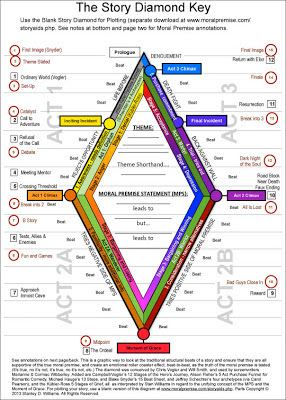
A useful structural tool is the Kübler-Ross Model of the five stages of grief. In my last workshops I have a slide that lists 7 stages, but I'm going to change that back to 5, because 2 of the 7 are unlike the others. So, 5 it is.  Here's a graphic that somewhat demonstrates the story algorithm. I say, "somewhat" because the ups and downs of one story dynamic to the next are never the same.


Where does this apply? Anytime you have a character going through a very difficult life change — death of someone close, divorce, serious loss of income, professional disappointment -- in short a grieving of any kind. It can just as easily be used in comedy, as Danny Rubin used it in GROUNDHOG DAY. (I've promised Danny to do an analysis on his masterpiece, but will need a couple days to work it out. )

Technique

Although you can structure your story in five acts, or five stages, you're better off foundationally meeting audience subliminal expectations of the 3 Acts with the help of the 13-16 turning points and sequences as described in this blog under Story Structure Basics, in The Moral Premise book, and in other good story technique books (e.g. Hauge, Snyder). Then, layer on the 5 Steps of Grief, if they apply. This will give you more turning points and twists in your story, hopefully positioned where the story is relatively slow. I have, as of this post, updated The Story Diamond Writing Aid, where you'll see the five stages overlapping with everything else. The PDF download is linked below. Click on image.

The Story Diamond Key


Saturday, January 12, 2013

The Importance of Screenplay Formatting - Part 2

I  hate spending time on this, yet it amusing... and informative.
I'm a story guy. I format screenplays out of necessity. "Structure" (a type of format) is far more important. Yet getting screenplays read by gatekeepers (especially at competitions) seems to be about format and style, and not the story, not the structure—legalism encroaches on art — flat boxes disguised as 3-dimentional curves.

Last year my post "Importance of Screenplay Formats" garnered some pushback. My original intent was to suggest that the story was more important than the format, and yet how some gurus and experts will tell you how utterly important correct format is if anyone is going to read anything you wrote. And there is truth in their assertion. I just question if anyone OF WORTH will read it.

I realize that some folks take pride in measuring indentations and circling in red the use of gerunds, adverbs, scene numbers, and SOUND EFFECTS that are not capitalized. But the sign on my bully pulpit still says: FORGET FORMATTING, just write a good story.

This mantra reminds me of Elmore "Dutch" Leonard, the prolific novelist (and source for a handful of movies, e.g. GET SHORTY) who famous said, (channeling a character from GET SHORTY):
Write the story, then get somebody to add the commas and shit.
Such elegance... and truth.

Yes, a properly formatted script will tell the studio, or any knowledgeable production manager, how long and how much money a script will take to produce. But do you think the delicacies of schedule and budget should effect your story, unless you're writing to a particularly small budget? 

I work on enough scripts that get made by studios, and I have not seen one yet that closely follows the "so called standards."  Yes, they roughly follow. But depending on who you talk to the standards are different. I've seen students criticize the format rules in Christopher Riley's The Hollywood Standard because they weren't like their USC Extension instructor's hand out.

Another thing I hear is this:
When you're famous and have mastered the art of the craft, you can break the rules.
Yes, that too is true. But young artists would be wise to copy the masters -- and that applies to screenwriting as well.

Is it possible for writers trying to break into Hollywood to be minutely concerned with formatting that the story suffers and doesn't rise to the bar? That's an interesting Catch-22.  
Write a good story, let someone else format it. 
To test the structure of my bully pulpit, since I jump up and down on it from time to time, I picked a Hollywood script that I did not work on and one that was successful at the theaters. While reading it I made a list of formatting or writing constructions that would typically cause a reader to stop by page five and throw it into the trash. What follows are 13 of the kind of problems that gurus and contest readers warn will get you rejected immediately.   But yet...well, look at this list, first:
  1. Describing what music should play in the background of the movie and listing it by artist and song.
  2. Repeated use of the phrase, "we hear...." or "we see..." in action description.
  3. Repeated use of pedantic verbs in the action description like "he looks," and "she walks."
  4. Describing camera movement, and then doing so in lower case.
  5. Use of a voice over narrator to tell the story. (Show, don't tell.)
  6. Use of bad grammar, (e.g. use of masculine pronoun with a female antecedent.)
  7. Numbering scenes.  (Never do this, we're told, even if it helps annotate feedback.)
  8. No visual scene description when entering a new space.
  9. Repeated and frequent use of gerunds (ing) and adverbs (ly) in action description.
  10. Not formatting "INTERCUTS."
  11. Not formatting "MONTAGES."
  12. A character does not "begin" to do anything, especially "watch" a "sound". 
  13. SOUND EFFECTS are not capitalized.

And what is the script that would be instantly rejected by so called value readers?  STRANGER THAN FICTION (Newmarket Press), by Zach Helm. It was this early version of the script that producer Lindsay Doran initially passed around town, instantly garnering interest from multiple directors and studios begging for the right to participate. Marc Forster and Columbia won. It stars a few names you may have heard of: Will Ferrell, Maggie Gyllenhaal, Dustin Hoffman, Queen Latifah, Emma Thompson, Tony Hale, Tom Hulce, and Linda Hunt.

Do you think these attachments cared about the bad style and formatting? Evidently not.

And how did Zach and Lindsay do it?

A GREAT STORY. The script, even in its early form, is a wonderful read.

Copy the masters. 


Tuesday, January 1, 2013

The Blind Side - Honor vs. Courage


THE BLIND SIDE


Written and Directed by JOHN LEE HANCOCK

Book: The Blind Side: Evolution of a Game by Michael Lewis


Lee Anne Tuohy (Sandra Bullock)

Sean Tuohy (Tim McGraw)

Michael Oher (Quinton Aaron)

S.J. Tuohy (Jae Head)

Collins Tuohy (Lily Collins)

Coach Burt Cotton (Ray McKinnon)
Miss Sue (Kathy Bates) 


In my workshops I talk a little about THE BLIND SIDE and express my awe at the delicacy of the shallow but poignant arc the characters' journey takes. Today, I was asked by a friend and client about the film's moral premise and how Alfred, Lord Tennyson's poem The Charge of the Light Brigade plays into the story. I had some notes, which I will share below, and perhaps expand on this at some time in the future.

The conflict of values in the story deals with COURAGE vs. HONOR. These both sound like virtues. But as we discover in Act 3, when Michael writes a critical essay, there's a difference. In the Act 3 sequence we discover that the entire movie is about the difference between having raw courage with no honor (which is what the characters in Hert Village demonstrate and temp Michael with), and  having the courage to seek that which is honorable (which is what Lee Anne Touhy teaches Michael).

Here is the poem that Michael critiques, and then a side-by-side script of Michael's essay from the movie that explains the moral premise. At the end I take a stab at the moral premise statement, which I argue EVERY character in the movie deals with in their own unique arc, from the drug dealer at Hert Village, to Lee Anne, to Michael, to the coach and even the English teacher who grades Michael's essay, giving him the GPA that allows him to get into college.


The Charge of the Light Brigade
Alfred, Lord Tennyson


Half a league half a league,
Half a league onward,
All in the valley of Death
Rode the six hundred:
'Forward, the Light Brigade!
Charge for the guns' he said:
Into the valley of Death
Rode the six hundred.

'Forward, the Light Brigade!'
Was there a man dismay'd ?
Not tho' the soldier knew
Some one had blunder'd:
Theirs not to make reply,
Theirs not to reason why,
Theirs but to do & die,
Into the valley of Death
Rode the six hundred.

Cannon to right of them,
Cannon to left of them,
Cannon in front of them
Volley'd & thunder'd;
Storm'd at with shot and shell,
Boldly they rode and well,
Into the jaws of Death,
Into the mouth of Hell
Rode the six hundred.

Flash'd all their sabres bare,
Flash'd as they turn'd in air
Sabring the gunners there,
Charging an army while
All the world wonder'd:
Plunged in the battery-smoke
Right thro' the line they broke;
Cossack & Russian
Reel'd from the sabre-stroke,
Shatter'd & sunder'd.
Then they rode back, but not
Not the six hundred.

Cannon to right of them,
Cannon to left of them,
Cannon behind them
Volley'd and thunder'd;
Storm'd at with shot and shell,
While horse & hero fell,
They that had fought so well
Came thro' the jaws of Death,
Back from the mouth of Hell,
All that was left of them,
Left of six hundred.

When can their glory fade?
O the wild charge they made!
All the world wonder'd.
Honour the charge they made!
Honour the Light Brigade,
Noble six hundred!
Some notes:


In football, Michael plays the blind side (left) tackle who protects the (right-handed) QB from what he can't see. 


Who is the Blind Side tackle in the story? Is it Lee Anne for protecting Michael Oher from what he can't see? ALSO, Michael says several times he has Lee Anne's back. So, he protects her when they go to the projects. Although she sees perhaps more clearly than Michael and is 'packing.'

At 100 min, after a short inspirational talk with Sean about how The Charge of the Light Brigade is really about LSU vs. Ole Miss football game (or so Sean leads us to think), Michael begins to write his essay, and we discover the inner secrets of what the movie is really about, and what ALL the characters struggle with, some unsuccessfully ending in death, and some with great success ending in a purposeful life.

Picture and notes
Michael's V.O. of his essay about
Tennyson's poem.
Michael writes his essay at a table in the Tuohy's home.
Courage is a hard thing to figure. You can have courage based on a dumb idea or a mistake but you're not suppose to question adults,
Montage of Michael's football coach, teachers, principal.
 or your coach or your teacher because they make the rules. Maybe they know best, but maybe they don't.
Michael walks past the gang bangers at Hert Village to join the other side. The gang is all about having courage to rebel against adult authority. There's no honor in their courage. The valley of Death to Michael is Hurt Village, which he is walking through.
It all depends on who you are, where you come from. Didn't at least one of the 600 guys think about giving up and joining with the other side (Michael Oher is that one guy.) All his buddies area dead. I mean, valley of Death that's pretty salty stuff.
CUT TO image of high school entrance arch, on which is written: "Wingate Christian School: With Men This is Possible, With God All Things Are Possible".
That's why courage is tricky. Should you always do what others tell you to do?
Lee Anne's mode of operation is always telling others what to do. She is the one in charge. Michael WALKS THROUGH ARCHWAY.
Sometimes you might not even know why you're doing something.
Michael walks into strange classroom with all smaller white kids…his first day. Does he have the courage to seek honor?
I mean any fool can have courage.
Michael sleeps on couch in Touhy's home... an unusual place for him to be.
But honor, that's the real reason you either do something or you don't.
Michael at laundry matt at night with his bag and shirt.
It's who you are and maybe who you want to be.
Sitting in the Laundry Matt reading his biology text book.
If you die trying for something important, then you have both honor and courage, and that's pretty good.
Michael rests his head back on the laundry machine after contemplating his text book. Cut to literature teacher reading essay.
I think that's what the writer was saying. That you should hope for courage and try for honor. And maybe even pray that the people telling you want to do have some too.
Michael's English teacher puts down paper and contemplates his own courage and honor when he earlier rejected Michael's attempts.


Lee Anne, Michael, and Michael's teachers all…. Hope for courage but try for honor….the moral premise arc!

THE MORAL PREMISE
Embracing courage without honor leads to a lost life and dread; but

Seeking honor with courage leads to a fulfilled life and purpose.