I just found out about this. Not much time left. Yet, regardless, some nice insight about writing for TV or movies.
http://www.scriptwritercontest.com/

 Perhaps before reading this, a brief primer on "hooks" is in order. HERE.
Hank Galliston (Anthony Edwards), publisher of a paranormal-enthusiast magazine, while trying to save his abducted wife Laila (Jacinda Barrett), learns that he must also save the world from an impending cataclysm.Conventional wisdom is that a story can have one hook, or maybe two if the second is a subset or is embedded in the first. Recall that a hook is an ironic impossibility (or improbability) that the storytellers need to make reasonable (i.e. believable.) Everything else about the story should be real (not an impossibility) so as to give the audience a footing in reality. The reality connection allows the audience to IDENTIFY with one or more of the characters. When there are too many hooks the audience can be lost trying to identify with the characters because so few plot elements have a basis in the audience's reality. One hook is entertaining, two or more are confusing.
Hank Galliston publishes the magazine Modern Skeptic, which focuses on the paranormal. His wife Laila buys a unique-looking clock from a boardwalk vendor and is later abducted. FBI Agent Riley arrives to show Hank and his copy editors, Arron and Rachel, video footage of Laila's abduction. The screen freezes on mercenary White Vincent, with whom Riley is familiar. Hank disassembles Laila's clock to find a flawed diamond. With light shone through it, the stone refracts a map. Hank shows the map and its markings to Father Mickle (Charles S. Dutton), a priest who talks of a language that died in the 2nd century. The priest also mentions the Rosicrucians, a group of Christian mystics of the time, and place called New Bartholomew. The map diamond is left with the priest and Vincent later assaults him, collecting the diamond. Hank leaves his team behind and travels to where New Bartholomew should be, with Agent Riley in tow, as she tells him White Vincent's terrorist history. Arron and Rachel travel to Bavaria to find the clock maker (Jan Tříska), who wears a Rosicrucian cross. He informs them that after the Nazis created a new "eternal life," the Church appointed twelve new "apostles" that assembled in 1938 to protect the war-torn world from doom. A clock was created for each. The apostles then scattered to hide from the Nazis. New Bartholomew was not a place, but one of the apostles. Hank finds the place on the map where New Bartholomew is located. It is a German submarine, stuck in Canadian ice, with some dead people inside including New Bartholomew, who resembles Hank. Outside, Vincent arrives as the clock maker's voiceover warns of the approaching tumultuous "zero hour".Here are the improbables for me, your improbables may vary. Any one of these is cool. Trying to find a foundation in reality with ALL of these in one episodes makes me dizzy ... with laughter.
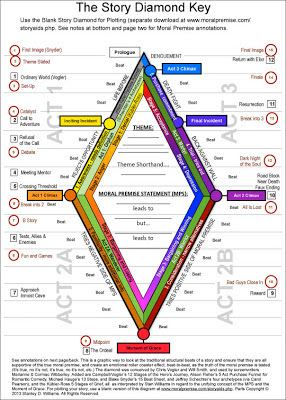
The moral premise should be evident in every scene, but what does this mean in practice? How is the moral premise made evident in EVERY scene? Is it only the vice for the first half of the film and the virtue for the second or the entire premise for every scene throughout the movie?MY RESPONSE
I truly hope you are able to answer this cry for help, but most of all I hope you see this as an honest testament of the power of your book and how it has affected writers across the globe. Your work is of great importance to us and I thank you from the bottom of my heart.

Perfection is the enemy of good.I keep telling myself that I can't do that film, or that documentary because I don't have the money. God knows I've produced enough stuff, but so much of it is just stuff, or if it's good enough I excuse myself from finishing it because I "say" I don't have the time or money.


Dear Tamera,Later, Tamera explained that her editors could not find any story threads to shorten or eliminate because the subplots were so closely interwoven to the main story. They published a book that had many more words in it that they had planned. And all her fans cheered.
I have never struggled so much to add value to a manuscript. To Whisper Her Name is a beautiful love story set against the backdrop of a healing nation. I loved the characters and couldn’t find a single one that I thought we could do without! You have captured Belle Meade and its rich history perfectly.
Tamera here: Thank you again, Stan, for your contribution to plotting this novel. You helped me tremendously in "seeing" more of the story than I've ever seen before. Ready to plot another one? : )


Write the story, then get somebody to add the commas and shit.Such elegance... and truth.
When you're famous and have mastered the art of the craft, you can break the rules.Yes, that too is true. But young artists would be wise to copy the masters -- and that applies to screenwriting as well.
Write a good story, let someone else format it.To test the structure of my bully pulpit, since I jump up and down on it from time to time, I picked a Hollywood script that I did not work on and one that was successful at the theaters. While reading it I made a list of formatting or writing constructions that would typically cause a reader to stop by page five and throw it into the trash. What follows are 13 of the kind of problems that gurus and contest readers warn will get you rejected immediately. But yet...well, look at this list, first:

 And what is the script that would be instantly rejected by so called value readers? STRANGER THAN FICTION (Newmarket Press), by Zach Helm. It was this early version of the script that producer Lindsay Doran initially passed around town, instantly garnering interest from multiple directors and studios begging for the right to participate. Marc Forster and Columbia won. It stars a few names you may have heard of: Will Ferrell, Maggie Gyllenhaal, Dustin Hoffman, Queen Latifah, Emma Thompson, Tony Hale, Tom Hulce, and Linda Hunt.
  THE BLIND SIDE
The Charge of the Light BrigadeAlfred, Lord Tennyson
 Half a league half a league,
Picture and notes
|
Michael's V.O. of his essay about
Tennyson's poem. |
Michael writes his essay at a table in the Tuohy's
home.
|
Courage is a hard thing to figure. You can have
courage based on a dumb idea or a mistake but you're not suppose to question
adults,
|
Montage of Michael's football coach, teachers, principal.
|
or your coach
or your teacher because they make the rules. Maybe they know best, but maybe
they don't.
|
Michael walks past the gang bangers at Hert Village
to join the other side. The gang is
all about having courage to rebel against adult authority. There's no honor
in their courage. The valley of Death to Michael is Hurt Village, which he is
walking through.
|
It all depends on who you are, where you come from.
Didn't at least one of the 600 guys think about giving up and joining with
the other side (Michael Oher is that one guy.) All his buddies area dead. I
mean, valley of Death that's pretty salty stuff.
|
CUT TO image of high school entrance arch, on which
is written: "Wingate Christian School: With Men This is Possible, With
God All Things Are Possible".
|
That's why courage is tricky. Should you always do
what others tell you to do?
|
Lee Anne's mode of operation is always telling
others what to do. She is the one in charge. Michael WALKS THROUGH ARCHWAY.
|
Sometimes you might not even know why you're doing
something.
|
Michael walks into strange classroom with all
smaller white kids…his first day. Does he have the courage to seek honor?
|
I mean any fool can have courage.
|
Michael sleeps on couch in Touhy's home... an
unusual place for him to be.
|
But honor, that's the real reason you either do
something or you don't.
|
Michael at laundry matt at night with his bag and
shirt.
|
It's who you are and maybe who you want to be.
|
Sitting in the Laundry Matt reading his biology text
book.
|
If you die trying for something important, then you
have both honor and courage, and that's pretty good.
|
Michael rests his head back on the laundry machine
after contemplating his text book. Cut to literature teacher reading essay.
|
I think that's what the writer was saying. That you
should hope for courage and try for honor. And maybe even pray that the
people telling you want to do have some too.
|
Michael's English teacher puts down paper and
contemplates his own courage and honor when he earlier rejected Michael's
attempts.
|

Consider it all joy, my brethren, when you encounter various trials, knowing that the testing of your faith produces endurance. And let endurance have its perfect result, so that you may be perfect and complete, lacking in nothing. (NAB, James 1:2-4)This passage hits a particular nail on the head with what we try to do --- or rather, what we MUST DO as storytellers. Our protagonist wants to reach the goal, but to do so our hero must traverse through myriad of trials and sufferings. Why do we drag our heroes through all of that? One answer is because in real life we are dragged through it all. The tests we put our hero through (as well as the trials we go through as humans) will teach our hero (and us) about life. Experience is the best teacher, after all. And simulations (movies) are a close second. Hopefully, in a redemptive story, our protagonist will persevere through the bad stuff and in the process learn something important, so that the end result her or she will be a better person -- and goal of the story achieved.


Critically acclaimed, financially successful and widely honored films are about universal values, that reflect the basic good in people: hard work, self respect, love of family, friends, community and God.
'Such films show us,' says director Mark Rydell, 'how the individual can make a difference—in his own life and the lives of others. '
'One of their messages,' says John Avildsen (director of ROCKY), 'is that ordinary individuals are capable of extraordinary acts.'The article discusses four films that do this:
 |
| Google QUERY LETTERS for more |
Paragraph 1: State the purpose of the query and what prompted you to write. "Dear Small Time Producer. // Thank you for speaking with me Saturday at the Writer's conference. Below is a log line for my completed romantic comedy screenplay, BREAKING IN, which has my bosses daughter attached to play the lead; you may have heard of her, "ANGELICA BEARTRAP."And sign off with your phone number.
Paragraph 2: The Log Line. "A desperate wannabe novelist battles the gatekeepers of a famous editor by breaking into the editor's office to put her manuscript on the top of the editor's pile with cleverly written faux coverage. Unbeknownst to the desperate writer, the editor is a nigh owl who returns to her office to find the writer caught by and flailing from from the ceiling fan like a monstrous mobile."
Paragraph 3: No more than 25 word bio of your professional credits. You can add another 25 words if someone of note has said something good about your writing, not your cooking, or your good looks, or how nice your mother is.
 |
| When writing...don't be presumptuous. |


