Tuesday, June 14, 2011

Getting Focus Group Feedback

Like a lot of you, I continue working on a number of story projects. One current project is NAUGHTY LITTLE NAZIS (D.K.N.), originally written by Nikita Mungarwadi when she was 13. At the time Niki went to the middle school where my wife, Pam, teaches. One day Pam came home and said that one of the students at school (but not one of hers) had read my book, The Moral Premise. That got my attention. It wasn't exactly written for early teen consumption.

The second sentence out of Pam's mouth was that the girl had written a screenplay and wondered if I'd read it for her. If the sentences had been reveresed I would have said "No, thank you." But how could I refuse to at least flip through the first few pages of the screenplay a teen had written after reading my book? It seemed "sacriledge" to say no.

Nikita Mungarwadi
So, a few days later a screenplay came home with Pam titled NAUGHTY LITTLE NAZIS. To say the least, it rocked my socks. I could hardly put it down. It needed some work to be sure, but the third thing that caught my eye was the author's name, "Nikita Mungarwadi." I have some connections to India, and as I found out Niki was an American off spring of Indian immigrants. Her Dad is the director of water distribution for S.E. Michigan for the City of Detroit.

I had to meet her. To make a long story short, I volunteered my time to work with Niki at their kitchen table with her dad helping us with Internet research about Germany during WWII.  We worked off and on for six months, and then I bought an option on the project to develop it further.

Here's the log line for the war-time action story:  A rebellious 14-year old German girl battles the Nazis to free her Jewish friends from the Ghetto before it's liquidated.  (The story is loosely based on a compaction of the teenage resistance groups active in Berlin during the war, which required considerable research on Nikia's part.)

Sanjeev (dad) and Nikita Mungarwadi, Stan Williams, Alex Krüger, Pam Williams. 

One of the problems with stories that are outside your experience is how to get a reading form someone that might know more than you do about it. The story had to read well to a German teenager, preferable form Berlin, I figured. Where was I going to find one of those, I thought. I'm in Michigan, and it's been decades since I was in Germany.

Niki and Alex. Alex returns to Berlin this week.
As it happened (for the convenience of this story) my son's family, who lives nearby, were hosting a 17-year German boy from Berlin as a foreign exchange student. The boy's uncle was in the Hitler Youth Corp. Such luck. Alex agreed to read the recent draft, and after Niki read it, and Pam, we all met for dinner at a local Indian restaurant.

Alex had a lot of great ideas for the character names to make them more traditional and German. With Nikita and Alex we refined a few scenes that they thought needed more danger and excitement. It's been fun working on a script written by a teenage an American-Indian girl, with a teenage young man from German (who's nearly forgotten how to speak in German after being the U.S. for a year), while sitting in an Indian restaurant in Michigan. Great Feedback. Now it's on to the next draft.


Saturday, June 11, 2011

The Good of Conflict and Immorality in Movies

What follows is an article I wrote for a Catholic website in 2003, while I was writing the first draft to The Moral Premise. I'm resurrecting it here for the record and to facilitate some discussions with some I consult with about the nature of the motion picture industry.

=======

THE GOOD OF CONFLICT
AND IMMORALITY IN MOVIES


Often I hear Christians complain about the protagonist in a movie because he or she made one or more immoral decisions, and is therefore a poor role model. Another oft heard criticism is that movies are filled with too much on-screen conflict or violence, thus giving audiences the wrong idea about how to resolve problems.  


These are definitely valid concerns to the extent that the on-screen portrayal of conflict and immorality is gratuitous.  But for most popular films there are some very good and moral reasons why movies must be about imperfect, immoral human beings, and why the conflict and suffering must be made visible. 

The word "must" in that last sentence is pretty strong, so let me explain. In the history of civilization, stories have played a very important role in forming our culture by passing on history, defining cultural norms, teaching us how to deal with problems, and answering burning questions like, "Why is there suffering?"


Educational gurus might divide the world of learning into three kinds of instruction: (1) experience, (2) observation, and (3) lecture. Experience is the best teacher. Lecture is the worst. The reasons for that have a great deal to do with the number of senses, and consequently the degree of emotional involvement of the learner. The greater number of senses involved, the greater the emotional tension, and thus the deeper the learning.
Whereas lecturing involves only one sense—hearing, experience demands the active participation of all six senses [Footnote 1].  


Experience also involves physical and emotional risk. Risk situations cause the release of adrenalin into our brain etching deeper memories about the experience and its lessons.

Somewhere between experience and lecture is observation, and the modern "movie experience" which is closer to SIMULATION. 


Why Simulation? The darkened theater is replaced by extreme realism, and audience members are transported into the on-screen character's world. To a great extent, movies become so real for audiences that they are almost as good a teacher as experience itself...including the sense of personal risk. 


But, do we want movies to teach us things? After all, the people making movies, so conservative Christian sentiment goes, are immoral pagans who ridicule God, don't go to church, and well, do everything in their life wrong. On some level, with some filmmakers, that can be true. Yet, when it comes to moral lessons that agree with Judeo-Christian values, there is an astonishing phenomenon. 


As it turns out, when a movie conveys moral truth it "sits right" with audiences, and word of mouth increases the film's popularity, tremendously. Conversely, when a movie is morally deceitful, people avoid it. Over the years, filmmakers have recognized this. (Actually, in POETICS, Aristotle was the first to write about the correlation between the truth of a play's moral message and its popularity.) As a result, today, it is a safe bet that a box office success is also a movie that conveys a true moral message [Footnote 2] 

All of that brings me back to the criticism about immoral characters and on-screen conflict. Without these elements movies would be incapable of presenting positive moral messages, infusing us with hope, or suggesting answers to why we suffer. If we remove the immorality and conflict we are left with no drama, no story to tell, and no lesson to learn. Showing the problem allows us to learn how the protagonist overcame it, or the consequences if he doesn't. 


Here then are seven reasons why the appropriate, and not gratuitous, portrayal of conflict and immorality are necessary, not just in motion pictures, but in all stories, if those stories are to effectively teach us moral lessons.


1. Identity. Conflict and immorality are revealed in the life of a protagonist who is like us. This allows us to identify with the protagonist, and see that his problems are, or could be, ours.


2. Meaning. How the protagonist resolves the conflict and immorality reveals the meaning of the associated suffering. We translate that meaning to the suffering in our lives. 


3. Consequences. The protagonist's decisions regarding the conflict and immorality result in consequences. We learn that similar decisions in our lives could result in similar consequences.


4. Hope. The protagonist's hope and perseverance in dealing with the conflict and immorality allows success. We are thus encouraged to hope and persevere, and likewise overcome our problems.


5. Risk. The on-screen protagonist must count the cost and take risks in opposing the conflict and immorality. This reminds us that our noble intents are worthless unless we honestly count the cost and are also willing to take risks to defeat sin and evil. 


6. Sacrifice. On screen heroes often suffer and sacrifice emotional and physical loss in their effort to love and save others from harm. Those are examples to us, of how we are asked to love our neighbor and families, and resist sin, even shedding our own blood in the process. [Footnote 3]


7. Visible. Movies are really about spiritual and emotional conversion. But since we can not see such journeys, filmmakers make the reality of that most important journey visible in the physical realm, as a metaphor. While we may think our spiritual journey is only spiritual or mental, the proof is in our behavior, in our actions and works. What we do in the physical realm, represents exactly what is going on inside.


So, the next time you go to a popular movie, recognize what it is you're watching. Look for and analyze the moral messages, and recognize that without the appropriate portrayal of conflict and immorality, there would be little to be learned about how to live in our conflicted and spiritually dangerous world.


[1]  There are six, not five senses. Most forgotten is the sense of balance, which is necessary for physically activity, including sitting in a chair during a scary movie. 


[2] Whether a movie conveys a morally true message has nothing to do with its ratings or appropriateness for children. See MEANINGLESS RATINGS.

[3] "In your struggle against sin, you have not yet resisted to the point of shedding your blood." Hebrews 12:4

Meaningless Ratings (2002)

What follows is an article I wrote for a Catholic website in 2002. The article reveals some of the motivation behind the research that resulted in The Moral Premise, which was begun the next year. I'm resurrecting it here for the record and to facilitate some discussions with some I consult with about the nature of the motion picture industry. It is dated, so I've done a little editing and added a few comments [in brackets].
=======
MEANINGLESS RATINGS

"I'd rather write an R-rated film that told the truth than a G-rated film that lied." That's what respected Christian producer and screenwriter, Brian Bird, said to me over lunch recently in Hollywood. He was tired of taking his children to see G-rated Disney fare that presented a worldview that was distinctly non-Christian — e.g. elevating faith in magic and fairies over faith in God and the angelic hosts.

For Christians, the Motion Picture Association of American (MPAA) film ratings, and the recent TV-ratings, do not tell whether or not a film is acceptable — to children or adults. But as a rough gauge of acceptability, they have provided some help. Or so I thought until recently.

When we first started our motion picture development company we made a decision to focus our efforts on writing only G, PG, and PG-13 rated films. No "R-ratings" we said — unless we felt particular inspired to do something as poignant as Schindler's List and we avoided gratuitous elements. But in recent months, some of the PG-13 films that have hit the theaters have caused us to rethink that rule. [And in 2004 there was THE PASSION OF THE CHRIST with a strong "R".] Increasingly, films that used to be rated R now appear to be rated PG-13. So recently we made the decision that our efforts would instead focus only on G and PG ratings, with PG-13 as the rarely allowed exception. [This makes business sense as well. The fewer admittance restrictions to a film, the higher potential box office.]

What is going on inside the MPAA rating board wasn't announced but it is being noticed. Peter Bart, VP and Editor-in-Chief of Hollywood's most respect trade publication, Daily Variety, wrote in his August 5, 2002 editorial “PG-13 Pictures Rate an 'R' for Raunchy” (p. 19):
More and more films like Austin Powers in Goldmember — movies steeped in toilet jokes and sexual innuendo — are earning PG-13 ratings rather than the more restrictive ratings they might have received a few years ago.

Is it pure coincidence that ratings mavens have seemingly become more liberal at a time when the major distributors are more conservative? When I asked one studio chief last week, he sat back and grinned: "Puzzling, isn't it?"

But parents may not be puzzled about whether they'd like their 13-year-olds to become aficionados of Austin Powers. Sure, no nasty penises or vaginas are on display (just some interesting facsimiles), and no one commits sexual intercourse, but the overall level of humor makes American Pie (which got an R) seem like a course at the Harvard Divinity School. When Dr. Evil refers to his lair, a submarine, as "long, hard and full of seamen," he is actually lifting the level of dialogue.
To set the record straight there are a number of motion pictures with PG-13 and even R ratings that, although they are not suitable for children, tell morally valid, redemptive stories with strong Judeo-Christian themes and values. Among such recent PG-13 films are: PAY IT FORWARD, THE APOSTLE, and WHERE THE HEART IS. Worthy R rated fare include WE WERE SOLDIERS, AMISTAD, THE GREEN MILE, AND BLACK HAWK DOWN, [and in 2004, THE PASSION OF THE CHRIST].

On the otherhand, there are also movies that deserve their restrictive R rating for no reason other than the filmmaker, in possession of a truly redemptive Judeo-Christian story, made stupid decisions regarding language and sexuality. One such movie is MAGNOLIA — a film that I would highly recommend if it wasn't for the zillion or so [unnecessary] expletives.

What Peter Bart suggests is that the MPAA ratings board has caved into the desires of filmmakers and the studios to produce raunchy, vile movies yet not necessarily jeopardize their $50 million marketing budgets. Instead of an R rating they get the more marketable PG-13. Why is the R rating now a problem when five years ago it wasn't? Because, not only are parents keeping a closer eye on what their kids are seeing, but theaters are doing a much better job of keeping kids out of R movies.

Additionally, TV shows with kid audiences are likewise turning away advertisements for films with R ratings. All of that hurts attendance. And while that's good for parents, it's bad for filmmakers of such fare. So, to help the studios and distributors appear to have a cleaner image, MPAA has embraced what might be called “ratings equivocation”. What used to be R can now be classified as PG-13. The result? Less conflict with critics, and more tickets sold ... to kids.

Parents beware. Don't read too much into a rating. Instead, get the scoop on the story and read what good Christian reviewers are saying about the picture, [although I still cringe at how some Christian reviewers count sweat words, and the number of times little Billy gets slugged in the stomach by big Bully. See my other post on "The Good of Conflict and Immorality in Movies.]  Better still, go ahead of time or along with your child or teen, and don't be embarrassed to walk out.

I love the movies. I produce them. But in regard to my children and grandchildren, I have little patience for irresponsible filmmaking.

Friday, June 3, 2011

Villains "Noble" Intent


In story development we often speak of heroes as having a weakness or imperfection. It is what allows audiences to identify with the protagonist and morally be sutured into his or her life. We also speak of villains has having an understanding (within themselves) that what they are doing is just, good, and right. No one else may believe it, but the villain, in his or her twisted logic, believes it.

This "light" of righteousness, as dark as it may be, also allows the audience to identify with the villain. Why? Because subconsciously, we, the audience, know that our best intentions often miss the mark. What we think is right, is often wrong. Maybe not to the extent that we'd be thought of as a villain, but it does put us in that arena.

What is right and wrong lies on a continuum. See this POST.

Today I was struck by three headlines where the three villains written about all have noble intent behind their actions. AP reports both:

From the AP & Fox News: Dr. Jack Kervorkian, the Michigan pathologist who championed physician-assisted suicides, died early Friday after being hospitalized with kidney problems and pneumonia. The 83-year-old Kevorkian, who said he helped some 130 people end their lives from 1990 to 1999, died about 2:30 a.m. at William Beaumont Hospital in Royal Oak, Michigan."

Notice the "noble" smile on Jack's face as he prepares again to help kill someone. Have you seen this man's "art."  Google it. It's what an art director would create for a villains lair.

And then there's Ratko Mladic claim:

From the AP and Fox News: "Ratko Mladic defiantly refused on Friday to enter pleas to what he called "obnoxious" allegations that as the Serb military chief during the Bosnian war he orchestrated the worst atrocities of a conflict that claimed 100,000 lives. He claimed he was defending "my people and my country."

Notice the ironic patriotic salute.

Well, we don't want to be like these guys, but they're great "role models" for our story's villains.

And just a reminder... the villain can be the protagonist.

Saturday, May 28, 2011

Big Yacht Repower - Post Production

This is about a documentary I produced, shot, and edited. The shoot began November 2009, ending in July 2010.  It was aired on Detroit Public Television in 2011. The On-Line version LINK is HERE at YouTube.   The video is embeded below.

Disclaimer
I put this in my moral premise blog because I don't have a production blog. It's out of the ordinary post for the others found on this blog because it does not deal with a mainstream feature film. However, Big Yacht Repower does have an imperfect protagonist: An Old 53-foot Hatteras that leaked oil and went slow.  The moral premise could be stated like this:
Old, leaky diesels lead to slow passages and low fuel economy. New, high-tech diesels lead to fast passages and high fuel economy.
Production notes and jacket copy below.


If the video doesn't play here easily, click on the YouTube icon  to watch on my channel at YouTube. 


Retrospect

Producing this took me back to my days of directing technical training video discs for Ford Motor Company. But back then I had great budgets with decent size crews,  Ford's engineering departments to prep props and set pieces, a huge studio just 50' feet down the hall from my cubicle, and often a travel budget. Big Yacht Repower was just the opposite in about every way, with one exception. Back then we were editing on 2-inch wide Quad tape and the best editing equipment available in the world. Each hour of tape in it's aluminum 15-inch diameter reels weighed 20 pounds. Big Yacht Repower was shot on a nearly obsolete SD, tape based camcorder. Each hour of 1/4-inch wide tape was in a tiny plastic case that weighed a few ounces. In the Quad-tape days I needed a study hand-cart, a van, and a strong back to take tapes to an edit facility. With BYR I could stick everything in my pocket, and thanks to Apple's Final Cut Studio suit of applications, edit on my laptop with sophistication I couldn't dream of back then.

Jacket Copy
BIG YACHT RE-POWER is the gritty inspirational documentary about the repowering of a classic Hatteras 53-foot motor yacht with two massive new diesel engines. It's a fast-paced forty-minutes featuring a handful of savvy marine technicians at the Gregory Boat Basin, a 100-year old Detroit marina, who upgrade the engines and technology on the old but beautiful boat, turning it into the faster boat of its kind on the water.

The doc was shot during the winter of 2009-2010 at the Gregory Boat Basin in Detroit. The boat is "Signature One" owned by Scott Gregory. That spring and summer we edited the project. We did it as a marketing piece for the Gregory Service and Restoration Departments. The whole story is told with visuals, music, and superimposed type. Pure visual storytelling.

Production Notes

I shot it on a Panasonic DVX-100A at 24P 16:9 with the help of a wide angle anamorphic lens adapter. (Standard Definition). I shot everything at 24P; but should have shot it at 24PA. The 24P mistake required I remove all the 2:3 pull down elements via Final Cut, and then adjust all the special effect time maps (time lapse) elements.  But in the end I had a true 24 fps timeline. (Note to Stan: Shoot 24PA from now on.) The combination of the small size camera, the low-light sensitivity, and the extra wide angle adapter allowed us to get in spots that even with the Panasonic 200 DVX HD would have been impossible. Lots of fun, a truck load of work, but very satisfying.

After months of editing I showed it to WTVS (Detroit Public TV) thinking it might make a good midnight 40-minute filler. They enjoyed it so much that they offered to use it as prime-time pledge break if we could find a matching sponsor. There were enough companies involved in the project, but no one could afford the matching pledge liability (they must have thought a lot of people would be watching) -- Duh!  So the premiere airing got bumped to March 19, 2011 (a Saturday) at noon and very few watched.

But before airing, I spent weeks color correcting the project (actually more black and peak level adjustments with some additional tweaks at the gamma) and preparing the elements for up-resing from standard definition to HD.  With the competent advice of editor Don Thompson at WTVS I upgraded my Final Cut version, and then recreated all the superimposed type and chapter headings in HD. The SD was up-resed to HD (1080x1240) and imported into a Final Cut HD timeline, into which all the HD type and Photoshop elements were added. That timeline was then rendered to produce the HD end product.

Seeing this on PBS in HD, and being a guest on the pledge-break that aired it, was a rewarding experience.

My thanks to Scott Gregory who bartered years of slip and storage fees for our 41-ft ketch, FAMILY TIES, and support of Dan Miller and his crew who did the expert work and didn't complain when I was in the way or asked them "Can you do that again?" and Scott Gregory, Jr. for piloting the camera boat for the final on-the-water at sunrise shots that cap off the project.

The completed project with a couple of bonus tracks can be ordered on SD DVD HERE.

Wednesday, May 25, 2011

Rollercoaster Charts

Just finished a couple of revision passes on D.K.N. (Naughty Little Nazis) a screenplay by Nikita Mungarwadi that we're developing.
Log Line: A 14-year old German girl battles an Nazi S.S. officer and his platoon to rescue her Jewish friends from the ghetto before they are liquidated.
The most recent revisions dealt with pacing. Since this is a war-time action picture, we had to make sure there were no long slow spots. In fact, while producing this graph we eliminated six pages that slowed the story down.  The numbers on the bottom indicate "calculated" pages based on Final Draft's 1/8 page as the smallest scene length... the actual script is shorter than the chart indicates.

Click to Enlarge

The top chart (Progress vs. Regression toward Goal) measures the scene's portrayal of the protagonist's progress or lack of it toward her goal. The Moment of Grace is near the center of the chart at the GREEN ARROW. Until that scene the protagonist's efforts are up and down, without any great progress. But after the protagonist learns some tough lessons that takes her to apparent defeat (end of Act 2) -- she rises to apply the moral premise and finally make serious progress toward her goal. Yet, there are repeated set-backs of ever escalating danger all along the way.

The bottom chart shows how much reflection vs. action exists and where.  As we should hope, as the story progresses the action becomes more intense, with the clear majority of the story above the line, well into the action arena.
The RED arrow is the Inciting Incident. BLUE the beginning of Act 2. GREEN the Moment of Grace. PURPLE the Climax to Act 2. YELLOW the beginning of the Final Conflict, with the Act 3 Climax occuring there the action and the coaster action gets the most fierce. These turning points are not positioned perfectly, but they respect the dynamics of the story. As we move forward we may find the need to adjust them.

If you want to know how these charts were created, HERE ARE THE INSTRUCTIONS. I began with Final Draft's Scene Report and used Excel 2011 chart generator.

Friday, May 20, 2011

Indexed Values

Recently I subscribed to a blog post called INDEXED. Occasionally the creator, Jessica (whom I suppose a wannabe atheist (*) based on some of her posts), produces a Venn diagram or graph that touches eloquently on the conflict of values that we use in creating stories. While some will claim that her interpretations of things are not universal, I think they do, for the most part, connect generally with the human condition.

I also like them because they are mostly visual, which is what movies are all about -- show, don't tell. Pictures are worth thousands of words and her little index cards are great examples of this truth.  I hope you can see protagonists and characters carrying around these cards (figuratively) in their pocket, and at a particular turning point in their story, they take the cards out and study them.


The challenge, perhaps to my students, fans, and clients is this: Take your story and create a graph or Venn diagram for the Conflict of Values your protagonist faces. Put that card in YOUR pocket, and when you're waiting in line, or stuck in traffic take the card out and imagine that your character is in your situation at that moment, sitting next to you. How would they see your current predicament in terms of the conflict of values that is illustrated on the card?

(*) I call all atheists "wannabes" because logically they have no rational basis for declaring there is no God. To do so, they would have to be omniscient... an attribute assigned to the essence that knows all things perfectly without error or contradiction. You can't claim something does not exist when your knowledge of the universe and reality is microscopically small. I'll accept agnostic, but not declarations. Every human discipline offers only a spec of knowledge of what is potentially possible. Science and theology are no exceptions to this. Some of what was known as universal truth by science 100 years ago, today is bunk... and the thousands of Protestant Christian faiths that all disagree with each other suggests a similar uneasiness. I'm Catholic for a host of reasons, not the least of which the Church does not claim to have all the answers. It has always embraced mystery as a tenet. That there is mystery in the universe/reality,  is what makes stories, in part, work. We are bounded by time and space. Stories working through our imagination allows us to see reality from a perspective that transcends space and time.

====

I wrote the above on May 20. On May 25 Ms. Hagy posted this index card:


Thursday, May 19, 2011

The Moral Premise is Now Likable on FACEBOOK

I've desired to carry on discussions with my many readers, and answer their questions form time-to-time. Nearly 100 people visit the Moral Premise blog each day. So, we have finally created a PAGE on FACEBOOK for The Moral Premise. Please "LIKE" us and join in the discussion about popular story structure, motion pictures, novels and comics. I'll do my best to keep up. LIKING us will also allow me an easier way to communicate to you about new features, workshops, and story ideas. Here is the link:

Wednesday, May 18, 2011

Produced by Faith

I just finished reading Produced by Faith: Enjoy Real Success Without Losing Your True Self, by DeVon Franklin, VP Production at Sony Entertainment. I picked up the book because DeVon was the studio executive from Sony/Columbia on Will and Jadden Smith's KARATE KID (2010). DeVon also worked with Will Smith as an intern some years back during his USC days.

If you're a regular reader of this blog you know that I'm a fan of metaphors, and all successful movies use them. Produced by Faith uses the creation of a successful movie as a metaphor for creating a successful life. DeVon also recounts some of his experiences during his rise to VP Exec. at Sony Entertainment.

But the reason I'm blogging about it here is because he spends a whole page (70) talking about The Moral Premise.  In part he writes:

FINALLY, AS YOU'RE WORKING on your script, you must know your moral premise and live by it. In his book The Moral Premise: Harnessing Virtue & Vice for Box Office Success, Stanley D. Williams, Ph.D., says that a popular movie always contains a moral premise that we all hold to be true. In The Karate Kid, it might be "Live in fear and you will die, but face your fear and you will triumph."

Most good movie scripts feature a powerful, universal moral premise that audience members can identify with. Your story must be built on a similar bedrock. What virtue do you extol in your work and what vice do you condemn? What do you stand for and what do you stand against? The moral premise of your faith should be the arbiter of how you act in business.

I'd like to point out that the Karate Kid (2010) MPPS statement he articulates works for the movie quite well, although it's not one of the several possible that I mentioned in my other post on the movie, nor is it one that came up during the multiple times I interfaced with Will and his team about the movie. DeVon's insight in what the movie is about adds an understanding that successful movies are true on various levels allowing them to connect with multiple sensitivities of broad audiences. 

I highly recommend this book.... and not because it mentions TMP... although that always helps.

Sunday, May 15, 2011

Michigan Film Incentives - Entrepreneurial Motherload

Below is testimony given by Detroit 187 (Now Cancelled, thanks to Gov. Rick Snyder) actress Erin Cummings before the Michigan State Senate Economic Development Committee 5-13-11 at the new Raleigh Studios in Pontiac, MI.  The subject is whether or not to continue the State Incentives for the Film Industry. She says briefly what we've all been saying for years. When you bring smart, entrepreneurial people to an area, their presence is felt in a multitude of ways.


MOVIES ATTRACT SMART ENTREPRENEURS
I voted Republican, and for Gov. Snyder for a host of reasons, most of them economic. But Snyder's arrogance on the Film Incentive issue, and his stupidity about what attracts people to a state for business puts him on my recall list. His former company, Gateway, is now just 40 miles from Hollywood. They're there, I conclude, because of the intelligence of the work force, which in part is in the Los Angeles area because of the immense intellectual requirement that motion picture development, production and distribution requires. L.A. attracts many of the smartest people in the world due to the movie industry. But not all of them end up making movies, nor do their off-spring -- which are born with the entrepreneurial smarts in their DNA. The result is a host of other industries and businesses that foster products and employment. It's not just the weather. And it's definitely not all about lowering business taxes... which the incentives do.

Unlike any other industry, the motion picture industry requires workers from every imaginable discipline on the face of the planet. There is not an industry that it does not touch. Name a job title, and you can find someone doing that to help make a movie. There is no other industry like it in the world. And while many motion pictures lose money (some would say most do), the financial upside is so great that it produces billions of dollars in total revenue each year, around the world -- to say nothing of the entrepreneurial charity work that Erin mentions.


Wednesday, May 4, 2011

WRITING GOOD LOG LINES


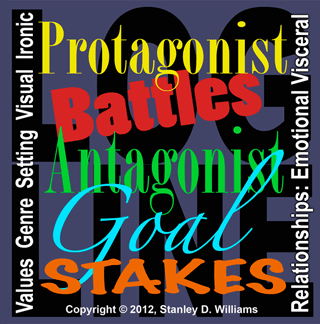
A key ingredient of the Log Line is the Story Hook. Here's a link about Hooks

Also, another explanation of this graphic and the log line is found HERE.

=====

This is the last article you’ll ever need to read on log lines. Our goal: a strong, pithy pitch for a movie that will keep you focused as a writer and get your audience into the theater.

Because I teach, consult, write, and direct, I am always in desperate need of a good log line. If not for the story I’m currently working on, then to explain to my wife what I did all day long at home while she was off earning money to pay for our groceries. I’m always having to come up with them, or help others figure them out – the log lines, not the groceries.  So, I needed an easy to remember formula that worked. But first, I needed a motivation. Don’t we all?

WHY LOG LINES?
Originally, log lines were long thin ropes on a spool with knots tied in them that mariners unreeled behind their ships to measure their speed – in KNOTS. They counted how many evenly spaced knots passed through their hand as the sand in the hour-glass drained from the top to the bottom. The mariner’s log line was a necessity in helping them navigate their journey and not get lost. It told them how far they had gone in a certain direction and when to turn the boat to find their destination.

[The other advantage of the marina’s log line was that if the boat got lost, the sailors simply had to follow the log line back to port. As time went on, and captains become more adventurous sailing to distant lands, the log lines got pretty big. But, after a few ships sank from the enormous weight of the reels, ships never got lost again. Why? They learned their lesson and never ventured far from port.]

Now, if that last part in brackets sounds like a joke, it wasn’t intended as such for the writers reading this. It’s the lie that tells the truth -- about the importance of log lines. Log lines help us navigate our writing. They also help to steer funding and attachments to our projects. And they direct audiences to theaters. Log lines are a necessary tool that keeps us focused in writing our story, and helps convince “names” to spend their time and money to get our story made and distributed. A good log line tells us how far we need to go before we arrive at a turning point in the plot. And, if we get lost, a good log line will lead us back to the beginning where we can start again.

THREE METHODS
Below, I outlined THREE methods of writing a log line, but I favor the first, and so the examples at the end of this post use the first. Use whichever sounds the most intriguing. Different stories/genres may lend themselves to one better than another. But all three need to at least imply all the critical elements of a good log line, which are listed in the next paragraph as I also describe the first method.

THE FIRST METHOD and ELEMENTS OF A GOOD LOG LINE
Fundamentally, a good log line will be a single sentence that will includes five elements.

The subject of the sentence will describe (1) an imperfect but passionate and active PROTAGONIST. The verb will depict (2) the BATTLE. And the direct object will describe (3) an insurmountable ANTAGONIST who tries to stop the protagonist from reaching (4) a physical GOAL on account of (5) the STAKES, if the goal is not reached.

The formula graphic at the right show you one possible way of organizing the log lone sentence. Notice that the terms (i.e. placeholders) I've chosen for the formula should be replaced or implied with specific nouns and visceral terms that fit your story. You don't have to be explicit, but you do need to communicate the moral and emotional tone that causes your protagonist to leap off the page with passion. That is, the log line is better if the words chosen enhance the story's marketability by suggesting the movie’s:
  • Values
  • Genre
  • Setting
  • Visual
  • Ironic hook
  • Relationships in the balance
  • Emotional context, and
  • Visceral action.

VERB
The verb you choose to depict the struggle must be visual and active. After all this is a movie, not a play or a novel. Thus, the log line verb should be one of the following, or one like them that best suits the genre:

struggle, battle, contends, wrestles, grapples, scuffles, fights, wages war, jousts, duels, spars, scraps, opposes, takes on, clashes, quarrels, feuds, or crusades.

STRUCTURE
Now, take all those elements and put them into a compelling sentence in this order:

[protagonist]…[verb]…[antagonist]…[goal]…[stakes].

What it doesn’t sound right? Then, rewrite it. You do know what a rewrite is, don’t you? As formalistic as all this sounds, expect to rewrite your log line many, many times --- not necessarily at first, but over the time that you develop your story and script. 

MORAL PREMISE
Having written the book The Moral Premise, it’s only fitting that I reference it here. While the log line describes the PHYSICAL essence of the story, the moral premise statement describes the inner working, or the PSYCHOLOGICAL essence of the story. If you’re not familiar with the moral premise statement construction, here’s an example. Its purpose is to articulate the arc of the story from psychological value to physical consequence. For instance:

Fear leads to paralysis; but
Courage leads to action.

The log line only hints at the context of the moral premise statement. Both are necessary to write a strong story that touches both physical and psychological beats.

Again, it’s worth repeating: While the log lines tell us what the movie is about PHYSICALLY, the Moral Premise Statement  tells us what the movie is about PSYCHOLOGICALLY, that is, the Moral Premise explains the conflict of values and the character's inner motivations which incites the physical action.

Audiences leave the theater thinking well or ill of a movie based on their subconscious awareness of the moral premise’s truth and consistency. Start with a good hook, then develop a good log line that includes the hook. Then, establish a true and consistent moral premise statement. With those tools in hand you’ll be well on your way.

THE SECOND METHOD - 4 QUESTIONS AND 4 ANSWERS

My friend Jeffrey Alan Schechter makes the justifiable claim that a good log line should clearly and unambiguously answer these FOUR QUESTIONS:
  1. Who is your main character?
  2. What is he or she trying to accomplish?
  3. Who is trying to stop him or her?
  4. What happens if he or she fails?
The answers to those questions, which MUST BE embodied in the log line, are:
  1. A sympathetic character, who is
  2. trying to accomplish a compelling goal while being opposed by...
  3. a powerful and committed opponent, over
  4. life and death stakes.
You see this is very similar to the first method, so I'll stop here on this.

THE THIRD METHOD - THE STORY QUESTION LOG LINE

Another intriguing method of constructing log lines is the Story Question Log Line. It might be formulated like this:

Will an imperfect PROTAGONIST be able to BATTLE an all powerful and ubiquitous ANTAGONIST to achieve his or her IMPOSSIBLE DREAM (e.g. a PHYSICAL GOAL)?  

[Example:  Will a lonely young man be able to fight off depraved government officials and blood-thirsty scientists, who want to cut up and dissect his new girlfriend — a real mermaid?]

LOG LINES: THE BEGINNING AND THE END

Log lines, as I said above, are the place that writers start. Log lines help to focus the filmmaking team as they move through the process of writing, development, attachment, production, and then marketing. But the best log lines are usually written AFTER the movie is finished. Why? Because movies are made three times: in the writing, in the shooting, and in the finishing. And it's not until it's all over that we really know what the film is about, and what the characters are REALLY about.  At any rate, log lines are critical to understanding what makes a good story. 

EXAMPLES USING THE FIRST METHOD
Here are a few good log line examples.
•   A naïve young man battles heartless authorities to protect the life of his girlfriend when it’s revealed that she’s not human— she’s a mermaid.
•   A police chief, with a phobia for open water, battles a gigantic shark with an appetite for swimmers and boat captains, in spite of a greedy town council who demands that the beach stay open.
•   A Parisian rat teams up with a man with no talent to battle convention and the critics that anyone can cook and open their own restaurant.
•   A lawyer who loses his ability to lie for 24-hours, clashes with his ex-wife for the affection of their son and the healing of their family.
•   A young farmer from a distant planet joins the rebellion to save his home planet from the evil empire when he discovers he is a warrior with legendary psychokinesis powers.

GIVE IT TIME – BUT DON’T STOP
Nothing good comes easily. That adage begins and ends with log lines. Their importance in the movie industry (and in all storytelling efforts) cannot be overstated. The human mind requires a respite from time-to-time to reach its full potential. Within your mind is the capacity to not only write a good log line, but construct the good story that goes with it. Write hard each day. But then relax and do something that involves physical activity aside from sitting in a chair and bending over a computer. Writing is hard work -- but you need exercise, too. I spend the mornings writing. In the afternoon I chop logs, garden, sail and chase my wife around town. You’ll be surprised how your mind assimilates and solves problems when you’re not trying to force it. As your project develops never stop coming back to your log line and see if you can make it that strong, pithy pitch that will sell your story.


Dr. Stan Williams, author of The Moral Premise: Harnessing Virtue and Vice for Box Office Success, consults on story structure, screenplays and the film industry from his home in Michigan and from the road in Los Angeles. You can reach him through his website at http://www.moralpremise.com.


Copyright © 2011 Stanley D. Williams


Thursday, April 28, 2011

Sell the Story

This article which I picked up from DIY Musician, written by Scott James, originally appeared on Echoes.

In 2009, Rob Walker and Joshua Glenn tried out a little experiment. They spent $128.74 on a bunch of yard sale junk and hired professional writers to draw up interesting stories about each item. Then they put everything up on eBay with the stories that they created to see what happened.

They spent $128.74 on junk and turned that into…$3,612.51!

How does that work?

Sounds like a good question that’s worth exploring, doesn’t it?  You might find some insight from the story of a flannel ball that they sold.  A pretty worthless object, right?  Not much practical value there.  Accordingly, they originally paid $1.50 for it.  You might be surprised to know that they ended up selling the ball of flannel for $51!

How? Well it all started by imagining it as something with a story.  Something beyond just the utility value.  Check out the first paragraph of the story that was written for it by Luc Sante:

After my friend Claude had his accident I went to visit him in the hospital. When I saw him I had to cough to divert a laugh. He looked like a guy in a cartoon, his entire body wrapped in bandages. He had broken everything that could be broken, from his skull to his toes. Somehow he was conscious and could speak, although to hear him I had to put my ear right up to his mouth-hole. I thought he said “door,” so I shut it, but he was still agitated. Eventually I got it: “drawer.” The one in his bedside stand contained a single object, a ball of wrapped flannel that looked like his head, only more colorful. I went to pick it up with my fingertips, but then had to readjust. Astonishingly, the thing weighed at least five pounds. I gaped at it, but Claude was making noises. I finally understood: “Don’t unwrap it.”

Suddenly we’re not thinking about the intrinsic value of a ball of flannel, but instead we’re drawn into a story… and ultimately projecting the intrigue and emotions of the story onto the object.  What we have to realize is that people aren’t paying for objects, they’re paying for the meaning that they assign to the objects.

So when you’re pitching your CD, are you communicating that you’re just selling your CD or are you communicating the story of the blood, sweat, tears, fun, hope, dreams, inspiration, excitement, talent, heartache, challenge, and triumph that went into it? What are you saying about it on stage? What are you writing about it to your mailing list? How are you presenting it on your website? Are you telling a story or just selling an object?

Sunday, April 24, 2011

Men in Black 1 & 2: Knowing and Pretending

 This post contains comments from both MIB (1997) and MIB II (2002). After MIB III comes out, I'll add to the post again.

MEN IN BLACK (1997) 98min PG-13
Budget $90M Est
Domestic BO: $250M
Worldwide: $326M

Director: BARRY SONNENFELD
Writers: ED SOLOMON, based on a LOWELL CUNNINGHAM comic.

TOMMY LEE JONES: Agent Kay
WILL SMITH: Agent Jay (James Edwards)
RIP TORN: Chief Agent Zed
LINDA FIORENTINO: Dr. Laurel Weaver
VINCENT D'ONOFRIO: Edgar
TONY SHALHOUB: Jack Jeebs
SIOBHAN FALLON: Beatrice


IMDB LINK

Men in Black's antecedent is a 1990 comic. (The Men In Black at Wikipedia.)  Not as deep or celebrated as other well-known superheros (Superman, 1939).  In many classic super hero comics, the "super" refers generally to the good guys who

Thursday, April 21, 2011

Entertain, Educate, Elevate - Mel Gibson

If an actor is any good, they are vulnerable, on stage and off. Transparency is necessary. Friends who have been with Mel in meetings say he's always anxious, and rarely looks you in the eye. That comes off on-screen, and because of it we are able to see inside the character... and man. It helps us identify with the story, because we all feel that anxious and unsure from time to time.  It allows us to see humanity for what it really is—unsure, but trying hard to be better.

I just read a great interview with Mel conducted by DEADLINE’S ALLISON HOPE WEINER. The interview is mostly about Mel's personal life, which only concerns me as it affects his craft... the writing, directing and acting. You will note that the best artists in any discipline have raw edges. It's what allows them to get in touch with their inner being and do art. It allows us to see honestly real humanity, exposed and struggling with mortality.

Here's something Mel said in the interview that applies to this blog and the art of crafting motion picture stories. What we do is not not just about entertainment, although that is where you need to start.
"And the end of the day, it’s what did they think of that? Did they get something from it? Were they entertained? Were they educated? Were they elevated? Were they all three? You know, which is really good? Entertain, educate, elevate. I think that’s what Jodie did [in The Beaver]. If you can get all three of those, you’ve got the Trifecta going." (Mel Gibson)

Saturday, April 9, 2011

Questions Answered about RomComs

Janet asked some questions in the previous post's com box. I'll answer them here.
Janet Asks: Do all the other main characters struggle with the same MP, but in regard to their own issues?

Answer: Yes. that is how the movie can have multiple story lines but still be about one thing. the principles are the same for a novel or a screenplay.
Janet Asks: I've just bought and read The Moral Premise and learned a huge amount from it. But I'm writing a short romance novel rather than a screenplay...The type of romance novel I'm writing needs two main characters (hero and heroine) but there's no room for an additional significant secondary characters or antagonist. (Each acts as the others' antagonist along with the characters' psychological flaws.) Both hero and heroine have different lessons to learn, so I'm struggling to form the vice and virtue sides of the moral premise.

Answer: Good romantic comedies have two protagonists, the man and woman, who are the antagonists for the other. But there are other characters. Each will have a "reflection" character, and each with have a "nemesis" character. These are like the good and bad angels on their shoulders creating scenes that push the characters one way or the other. Each of these minor characters will have arcs that deal with the same moral premise as the main characters do, but obviously just not in as much depth.

When you say the hero and heroine have different lessons to learn, if those lessons are different sets of virtue and vices, then you have two different stories. Your story will connect better with audiences if the virtue and vice set are along the same continuum for both. See the posts on this blog under the topic of "values" (below and to the right under the Movies & Topics list.)

It is not always possible to squeeze a moral premise into an existing story that violates some of the natural laws of storytelling. I frequently guide students to change their story so it's about one thing, and not dilute the core psychological and moral principle which the story is REALLY about.
Janet Asks: Both characters' lives are out of balance. The heroine focuses on work and has no social life, whereas the hero has made play his priority and isn't into serous relationships. (He's successful in his work so he has no lesson to learn about needing to work harder.) She needs to learn how to have fun while he needs to learn that fun flings won't make him happy. If the story was just the heroine's, then the moral premise would be easier, e.g.: A life totally focused on work brings yearning and and sadness but balancing work with fun brings fulfillment and happiness.' But this doesn't include the hero's issues.
Answer: For this to work, you need to change elements of your story. See the posts on Nicomachean Ethics — "Mean Virtue.  If your heroine is into work and not play, then the hero would be into play and not work. Don't make them too extreme in those areas, but the bias has thrown their lives (with everything in their lives) out of balance. The purpose of the antagonist in a story is to change the protagonist by obstructing the protagonist's goal. Thus your characters are like iron-sharping-iron.  

Janet Asks: Does the the moral premise in story with two main characters (who are both heading towards a happy ending) need to incorporate both arcs?--something along the lines of: 'Both an excessively serious approach to life and an excessively playful attitude lead to unhappiness, but a healthy balance between the two leads to fulfillment and happiness.' Often in romance novels the hero and heroine have similarly opposite flaws as the ones above such as Risk/caution/ or using others/helping others, so I'd love to be able to get the moral premise right for 2 protagonists dealing with opposite issues.
Answer: Yes, you got it. This is the Nicomachean Ethic post, precisely.

Friday, April 8, 2011

The Moral Premise Book Mark & Check List


UPDATE: See the updated list of criteria published August 19, 2013, HERE.

The new, 14-pt. coated Moral Premise Bookmark with rounded corners and improved check list is now available. The bookmark will help you write stories and screenplays better.
If you'd like a "physical" Moral Premise Book Mark Check List (2.75" x 8.50", with 14pt UV coating on both sides), send me a No. 10 SASE to Moral Premise Book Mark, P.O. Box 29, Novi, MI  48376, and I'll send one to you, FREE.
When I travel to Hollywood to work on a film as a story consultant I don't always take as proactive an approach as I think would be welcome. Part of my holding back is the natural intimidation I experienced because: (a) I am not as familiar with the story as the producer and writers are, who have been discussing the project for months before I arrive. And (b) I'm just a bit star struck being in the same room with people I've only read about in the trades. 


Yet, when I analyze a successful film I'm amazed at the depth to which so much about the film consistently applies a true moral premise. For example, in THE BLIND SIDE each of the main characters (Michael, Leigh Anne, Michael's teachers, and Alton the drug boss) are involved in a multilayer retelling of Alfred, Lord Tennyson's poem THE CHARGE OF THE LIGHT BRIGADE. Each of the movie's characters test the moral premise, which is about courage and honor. That premise is made fairly explicit in the poem and in Michael's essay about the poem featured at the film's end. Such "discoveries" remind me that I need to be more proactive and bring more to the table, so that future films have the potential to entertain and enlighten audiences... and help producer's succeed at the box office... like THE BLIND SIDE has.

The book mark will thus help them and me do a better job at telling stories. Here's the check list on the back, revised April 5, 2011.

The Moral Premise Story Check List
  1. What is the conflict of values around which everything in your story revolves?
  2. What is the Protag’s main physical goal?
  3. What are the P’s secondary physical goals (e.g. personal, professional, family, and career)?
  4. How is your P morally imperfect related to each of those goals?
  5. What is P’s psychological problem (vice) that obstructs the physical goals?
  6. Toward what greater virtue or vice does the P progress?
  7. How does P show desire to change?
  8. What physical obstacles, metaphored by the psychological problem, do the characters encounter, especially the P?
  9. What story altering moral decisions does the P make at the story’s key turning points? (see other side)
  10. Do the characters’ major decisions come from the psychological motivations generated by the story’s virtue and vice?
  11. What is your story’s SINGLE Moral-Physical Premise Statement (MPPS)? Will a general audience think it’s true?
  12. Does the P’s psychological and physical arc follow the MPPS in every scene?
  13. Do all the other main characters struggle with the same MP, but in regard to their own issues?
  14. Is there a Moment of Grace (MOG) for each of the main characters?
  15. Does the P’s motivation, either side of the MOG, parallel the  the MPPS’s vice-virtue structure?
  16. How is the MP consistently applied to all other aspects of the story & movie-craft: e.g. art direction, music, songs, lens selection and position, lighting, wardrobe, blocking, marketing?
  17. Is the MP creatively but clearly stated somewhere in dialogue? Need it be?
  18. Is the truth of the MPPS tested by the characters through the story like an emotional roller coaster scene-to-scene-to-scene from beginning to end?