Wednesday, August 4, 2010

Can a "moral premise" be "art"?

A reader (John Conley) writes:

How true does the following Moral Premises seem to you?
1) "A Society that denounces Art and practices Falsehood collapses; but a society that celebrates Art and Truth flourishes."
Or simply put:

"Denouncing art and practicing falsehood leads to a collapsed society; but the celebrating art and practicing truth leads to a flourishing society."  
These have potential but (at face value) are problematic because of how people can casually interpret "art."  

Too many people interpret "art" as "whatever I like."  I had a friend that is an artist that had a show once that exhibited a number of paintings of a dark and grotesque society. They were depressing and I couldn't wait to leave the exhibit. On the other hand I have seen paintings and photography of the poor and homeless, and the artist has discovered the dignity of the person in the painting and  elevated the viewer's interpretation to one of hope.  (Bestow Hope!)

The Catechism of the Catholic Church helps us here understand why some art is popular and others are not. Where the art lifts up human dignity and truth people will flock to it:
Indeed, art is a distinctively human form of expression; beyond the search for the necessities of life which is common to all living creates ... art is a form of practical wisdom, uniting knowledge and skill, to give form to the TRUTH of REALITY in a language accessible to sight or hearing. ( CCC 2501. c.f. CCC 2500-2513)
As artists (screenwriters are artists) we seek what is good, true, AND BEAUTIFUL... not just because such works have an opportunity at box office success, but also because working on such things gives us a healthy satisfaction that our life counts for something meaningful to others. 

So, John,  in that respect, if "art" is presented in that uplifting and dignified manner, your statements ring true. I'd also be careful that the virtue and vice are true psychological values and not physical acts, and that the moral premise statement can be easily applied to an individual as well as society. So, I might  revise the statements in this way:

The demeaning of true art, leads to falsehoods, which leads to collapse;
but elevating true art, leads to truth, which leads to vitality.

J.C. also asked if this moral premise statement sounded true:
"Leaving your health in the hands of others leads to death; but taking your health into your own hands leads to life."
Yes it does. It is very similar to the moral premise statement I came up with for A BEAUTIFUL MIND:

Depending only on others for our well-being leads to impotency; but
Taking personal responsibility for our well-being leads to productivity

Thanks for the good questions, J.C.... they get me to blog.

Stan

Friday, July 30, 2010

The Code of Chivalry

In posting the interchange between J.C. and myself, I came across this. I think audiences would like more of the list below... slightly edited.


FAIR PLAY
  • Never attack an unarmed foe.
  • Never use a weapon on an opponent not equal to the attack.
  • Never attack from behind.
  • Avoid lying to your fellow man.
  • Avoid cheating.
  • Avoid torture.
NOBILITY
  • Exhibit self control.
  • Show respect to authority.
  • Respect women.
  • Obey the law.
  • Administer justice.
  • Protect the innocent.
VALOR
  • Exhibit Courage in word and deed.
  • Defend the weak and innocent.
  • Avenge the wronged.
  • Crush the monsters that steal our land and rob our people.
  • Fight with honor.
  • Never abandon a friend, ally, or noble cause.
HONOR
  • Always keep one's word of honor.
  • Always maintain one's principles.
  • Never betray a confidence or comrade.
  • Avoid deception.
  • Respect life.
  • Defend freedom.
COURTESY
  • Exhibit manners.
  • Be polite and attentive.
  • Be respectful of host, authority, and women
LOYALTY
  • To God, country, and the code of chivalry.
  • To friends and those who lay their trust in thee.

Chivalry vs. Rashness

Discovering what your story is really about, at the moral premise level, is always a challenge. Here's a short (edited) email exchange that can shed some light on the matter.  A reader writes:

Stan,

Good morning!  I have read most of your book over the weekend and now am trying to apply the steps. But I'm stuck.

I'm working on a romantic comedy and the theme is Chivalry. Now this is where it gets confusing: I have CHIVALRY as my Virtue and IMPOLITENESS as my Vice.

My moral premise is this:
IMPOLITENESS leads to LONELINESS, but
CHIVALRY leads to SOMEONE TO SHARE LIFE with.

My hero has RASHNESS as his assigned vice and the villain has LOVE as his assigned virtue.

Am I headed in the right direction???

John Conley

Before I share my response to J.C. let me help the reader see what J.C. has done.

Notice he wants to relate to each other the virtues of CHIVALRY and LOVE.

And he wants to relate IMPOLITENESS and RASHNESS.

Now, let's go to my reply.


Dear John:

You are close.

But, you'll have to be settled in your mind that IMPOLITENESS and RASHNESS are the same thing, just different examples of it; and that CHIVALRY and LOVE are likewise the same thing and just different examples of the same virtue. But to me (and I think to your audience) they're not the same. Let me give you some examples of how I'd go about this.

"Love" is too general in my opinion to be a good core virtue. "Sacrificial love" makes more sense, because it can't be confused with "lust"... a vice. So the terms you choose need to be specific enough that they can't be confused in your mind or your audience's mind. And while you may never state the moral premise in dialogue, the ideas will come across clearly in the subtext. So you have to be careful.

Second, "chivalry" is not necessarily the same thing as "love".

In my Rodale Synonym Finder, "chivalry" is associated with these terms: brave, valor, fearlessness, daring, tenacity, justness, magnanimity, grit. (all of which surprise me because I thought "chivalry" meant "being a gentlemen and opening doors for ladies".  (My Rodale is dog eared for reasons such as this.)

Likewise, Rodale associates "rashness" with: unduly quick, hasty, reckless, careless, thoughtless, over bold, impulsive, harebrained, etc. (there's also the physical aspect of "rash" which means a skin eruption. Hmmm? Might be something to use as a metaphor.)

So, it is possible for a character to be both rash and chivalry, or rash and a good lover (either in the sacrificial or the lustful sense) -- as in "He recklessly pursued the crook with tenacity;" or "He was rashly chivalrous;" or "He was rash in his demonstration of his love for her."

Also, "impoliteness" implies a lack of concern for others, or courtesy for others, as well as being imprudently bold, or not understanding protocol or good manners. Well, maybe your character understands what good manners are but he ignores them out of selfishness or laziness.

So, open up a synonym finder and find truly opposing virtues and vices.

Good Luck,
Stan

Dear Stan,

I just finished rereading your book.  This time through I made sure to look up in the dictionary all the words that I did not know.  BIG IMPROVEMENT.  I can now apply the knowledge in your book.  Here is the moral premise for a TV show idea I'm working on.  The overall theme is "service".

"Serving others leads to prosperity; but serving one's self leads to suffering."

OR

Serving leads to prosperity; not serving leads to suffering.

What do think?!  Do I have it?

Also I picked up a copy of Rodale's Synonym Finder.  Thanks for listing it as a resource.

One last question.  What's the best way to go about finding the Tone for any particular story you are creating?  Is it just a matter of looking around for something similar or is their a method that I can use?

--Thanks, John
Dear John,

Yes your moral premise statement sounds spot on. Both versions are excellent. The psychological virtue and vice are naturally opposite as well as the physical consequences. It's worth noting that the whole point of serving others is to alleviate their suffering. But when we try to alleviate ONLY our own suffering we cut ourselves off from the services and love of others... leaving us worse off. I think the natural law in all this is that we are made to be dependent on others. You know the old adage, "no man is an island."

TONE

Part of tone comes from the genre. Another part is the thread produced by the moral premise, assuming you consistently apply it. Tone also involves, obviously, emotion. You can have scenes that have elements that are mean spirited, but the overall tone of the movie will be dependent on how the filmmaker portrays the consequence of the mean spiritedness. (Example: AS GOOD AS IT GETS: Protagonist Melvin Udall (Jack Nicholson) is as mean spirited as a character can get without committing a crime. But we have compassion for him because his OCD is so humorously displayed; we understand where he's coming from and we root for him to change. And by God's grace, by the end of the movie, thanks to his antagonist, Carol Connelly (Helen Hunt) he does.)

If a character is mean spirited, are the others in the scene also mean spirited out of revenge or do they illustrate compassion toward the person who is mean spirited? When my wife gets angry with me, am I angry back at her? The answer to that is, unfortunately, too often, yes. That results in an angry tone. But if I could be compassionate and connect better with her feelings, the overall tone might be one of consideration and compassion, accentuated by the contrast. The audience will naturally gravitate toward the virtue, which they know they'd prefer in real life.

What you suggest is an excellent way for any of the elements of a film. Copy the masters. All new stories have antecedents, that is, other films that have similar elements. Study them. Watch them over and over. Get the sense, the rhythm, the sequence of plot points. You might do well to replicate it (beat for beat in your own story) and see if you learn anything. No doubt you will.

Stan

Friday, July 23, 2010

What's Lindsay Lohan's Psychological Story Spine?

"Inspiration you will not find. It will find you." (George's professor,  "George Lucas in Love." )

That wonderful line is repeated in a more common form by George's "girlfriend" when she kisses him on the cheek and tells him, "Just write what you know." But how are you going to know what you need to write?

But if you do KNOW, what a liberating feeling for writers of any genre. Instead of knocking writer's block out of your head, become an expert on something. Who will dare argue with you then.

So, what has any of that to do with our latest new "love child," Lindsay Lohan?  Plenty.

But first, a comment about the picture at right, obviously taken during her more "natural" period, when she was feeling healthy and confident. She's a pretty girl, with a disarming, comfortable smile. I think this picture reveals her "true essence" and not the spoiled brat image she's more recently be able to convey as she  headed off to jail to have her hair extensions and false eyelashes removed by the guards (after she refused to do it on their own).

Do you see the character arc here? It's abundant. And I hope that Lindsay will be able to learn much about her true, natural beauty while sitting in her cell.  But, let's get back to the point.

"What point is that, Stan?"

Well, ah .... that characters you write about in your stories must reflect the true essence and real (but false) masks that regular people are and pretend to be. The artists that we revere, like Norman Rockwell, and even the great masters of the last centuries, frequently used real people to sit as models for their paintings.

Write what you know.

As fictional writers we sometimes get credit for "making up and creating" great characters. But, let's be honest. You're better off using real people as models. You'll stay more true to their true essence and false masks.

Usually, however, although we "watch" and contemplate those around us and in the news, we still may not know what makes them tick. We see the nuisances of their life, but what's driving them? Is there a childhood wound? Was the individual's parents as mentally deranged as our loving neighbor seems to be? What's the motivation for their erratic (and entertaining) behavior?  The problem is WE REALLY DON'T KNOW... but we need to know (even a tiny bit more) if we're going to write competently.


THE $4.95 WRITER'S AID

One day, while trying to figure out the personality disorders of some students, I was walking through a college bookstore. As I turned a corner I was almost run down by a seven-foot rack containing dozens of colorful, laminated Academic QuickStudy.com aids. Printed on three-hold punched, plasticized, tightly packed text cards, were the answers to all the college exams ever given. There was one for Physics, American History, Biology, Calculus, French and dozens more. And then I saw it, the answer to ever writer's dream. It was titled "PSYCHOLOGY: ABNORMAL" (emphasis in the original).

Like God guiding my hand I lifted it quickly from the rack. I started to drool. The colorful boxes were labeled with titles that lite up like flashing neon signs on a dark night: "MENTAL ILLNESS...Criteria & Definitions, Causal Factors, Cause of Disorders, Classification & Diagnosis, Treatments, General Causes of Abnormality."  Opening up the card (it's one 11 x 17 inch laminated sheet folded to 8.5 x 11) there are short, understandable descriptions of disorders usually first diagnosed in infancy, childhood, or adolescence (e.g. childhood wounds), Anxiety Disorders, Substance Related Disorders, Mood Disordeers, and it goes on and on -- with fairly specific descriptions like this one:
Dissociative Fugue: Characterized by episodes of sudden, unexpected travel away from home or one's ordinary place of work, accompanied by an inability to recall one's past and confusion about personality or the assumption of a new identity.
That could be the diagnosis of Colton Harris-Moore (aka "the Barefoot Bandit"), accompanied by:
Antisocial Personality Disorder: A pervasive pattern of disregard for, and violation of, the rights of others that begins in childhood..."
Has anyone talked to his mom lately, who considered Colton her hero.

As for Lindsay Lohan, well, as I read the story about her refusal to take out her hair extensions, remove her false eye lashes, and how she had collagen lip implants just before entering jail,  there's this:
Body Dysmorphic Disorder: The preoccupation with an exaggerated or imagined effect in physical appearance.
Or
Histrionic Personality Disorder: Characterized by pervasive and excessive emotionality and attention-seeking behavior, originating in early adulthood and manifesting in a variety of contexts.  Individual feels uncomfortable and unappreciated if he/she is not the center of attention. Individuals with this disorder will often behave in a melodramatic, histrionic, and flirtatious manner.
Then, again, she could be suffering simply from:
Immaturity: Maturity level is below the degree of what is expected at specified age or social milieu.
What's nice about the Quick Study aid is the focused summation of personality and psychological descriptions that would all a writer to focus the behavior of a character to a specific set of actions. 

Wednesday, July 21, 2010

Shirley Sherrod the NAACP: What Can We Learn About Storytelling?


The developing story about Shirley Sherrod, who is black, and who was (is/will again be) the Agriculture Department's director of rural development in Georgia, provides us with important lessons in dramatic story writing.

In Ms. Sherrod's case the video of her speaking to an NAACP chapter that was released by conservative bloggers, was snipped from a larger story that revealed the context, or truth, of her remarks. In other words, what the clipped video tells us is not the whole story, nor is it true of her perspective on race.  

What made her edited remarks news-dramatic, entertaining, provocative, and "got people to the theater," were four dramatic elements that WILL help every fictional story we create. 

1) JUXTAPOSITION OF SCENE. The story about her (a black lady)


Saturday, July 10, 2010

IRELAND: A Story of Love Betrayed.

In Ireland...

"The Greatest Wound ... in This Present Crisis Is the Betrayal of Love"

Below I provide a clip and then a link to a document I copied from the ZENIT NEWS SERVICE, 7-10-10. It is instructive but not because it's from a Catholic Cardinal who addresses the recent priestly-sex-crisis in an emotionally torn Ireland. It is instructive because it explicitly explains the importance of stories in a culture torn by troubles — troubles that are abrupt turning points, where protagonists make moral decisions, and change history forever. That is what happens in real life stories, and that is what must happen in our fictional stories.

As the title of the Cardinal's talk can be put into moral premise terms:

"The Betrayal of Love leads to the Greatest Wound; but the faithfulness of Love leads to the Greatest Healing."

Stan Williams

* * *
Cardinal Murphy-O'Connor Addresses Ireland's Priests

MAYNOOTH, Ireland, JULY 10, 2010 (Zenit.org).- Here is the address Cardinal Cormac Murphy-O'Connor, the retired archbishop of Westminster, delivered June 15 at the Maynooth Union Celebrations to mark the end of the Year for Priests. The address was written and the invitation extended prior to his appointment by Benedict XVI as the apostolic visitor for the Archdiocese of Armagh.

* * *

I am delighted to be with you this afternoon and I am very pleased so many of you are here. Perhaps before I begin I should say that this address was just about completed before my appointment by Pope Benedict as one of those involved in the Visitation here in Ireland.

When we come together on these anniversary occasions we have plenty of stories to tell. Being Irish it would be strange if we didn’t. Stories are important. They carry our history, our experience, our humour and our pain. When we tell them, we again put shape on a life and a history. Sometimes, they carry a memory of which we can’t let go. Often, they carry a moment, a person, an experience that still nourishes us. In sharing our stories we share ourselves and express not only our past but also our future hopes.

As well as our personal stories, there are also the grand ones; those that have shaped the identity of the nation and of the Church. How many times has the story of Ireland been told - its sorrow and its triumphs? To how many foreign lands has that story been carried by generations?

READ MORE >>  (Downloads PDF)

Friday, July 9, 2010

ARISTOTLE'S NICOMACHEAN ETHICS - Mean Virtue

Back in February 2010 I wrote about how a producer I was working with had suggested that the vices of a particular story we were working on were at the two extremes of a moral continuum, with the virtue being in the middle. I had always said that any virtue taken to extreme produces a vice; but I had never diagrammed it or put it in a table until that day in the story meeting. It struck an immediate chord. You can read about that illumination at this post: EXPANDED CONFLICT OF VALUES AND THE MORAL PREMISE.

What that producer articulated was the result of some insightful thinking thousands of years earlier by Aristotle in an essay known as ARISTOTLE'S NICOMACHEAN ETHICS. (Wikipedia Article.)

I felt embarrassed to have missed such a basic piece of early literature that is reflected in the Moral Premise book. (As I have said, this is nothing I invented; but just trying to articulate it and make it useful for today's story writers).

A summary of Nicomachean Ethics and that "middle" or "mean virtue" discussed in the Feb. blog can be expressed in a table, which Aristotle constructed. Below is a simplification and expansion of his table thanks to ideas and prompting from several readers: Thank you Janet and Kit.

I have blogged several times since about this, and you can find those articles collected HERE (which is the TOPICS link in the right column).


The words in the table, like all words, contain contextual and cultural connotations that may be different from your understanding or your character's experiences. Therefore, the table should be used only as a guide or suggestion and not as a rule.

Feel free to add your comments and suggestions to the com box thread.

Click on the chart below to enlarge.


Addendum November 15, 2025

I came across two additional charts that enhance the above content. Here they are.


Moral Premise Analysis by Miquiel Banks

Some time ago I started receiving emails from an independent film reviewer, Miquiel Banks. Since then, Miquiel has been creating a series of beautiful on-line documents that are very much like the movies he's writing about -- there are nearly as many pictures as there are words.

But what interests me with Miquiel's work is that he's the first to repeated use the moral premise as a cornerstone of his analysis and writing.

I have not read everything Miquiel has review, and indeed I have not seen all the movies he's thought-through, but I've seen enough to recommend his effort and frequent good insights.

You an find his reviews here:
http://www.scribd.com/document_collections/2509330
I'm sure he'd like to hear form you via scribd if you so choose.

In the meantime I've asked him about his source of film stills. But he's keeping that a secret.
Here's a link to his Karate Kid review. He came up with a good moral premise for the movie. He's done a lot of good work.

http://www.scribd.com/doc/33617688/TMP-Film-Review-The-Karate-Kid-2010

My moral premise analysis of Karate Kid (2010) is HERE

Tuesday, July 6, 2010

LICENSE TO WED

You want a bad example of a moral premise that seems to be right, but fails at the box office? Okay, here you go.

Pam and I are catching up on some Netflix DVDs that have been laying around. (We really should go see ToyStory 3 and a few others...but we were tired.)

Interesting premise, this film. Ben (John Krasinksi) and Sadie (Mandy Moore) "fall in love" and start living with each other. Six months later they decide to get married. Her family are lapsed church goers to what evidently is an Episcopal Church called St. Augustine where Rev. Frank (not FATHER Frank, is played by Robin Williams) has been the pastor for 20 years. Rev. Frank's specialty is pre-marital counseling. Of the hundreds of couples that have passed his "course" and that he has agreed to marry, none of gotten a divorce. The ticking clock is that there is only one opening in the church's schedule for the next two years, and that's in 3 1/2 weeks. Thus, the ticking clock, so to speak. But in the end we discover that is is of no consequence. False ticking clock — weak story beat.

As typical romantic comedies go, this story seems to have the physical and moral premise elements all in place to be really true and funny—the most dominant premise being that Robin Williams promises to "open" the movie. I should also say that Many Moore is a good draw, but John Krasinski seems to be out of his skin and awkward. But I'm not a reviewer postulating my preferences.

What makes this movie noteworthy for this blog is that while all the elements seem to be there, the movie was barely noteworthy at the box office. From a $35MM budget it did only $43.8MM in its opening domestic frame. Now Robin Williams is not truly an opener, as you might think. He's definitely the best at getting and delivering a joke. He can recite the Yellow Pages and make you laugh; but he's never been known for opening in a protagonist role and carrying the story.

Here are some bullet points that were obvious during the first viewing of LICENSE TO WED.
  1. The protagonist seems to be Rev. Frank, insofar as Robin Williams gets star billing, gets a great deal of screen time, AND the title of the movie LICENSE TO WED is about him. 
  2. True to form for a protagonist, Rev. Frank makes 80% of the decisions that drive the story forward, as he creates intriguing situations for the young couple to navigate as they prepare for marriage. ("No more sex until the wedding," "write your own vows," "learn to be a good back-seat driver",  "learn how to argue." etc.)
  3. But front to back, beginning to end, Rev. Frank, although a bit wacky, has no vice, only a sense of virtue that is wacky but not disordered. One key is that he is exactly the same at the end of the movie as he was at the beginning. No arc. What? A protagonist with no arc?
  4. O, but the young man or lady must be the co-protagonists. Well, that would seem like a good idea for a romantic comedy. Duh! But if you plot out the major moral decisions Ben and Sadie make on their own, you discover that there are about only two, one in Act 1 (when they decide to get married BEFORE taking Rev. Frank's course) and one in Act 3 (when they decide to get married AFTER Rev. Frank's gauntlet.) That would suggest they are the antagonists. What!?
Yep, things are a little backward here. Entertaining. Some good laughs. A nice ending. The young couple learn some valuable lessons (which hint at one of a number of true moral premises.) But ultimately the story disregards many of the natural laws of story telling, see points above, and the moral lessons are not consistently about one thing. Instead there's a pleasant potpourri of moral truths about "being friends before being lovers," "be dependent on your spouse more than others," "show deference to your spouse's needs," "respect and be gracious to your in-laws," and "don't agree to participate in stunts that are funny but have no purpose" (that last one was for the actors). The "argument lesson" and the "driving lesson" and the "one-on-one lesson" were cute scenes that did not reinforce any single story concept about Ben or Sadie other than Rev. Frank is crazy and this might be a funny movie to let Robin Williams ad lib. 

The truth of what I'm writing here was made clear when you watch the DELETED SCENE commented on by the director, Ken Kwapis. In each he tells you that these fully shot and edited scenes (many of them clever) had nothing at all to do with Rev. Frank's intervention in Ben and Sadie's relationship. Thus, they seemed out of place. The scenes were more traditional romantic comedy fair where the co-protagonist's false identity and true essence battle it out. But, Ken, tells us that in his mind the Rev. Frank interventions were what the movie was about, and thus the movie was about Rev. Frank... the minister ... who had no "ark".  And without an ark one sinks in deep water.

Thursday, July 1, 2010

Can Games Have a Moral Premise?

I came across this post today by Reid Bryant Kimball a game designer, about how the moral premise can be used in game design. It's very well thought out and comprehensive.

Infusing Games with a Moral Premise

My main complaint with morality choices in games is that they seem to be a collection of random situations that the developers hope players will find engaging. But they are unconnected and don’t contribute to any sort of analysis of what the whole gaming experience means.
Cultures thousands of years ago first used values to help influence behaviors and decisions among their people. Values have been so fundamental to the evolution of civilizations that they have helped spawn legal and religious systems that continue to this day.
The strength of a society is often derived from how strongly the public defends its core values. If its people do not strongly protect their values, then it is deemed to fall eventually, as those in power subvert their own laws once deemed inconvenient. It’s worth considering creating games based on values, since values have served an important purpose for thousands of years and will continue to do so.
Read the rest of this interesting article by clicking on the link below. (Reid posted a comment below.)

https://www.gamasutra.com/blogs/ReidKimball/20090706/84747/Infusing_Games_with_a_Moral_Premise.php

Wednesday, June 30, 2010

Story Structure Basics - 13 Major Beats

[Revised 18 March 2015]

Click for Larger Image
Often when a producer or writer sends me a script to analyze it's because they sense that there's a problem with their story. Usually they're right, and the biggest offender is a lack of structure.

The problems reveal themselves in several ways. There may be three acts, but the protagonist doesn't have a physical goal that the audience can see and root for. Their protagonist may have a physical goal, but the turning points are not the result of the protagonist's moral decision or action. There may be turning points initiated by the protagonist but not for any singleness of moral purpose. In biographies the writers are often so taken by what they presume to be the moral virtues of their protagonist that they fail to include any serious conflict or an antagonist that forces the protagonist to change. The result of problems such as these is the lack of drama, weakened entertainment value, or no way for an audience to become emotionally engaged. 

Perhaps most difficult to obtain is an even emotional roller coaster effect throughout the story. Often critics and viewers complain about a slow second act, or a "sagging middle." The beat outline describe in this post can solve that problem. Each beat (13 or 20), when properly understood and applied, creates a regular roller coaster from front to back. Notice the wavy blue line in the graphic; this represents one ideal of how an audience's emotions can be manipulated by understanding the placement of the 13 (20) beats. Each peak and valley of the line corresponds to a beat. If the beats are missing or misplaced, the blue line sags or plateaus.

What causes the ups and downs is whether or not the protagonist is portrayed as achieving his goal or not. Is he or she being successful or endangered? That emotion is tied directly to the           assimilation of the Moral Premise in the life of the protagonist—will the protag. learn the truth of the moral premise and achieve his or her goal or not. All of this happens in the minds and hearts of your audience on a subliminal level, but it should never be subliminal to the creator, you.

What follows is a generic summary of what I might write in a story report to such writers or producers, as I explain the basics of what's missing in their story. I usually start off by describing that what follows is a natural law of story telling. It's not my opinion, but the consequence of untold experiments of storytelling over the ages. If you want a story to connect, then you can't ignore this stuff, at least not story foundations. [See subsection Story Development Steps/Story Foundations]

First Entertain

There's an adage in Hollywood, and similar industries, that says: "FIRST ENTERTAIN."

Successful entertainment, to me, is defined as emotionally engaging audiences so that they're willing to buy a ticket, or dispose of some of their free time. 

For me, the term "entertain" has an emotional element and a training element. (I'm sure this is NOT the word's etymology, but humor me.) Successful entertainment always emotionally engages your audience, AND it passes onto them some true moral message usually hidden in the subtext.  (For the girl on the right that truth is "Never, ever believe your mom when she says, 'Trust me, you'll love it.'")

So, we have something that is emotional (E) and we have a training element (TRAIN). That gives us E-TRAIN. Also there is the idea that both the emotional and the training enter into the person's consciousness and become INGRAINED (which rhymes with ENTER-TAIN-ED -- like I said, humor me). The key word there is ENTER.

Successful entertainment, therefore, ENTERS into a person EMOTIONALLY and TRAINS them about something true. First ENTERTAIN as you EMOTIONALLY TRAIN.

Okay, Okay, so TRAIN and TAIN are not the same. Let me  s t r e t c h  it for ya. TAIN rhymes with STAIN, and good entertainment leaves behind a stain.... no, no, you potty head... a stain in your brain—a memory. (Geez! I can't take you anywhere.) Another way to understand this is that ENTER-TAIN is a lot like INNER-TRAIN. That is, something is "entertaining" because it has the ability to train our memories. The reverse is also true: if we want to train our memories there must be some emotional involvement, some entertainment. Memories do not "stick" without adrenalin burning some synapses together in our brain.  

The long of this short post is that successful communication has three components. It must ENTERTAIN, and for it to do that it must be MORALLY TRUE (at a psychological, spiritual, or subliminal level), and it must EMOTIONALLY ENGAGE (it must be be a visceral simulation of life).

That is what stories do better than a thrill ride at an amusement park, and what stories do almost as good as real life experiences (life's best teacher), but with out the physical danger.

(And you can believe the little girl above would feel a lot safer at the movies. Real life does have its drawbacks, especially when your mother is C R A Z Y!)

Wednesday, June 23, 2010

Screenplay Checklist & the 4M's of the Moral Premise

SCREENPLAY CHECKLIST

Came across this very good checklist for screenwriters at Danny Santos' blog.  Here's the first of eight sections. All good. The only problem is you have to have some sense of what the answers SHOULD be.  Check out the whole list at his blog, HERE.

Plot

  • Does the script make yourself ask “what comes next”, is it a page turner?
  • Are the stakes realistic for the setting?
  • Is the journey compelling?
  • Does the protag make a decision that leads to an action?

THE 4M'S OF THE MORAL PREMISE

Danny has also condensed the essence of the moral premise to four words. I like this. You can read the full post (it's short) HERE:
It takes 4 “M’s” to work out the moral premise, they are Morality, Malignance, Maturation and Misfortune.  The first two are the choices the protagonist has to choose between [that] ... lead to the other 2 “M’s”, Maturation and Misfortune, these are the effects of the choice.
But he doesn't mention the book or my site.  : (>

Sunday, June 20, 2010

The Moral Premise Statement LIST

I have created a single page that lists all the moral premise statements used in the book and my workshop slide presentation. In the weeks to come, I'll be adding statements from his blog, of which I think there are more than in the book and workshop. That page is here: http://www.stanwilliams.com/MORALPREMISE/MPS.php

The page is the idea of William Fitzpatrick who created and manage a WikiScreenplay site that is no longer operative...it appears. 

Thursday, June 17, 2010

Abby Sunderland's Story Leads to Inspiration

In the wake of Abby Sunderland's rescue in the South Pacific, at the cost of hundreds of thousands of dollars to Austrailia and at least one fishing vessel, some have compalined that the rescue cost too much money. Others have written that letting a 16-year old sail around the world by herself was foolish and should have been prevented. And still others suggest that the parents and/or sponsors should be punished  and forced to pay for the rescue.

But there is a more significant reason we do not hesitate to rescue people like Abby Sunderland.

Abby's quest is an inspiration and a salute to our efforts to overcome the difficulty of the human condition. Her attempt to sail around the world (even with the rescue) rouses in our spirit a desire to conquer what seems otherwise impossible. While thousands of teenagers are destroying their lives with drugs, violence, sex, and more mediocre journeys of self-indulgence, Abby Sunderland rises above the roar of the headlines with a truly remarkable accomplishment... even in her rescue.

Sunday, June 6, 2010

The Karate (Kung Fu) Kid

In August of 2008 I was asked to review the then current screenplay for the KARATE KID V, in which Jaden Smith would star. At the time I didn't understand how an a boy Jaden's age and size could pull off a movie with so many physical demands. But based on the TRAILERS on the movie's YouTube page, there is no doubt that Jaden Smith is not your typical 11-year old. On both an emotional and physical level he appears to carry the role with a weight that redefines his otherwise small stature. He is, after all, the off spring of Will and Jada Smith and the star quality DNA is clearly present. I will write more about the film's moral premise after I see it a few times.  Check it out this weekend and let me know what you think.

UPDATE: Just got back from a sold out screening in Novi, MI. This movie is better than the original. It's 140 minutes (with credits) and it has you for the whole ride. Jaden's performance is remarkable. The moral premise is about "respect"... more later. Highly recommended. Loved it.

My moral premise analysis of Karate Kid (2010) is HERE.

Wednesday, June 2, 2010

Romance Writers & The Moral Premise

A few blogs ago I wrote about Myra Johnson and her "gang" of romance writers. Well, I didn't know they were a gang then, just a few I thought. Then she asked  me to be a guest blogger for Seekerville, the blog site for The Seekers, "a group of fifteen unpublished and newly published Christian writers."

The first writer on their bio list, Mary Connealy, "writes romantic comedy with cowboys."  She's married to a Nebraska rancher. Yep, they sure do sound like a posse out hunting for .... romance. This should be fun, a few are sending me romance novels they've published, for me to read before I write for them.

Myra was kind enough to send along a couple of links to Seekerville Blog posts that referenced The Moral Premise. One was a Guest Post by their agent Natasha Kern where she shares her critical understanding of novel story structure and elements. It's a very enlightening read, and about mid way she has some nice things to say about TMP.

Aside from TMP, however, she gives stellar advice to all writers about lessons that need repeatedly to be learned.

Monday, May 24, 2010

Myra Johnson - Novelist

Hearing from other writers who have read The Moral Premise makes my day. I'm humbled and thrilled. (See the COMMENT to this post. These are writers who were recommended to The Moral Premise by their agent, Natasha Kern.)

The other day I received a SASE from Myra Johnson requesting the Moral Premise bookmark. Included was her business card and a nice little postit note that read:
Thank you! Your book has made a huge impact on my writing! Myra Johnson. 

Myra writes romance novels (that's her writing cave in the picture from her website). Here's what he has on the first page of her website which you can access by clicking on the title of this post above:
In real life and in the books I write, it seems life and love are always on a collision course. It hurts like crazy when life in the real world rains all over our romantic dreams. But I still believe in love, which is why you'll find enduring messages of forgiveness and reconciliation in my stories. Messages of hope. Messages of faith. Messages of God's unconditional love . . .

Because romance gets messy when life and love collide!
Isn't that the truth.

I don't hear from many novelists, so I kept digging. On her "books for writers" page I found a blurb about the Moral Premise. You can read it HERE for yourself.

Thanks, Myra, glad I could help. Good luck and God Speed on your writing.

Tuesday, May 11, 2010

Romances and the Conflict of Values

A reader writes with a problem (indented).
Dear Dr. Williams:  Thank you for writing The Moral Premise and frequently updating your blog. I have learnt a great deal from both, and I'm actively trying to incorporate the methods outlined in the book into my own work. I am a novelist, and I can see how this is just as applicable to us as it is to screenwriters. My genre is 'love story' which opens up another can of worms for me as a writer. I'm having some issues when trying to understand how to apply antagonistic forces. I believe you stated somewhere that love stories would involve a co-protagonist setup and that the man and woman would be antagonists to each other. With no clear antagonist practicing the vice side of the moral statement, I am unsure how I apply the vice side throughout a love story and how the two characters should arc. If you are able to provide me with any guidance as to how a moral premise operates in a love story with two protagonists I would be very grateful.  (Signed: G.M.)

Dear G.M.: Tell me a bit about your story and how ends. Is it a love story (someone dies), a romance (a persona dies), or a romantic comedy (two egos die)?  (Stan)

[Following: GM is in black and my response is inbetween in purple. (SW)]
It's a romance as I have not envisioned a tragic ending. The story involves a man and a woman who dated when they were young and fell in love, however his work/career was extremely important to him and they amicably parted ways as she knew how much it meant to him.
Sounds a little like Nicolas Cage's FAMILY MAN.
She did not realize until later that she was pregnant with his child. By then he was career bound, and she had lost contact with him. She decided to raise the child alone but this came at the expense of her own career. When the novel essentially begins, he is driven by his career and money, and he is isolated and lonely. Conversely she has struggled to keep her daughter and herself afloat, and all three (mother, father and child) will somehow come together at some point in the story (the inciting incident and goal that will bring them together is still unknown) and priorities will have to shift if he is to learn to value love over business/money, he is to connect with his daughter, and we are to have the man and the woman fall in love again.
So, it's a remarriage, romance story.
With so many elements to the story, I’m worried that the above will not follow one set moral premise statement, and perhaps I have thought about the story in a backwards manner with the ‘moral premise’ as a step after the above plot brainstorming rather than before it.
 Based on what you've told me so far, there's not too much for even a movie.  Novels, which I have not studied in depth in terms of the moral premise, may well indeed have more than one moral premise... even as some movies do. Some other posts deal with this from some of my other readers.  But I  suspect the different moral premises need to be tightly linked on a value level. Novels can do this more easily than movies, because novels can be longer, have multiple stories interwoven, and transcend eras easier. But the novel will resonate best with readers if the story comes back to one thing about which the story ultimately reinforces.
My idea behind the story stems from putting love first as opposed to money, and as a result I have put together:
Greed and selfishness leads to isolation and hatred, but
Generosity and sacrifice leads to inclusion and love.
Yep, that is what I was going to suggest, or something very much like that.
My difficulty in getting my head around all this is due to the fact that in romances the two characters are typically opposites.
As they are even in successful marriages... opposite in some respects, but not every respect. The drama explores the opposites, not what they have in common. Perhaps you're thinking they need to be opposite in every respect. The story will assume they have much in common, but the drama and the emotional journey of the story will explore how they learn to "love" each other's differences. (I'm thinking of the Fred Astair and Ginger Rogers films. They both loved to dance, but the drama was never about the dancing.)
In a typical non-romance story this would mean one was a protagonist and one was an antagonist. Yet in a romance we have two protagonists who we want to remain opposing for conflict purposes, yet we still need both heading for the same goal with the same moral premise, and all this is with a different type of antagonistic force present. 
Moving the “normal” structure around to fit a romance is proving difficult to visualize. 

Many thanks,
G.M.
 
[Now, my in depth response.]

Well, let me help you. It's not that difficult at all.

The simple answer is that each character (the man and the woman) struggles with the vice side of the moral premise in their own way, and becomes the obstacles and the antagonist for the other. 

Jeff Bridges & Maggie Gyllenhaal, CRAZY HEART (2009)
I like the way Michael Hauge explains this. He calls the two moral premise values the character's "identity" and the character's "essence." At the beginning of the story each character has an "identity" that they have given to themselves; that is they have put on a mask and are pretending to be someone they are not at their essence. But the identity, because it is false, has holes, and the romance character can see through those holes to the person's true essence. Each character falls in love with the other person's essence and are repulsed by that person's false identity. In Crazy Heart, the romance sub-plot between Blake and Jean occurs because Jean sees what Blake could be. She falls in love with his essence. But when he can't seem to fall in love with his own essence, she breaks it off.

So when the man reveals or practices his false identity the woman is turned off and repulsed. Likewise when the woman reveals or practices her false identity the man is turned off and repulsed.  But when each practices their essence, there is attraction.
In over simplified terms of the Moral Premise, the false identity is that person's vice, and their essence is their virtue. In more accurate terms, it's the moral premise vice that allows the character to hide behind their identity and camouflage their essence. And it's practicing the moral premise virtue that allows their true essence to be revealed. 

Although the man and woman may have similarities, the story is about how these two characters are different, even opposite in some ways. To be complete and happy and fulfilled, they have to be together so their essences are complimentary. 

Both may love the opera, but one likes to sit in the balcony and the other in the front row. They are both stubborn and demand their own way. Thus the drama comes out of the battle to decide where they will sit to enjoy the thing that they both love. the story is about stubbornness and forbearance --  not the opera.

Now about somethings each needs to be stubborn... justice, for instance, or if they're investors in the opera they can be stubborn about the singers being on pitch and not just looking the part. But about other things they need to drop the stubborn "identity" and be "forbearing."

Each character, at a subliminal level, longs to be complete and whole. In and by themselves they never will be. But with the right mate, they can participate in that wholeness somewhat vicariously, and by virtue of being married and (one flesh) they can participate with the other person that makes them a whole, if only by  proximity.

A personal example: my wife, Pam, and myself. I am not sentimental nor do I value nostalgia in the least. But at the right time I realize that being sentimental and nostalgic has some value. But to this day I could never express such emotion or sympathy toward others. But Pam does it so naturally. So, I can facilitate her getting to a family gathering where she can dole out the sentimentality, nostalgia and sympathy. I'll sit next to her when she does this, and I will aid her by finding money so she can buy the stupid little gifts that others love for their tacky sentimentality. (Can you tell I am not into this.) So, in that way, we are made whole. My vice (hating to be sentimental) is countered by her virtue (sentimentality.)  But my vice (arrogance) can prevent her from being sentimental and putting her down for it.


2. The arc from vice to virtue does not need to be wide or long, nor does it need to deal with vile or overly righteous values.  Not shown above, but imagine, the story being about moving from courage to honor (two small arrows at the right would do this). That is the moral arch of THE BLIND SIDE which deals with two virtues (one not as good as the other)  and how any fool can have courage, but not everone arrives at honor. 

In the diagram above the two yellow arrows can represent the moral arcs of a romantic couple. For their peculiar reasons each is deceptive to the other, thinking they need to lie about what they do, where they're going, or why, in order to appease the love of the other. But the other doesn't buy the lie and there's rejection. It's only when they take off their masks, and are truthful to each other that there is acceptance. 

3. Here's a variation on this theme:

The character represented by the left arrow believes (has the false identity) that they have to be deceptive to be accepted. Whereas the character represented by the right arrow is so scrupulous about telling the truth that it sounds like an over the top lie all the time. Both are vices. The virtue is graciously telling the truth. 

In these ways each protagonist becomes the antagonist for the other. So the man's goal and the woman's goal is to get together with the other. To do that he thinks he has to be God's gift to women and be arrogant and controlling. (WHAT WOMEN WANT) But that "identity" he keeps practicing turns off the woman, and thus he's rejected. At the same time she arrogantly believe she has to protect herself from such cads, and defends everything she does and puts him in his place. And that repulses him. So, they become each other's antagonists. 

4. Now, in your case, both the man and the woman have to practice a vice which will block their true essence from being regularly revealed. they are both determined to be right about what they believe, and both have to change to meet in the middle and get together. A very typical virtue and vice scenario for stories like yours is arrogance vs. humility. Or going back to your original moral premise statement:

Greed and selfishness leads to isolation and hatred, but
Generosity and sacrifice leads to inclusion and love.

The man, involved in business, is easy. But,how can you make her greedy about what she is doing? They both have to be imperfect. She can't be greedy about making money, that's his problem.  OR, perhaps she is greedy by virtue of being poor. Perhaps she's a hoarder: or perhaps she is about time. Or she could be selfish and proud about being poor. She could see "money is the root of all evil" but she only believes that because she's never had any. She's forgotten that the adage is "the LOVE of money is the root of all evil". In what ways is she NOT generous? That is her vice, and it blocks the guy's ability to see her goodness. But she does have some and by the first ten pages we know that that is.

But, if you're determined to make her the perfect person, and him the bad guy, then you have a story about HIM, not her.  If you want to make the story about both of them, they both have to be imperfect. 

Watch any Romantic Comedy that was successful in the box office and you'll see this. Take out the wild comedy, and you'll have your romance. 

Hope this helps. Let me know. 

See also this post on the Conflict of Values: http://moralpremise.blogspot.com/2010/02/expanded-conflict-of-values-and-moral.html

Monday, May 10, 2010

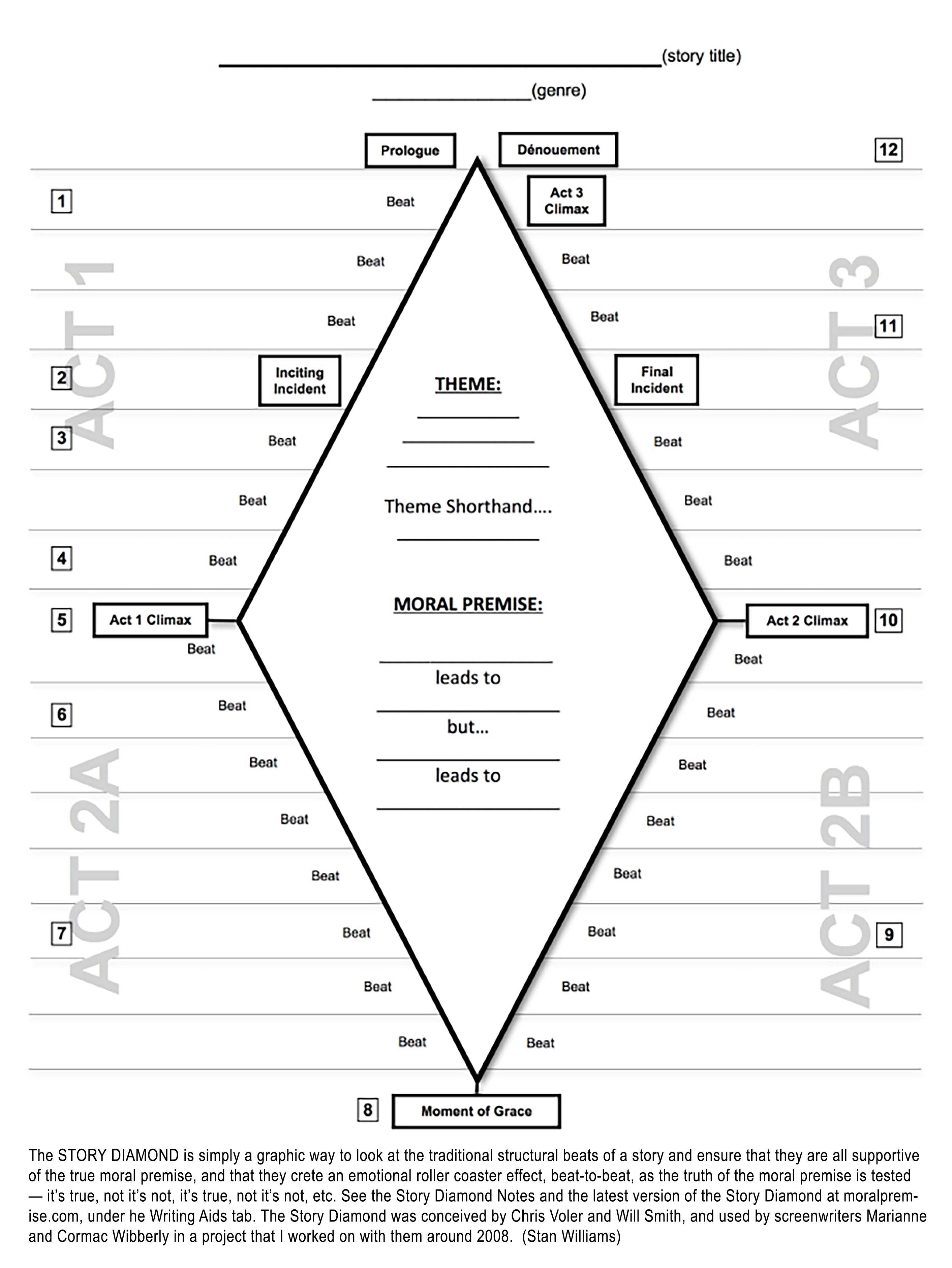
The Story Diamond

The Story Diamond is a useful diagram in structuring a story or screenplay. It was conceived by Chris Vogler and Will Smith, and then used by screenwriters Marianne & Cormac Wibberley for an upcoming Will Smith project that I was called in on to brainstorm. The image below is close to what they handed out. I've added the ACT 1, 2A images, and the explanation at the bottom. You can download this image HERE.


With their permission I took it and enhanced it by overlaying the various story structures used in the industry. The latest version is linked on the moral premise website in the middle of THIS PAGE... scroll down to find it. 

Here's what it looks like today with a host of other story structure systems overlaid. A full explanation of the Story Diamond is presented in my On-Line Storycraft Training series. You can download the latest version HERE.