Monday, May 24, 2010

Myra Johnson - Novelist

Hearing from other writers who have read The Moral Premise makes my day. I'm humbled and thrilled. (See the COMMENT to this post. These are writers who were recommended to The Moral Premise by their agent, Natasha Kern.)

The other day I received a SASE from Myra Johnson requesting the Moral Premise bookmark. Included was her business card and a nice little postit note that read:
Thank you! Your book has made a huge impact on my writing! Myra Johnson. 

Myra writes romance novels (that's her writing cave in the picture from her website). Here's what he has on the first page of her website which you can access by clicking on the title of this post above:
In real life and in the books I write, it seems life and love are always on a collision course. It hurts like crazy when life in the real world rains all over our romantic dreams. But I still believe in love, which is why you'll find enduring messages of forgiveness and reconciliation in my stories. Messages of hope. Messages of faith. Messages of God's unconditional love . . .

Because romance gets messy when life and love collide!
Isn't that the truth.

I don't hear from many novelists, so I kept digging. On her "books for writers" page I found a blurb about the Moral Premise. You can read it HERE for yourself.

Thanks, Myra, glad I could help. Good luck and God Speed on your writing.

Tuesday, May 11, 2010

Romances and the Conflict of Values

A reader writes with a problem (indented).
Dear Dr. Williams:  Thank you for writing The Moral Premise and frequently updating your blog. I have learnt a great deal from both, and I'm actively trying to incorporate the methods outlined in the book into my own work. I am a novelist, and I can see how this is just as applicable to us as it is to screenwriters. My genre is 'love story' which opens up another can of worms for me as a writer. I'm having some issues when trying to understand how to apply antagonistic forces. I believe you stated somewhere that love stories would involve a co-protagonist setup and that the man and woman would be antagonists to each other. With no clear antagonist practicing the vice side of the moral statement, I am unsure how I apply the vice side throughout a love story and how the two characters should arc. If you are able to provide me with any guidance as to how a moral premise operates in a love story with two protagonists I would be very grateful.  (Signed: G.M.)

Dear G.M.: Tell me a bit about your story and how ends. Is it a love story (someone dies), a romance (a persona dies), or a romantic comedy (two egos die)?  (Stan)

[Following: GM is in black and my response is inbetween in purple. (SW)]
It's a romance as I have not envisioned a tragic ending. The story involves a man and a woman who dated when they were young and fell in love, however his work/career was extremely important to him and they amicably parted ways as she knew how much it meant to him.
Sounds a little like Nicolas Cage's FAMILY MAN.
She did not realize until later that she was pregnant with his child. By then he was career bound, and she had lost contact with him. She decided to raise the child alone but this came at the expense of her own career. When the novel essentially begins, he is driven by his career and money, and he is isolated and lonely. Conversely she has struggled to keep her daughter and herself afloat, and all three (mother, father and child) will somehow come together at some point in the story (the inciting incident and goal that will bring them together is still unknown) and priorities will have to shift if he is to learn to value love over business/money, he is to connect with his daughter, and we are to have the man and the woman fall in love again.
So, it's a remarriage, romance story.
With so many elements to the story, I’m worried that the above will not follow one set moral premise statement, and perhaps I have thought about the story in a backwards manner with the ‘moral premise’ as a step after the above plot brainstorming rather than before it.
 Based on what you've told me so far, there's not too much for even a movie.  Novels, which I have not studied in depth in terms of the moral premise, may well indeed have more than one moral premise... even as some movies do. Some other posts deal with this from some of my other readers.  But I  suspect the different moral premises need to be tightly linked on a value level. Novels can do this more easily than movies, because novels can be longer, have multiple stories interwoven, and transcend eras easier. But the novel will resonate best with readers if the story comes back to one thing about which the story ultimately reinforces.
My idea behind the story stems from putting love first as opposed to money, and as a result I have put together:
Greed and selfishness leads to isolation and hatred, but
Generosity and sacrifice leads to inclusion and love.
Yep, that is what I was going to suggest, or something very much like that.
My difficulty in getting my head around all this is due to the fact that in romances the two characters are typically opposites.
As they are even in successful marriages... opposite in some respects, but not every respect. The drama explores the opposites, not what they have in common. Perhaps you're thinking they need to be opposite in every respect. The story will assume they have much in common, but the drama and the emotional journey of the story will explore how they learn to "love" each other's differences. (I'm thinking of the Fred Astair and Ginger Rogers films. They both loved to dance, but the drama was never about the dancing.)
In a typical non-romance story this would mean one was a protagonist and one was an antagonist. Yet in a romance we have two protagonists who we want to remain opposing for conflict purposes, yet we still need both heading for the same goal with the same moral premise, and all this is with a different type of antagonistic force present. 
Moving the “normal” structure around to fit a romance is proving difficult to visualize. 

Many thanks,
G.M.
 
[Now, my in depth response.]

Well, let me help you. It's not that difficult at all.

The simple answer is that each character (the man and the woman) struggles with the vice side of the moral premise in their own way, and becomes the obstacles and the antagonist for the other. 

Jeff Bridges & Maggie Gyllenhaal, CRAZY HEART (2009)
I like the way Michael Hauge explains this. He calls the two moral premise values the character's "identity" and the character's "essence." At the beginning of the story each character has an "identity" that they have given to themselves; that is they have put on a mask and are pretending to be someone they are not at their essence. But the identity, because it is false, has holes, and the romance character can see through those holes to the person's true essence. Each character falls in love with the other person's essence and are repulsed by that person's false identity. In Crazy Heart, the romance sub-plot between Blake and Jean occurs because Jean sees what Blake could be. She falls in love with his essence. But when he can't seem to fall in love with his own essence, she breaks it off.

So when the man reveals or practices his false identity the woman is turned off and repulsed. Likewise when the woman reveals or practices her false identity the man is turned off and repulsed.  But when each practices their essence, there is attraction.
In over simplified terms of the Moral Premise, the false identity is that person's vice, and their essence is their virtue. In more accurate terms, it's the moral premise vice that allows the character to hide behind their identity and camouflage their essence. And it's practicing the moral premise virtue that allows their true essence to be revealed. 

Although the man and woman may have similarities, the story is about how these two characters are different, even opposite in some ways. To be complete and happy and fulfilled, they have to be together so their essences are complimentary. 

Both may love the opera, but one likes to sit in the balcony and the other in the front row. They are both stubborn and demand their own way. Thus the drama comes out of the battle to decide where they will sit to enjoy the thing that they both love. the story is about stubbornness and forbearance --  not the opera.

Now about somethings each needs to be stubborn... justice, for instance, or if they're investors in the opera they can be stubborn about the singers being on pitch and not just looking the part. But about other things they need to drop the stubborn "identity" and be "forbearing."

Each character, at a subliminal level, longs to be complete and whole. In and by themselves they never will be. But with the right mate, they can participate in that wholeness somewhat vicariously, and by virtue of being married and (one flesh) they can participate with the other person that makes them a whole, if only by  proximity.

A personal example: my wife, Pam, and myself. I am not sentimental nor do I value nostalgia in the least. But at the right time I realize that being sentimental and nostalgic has some value. But to this day I could never express such emotion or sympathy toward others. But Pam does it so naturally. So, I can facilitate her getting to a family gathering where she can dole out the sentimentality, nostalgia and sympathy. I'll sit next to her when she does this, and I will aid her by finding money so she can buy the stupid little gifts that others love for their tacky sentimentality. (Can you tell I am not into this.) So, in that way, we are made whole. My vice (hating to be sentimental) is countered by her virtue (sentimentality.)  But my vice (arrogance) can prevent her from being sentimental and putting her down for it.


2. The arc from vice to virtue does not need to be wide or long, nor does it need to deal with vile or overly righteous values.  Not shown above, but imagine, the story being about moving from courage to honor (two small arrows at the right would do this). That is the moral arch of THE BLIND SIDE which deals with two virtues (one not as good as the other)  and how any fool can have courage, but not everone arrives at honor. 

In the diagram above the two yellow arrows can represent the moral arcs of a romantic couple. For their peculiar reasons each is deceptive to the other, thinking they need to lie about what they do, where they're going, or why, in order to appease the love of the other. But the other doesn't buy the lie and there's rejection. It's only when they take off their masks, and are truthful to each other that there is acceptance. 

3. Here's a variation on this theme:

The character represented by the left arrow believes (has the false identity) that they have to be deceptive to be accepted. Whereas the character represented by the right arrow is so scrupulous about telling the truth that it sounds like an over the top lie all the time. Both are vices. The virtue is graciously telling the truth. 

In these ways each protagonist becomes the antagonist for the other. So the man's goal and the woman's goal is to get together with the other. To do that he thinks he has to be God's gift to women and be arrogant and controlling. (WHAT WOMEN WANT) But that "identity" he keeps practicing turns off the woman, and thus he's rejected. At the same time she arrogantly believe she has to protect herself from such cads, and defends everything she does and puts him in his place. And that repulses him. So, they become each other's antagonists. 

4. Now, in your case, both the man and the woman have to practice a vice which will block their true essence from being regularly revealed. they are both determined to be right about what they believe, and both have to change to meet in the middle and get together. A very typical virtue and vice scenario for stories like yours is arrogance vs. humility. Or going back to your original moral premise statement:

Greed and selfishness leads to isolation and hatred, but
Generosity and sacrifice leads to inclusion and love.

The man, involved in business, is easy. But,how can you make her greedy about what she is doing? They both have to be imperfect. She can't be greedy about making money, that's his problem.  OR, perhaps she is greedy by virtue of being poor. Perhaps she's a hoarder: or perhaps she is about time. Or she could be selfish and proud about being poor. She could see "money is the root of all evil" but she only believes that because she's never had any. She's forgotten that the adage is "the LOVE of money is the root of all evil". In what ways is she NOT generous? That is her vice, and it blocks the guy's ability to see her goodness. But she does have some and by the first ten pages we know that that is.

But, if you're determined to make her the perfect person, and him the bad guy, then you have a story about HIM, not her.  If you want to make the story about both of them, they both have to be imperfect. 

Watch any Romantic Comedy that was successful in the box office and you'll see this. Take out the wild comedy, and you'll have your romance. 

Hope this helps. Let me know. 

See also this post on the Conflict of Values: http://moralpremise.blogspot.com/2010/02/expanded-conflict-of-values-and-moral.html

Monday, May 10, 2010

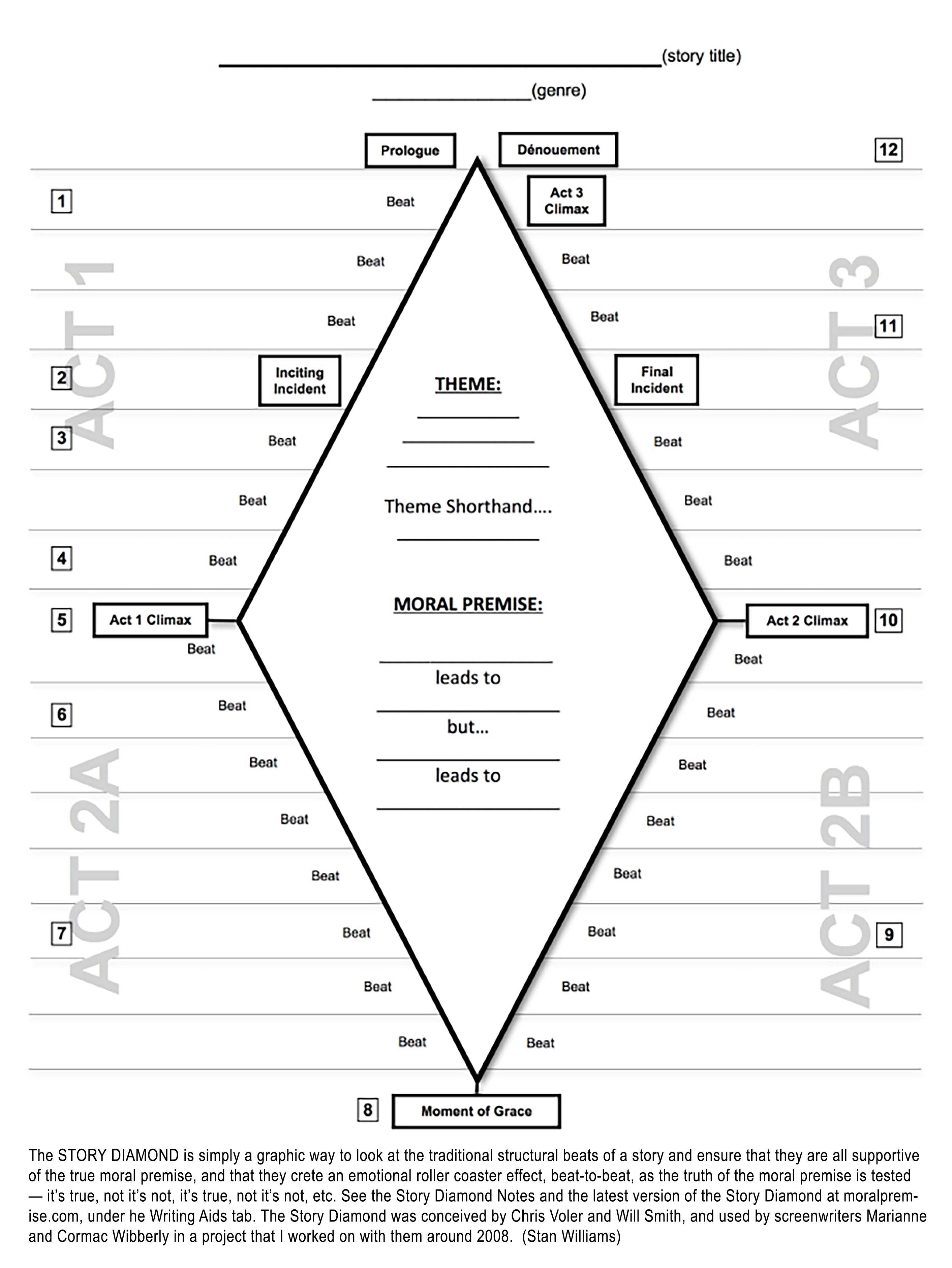
The Story Diamond

The Story Diamond is a useful diagram in structuring a story or screenplay. It was conceived by Chris Vogler and Will Smith, and then used by screenwriters Marianne & Cormac Wibberley for an upcoming Will Smith project that I was called in on to brainstorm. The image below is close to what they handed out. I've added the ACT 1, 2A images, and the explanation at the bottom. You can download this image HERE.


With their permission I took it and enhanced it by overlaying the various story structures used in the industry. The latest version is linked on the moral premise website in the middle of THIS PAGE... scroll down to find it. 

Here's what it looks like today with a host of other story structure systems overlaid. A full explanation of the Story Diamond is presented in my On-Line Storycraft Training series. You can download the latest version HERE.


Tuesday, April 20, 2010

Redemptive Crazy Heart

CRAZY HEART
Moral Premise Analysis

Written & Directed by Scott Cooper
based on novel by Thomas Cobb

Bad Blake (Jeff Bridges) (AA: BEST ACTOR)
Jean Craddock (Maggie Gyllenhaal)
Wayne (Robert Duval)
Tommy Sweet (Colin Farrell)

Music by
Stephen Bruton, T-Bone Burnett, & Ryan Bingham

  
Length: 106 min (1:46)
Domestic Gross 35MM

Act 1-2 Break
(Theoretically: 25% = 26.5 min.)
Actual: After Jean's first interview with Blake, he asks her:
"Did you get what you need?
and she responds: "I could always use more." (28:42)
 
Moment of Grace
(
Theoretically: 50% = 53 min.)
Actual: After Blake rolls his truck and
the doctor tells Blake to start taking care of himself. (55:30)
 
Act 2-3 Break
(
Theoretically: 75% = 79.5 min.)
Actual: After Blake loses Buddy in the mall and Jean leaves him.
Next morning Blake calls Wayne: "I want to get sober." (90 min.)

MORAL PREMISE
Self-hated leads to a destructive and empty life; but
Self-love leads to a constructive and fulfilled life.


One night a few months ago, while in L.A. on a consulting job, I saw CRAZY HEART  at the instigation of writer-director Mike Soccio. Mike was lamenting the ending of Crazy Heart because Bad Blake (Jeff Bridges), does not end up with his love interest Jean Craddock (Maggie Gyllenhaal). The next day Mike and I tossed around the idea that the movie didn't do that great at the B.O. principally because it didn't have that expected "Hollywood Ending."  It was a let down for the audience that after all the trials and tribulations that Bad Blake goes through, especially after his successful effort to get his life straightened out, the girl goes to another man -- and a man we never meet, nor do we know anything about. Mike was nearly pounding the table in expressing the audience's disappointment. 

I agreed with Mike then, and I do now, even after studying the story and coming to appreciate the "rewarding" genre-bending structure that Crazy Heart employs. It's a structure that  stretches the genre of a "romance" in an appropriate and truthful way, leaving us with a slightly independent feel and a terrific story.  I think the fact that Blake does not end up with the girl actually opened the door for Jeff Bridge's Academy BEST ACTOR win -- something I had hoped for.  And, I will attempt to describe why the movie would have been a disaster, in a narrative sense, if Blake had ended up with Jean.

ANALYSIS

In CRAZY HEART, Bad Blake's physical goal is to write new songs for his successful prodigy, Tommy Sweet.  But the psychological problem that prevents this is Blake's own self-hatred and the physical manifestation of that hatred — alcoholism. One of the wounds from Blake's past is that during the days when he was making a name for himself and touring, he became an absentee father. In our story Blake has not seen his son, Stephen, since his boy was four. That is the age of Jean's boy (Buddy), and it explains why Blake takes to Buddy-- it's an effort to redeem his past.

Thus, Blake's psychological goal is to love himself. Once he learns to love himself, he can stop drinking, and with the absence of alcohol he can, once again, become a songwriting powerhouse.

To tell this story our protagonist, Blake, needs help to see his problem and to learn to love again. He can't possibly love others until he learns to love himself.

The agents, or mentors, that lead Blake on that journey include a variety of characters, from his manager, to Tommy, and to his friend Wayne. But the most important guide on his journey is the aspiring journalist Jean Craddock.  

Jean, therefore, is not the goal, but the muse. The story is about Blake learning to love himself, not Blake learning to love Jean. Oh, it could have been about learning to love Jean, but that story, if it's to happen, is after the fade to black. (She's not married yet.)

Further, Jean's goals as muse, is not simply to stimulate Blake's songwriting that seems to come naturally to Blake, but to be his muse toward health and love—two criteria for being able to write songs. The narrative structure allows Jean to give herself to Blake in love, to remind Blake of the hope and inspiration that love can bring. So, that is what she does. Similarly, Blake's manager,  Wayne and the doctor do what they can to guide Blake toward self-respect and health. Indeed the manager starts and finishes the journey, and the doctor partners with Jean in the Moment of Grace to turn Blake in the opposite direction.

Buddy's role is also designed to inspire Blake to see the redemption of love, for Buddy is a metaphor for Blake. Not only does Buddy represent the flesh and blood son Blake lost, but when Blake drinks in the mall bar, Buddy leaves. That's a metaphor for when Blake drinks, Blake's essence leaves. And when Jean tells Blake that he'll hurt Buddy with his drinking, the meaning is that Blake will hurt Blake with his drinking.

By the end of the story Jean and the others have succeeded—Blake returns to self-respect and self-love and is productive and fulfilled. In this light, for Jean to become the object of his journey, for her to become his goal, would discredit the story being about Blake and the fundamental journey he's on.

MUSIC

Music plays an important role in communicating to an audience what a movie is really about at a psychological or spiritual level. And the music in CRAZY HEART is central. An examination of the songs reinforce the above analysis. The songs are not so much about a man loving a woman, but simply about a man loving and respecting himself.

The movie's theme song is Ryan Bingham's THE WEARY KIND. It's not a song about love between a man and a woman, but about a man learning to give his life one more chance.


And this ain’t no place for the weary kind

And this ain’t no place to lose your mind
And this ain’t no place to fall behind

Pick up your crazy heart and give it one more try

In the song SEARCHING, it does look as if this could be about a man and a woman, but as we see Jean being the muse, we realize that Jean's love is a metaphor for the real object of Blake's love, himself -- not in narcissism, but in self-respect.  Read these lyrics with "self" standing in for "you" -- or Jean standing in for loving self.

SEARCHING
I've spent a lifetime darling

Searching looking for someone like you

Dreaming in all my dreams
I dream that someday
I'd find someone like you
Other loves have come my way
but they were not for me

Tell me that you're here to stay don't ever set me free

Then there is the song Wayne sings (off camera), LIVE FOREVER. This is not just a song for Blake about his son, or for Jean about Buddy, but principally about all fathers and mothers (especially Blake's father and mother). For whatever happened in Blake's past, and we don't know everything, it's evident that the "darkness" had taken Blake. Wayne's song is to all of us, a plea for all of us to do what we can as parents to raise up our children with self-respect so they do not become like "bad" Blake:

LIVE FOREVER
You fathers and you mothers

Be good to one another

Please try to raise your children right
Don't let the darkness take 'em

Don't make 'em feel forsaken

Just lead them safely to the light

When this old world is blown us under

And all the stars fall from the sky

Remember someone really loves you

We'll live forever you and I
I'm gonna live forever

I'm gonna cross that river

I'm gonna catch tomorrow now.

And finally, THERE'S A BRAND NEW ANGEL


Open the gates
Welcome him in. 

There's a brand new angel,

a brand new angel

with an old idea.

The "old idea" here is not the "old, bad Blake" but the old idea of a noble, constructive, tradition and not the modern tendency toward cynicism, anarchistic indulgence, and moral deconstruction. Blake is the brand new angel. Welcome him in.

Sunday, April 18, 2010

Heroic Addition - Hurt Locker


HURT LOCKER
Brief Moral Premise Analysis
Script by: Mark Boal
Directed by: Katherine Bigelow

Bravo Company's Explosive Ordinance Demolition (EOD) Team
Sgt. FC William James (JAMES) – Jeremy Renner
Sgt. JT Sanborn (SANBORN) – Anthony Mackie
Specialists Owen Eldridge (ELDRIDGE) – Brian Geraghty


This is a great movie that won six 2009 Academy Awards including Best Original Screenplay, Best Direction, and Best Picture. But it did not resonate with general audiences, doing only $12.6 MM at the box office ($11 MM budget). Why would such a powerful movie in many respects fail to garner a large audience, although marketing an independent movie that is picked up late by the domestic distributor (SUMMIT) no doubt had an effect on its availability to a wider audience.

THREE PROBLEMS

HURT LOCKER suffered at the box office needlessly. All successful movies, in terms of story: (1) Needs to have ONE clear protagonist; (2) The protagonist needs a PHYSICAL GOAL that the audience can see and root for; and (3) The underlying subtext of the story (what the story is really about, that is, the moral premise) needs to be TRUE and CONSISTENTLY APPLIED and be about ONE THING.

A VISIBLE PHYSICAL GOAL
 
In most of my consulting I focus on the truth and consistency of the moral premise's portrayal. But the more scripts and stories I look at for students and clients, I'm beginning to focus more on the PHYSICAL PREMISE... the goal. Without a clear goal you shouldn't even waste your time thinking about a moral premise.

Michael Hauge calls the PHYSICAL GOAL the OUTER MOTIVATION, and indeed that is a good name for it, just as the PSYCHOLOGICAL GOAL (or the moral premise) is the INNER MOTIVATION.  In his on-line article titled "Arenas and Finish Lines: Avatar" Michael discusses why Avatar did so well at the box office and why Hurt Locker did so poorly. Simply put, Avatar's protagonist has a goal (stop the destruction of Na'vi) while the protagonist of HURT LOCKER just wants to survive the next assignment to defuse and dispose of a IED as member of an EOD (Explosive Ordnance Disposal) team.

But James, the intended protagonist, survives multiple defusing and disposal events, so we're never sure when he's reached his goal. It certainly isn't to return home. In fact, the opening supers tell us that perhaps this man has no goal, other than to continue to feed his addiction to war.

As a result, the audience is left underwhelmed with no one to root for.

As I discuss below, however, the supposed "antagonist", Sanborn, may have been the better protagonist. Sanborn has a goal, to get home alive, and later develops a second goal, to get married and have a boy, which is a further and natural development of the first. We identify and root for Sanborn, we don't for James. 

A DEMONSTRATED TRUE MORAL PREMISE

Normally, a well crafted true moral premise would help a film connect with audiences. And in the HURT LOCKER we have a decently crafted and implemented true moral premise. Let me describe that first, before going on to the contrary depiction in the film.

The still image above is a frame from the slow motion shot of an expelled casing from a sniper's round tumbling harmlessly to the desert floor. It indicates HURT LOCKER's Moment of Grace (MOG), and as you should expect the "shot" occurs in the exact middle of HURT LOCKER at 63 minutes (the film's length is 126 minutes, not counting the credits).  This particular casing is from the round fired by Sgt. Sanborn at an Iraqi insurgent sniper during a sniper duel. Sanborn's spotter is Sgt. James. 

The slow motion image is symbolic on a number of levels.
A. The casing is similar in shape to the IED casings which are the EOD's primary task to defuse and destroy.

B. Whereas the IED's disrupt the ground from below bringing indiscriminate death to civilians and combatants, this sniper's casing disrupts the gravel from above bringing discriminate death to a single combatant.

C. Before an IED explosion the IED's casing lies dangerously beneath the surface. After the sniper's shot the round's casing lies harmlessly above the surface. 

D. For the first half of the story the drama between Sgt. Sanborn and Sgt. James lies dangerously beneath the surface. After this particular round is fired (and the MOG), the drama between these two men lies benevolently above the surface. 

E. Before the MOG the conflict between Sanborn and James escalates to the point where Sanborn seriously considers killing James in a faked accident. After the MOG the two men learn to work together for the benefit of all.

BEFORE THE MOG


When James comes on the scene as the EOD's bomb tech we discover that he is not only very good at what he does, but he likes to do things on his own. On his first mission he discharges a smoke bomb presumably as a diversion to possible snipers or an insurgent capable of detonating the IEDs. But the smoke also inhibits Sanborn and Eldridge from doing their jobs to cover James.
James' cowboy personality, angers Sanborn. When we learn that James was a Ranger, we're reminded that in Sanborn's mind James is a "lone ranger" and the connotation is not a good one. To the audience however, upon seeing how good James is, we're reminded of the heroic cowboy that rides into town, single-handedly saves the town from the bad guys, and then rides out of town -- again alone. Indeed, James' character seems to have no vices except that he doesn't communicate with his team, as army procedure seems to dictate.  James' independence is illustrated in other ways:

  • He takes the shrapnel protecting plywood off his room's windows and basks in sunlight.
  • He doesn’t listen to Sanborn, especially when Sanborn wants James to get out of the kill zone.
  • He refuses to use the robot, he puts on his suit and wades in.
  • He single-handedly confronts and backs down an aggressive taxi driver, alone, while a whole platoon stands by seemingly helpless. "If he wasn't an insurgent before, he is now."
  • He refuses to talk to Sanborn during mission. (But then Sanborn is distractingly annoying.)
After the first mission (during which James deploys the smoke bomb,  disarms 7 IED's in a daisy chain, and comes face-to-face with the insurgent who runs away) Sanborn helps James out of his bomb protective suit and they have this exchange that begins at 26 min 46 seconds:
JAMES: That wasn’t so bad. First time working together. What’d think? 
SANBORN: Hmm, I think us working together means I talk to you, and you talk to me? 
JAMES: We going on a date, Sanborn? 
SANBORN: No. We’re going on a mission, and my job is to keep you safe so we can keep going on missions. 
JAMES: It’s combat, buddy.
THE MOMENT OF GRACE
The MOG in HURT LOCKER should be occurring half way through the story at 63 minutes. The EOD is pinned down by sniper fire beginning at 54:40 to about 1:08:50. It's a long scene, during which there are long periods of Sanborn (above, left) and James (above, right) waiting out the insurgent sniper perhaps a mile away. As you can, tell the 63 minute shot from Sanborn's rifle is in the midst of this scene. It is a scene that demands these two men talk carefully to each other according to a procedure they have been trained to follow. Their teamwork saves their lives, a teamwork that involves Eldridge as well. Here, pinned down by the enemy they learn to trust each other. 

After the MOG shot described above, they continue to wait out the insurgents into dusk in case there are more lurking in the distant building. During that time Sanborn, his eyes glued to the telescopic finder, begins to cough. Some minutes later, James asks Eldridge for a juice pack. 

When James gets the pack he looks at it as if he is praying over it. Although his fingers hurt he gets the straw punched in through the side, and then he slides over to Sanborn and holds the straw to Sanborn's lips... for Sanborn cannot put down the weapon that is protecting them.

JAMES: Drink. Drink it.
And Sanborn does, all of it.

After this whole MOG scene the EOD team finally gets back to the barracks and celebrates their new found camaraderie with stomach punches that one reviewer describes this way:
They trade “stomach punches in a ritualistic display of affectionate aggression that looks as if it will end in either sex or murder, and Ms. Bigelow’s insight is that the tense comradeship of soldiers rests, often tenuously, on barely suppressed erotic and homicidal impulses.
Indeed after this, Sanborn increases respect for James, and James reciprocates by including Sanborn in the diagnosis and solutions that confront the team. James isn't perfect, and his lone ranger attitude draws Sanborn and Eldridge into a night hunt that gets Eldridge shot in the leg and sent home. It' is James' fault for ignoring protocol and letting platoons search out the bad guys. At least he doesn't go out alone.... although earlier he did and almost got killed by a housewife and then the guards of his own base.

But to show how much the team has grown from beginning to the end, at the end they are confronted by a family man who has been forced to become a suicide bomber. this time Sanborn and James work together. Before initiating thier plan they talk it over, and bump fists:

SANBORN: Go get them.
JAMES: Let's do it.

It is a dramatic change from the beginning.

The most dramatic change of call is when Sanborn, previously afraid to enter the kill zone, now stands side-by-side with James in his suit, as they struggle to cut through the locks that fatally imprison the father.

There is much more to share about these two men, especially the final conversation in their Humvee after they fail to save the man strapped with bombs and locks. But let's move on for now.

THE MORAL PREMISE

With the short explanation above it seems that the moral premise might be stated this way:
Demanding arrogance leads to animosity and hatred; but
Competent teamwork leads to respect and honor.


It's a lesson that James concedes in his embrace of Sanborn's defensive and effective support, and Sanborn learns about James. 

BUT "HURT LOCKER" IS NOT ABOUT ONE THING


As true and well-developed as the moral premise is, the movie is not perfectly structured around that one truth. Indeed, there is a second moral premise, but I am having trouble articulating it. Perhaps someone else will see what I can't (although there are hints that follow) and explain it to all of us in the com box below.

But there are two things that dilute and confuse the one thing described in the moral premise, which I think inhibits the audience's understanding of what the movie is trying to say.

HURT LOCKER begins with this quote from Chris Hedges book "War is a Force That Gives us Meaning." Superimposed over black, the first thing we see is this:
The Rush of a Battle is often a potent and lethal addiction, for war is a drug.
and then part of the quote fades away leaving us simply with:
war is a drug

At the end of the movie, a movie that is clearly intended to be about William James, he goes home to be with his wife and son, and he struggles with making decisions about cereal in the grocery story (a decision that has no moral significance). And we find him cleaning out the leaves from the eaves, an action that is just like clearing the gravel off an armed IED, but with the leaves in the eaves there is no moral significance, and James knows he was called to do something significant with his life.

As he sits on a bed with his toddler son and they play with a Jack-in-the-Box (a metaphor for the IED), the jack pops up, and the baby laughs.
JAMES: You love playing with his stuffed animals. You love your mommy, your daddy, your nature pajamas.  You love everything, don’t you? Yeah! But you know what buddy? As you get older, some of the things that you love might not seem so special anymore, you know. Like your jack-in-the-box. Maybe you realize it’s just a piece of tin and a stuffed animal.  As you get older, there are fewer things you really love. And by the time you get to my age, maybe it’s only one or two things. With me, I think it’s one.
In the next images, we see James landing back in Iraqi, for a new rotation as the bomb tech for Delta Company, and 365 days to go. 

The first and last images of HURT LOCKER tell us that for this warrior, war is an addiction. It's the only thing he can like, or the only thing that gives him a rush of satisfaction and significance. 

Unfortunately for the box office that is not what the clear moral arc seems to be for the the main characters. That war is a drug is a valid theme, but it dilutes the resonant meaning of the above moral premise so aptly demonstrated in the story per se. Perhaps someone else can suggest a moral premise that involves the "rush of battle and addiction" as some combination of virtue and vice through which the characters arc. And indeed, there are the scenes wherein we see James feeling very satisfied at the completion of a mission. To James defusing a bomb is as satisfying as sex, and after he completes his duty, he's quick to lay back and have a smoke. For him the rush of defusing a bomb is like an addiction that he can't wait to experience and later memorialize. He even keeps a collection of triggering devices that almost killed him, and in with the devices is his wedding ring. Thus, the connection between the adrenaline rush of sex and James' encounters with bombs is astonishingly clear.

But that is not the clear arc that we encounter with him and Sanborn's relationship, except to say that Sanborn doesn't share James' addiction and can't figure the guy out. So, we need a second moral premise for this addiction thingy, that interconnects with the teamwork idea, if we're going to help this movie succeed at the box office. Well, it's too late now, but that seems to be a valid effort at least to help us all in future projects.

AND "HURT LOCKER" IS NOT ABOUT ONE PERSON

The second element that seems to have diluted HURT LOCKER from resonating with the audience is that the most significant character arc is not James' arc, but rather Sanborn' s arc. This easily confuses audiences. The movie is clearly intended to be about James and his journey... a journey that audiences' expect to be about discovery,  learning, and change. But, James has almost no arc. Indeed, when he returns for another rotation it could easily be his third or fourth rotation to Iraq. We don't know. There is no significant change evident in James' character from the opening scene to the final. 

But, Sanborn's arc is huge. Early on, when he and James are shaving in the base bathroom, and he expresses his anger at James for not following protocol on their first outing, they have this interchange beginning on page 29:
SANBORN: What you did yesterday, wasn’t cool.


JAMES: Yeah, I know. You’ll get it, though. You’ll get it.
James' arrogance grates on Sanborn.
SANBORN: I was in intelligence for seven years before I joined EOD. We ran missions in every shit hole you can imagine. So, I’m pretty sure I can figure out a redneck piece of trailer trash like you. 
It’s a harsh racial remark coming from a black man to a white man.
JAMES (almost affectionately): Looks like you’re on the right track. (smiling) See you out there.
Later when Sanborn discovers that James has a son, Sanborn says he's not ready for a child, even though his girlfriend wants one.

By the end of the movie, after their final scene in trying to save the father (note they just saw the father of some children die) and both of them coming close to death from the explosion, Sanborn (with cuts on his face) engages James in this discussion:
SANBORN (near tears, face scared with bloody cuts): Shrapnel zings by, slices my throat. (recall that James has shrapnel wounds all over his body.) I bleed out like a pig in the sand. Nobody will give a shit. I mean, my parents will care, but they don’t count, man. Who else? (pause) I don’t even have a son.


JAMES: Well, you’re going to have plenty of time for that, amigo.
(notice the affectionate "amigo", which follows James earlier calling Sanborn "bro.")


SANBORN: No, man.


JAMES: You know.


SANBORN: I’m done. (beat) I want a son. (beat) I want a little boy, Will. I mean how do you do it. Take the risk? 

JAMES: I don’t know. I just … I guess I don’t think about it.


SANBORN: Every time we go out, it’s life or death. You roll the dice. You recognize that, don’t you?


JAMES: Yeah. Yeah. (beat) I mean, Yeah, I do. But I don’t know why. (stutters)I don’t know, J.T.  Do you know why I am the way I am?


SANBORN: No, I don’t.
This from a man who earlier had said: 
"I can figure out a redneck piece of trailer trash like you."
The main characer that goes through the greatest arc and change is Sanborn, but the movie focuses on James.  The audience has to be asking, "WHO is this movie really about?" Is it Sanborn, or James? With whom are we to identify? And is the movie about:
-- teamwork
-- war as a drug
-- we fight for our family's freedom?

I think this lack of unity about the protagonist, and the movie's thematic elements, aids in its lack of overwhelming resonance with general audiences.
[Side note: I can't help but notice that James Cameron's movie, AVATAR (which was also up for BEST PICTURE), is decidedly liberal in its portrayal of the U.S. military, as if the U.S. Army only battles for greed and power. But his divorced wife, Katherine Bigelow's movie, HURT LOCKER is clearly about the moral significance, valor, and virtue of our warriors and why we go to war. Indeed the title of the book she quotes at the beginning of the movie is, "War is a Force That Gives Us Meaning" ... not a book I can imagine James Cameron reading. ... but then I have not read the book and I do not know it's central theme.

And what was that... what was the noble warrior's name in HURT LOCKER? The name of Bigelow's former husband? Is there a message here ... not so explicitly hidden? ]

Dischord vs. Harmony

DATE NIGHT
Brief Moral Premise Analysis

Script by:  Josh Klausner
Directed by: Shawn Levy

We watched this in the theater and have not been able to judge its success through the total box office, nor study it in DVD format. (Update: Off $55M budget, Date Night succeeded WW with $152M.) Before Pam and I went, I took note that the film (including the credits, which are actually NOT part of the story) was 88 min long. I divided by two and put 44 min at the top of my little notebook I take to the theater. The scene that embraces the time from 40-48 minutes should include the story's Moment of Grace (MOG) and a switch in the character's mode of operation (MO) in their journey to attain their physical goal. Their MO before the MOG would indicate what vice they are struggling with, and their MO after the MOG would indicate what virtue they're attempting to embrace.

Date Night is essentially an action movie, about suburban couple Phil and Clair Foster (Steve Carell and Tina Fey) who go into town on a special date night to reignite their marriage. I'll leave the plot for other reviewers, as my task here is simply to I.D. the MOG and a possible moral premise around which the movie is built.  Suffice it to say, fireworks ensure.

As we sat enjoying the chase scenes and Carell and Fey's trademark humor (albeit a bit too adolescent for our tastes) Phil pulls Holbrooke's (Mark Wahlberg) hijacked sports coupe over to the side of the road and a constructive argument ensues. Suddenly, in the midst of the hilarity and action there is a serious discussion about their relationship, as if a marriage counselor had suddenly popped up in the back seat and said, "You guys need to talk out your problem."

I glanced down at my iPod's stopwatch. It read 43 minutes. I glanced at the time I had circled at the top of my notes -- 44 minutes. And I started taking notes of the dialogue as best I could. Here's a first draft of what could be the moral premise for DATE NIGHT:
In marriage:
Taking the other for granted leads 
to boredom and discord; but
Courting and surprising the other leads to romance and harmony.
Before this MOG (during which there is no conclusion) the characters are living like roommates. Not only is there no sex, there's no romance, and there's an effort on Clair's part to do everything for everyone. She's worn out and just wants to get away....not from the marriage, but just for a little solitude. It seems to her that Phil does nothing for them as a couple. As a result she complains that she can't "light-up" Phil's life by putting on something sexy when he comes home to satisfy his "gross sexual fantasies" (an over-the-top reference to "simple romance," for which they both long.) But Phil is not thinking ahead far enough to surprising Clair and being romantic, because he says. she is always doing everything for everyone, and she doesn't wait for him to do anything for her. If she did, perhaps he could surprise her now and then. So, Clair takes the lead, and Phil tries to go along. This is evident, too, in her getting all dolled up for their weekly date night, but without telling him that she's expecting more than the greasy spoon at the end of the block.

The image at the top of this blog illustrates one such beat. Once they figure out that their journey in this movie is to find the Flash Drive (this film's MacGuffin) Clair takes Phil's sports coat, wraps it around her hand, and smashes through a door window to gain access to an office where they might get a clue for their hunt. Phil is shocked. B&E is NOT something he would have done. She acted independently.

Earlier, Phil does something similar in the restaurant when he takes the Triplehorn's reservations—something he did independently that she would not have done.  Both decisions lead to discord and get them in trouble.

After the MOG they attempt to act within the loose definition of working together to make decisions. He boosts her up to a fire escape to B&E their next location; he doesn't usurp her but they do it together. Earlier, it is her idea to visit Holbrooke for help (something Phil is not, after the fact, in favor of). Later it's Phil's idea to visit Holbrooke, but this time with her agreement.

Before the MOG they act unilaterally, after the MOG they act bilaterally. It is by working together, and not taking the other for granted but cooperatively surprising the other, that they accomplish their mission, and end up rolling in the grass in each other's arms in their front yard. The romance, and presumably the s-x is back. No sequel is planned. 

Monday, April 5, 2010

Scene-By-Scene and the Moral Premise

A reader asked a short time ago how the moral premise can help to write a good scene.

The answer is the same as how the moral premise can help to write a good movie.

Think of this analogy:
A scene is to a movie, as a paragraph is to an essay, as a propositional statement is to a logical syllogism.

In a syllogism there is a propositional statement followed by one or more statements of evidence, ending with a conclusion. In a good syllogism the various propositional statements are RELEVANT to the argument, constituting together SUFFICIENT evidence that is generally ACCEPTABLE to the opponent, and include the best REBUTTAL arguments against the position. (Those are the four criteria of a good argument as constructed by T. Edward Damer.)

Essays (or any persuasive communication construction) are exactly the same. The essay sets out to tackle a position on a topic. Each middle paragraph should provide evidence that supports the final paragraph's conclusion.

In both the syllogism and the essay, there is a beginning (postulate), middle (evidence), and end (conclusion).

Do you see the story setting up in this way, scene by scene.

So, in a movie, the story BEGINS with a character with a problem (the postulate, or major premise of an argument.) The obvious physical problem is a metaphor for his psychological (or emotional or spiritual) problem. There really is only ONE problem that takes form in the physical realm and the psychological realm. That PROBLEM is the BEGINNING, or the syllogism's postulation, or suggestion that we have a topic confronting us that needs a solution.

The movie then begins to present evidence that pertains to the problem. In a well formed movie that evidence is RELEVANT, SUFFICIENT, ACCEPTABLE, and provides a good REBUTTAL with respect to reality as perceived by audience.  This is the MIDDLE.

Taken all together, that evidence leads to a natural conclusion (or ENDING), and the story's resolution.

Now, if you don't quite get all that, please read it again, or ask a question. Because the next chunk of understanding is related to all that above.

So, the SCENE is just like the MOVIE, in that there is a BEGINNING, MIDDLE, and END, and because this is a movie that has a consistently applied moral premise, everything in the scene pertains to the same postulation, evidence, and conclusion, but just in smaller chunks.

In a recent blog post David Mamuet is quoted as summarizing a scene this way:
WE, THE WRITERS, MUST ASK OURSELVES OF EVERY SCENE THESE THREE QUESTIONS.
1) WHO WANTS WHAT?
2) WHAT HAPPENS IF HER DON’T GET IT?
3) WHY NOW?
 I might revise those somewhat this way:
1. Who wants what?
2. Why do they want it?
3. What happens if she doesn't get it?
See, the beginning, middle and end?

Well, the answers to each of those questions resides in the moral premise statement. AND, each main character in that scene will approach and answer each of those questions with answers (e.g. actions) that are answered by the moral premise statement.

So, if the moral premise of a movie (and of a scene... and of each character) is:

Pride leads to destruction; but
Humility leads to life.

then the two characters in the scene are going to either be pursuing pride, or humility, or some position on a continuum between Extreme Pride and Extreme Humility, but not starting from or ending at the same point. (See my post on the Expanded Conflict of Values.)

Keeping it simple for this explanation, in a scene you have two characters in conflict. One is trying to resolve the conflict in the scene by seeking a position that satisfies his or her pride, while the other is attempting to resolve the situation using humility. But every step toward humility (by either character) leads to life, and every step toward pride (by either character) leads to destruction.

Notice I said "LEADS TO". By the end of the movie we might actually "see" life or destruction, but in a scene we'll just see a small snippet of or step toward one or the other, --which when taken in total will naturally end the movie on one note or the other.

Thursday, March 25, 2010

The Hero's Two Journeys - A Review

This is a short review of THE HERO'S TWO JOURNEYS from Michael Hauge and Chris Vogler.  If you read much of this blog, or have read my book, The Moral Premise, you'll know that uniting the inner and outer journey of the protagonist into a cohesive whole, about one true thing, is the crux of all stories that connect emotionally with audiences. Thus, this DVD/MP3-CD set is a valuable resource for writers. In addition to recapping their own expertise proven over decades of work in Hollywood, Michael and Chris reveal many practical story secrets that bring together a hero's inner and outer journey so the story will resonate with audiences.


My introduction to Michael Hauge (left) was years ago during one of his national tours when I attended his two-day Detroit workshop. You'll see him cited numerous times in my book.  When "The Moral Premise" was released, Chris Vogler (right) offered to write the book's Foreword. Then as I started to work as a story consultant in Hollywood, I found myself on the same side of the table with Michael (on SEVEN POUNDS) and then again with Chris on a movie yet to be released.

The package, published by Screenstyle.com and the other usual sources like Amazon, includes 4 discs (3 DVDs and a MP3/CD-ROM) with over 10 hours of workshop material from Michael and Chris. (The "CD" disc in my package is mislabeled a "Compact Disc." Instead it is a MP3/CD-ROM filled with files from what looks like 6 CDs. Most players (CD, DVD) can read the disc and these files, but the easiest way to access them is through your computer and download them to a MP3 player.)

Here are some brief notes on the content from the main attraction of the package, their joint DVD workshop on joining the inner and outer journey.

CREATING IMMEDIATE EMOTIONAL IDENTITY WITH YOUR CHARACTERS

I have written before on this topic because it is critical for the audience to get under the skin and in the mind of the story's characters, especially the protagonist. Movies resonate with audiences only when the audience can physically root for the protagonist (in the physical story,) and mentally participate in his or her decisions (in the psychological story). Of course, the two journeys are really just one story, as any person is one person with two identities -- what we are like on the outside, and what we are like on the inside. But what we are on the inside is what motivates (or causes) what happens on the outside. (See The Moral Premise, Chapter 6.)

So, here are five ways that Michael Hauge says you can use to foster the audience's immediate emotional identification with your character(s):
  1. Make the character sympathetic, the victim of undeserved misfortune.
  2. Put the character in jeopardy. We ID with people we worry about.  Many stories start with an orphan.
  3. Make character likable, kind, goodhearted. They need to be relatable, not likable.
  4. Make characters funny. We like to be with people who make us feel good about ourselves or have the courage to say things we don't.
  5. Make characters powerful, or very good at what they do. 
Michael says to use at least two of these. But the more the better. In CRAZY HEART, Bad Blake embodies all five: 1 (we feel sorry for whatever took Blake to the depths he's in), 2 (Blake is constantly on the verge of either getting fired from a gig or killing himself), 3 (he is goodhearted), 4 (he's says things we'd never say but at times have wanted to say), and 5 (he can be a good songwriter and performer). Result? ACADEMY AWARD FOR BEST ACTOR. (Blog post on CRAZY HEART.)

Michael's best selling book is WRITING SCEENPLAYS THAT SELL.

DIFFERENT WORLDS AND VALUES

Chris writes mostly about the 12 Steps of the Mythic Hero (THE WRITER'S JOURNEY). In one part of this DVD set he talks about how the hero begins in the Ordinary World and spends Act 2 in a Special World where the values are much different. That conflict of values is the character's INNER conflict that sets up the OUTER conflict.

Chris' insight in this speaks to the vice and virtue of the moral premise statement, and how the main characters, upon entering the Special World, are forced to make some concessions to their life, in order to return to some degree of normalcy once the journey and the story are over.

The Ordinary World and the Special World are both physical entities, but the different set of values (psychologically) are the things that drive the action differently in these two worlds.  All action begins in the mind with a set of values. [The above illustration is from the Moral Premise workshop.]

The Special World, physically, can also become an excellent METAPHOR for what is happening in the "unconscious mind".

A JOURNEY OF FULFILLMENT

One  point I feel a bit contrary about is when Michael says:
The inner meaning grows out of the outer journey. 
Here is what I think he means: The outer journey is the result of an inner conflict of values, but by experiencing the outer journey's difficulty, the character learns something spiritual or mentally. Thus, the inner learning comes as a result of the outer experience. One of the two gentlemen explains it something like this: (here paraphrased):
The inner journey is a journey of fulfillment where the character changes from say "protection" to "courage" from "fear" to "courage, or from "being uninvolved" to "being involved."
[Sounds like the beginnings of a Moral Premise statement.]

REAL LIFE


In another place, Michael says: 
What I love about this... is that although we're talking about all these fictional characters, I'm also talking about real life. The characters in movies mirror what we all do, and our own story.
Bingo! Even if our characters are in some fictional or fantasy world, their moral decisions must be similar in nature to the audience's day-in-day-out lives. And that is the best way to connect o audiences...write about their moral experiences. 

PERSONA vs. ESSENCE

Another comparison that the men set up is the difference between persona (or personal identity) and essence (the person's true character). The story is about a character's journey from his outward persona and how his true (inner) self is revealed. There are a number of ways in which Hauge discusses this can happen. But I can't help but come back to the concept of the moral premise, and how the main characters all must traverse from some vice (what they are pretending to be) to some virtue (what their true selves tell them they ought to be). Michael points out that in romances,  especially romantic comedies, the girl falls for the guy's true essence. And when the guy lets his bravado go wild and struts around showing his (false) persona, the girl turns away. But when the guy gets in touch with his inner self and lets his virtue shine through, the armor gleams, and the girl comes running back.  Thus, in a good film, there is that conflict of values which is the conflict between the persona-mask, and the effort to get the characters to take the mask off, and enter Act 3 successfully.

12 STEPS OUTER AND INNER

A highlight of the DVDs is when Chris takes his traditional 12 Steps (from the Hero's Mythic OUTER Journey) and articulates their INNER counterparts. I'm going to short hand them here, but the comparison is valuable.
  1. Ordinary World: Limited awareness of internal problem.
  2. The Call to Adventure: Awareness that you need to change. 
  3. Refusal of the Call: Fear and resistance to change.
  4. Meeting the Mentor: Wisdom delivered that meets need.
  5. Crossing the Threshold: Committing to change.
  6. Testing by allies and enemies: Experimenting with the kind of change that is needed
  7. Approach: Preparing mentally for a major shift.
  8. Ordeal, death, and rebirth: Removal of the inner mask. Center shifts.
  9. Reward: Accepting consequences, both good and bad
  10. The road back: Rededication, and removal of the outer mask.
  11. Resurrection: Hero explains what was learned.
  12. Return with the Elixir: Mastery and future confidence. 

So, there are a few of the discussions that Hauge and Vogler cover in this excellent 4 disc set. Your writing will be better it.