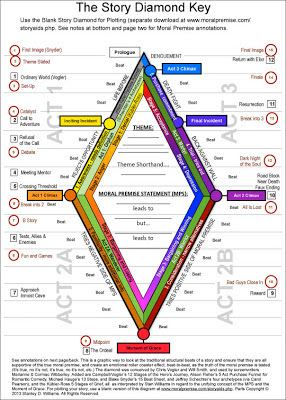
My thanks to British entrepreneur and screenplay program guru Dan Bronzite for featuring a second of my essays on The Moral Premise this month in his newsletter, SCRIPT TIPS. Here's link to the front page:
http://www.movieoutline.com/archive/scripttips0210.html
and a second link directly to the article.
http://www.movieoutline.com/articles/movie_story_theme.html
Dan's main site is here
http://www.movieoutline.com
has a slew of great resources and articles by many professional practitioners. This month they are coming out with version 3.1 of his MOVIE OUTLINE software that has some very cool features including the ability to assign emotional values (+/-) to scenes and visualize a chart of the roller coaster effect. His software is also reasonable priced and works on both PC and Mac.
Discussion and analysis of screenplays, scripts, and story structure for filmmakers and novelists, based on the blogger's book: "THE MORAL PREMISE: Harnessing Virtue and Vice for Box Office Success".
Tuesday, February 23, 2010
Monday, February 15, 2010
Expanded Conflict of Values and The Moral Premise
UPDATE: What is discussed in this post is not some new discovery. Not much is new under a billion year old sun, even if it's continually being rediscovered. See end of this post for link to another post that reaches back a few years to something called Nicomachean Ethics.
During a recent story meeting in L.A. our well-known host and producer solved a story problem we were having by introducing a brilliant expansion of the moral premise concept as it pertains to the conflict of values. I'm sure it applies to other well-known stories once we have time to think more about it. Perhaps readers will have some suggestions.
To introduce this expanded conflict of values idea let me first review some basics from the book and my workshops. I'll use some old and new workshop slides to illustrate.
[Clicking on any slide opens a larger vision in a new window.]
Slide A
All drama requires a conflict of values, principally between the protagonist and the antagonist. The values can be identified by a virtue and it's opposite vice. For instance, generosity (a virtue) is related to greed (the contrary vice). Both of these values (generosity and greed) can be depicted in different characters to different degrees. And both protagonist and antagonist, in the telling of the story, will move along a continuum of pure greed at one end (black) and pure generosity at the other end (white.) In a redemptive story the protagonist may be a little greedy at the beginning of the story, but by the end, he will have moved toward the virtue end of the scale and become somewhat generous.
I've made the point, illustrated by the color arrows in Slide A, that if the "greed" and the "generosity" are too far apart, the story may come off as unrealistic and artificial. In 2 hours, it's hard to envision a protagonist going from a greedy crook to a generous social worker. Some movement, please, but not too much. Keep it real. At the end of a redemptive movie, a protagonist will still be imperfect, just not as as imperfect as he or she was at the beginning.
Slide B
Slide C
Thus, for a movie with the moral premise:
A deceptive heart leads to rejection; but...our protagonist may start somewhere in the middle of the vice-to-virtue continuum, then during Act 1 and the first half of Act 2, move toward the vice in an effort to achieve his or her goal. But in the second half of Act 2 and Act 3, she will move to the virtue side as the goal is achieved. In the example in Slide C, the character slides toward deception before she learns to tell the truth and moves toward success. This, of course, is story with a "redemptive" end, or what I call in the book a "classic comedy" as opposed to a "tragic drama."
A truthful heart leads to acceptance....
Slide D
The scene where our character changes tactics or methods in their pursuit of the goal is halfway through Act 2 and is called the Moment of Grace. All main characters should have moment's of grace, and they should be plotted out before the script is written.
Slide E
In a typical comedy or drama the protagonist is opposed by the antagonist and while the protagonist makes a turn for the good at her Moment of Grace, the antagonist, likewise, has a Moment of Grace, where he turns deeper to the dark side. With respect to the example in Slide E, the moral premise for the antagonist might be something like this:
A deceptive heart leads to rejection; butSlide F
A habitual lying heart leads to isolation and despair.
In a buddy drama or romantic comedy with a redemptive ending, the two main characters are co-protagonists, and each becomes the antagonist for the other. Perhaps they are both deceiving each other at the beginning of the story, and through a singular moment of grace they both learn that it's better to tell the truth. Of course, they don't learn that lesson real quick else the movie would be over in a flash; and since none of us learn anything very quick, we are able to identify with the slow learning protagonist(s) and the movie becomes more realistic. The "A (P)" and the "P (A)" designations in the diagram reminds us that each character is both a Protagonist to themselves and an Antagonist to the other. While each character deals with the same dipole of values, the specifics of the plot for each particular story is different. Jane may be deceiving Jack about where she lives, and Jack may be deceiving Jane about his education.
Slide G
In a similar vein (but in the opposite direction) a story could have both characters reject the moral premise's truth, and lie to each other more at the end of the story than at the beginning. Neither would achieve the redemptive goal, but rather a goal that is tragic.
THE SMITH OBSERVATION
Now, here's the expanded concept of how the conflict of values works in an expanded way. Credit goes to Will Smith for recognizing this and how is can be used effectively in story telling. Like other natural laws of story telling this has probably been used many times, but I have not seen it artiuclated or documented until Will brought it up in our meeting. It was pretty exciting and will definitely make the movie we were working on all that much better. (Note: The examples I use below do NOT refer to the project in development.)
Slide H
It's common knowledge that any virtue when taken to an extreme becomes a vice. We see such characters all the time in movies, like a mother who becomes so kind that she intrudes far longer and deeper into her adult son's life than a mother should; or religious sanctity that results in delusion; or generosity that goes so far as to discard personal responsibility in the giver's life or creates slothfulness in the life of the recipient; or over protection that creates debilitating co-dependencies.
Notice that in the graphic the tradition vice (to the left) is the abandonment of the virtue, while the other end is the virtue taken to the extreme by a manic, obsessive, or repressive disorder. Where the absence of the virtue is the result of some degree of evil, the other end is the result of an extreme effort to be good. So, how does this work when we apply them to character arcs?
Slide I
A deceptive OR scrupulous heart leads to rejection; butNotice the whole continuum deals with the values of deception and truth-telling, either truth-telling in its absence or to the point of being repressive and hurtful. The Bible asks us to speak the truth in love, which suggests that we can speak the truth in a way that is either hateful or harmful.
A truthful and compassionate heart leads to acceptance.
Slide H
Thus, in a buddy film or romantic comedy or drama, our co-protagonists and co-antagonists may struggle with the values either side of the virtue. Each tugs on the other to move toward the middle and toward the virtue. One character is untrustworthy because he is always lying, and the other is untrustworthy because they are being so scrupulous and manic that the truth is contaminated. (Again, as a reminder, in films of these genres each co-protagonist is the antagonist to the other. )
Slide J
Finally, Slide J suggests a structure I've not considered before, but one that probably exists in many films. A tragic film where the characters, at their moments of grace, let their pride get the best of them, and refuse to move toward truth, manically displacing themselves toward their respective vices of deception and scrupulosity. Could be a comedy... I guess.
Comments? And again, thanks to Will Smith and his constant pursuit of excellence.
(See posts on: Nicomachean Ethics, especially the advanced use of this concept that I explain in my review of THE KITE RUNNER.)
Monday, February 1, 2010
Story SECRETS - Suspense, Intrigue, Drama, Irony
This is a reminder to me that SECRETS (irony) in stories are essential to create suspense, intrigue, and a lot of fun for both writer and audience. Secrets held by characters and audiences are foundational to story suspense. This reminder came to me while Pam and I were watching the Fred Astaire and Ginger Rodgers collection of musical comedies. In each of these entertaining films the fun comes from misunderstandings that are secrets held on various levels. Ginger's character thinks Fred's character is someone other than he is, and Fred doesn't know that she thinks he's some one else. The misunderstanding is assisted by a mix up in hotel rooms, ambivalent wives, and over scrupulous assistants. Yes, it's farce, and as we watch we subliminally believe that we'd never fall for such antics in real life, but we allow ourselves to be carried away by the silliness because its funny and we know there's going to be another great dance number (that took 40 takes to get right) just around the next dramatic beat.
There are major secrets (that move the drama forward) and minor ones that add color to the plot. Here are some of the secret structures I've seen. (What are the others?)
To create major suspense let the audience know something critical to the lives of the characters that no character knows. (We're on pins and needles wondering when one or all of the characters will find out the secret, and what will happen as a result.)
To drive the drama forward let the audience know something that only one other character knows, such as the protagonist or the antagonist. (We wonder why she doesn't reveal the truth, or maybe we know why. We see the antagonist preparing to trap the protagonist, and we want to yell out to our hero "Watch out he has a knife (or a cream pie)." But "secretly" we don't want him to or her to know too soon because then the movie would be over.)
To reward the audience for sitting through the long scenes that are boring but essential to the story (I suppose) there are secrets that one or more characters know but that the audience does not until it's revealed. (We see characters plot and plan but without explanation to us. We hope they'll succeed because then we'll be rewarded with some surprise or extravaganza, like the final big dance number on the big white set. )
SECRETS in stories, you see, are things we love, and hope for. They are like Christmas presents. Yes, we want to know what's in the package under the tree, but if we really knew, then Christmas wouldn't be anything to look forward to. So, we shake the package, and try to guess, but we really don't want to open it too soon because we'd spoil the surprise that the secret holds.
There are major secrets (that move the drama forward) and minor ones that add color to the plot. Here are some of the secret structures I've seen. (What are the others?)
To create major suspense let the audience know something critical to the lives of the characters that no character knows. (We're on pins and needles wondering when one or all of the characters will find out the secret, and what will happen as a result.)
To drive the drama forward let the audience know something that only one other character knows, such as the protagonist or the antagonist. (We wonder why she doesn't reveal the truth, or maybe we know why. We see the antagonist preparing to trap the protagonist, and we want to yell out to our hero "Watch out he has a knife (or a cream pie)." But "secretly" we don't want him to or her to know too soon because then the movie would be over.)
To reward the audience for sitting through the long scenes that are boring but essential to the story (I suppose) there are secrets that one or more characters know but that the audience does not until it's revealed. (We see characters plot and plan but without explanation to us. We hope they'll succeed because then we'll be rewarded with some surprise or extravaganza, like the final big dance number on the big white set. )
SECRETS in stories, you see, are things we love, and hope for. They are like Christmas presents. Yes, we want to know what's in the package under the tree, but if we really knew, then Christmas wouldn't be anything to look forward to. So, we shake the package, and try to guess, but we really don't want to open it too soon because we'd spoil the surprise that the secret holds.
Monday, January 18, 2010
AVATAR'S Grace Augustine
Here's a link to Amy Julia Becker's blog entry on the transformation of AVATAR's Dr. Grace Augustine. It's a good piece. Amy was reaching out asking for reaction so I set about to comment in the blo's com box, but I couldn't help resist a little elementary instruction about myth to the previous comments. James Campbell and Christopher Vogler write well about myth... oh, yes, almost forget -- there's J.R.R. Tolkein.
Wednesday, January 6, 2010
AVATAR: Regardless of the politics, the moral premise is true.
2009
Director/Writer: James Cameron
There have been numerous articles about AVATAR's political bent.
I'm politically conservative, and the bias in AVATAR was more than obvious. The movie was filled with political over generalizations that would make me shutter as a storyteller. But, the movie is true. No, I don't think it was true politically, but it was true morally. And it is the moral truth of a story that is at the fundamental heart of connecting with audiences. I loved AVATAR for that reason..well, okay, I'm also a sci fi buff and the special effects were wonderfully convincing. Loved those transparent computer screens and pads.
But, regardless of whether or not you embrace Cameron's political bias, AVATAR is true at the level of the moral premise, which can be expressed like this:
To the extent that European settlers came to North America and "conquered" the land out of greed, abuse and disrespect for life, they could expect some dread and destruction as a result. And to the extent that the Indians were greedy, abusive, and disrespected the life of the new comers, they, in turn, could likewise expect some some dread and destruction. But to the extent that either side respected the other, progress and hope would be the result and there are numerous stories on both sides that indicate such.
The same can be said of both sides in the various wars we've been part of of as a country, as well as the current Mid-East conflicts. Both liberals and conservatives are, at times, guilty of greed and abuse by disrespecting the other side and refusing to seek truth together, and both liberal and conservatives are, at times, seeking truth in a respectful and cooperative venture with wonderful progress benefiting all of mankind as the result. But the moral premise of AVATAR is true, regardless, in all of our lives -- it's a natural law of the universe.
AVATAR's MOMENT OF GRACE
I took "liberal" notes during my first exposure to the film, and I could write a lot about it if I had the time. But for now let me point out Jake's Moment of Grace... that moment 1/2 way thorugh the movie where the protagonist makes a major shift in thinking about whether to accept or reject the truth of the moral premise. By my stopwatch the story portion of the movie is 2 hours 34 minutes long. That means, if Cameron followed a natural story plan, the main character must come to some realization that shifts his motivation at about 1 hour 17 minutes.
According to my notes, in the minutes leading up to that point, Jake is led to and chooses a dragon as his own. And with Neytiri he has a wonderful time riding the skies of Pandora as he literally makes connection with what is true about Pandora. It's a mind opening experience for him. And then he's back in his real world, and one of the first things he says, in a daze is: "Theirs in the true world. In here is the dream." My notes claim that comment comes at 1 hour 17 minutes.
From that moment on Jake begins to see Pandora and the Na'vi differently.
Ah, I could go on. The movie is expertly structured. Jake's outward goal is to do something that allows him to have his legs back, and thus the Avatar gives him that freedom and joy of being whole again. Right after Jake's MOG, just described, the evil Colonel Quaritch pays him a visit, and perhaps sensing Jake's recent embrace of the Na'vi way of looking at things, the Colonel offers him his real legs back. But there's another way for Jake to realize his goal, as the movie reveals.
My suggestion is to look past the political slant of the movie and enjoy it's true moral premise. It's a great ride, and further reinforces my contention that the best movies are longer than 2 hours. Pam and I both thought the time just flew by.
Director/Writer: James Cameron
There have been numerous articles about AVATAR's political bent.
I'm politically conservative, and the bias in AVATAR was more than obvious. The movie was filled with political over generalizations that would make me shutter as a storyteller. But, the movie is true. No, I don't think it was true politically, but it was true morally. And it is the moral truth of a story that is at the fundamental heart of connecting with audiences. I loved AVATAR for that reason..well, okay, I'm also a sci fi buff and the special effects were wonderfully convincing. Loved those transparent computer screens and pads.
But, regardless of whether or not you embrace Cameron's political bias, AVATAR is true at the level of the moral premise, which can be expressed like this:
Greed, abuse and disrespect for life and creation
leads to dread and destruction;
but generosity, kindness and respect for life
leads to hope and progress.
To the extent that European settlers came to North America and "conquered" the land out of greed, abuse and disrespect for life, they could expect some dread and destruction as a result. And to the extent that the Indians were greedy, abusive, and disrespected the life of the new comers, they, in turn, could likewise expect some some dread and destruction. But to the extent that either side respected the other, progress and hope would be the result and there are numerous stories on both sides that indicate such.
The same can be said of both sides in the various wars we've been part of of as a country, as well as the current Mid-East conflicts. Both liberals and conservatives are, at times, guilty of greed and abuse by disrespecting the other side and refusing to seek truth together, and both liberal and conservatives are, at times, seeking truth in a respectful and cooperative venture with wonderful progress benefiting all of mankind as the result. But the moral premise of AVATAR is true, regardless, in all of our lives -- it's a natural law of the universe.
AVATAR's MOMENT OF GRACE
I took "liberal" notes during my first exposure to the film, and I could write a lot about it if I had the time. But for now let me point out Jake's Moment of Grace... that moment 1/2 way thorugh the movie where the protagonist makes a major shift in thinking about whether to accept or reject the truth of the moral premise. By my stopwatch the story portion of the movie is 2 hours 34 minutes long. That means, if Cameron followed a natural story plan, the main character must come to some realization that shifts his motivation at about 1 hour 17 minutes.
According to my notes, in the minutes leading up to that point, Jake is led to and chooses a dragon as his own. And with Neytiri he has a wonderful time riding the skies of Pandora as he literally makes connection with what is true about Pandora. It's a mind opening experience for him. And then he's back in his real world, and one of the first things he says, in a daze is: "Theirs in the true world. In here is the dream." My notes claim that comment comes at 1 hour 17 minutes.
From that moment on Jake begins to see Pandora and the Na'vi differently.
Ah, I could go on. The movie is expertly structured. Jake's outward goal is to do something that allows him to have his legs back, and thus the Avatar gives him that freedom and joy of being whole again. Right after Jake's MOG, just described, the evil Colonel Quaritch pays him a visit, and perhaps sensing Jake's recent embrace of the Na'vi way of looking at things, the Colonel offers him his real legs back. But there's another way for Jake to realize his goal, as the movie reveals.
My suggestion is to look past the political slant of the movie and enjoy it's true moral premise. It's a great ride, and further reinforces my contention that the best movies are longer than 2 hours. Pam and I both thought the time just flew by.
Friday, December 25, 2009
PRECIOUS: Turning Points and Moral Premise
PRECIOUS
Based on the Novel PUSH by Sapphire.
Clareece ‘Precious’ Jones – Gabourey ‘Gabby’ Sidibe
Mary – Mo’Nique
Ms. Rain – Paula Patton
Mrs. Weiss – Mariah Carey
Conrows – Sherri Shepherd
PRECIOUS vs. THE BLIND SIDE
At some point I'll need to write up a comparison of THE BLIND SIDE to PRECIOUS. Both are stories about black teens in need of a second chance. BLIND SIDE is about a boy, and PRECIOUS is about a girl. Both teens are overweight, lost with no parents to love and care of them, nearly illiterate but smart; they are humble, good hearted, and both need to learn to be self-reliant and pursue a goal to change their lives.
As of last weekend (13 Dec 09), PRECIOUS's domestic U.S. B.O. was $38MM off a $10MM budget, and THE BLIND SIDE did $150MM off an undisclosed budget. PRECIOUS looks like the loser in this comparison, except to be successful (by my business calculations) a project only has to do 3.5 times it's budget, and PRECIOUS is a bit beyond that. More importantly, Precious is not family friendly (strong "R"), while THE BLIND SIDE is PG-13 and endearing in many ways. So, it's interesting that PRECIOUS has done as well as it has. More on that later.
THE MORAL PREMISE(S)
Here are some quick observations of PREVIOUS and the film's moral premise. Only a little story stuff here, mostly analysis. To give you a hook to hang my observations on here is what I think the moral premise is. Actually, I think there are three interleaved and interrelated moral premises for this film. That these values, themes, and consequences are all interrelated, and yet stand on their own is one reason the film is so rich. The statements might be stated this way as if leaning the early lessons open the awareness and opportunity to learn the second and third lesson.
Please comment and suggest your own moral premise statement(s).
FIRST
Blaming others for our circumstances leads to selfish abuse; but
Empowering ourselves to change our circumstances leads to protection
SECOND
Accepting ignorance leads to lack of opportunity; but
Pursuing knowledge leads to vision
THIRD
Relying on the resources and decisions of others (government)
leads to dependency; but
Becoming self-reliant leads to independence.
Blaming others for our circumstances leads to selfish abuse; but
Empowering ourselves to change our circumstances leads to protection
SECOND
Accepting ignorance leads to lack of opportunity; but
Pursuing knowledge leads to vision
THIRD
Relying on the resources and decisions of others (government)
leads to dependency; but
Becoming self-reliant leads to independence.
Please comment and suggest your own moral premise statement(s).
The movie claims to be 110 minutes, but that's with 9 minutes of head and tail credits. My timing in the theater was right at 101 minutes (or 101 pages). So, at approximately pages 15, 30, 50, and 70, I expected to see some turning points, and I was not disappointed.
The turning points I discuss below are those discussed in my book and workshops, as well as those of Michael Hauge. My terms are slightly different than Michael’s but the concepts are the same.
Act 1 TP (1A-TP)
Act 1 Center TP is bifurcated. There are two halves, at 8 min. and 16 min...
The inciting incident occurs at 8 min when Precious is told she can’t attend high school because she’s pregnant. The NEW OPPORTUNITY that begins Act 2 is now only a possibility, and that is attending Alternative School. When Precious asks what "alternative means" she's told:
PRINCIPAL: Alternative school. It's like a choice an alternative way of doing things.
This meaning of this line reaches into the heart of the movie: "You have a choice of doing things differently." Up until now, Precious' life is determined by her mother (Mary) and father (Carl) who are abusive in the extreme. The father is out of the picture now literally, but not substantively. Mary and Precious have an abusive co-dependency relationship. To break the cycle, one of them is going to have to make a CHOICE and do things differently, or find an alternative way of doing things.
The new opportunity is reinforced when the principal comes to Mary and Precious’ apartment—and although Mary only allows communication via the door pager—it’s enough.
At 16 min. Precious goes to the Alternative School to check out the possibility of going on a new journey. She hasn’t committed to it, but she’ll consider it.
The second half of Act 1 is the protagonist’s rejection of the opportunity, or her lack of making the commitment. We know she has to, but we’re intrigued and want to know how it will happen. (If she were to reject the New Opportunity, the movie would end at the end of Act 1.) Next.
Precious' initial rejection of the alternative school comes in the form of her mother's violent rejection of anything getting in the way of welfare (an education would result in knowledge and literacy so that a job could be obtained) and in some states going to school automatically takes you off the welfare rolls.
Other obstacles include: (a) the alternative school's entrance written test which Precious observes is prejudice against people in her kind of situation (it requires that you can read), (b) the absence of literal, moment-by-moment directions that tell her what to do (there is an assumption on the school's part that she'd walk into the classroom down the hall, and Ms. Rains' encouragement to come isn't literal enough; and (c) Precious’ bad life style that make her sick and cause her to throw up a bucket of stolen fried chicken (her breakfast). This last scene becomes the climax to Act 1, and a metaphor for the change in direction she needs to take: throw up your past and go in the opposite direction. The wastebasket she uses to regurgitate in is in the opposite direction to the classroom's entrance. She finally turns her back to the basket and wanders down the hall to the classroom.
We’ve made it through Act 1. Go back and look at everyone of the moral premise clauses, and you’ll see them reprised visually in the on-screen events of Act 1. She empowers herself to change something. She pursues knowledge, and it’s SHE that chooses to go to the school, take the test, and walk down the hall to class.
Remember one of the most important rules of all story telling: The PROTAGONIST must make the MORAL DECISIONS that CHANGE their life, and head the story in a NEW DIRECTION. That old direction and the new direction are described by the moral premise statements, and we must see actions on screen that reinforce what the moral premise describes.
Act 2 begins at 27 minutes.
With great reluctance, Precious enters the classroom, already occupied by a few other girls. (There's a resemblance here to The Breakfast Club).
The first half of Act 2 sees the Protagonist pursue the new goal (empowering herself, her education, and her self-reliance) while embracing an old method. In this case that old method is being dependent on her mother, being open to being dependent to welfare, and she’s not convinced that being ignorant is a bad thing.. It's a combination that doesn't help Precious break the cycle of her co-dependency and consequently there is always the threat and challenge to give up school and turn completely to welfare...until the Moment of Grace (MOG) arrives, halfway through the movie.
There should be a MOG for each main character. In this movie there are two main characters: Mary and Precious. Each has a moment of grace.
Act 2 TP - Mary's Moment of Grace at 46-49 min.
A welfare investigator comes to visit Mary in her apartment. The investigator comes a little early, which angers Mary, because she hasn't had time to fully implement her usual fraud with the help of Precious and Aunt Dot, who cares for Precious' first child, Mongoloid (Mongo). The fraud is that there are three mouths to feed, not two, and quickly Mary dons a wig, applies lipstick, and vice grips Mongo to her lap, while putting on a polite sweetness as she lies to the investigator about looking for work, carrying for the baby, et al. As soon as the investigator is gone, Mary tosses the child aside and swears at the inconvenience. The gross assumption is that she is a victim and the government owes her money to maintain her lazy, abusive lifestyle. While the fraud goes down you can see Precious’ emotional revolt at it all. When the investigator asks Precious something, Precious faces a moral dilemma. But Precious goes along with the fraud, as does Aunt Dot. Mary has multiple opportunities to tell the truth verbally and non-verbally, but rejects the truth of the moral premise and chooses the dark side. Her path from this point forward will spiral downward. Mary has rejected her Moment of Grace.
The very next scene is Precious’ MOG.
Act 2 TP - Precious' Moment of Grace at 49-51 min. (The exact midpoint of the 101 min long film.)
This scene is very similar to the scene before. It takes place at the welfare office, where a welfare agent (Mrs. Weiss convincingly played by a deglittered Mariah Carey) questions Precious as to if she's eligible for welfare. But it's in the welfare office, and it's a different agent. But the questions are similar to those put to Mary. But Mary isn't present, now. Even though Precious was sent to the office by Mary,with the intent of furthering the fraud and extracting more money from the government, Precious isn't as sold on the need for dependency or fraud. Precious' moral sense has not been fully corrupted. When Mrs. Weiss asks about her father, Precious first says nothing and then blurts out: "My father gave me this baby and the one before." By the end of the scene Weiss is horrified at what Precious has been through. In the first line of the voice over in the next scene as Precious walks away from the welfare office we hear, "I couldn't lie no more." She has taken the first steps that will break the dependency. From this point on Precious will make progress that before would present impenetrable obstacles.
One of those dramatic beats occurs a few pages later when Precious acknowledges to us, during one of the classroom journaling sessions:
PRECIOUS (thinking): My mom says I can't learn from no book. But I am learning from a book.
Around her are signs that speak of "self determination." The journal is a huge step toward "self expression." Journaling helps US define our identity with few outside influences.
Moments later her body goes into labor contractions, and she screams all the way to the delivery room. Finally, a nurse, John, yells at her to “STOP!” Momentarily she does. It's a poignant moment. The screaming is the plaintive sound of a dependent person who has no control over her own life, or the pain in that life. But John, a successful nurse, knows differently. There is pain in life, but we have a choice to scream (as if we are the victim) or not to scream and put up with the pain (taking control of ourselves.)
John later establishes a good and healthy relationship with Precious and the other girls in the class. He becomes a role model for them. Part of that relationship is a wonderful scene where John is visiting Precious in her hospital room, while her fellow students are visiting. It's his lunch hour and he's eating fresh fruit purchased from an organic food store. The girls all talk about how much they love McDonalds, and John says that McDonalds is bad for you, and that Precious will not be allowed to eat anything except what is good for her as long as she’s at the hospital. It's a discussion about breaking old, harmful, dependent habits, and establishing healthy ones. By the end of the discussion Precious is smiling (John's attention to these girls is healing... he's good looking and respectful) and she says she wants some of that organic food.
Even the word "organic" is insightful. It's the opposite of "artificial" which is what dependency on others is. Organic reflects taking charge of our life. It's a choice. It's an alternative. It's something that is better for you. Being in charge and taking personal responsibility.
Act 2 Climax - 65-67 min
Our protagonist now enters the devils lair, where she is sure to be defeated, in a way. Precious leaves the hospital with Abdul and trudges back to her apartment and climbs the many flights of stairs to her apartment. Entering her apartment, Mary (still stuck to the TV watching the $100,000 Pyramid quiz show that presents only thin white successful people) takes no immediate notice of her daughter, or grandson. Instead, Mary demands:
MARY: Where you been all this time?
When Mary asks to see the baby and commands Precious to get her something to drink, Precious gives the baby reluctantly to her mom, and walks to the kitchen. Moments later, just about the time we think Mary may have changed, Mary throws the baby on the floor and then heaves the nearest heavy object at Precious. This time Precious doesn't take the abuse, but comes quickly back to battle her mother throwing her aside, turning over the TV breaking it, picking up her baby and purse, and leaving the apartment quickly. No sooner does mother and child get to the bottom of the staircase than Mary hurls the broken TV down the multiple flights and tries to kill Precious and the baby. But the TV misses, as Precious moves out of the way just in time. Throughout this scene there is a church choir singing a Christmas hymn.
This is a dramatic turning point where Precious clearly turns from dependency to independency, for her own sake but also a basic necessity for the baby's survival. Precious catches a glimpse of the church choir singing as she escapes from her mother, but I can’t catch the lyrics. Sounded like a Christmas hymn.
Lyrics to songs are important at revealing the filmmakers’ mindset about where the story and characters are going. But I have no list of the music at the present, else I’d look up the lyrics. Ah just found one of the songs: HAPPY by Leona Lewis. Lyrics HERE.
Act 3 begins at 67 minutes.
Precious enters the unknown world of self-determination.
At first she stands outside a church watching the choir practice that we’ve been hearing. She sees herself singing in the choir in a robe, with the baby. It’s a beautiful scene. But she doesn’t go in. Back in the apartment, an out of control Mary destroys everything in P’s room.
Precious navigates the challenges of taking personal responsibility. At this point she only has Abdul yet she also wants Mongo. But her mentor, Ms. Rains, and others, try to persuade her to give the child up for adoption so she can concentrate on her studies, AND to provide the children with the opportunities she didn't have, thus helping to break the cycle of poverty that alone she may not be able to do for her kids.
Act 3 Mid point Turning Point at 79 minutes
Mary is clearly the antagonist and keeps trying to bring Precious back under her rule of dependency, for that is how Mary gets money for doing nothing. Her next push to break Precious down, defeat her independent spirit, and get her to come home so the welfare payments might have a chance of starting up again, is to visit Precious in her halfway house apartment and lower the final blow. Precious is not happy to see her mom.
MARY: Your daddy's dead.
(long pause)
PRECIOUS: Is that all you came to say?
MARY: He had the AIDS virus.
Then Mary goes on to say that she (Mary) doesn't have it, but Precious probably does... and that means Abdul probably does. Precious visits a clinic and is tested. She's HIV+. This devastates Precious, and once again she has to make the decision to take control of her life, and the curse of being HIV+, which greatly add to her burden and ability to stay on her own. It is a daunting challenge. In her next journaling class all she can write on the paper is "WHY ME?"
What is her answer? Does she make a moral decision or let fate take over. Her answer is true to the moral premise's good side. She says to Ms. Rains:
PRECIOUS: Let's say I am HIV positive. I stopped breast feeding (Abdul).
Then she cries, her staid constitution broken down by the realization that her life and Abdul's life are on her shoulders. No one else's. It's almost too much to carry. Beforehand, she didn't cry because she could be callow, blaming others for her circumstances. But now, taking responsibility to change her future demands honesty and with that vulnerability. What is Ms. Rain's response?
PRECIOUS: [Crying hysterically] Nobody loves me!
MS. RAIN: People do love you, Precious.
PRECIOUS: Don't lie to me! Love ain't done nothing for me! Love beat me down! Love rape me. Made me feel worthless! Called me an animal.
MS. RAIN: [Tears begin falling from her eyes] But that's not love. Your baby loves you. *I* love you! Now, WRITE!
That is: Take control. Love yourself.
The Act 3 Climax is from 92 - 100 minutes.
Mrs. Weiss has Mary and Precious in her office, and tries to get Mary to talk about the abuse to Precious. This is the scene that seals Mo’Nique Academy Award nomination and perhaps a win. Mary slowly, with a great deal of prompting begins to tell when the sexual abuse of Precious began, at age 3 by Precious’ dad. Mary is afraid of Carl, but allows the abuse, and does nothing to stop it. Mrs. Weiss is horrified. Precious listens intently. But Mary, as every good villain has an excuse:
MRS. WEISS: [Angrily] You just sat there, shut up, and let him abuse your daughter.
MARY: [Hysterically in tears] I did not want him to abuse my daughter! I did not want him to hurt her! I didn't want him to do nothing to her!
MRS. WEISS: [Overlapping with Mary's voice] But you ALLOWED him to hurt her! You did!
MARY: But, those... those things she told you I did to her? Who... who... who else was going to love me? WHO else was going to touch me? WHO else was going to make me feel good about myself?
Looking at the negative side of the moral premise statements earlier, here we see the depths to which Mary has descended. She’s been there the whole time of the story, but it is at 92 minutes that the au
dience sees the full tragedy of rejecting the truth and accepting the falsity of the moral premise’s dark side. She blames others for her circumstances (who is going to touch me?). She reveals her ignorance that she could change her circumstances (she’s revealed as having not knowledge or vision of what could be). She demonstrates that she has relied totally on the resources and decisions of others for everything in her life (“I did not want….”) but she did nothing because she did not know how.
As if the monster that Mary has become has any redeeming value left in her, she leaves the office and returns momentarily with Mongo, giving him to Precious—a nod by the filmmakers that we need to feel sorry for Mary, and realize that there is good and bad in all of us.
Contrast Mary’s state with what Precious’ then says and does. Remember her visits to Mrs. Weiss were in order to get on welfare and receive public assistance. All the time we see Precious in Mrs. Weiss’ office Precious is holding on to the possibility of following in Mary’s dependent path.
At 100-min. Precious, having said very little before, stands with Mongo in her arms:
PRECIOUS: I like you too, but you can't handle this.
(to her mom) I didn’t know what you were really like until now.
And with Mongo in tow she says to the both of them:
PRECIOUS: You’ won’t see me again.
And she walks out.
The final denouement is less than a minute long. Precious is walking down the street with her two kids in tow. We hear her thoughts, as we have throughout the picture, something to this effect:
PRECIOUS: They say I can read now at a 7th grade level. Next year it’ll be high school, and then college.
And with that we have all the confidence in the world that Precious, unlike her mom, has embraced the good side of the moral premise. She will succeed because she has learned to empower herself, to pursue knowledge, and become self-reliant. The result of all that, which we don’t see in its completed form, but we do see immediately and not subliminally is this: -- Precious (as she walks away from the welfare office holding her two kids) is protecting her family, she following her vision, and she is determined to become independent. It’s a new and frightening journey. But she seems up to the fight. We have hope for her. (I look forward to the sequel.)
Saturday, December 19, 2009
Say Good-Bye To Writer's Block REPRINTED
Dan Bronzite is the editor of ScriptTips Ezine, and CEO of Movie Outline Software. Recently Dan asked if he could reprint an article I wrote a while back on the relationship between writer's block and the moral premise. I said yes, and as the article was released this past week. The link to the article (Say Good-Bye to Writer's Block) is here: http://www.movieoutline.com/articles/writer_block.html
Dan wrote again and said:
So, I read my own article again; it does a good job of summarizing the importance of following a true moral premise in anyone's life-story, and I was reminded of something, that Dara Marks in Inside Story writes about. Too often we embrace a "position" or "policy" that is more about not offending someone's contrary views, than it is about embracing what is true. We falsely believe that one value is as good as another. But all story tellers knows that's nuts.
There are many issues facing the political scene today that are more about tolerating things that are false or even evil, just so we don't offend another person's beliefs or values. The problem with that is that the other person's beliefs or values may actually be harmful to themselves and others. The Catholic Church is often lambasted for objecting to various lifestyles and behaviors; the criticism is that the Church is not tolerant. As if tolerance of things that are contrary to natural law, what is true, or what is evil is somehow a virtue. "Tolerance of evil" is a false theme. It will not only destroy you but your story as well.
So, our telling of stories that connect with wide general audiences need to be about things that are true. Pursue what is good, true, and beautiful. And not everything open to a character these days fits into those categories.
Dan wrote again and said:
Thanks again for allowing us to republish your article which will feature in this month’s ezine. ...I read your article again and I have to say.. it really is great. I think even your article has the “Moral Premise” because it is not just flimsy, superficial advice, it really gets to the heart of the issue.He offered to give me another spot in a later issue, that I'll take him up on.
So, I read my own article again; it does a good job of summarizing the importance of following a true moral premise in anyone's life-story, and I was reminded of something, that Dara Marks in Inside Story writes about. Too often we embrace a "position" or "policy" that is more about not offending someone's contrary views, than it is about embracing what is true. We falsely believe that one value is as good as another. But all story tellers knows that's nuts.
There are many issues facing the political scene today that are more about tolerating things that are false or even evil, just so we don't offend another person's beliefs or values. The problem with that is that the other person's beliefs or values may actually be harmful to themselves and others. The Catholic Church is often lambasted for objecting to various lifestyles and behaviors; the criticism is that the Church is not tolerant. As if tolerance of things that are contrary to natural law, what is true, or what is evil is somehow a virtue. "Tolerance of evil" is a false theme. It will not only destroy you but your story as well.
So, our telling of stories that connect with wide general audiences need to be about things that are true. Pursue what is good, true, and beautiful. And not everything open to a character these days fits into those categories.
Sunday, December 13, 2009
The Moral Premise is a Lifesaver
Got this today:
Dear Dr. Williams:
Two and a half years ago I picked up "The Moral Premise" and thought it was pretty good, did most of the exercises, and put it down. Today I picked it up again and I finally got it--on a gut level. The Moral Premise is the missing piece of the puzzle, the reason why all my plays haven't worked, and why they can work from now on. Your book is a lifesaver.Thank you Adam. That made my day.
Adam Schwartz
Monday, September 28, 2009
Simplifying the Moral Premise
This post from George Chatzigeorgiou, a moral premise fan from Greece whose material I have posted before.
=====
While watching films and noticing how the moral premise works in them, I've found that in many good films, although there is a moral premise, it doesn't have the fully realized structure that is presented in the book, mainly plot arcs and moments of grace for main characters besides the protag. For example, the kind of films some call "character study" do not have full arcs for secondary characters ("Taxi Driver" for instance).
Thus, I've compiled a set of general rules which I think can be applied in just about any film with a good moral premise. I find these rules very freeing, cause they help me apply a moral premise without feeling confined by a highly rigid, "idealized" structure that serves well as a general guide and as a general template, but I don't think it's necessarily meant to be fully realized. So let me know what you think, will you? (In my general rules I've also included Blake Snyder's advice that the movie's theme should somehow be stated through dialogue during the set up.) I also think that these rules serve as a simplified summary of what the moral premise's all about.
Summary of the rules of a good moral premise:
1) Have a moral premise as the movie's thematic core structured as: [Virtue] leads to [success], but [vice] leads to [defeat].
2) Make the theme crystal clear by including a distinctive theme statement (preferably in the set up), by infusing the movie with "moments of grace" (beats which awaken in the minds and hearts of the audience what the movie is really about), and by exhibiting both sides of the moral premise, as well as each side's consequences.
3) Keep the moral premise consistent throughout the movie and don't betray it. This, in short, means that any character choosing to practice the virtue side should ultimately experience success, while any character choosing to practice the vice side should ultimately experience defeat.
George
=====
While watching films and noticing how the moral premise works in them, I've found that in many good films, although there is a moral premise, it doesn't have the fully realized structure that is presented in the book, mainly plot arcs and moments of grace for main characters besides the protag. For example, the kind of films some call "character study" do not have full arcs for secondary characters ("Taxi Driver" for instance).
Thus, I've compiled a set of general rules which I think can be applied in just about any film with a good moral premise. I find these rules very freeing, cause they help me apply a moral premise without feeling confined by a highly rigid, "idealized" structure that serves well as a general guide and as a general template, but I don't think it's necessarily meant to be fully realized. So let me know what you think, will you? (In my general rules I've also included Blake Snyder's advice that the movie's theme should somehow be stated through dialogue during the set up.) I also think that these rules serve as a simplified summary of what the moral premise's all about.
Summary of the rules of a good moral premise:
1) Have a moral premise as the movie's thematic core structured as: [Virtue] leads to [success], but [vice] leads to [defeat].
2) Make the theme crystal clear by including a distinctive theme statement (preferably in the set up), by infusing the movie with "moments of grace" (beats which awaken in the minds and hearts of the audience what the movie is really about), and by exhibiting both sides of the moral premise, as well as each side's consequences.
3) Keep the moral premise consistent throughout the movie and don't betray it. This, in short, means that any character choosing to practice the virtue side should ultimately experience success, while any character choosing to practice the vice side should ultimately experience defeat.
George
Wednesday, July 15, 2009
Top 10 Secrets of Successful Screenplays
As I was preparing for TIGER'S HOPE, CBS organizers asked me to present a talk at a local film production expo—Michigan Makes Movies EXPO. My workshops are based on my book: "The Moral Premise: Harnessing Virtue and Vice for Box Office Success", that Will Smith says is "the most powerful tool in his new toolbox." When I gave the organizers the title of my talk, they weren't sure they wanted to use that title, because it would confuse people. "What is this guy doing talking about a moral premise at a film expo? I mean it's Sunday, but isn't morality for Sunday morning at a Church?" So, I changed the title to "Top 10 Secrets of Successful Screenplays." Of course, the content was identical, except I put ten magenta and yellow numbered buttons throughout the presentation. "There's more than 10, here." I blurted out.
The organizers were hoping for 500-600 to show up. Instead 1,500 crammed the aisles of the Rock Financial Showplace in Novi, just 3.6 miles from my driveway. It's closeness to my home was good, because time got away from me (we went to a late Mass), and I found myself rushing to the site and the "greenroom" trailer, flying a "Welcome Guest Speakers". When my handler (Steve) guided me through the hall for my 3:30 talk, I could hardly find a place to walk for all the people in line behind several of the breakout room doors. (!). They set me up with a room that had crammed into it about 120 chairs. Be the time I started all the chair were filled, and 1/2 way through the SRO crowd were turning people away.The day of the expo I read a web news report of a man at a fair nearby, who was impersonating Robert DeNiro. Guess what, the man was no impersonator. About every other day that I'm out on the road I pass a movie trailer or make-up trailer.... with California plates. And when we decided to use the RED camera on Tiger's Hope (the latest technology that Hollywood has embraced) I was surprised to discover a supply of perhaps 12 in the city for rent. That's really significant. (But I think the cheapest rates are still in CA
There's a thirst for knowledge, and the Expo this past Sunday was one of those great events where for $20 attendees could gain a huge amount of knowledge in a very short period of time. The best students are enthusiastic and hungry students. And they were in large supply on Sunday.
At the end of my one-hour talk (the workshop is actually 16 hours, so these 1 hour gigs are a challenge, especially with the multiple movie clips I use to demonstrate the moral premise) I announced that the books were available on line at Amazon.com or MoralPremise.com, and that I had a box of books with me, but I wouldn't be able to sign them personally until after the next session in which I was scheduled to appear on a pitch panel. Well, before I could unplug my laptop, 18 books disappeared from the box and $20 bills were being stuffed into my hands or Steve's. After the second session on pitching, I had a line up of people to talk to, and a few more books to distribute, and when I left the building, the green room was being towed out of an empty parking lot.
Monday, June 29, 2009
The Dramatic Center

Recently I was asked by two editors to write a chapter for "their" book — a book written by others, but with the editor's names on the cover. I've never thought this was a very good idea. And sure enough, this was one time when the more I discussed the chapter with them (by email) the more I felt they were typical charlatans. What tipped the scale for me was when the chapter that I wrote for them for free, they refused to allow my book's website URL in my bio. Enough. A couple of the values I value are fairness and generosity. The editors and I had a conflict. The essence of all good stories. So I told them: "End of story. No, you can't use my essay."
So, here it is, I'm at least generous, but not a sucker.
----
The Dramatic Center - the Conflict of Values
The dramatic center of any story is the conflict between two opposing values. Discovering what those values are, which drive your protagonist and antagonist against each other, is critical to knowing what your story is about, and how it begins and ends.
When writers come to me for help because their story doesn’t resonate, often it’s because the conflict is not centered around a central opposing pair of values. Many writers will construct a story around a physical conflict, but fail to realize that for the story to organically connect with an audience the physical conflict must be rooted in opposing psychological mind-sets or moral values. Never forget that all physical or visible action begins with a psychological decision, and that decision is rooted in a value. Stated another way, no action can occur without first being motivated out of moral ideals.
Consider that 9-year old Toby wants a dog, but his mother has said, “No!” The explicit premise or physical storyline might be: “Toby tries to persuade his Mom to let him have a dog.” That’s what the movie is “about.” But what is it “really about?” What are the values that Toby and his Mom each hold that cause them to be in conflict? Is it that Toby loves dogs and his Mom hates them? Not likely. You have to go deeper and examine the human conflict in terms of universal values, or the things people hold true regardless of culture.
For example, Toby and his Mom may be in conflict over the difference between slothfulness and orderliness. Mom knows Toby pretty well and she doesn’t think her son will pick up the backyard after a dog’s droppings, and Mom, in the same backyard, is trying to hang clean laundry on the line to dry. Yikes! Or, perhaps the story is about keeping promises vs. breaking promises. Toby promises to take care of his messes, but Mom always ends up picking up after him.
The other dimension of such conflicts is that society, in general, will value one of these traits as morally good (cleanliness or keeping promises) and the other as morally bad (slothfulness or breaking promises). The values that allow society to make progress are called virtues, and those that degrade society are called vices. Thus, the story of Toby and his Mom is really a story of moral values, or to be precise it’s about a moral premise. While the physical or explicit premise is about taking care of the dog, the psychological or implicit premise is about taking responsibility. And it is those psychological values that drive the protagonist and antagonist to conflict and thus create drama.
Once you figure out what the essential conflict in values is, you’re story will write itself. Suddenly you will know what Toby’s character flaw is (he’s a pig pen and he loves it) and what Mom’s character virtue is (she keeps a clean house and she loves it). And now you can write out what is called the story’s moral premise around which every creative aspect of the story will flow. It could be something this simple as this: Slothfulness leads to Loss; but Orderliness leads to Gain. And the question for your plot is this: Does Toby’s values change or do Mom’s values change? And what are the physical consequences?
Understanding the heart of the moral conflict in your story, and how the consequences flow from the virtues and vices involved, will forever liberate you from writer’s block.
EXERCISE
Let’s look at one of those great stories you’ve started but could never finish. Take one out of that dull gray filing cabinet in the corner, and let's see if we can fix it.
Process the following steps iteratively. That is, repeat them until the answers to each step are in sync with the others, and when repeating the questions your answers do not change.
1. Revisit a story that you’ve given up on. Scan enough of it get it fresh in your mind.
2. Write down the protagonist’s physical goal. Make sure it’s something the audience can visibly see and root for, or against.
3. Write down the value that ultimately drives the protagonist successfully toward that goal. If your story is redemptive, this must be a strength or virtue. If the protagonist is a “bad guy” the value is a weakness or a vice.
4. What is the value opposite the value you wrote down in No. 3? Your answer to this question should be the motivating value of the antagonist. Is it? If not, fix it.
5. Write down the physical consequences that naturally (in reality) follow the practice of the values you identified in Questions 3 and 4. Is your story consistent to this “truth and consequence?” Or is the consequence contrary to the vice or virtue practiced?
Now, a word of caution. Understand the difference between your voice as the screenwriter or filmmaker and the voice of the story. They are not necessarily the same, especially when it comes to ironic endings. CHINATOWN is a good example. The story’s voice says that evil wins, but the filmmaker’s voice rejects the evil, and claims the movie a tragedy.
6. After thinking about the story you’ve dragged out of the dust pile, see if you can create a true moral premise statement for the story that you want to tell. It should be structured like this:
[a moral vice] naturally leads to a [detrimental consequence] but
[a moral virtue] naturally leads to a [beneficial consequence].
[a moral virtue] naturally leads to a [beneficial consequence].
Formulating such a statement will tell you everything you need to know about your story and the motivation of all its characters.
8. Repeat these steps until they are in harmony. Now rewrite the screenplay. You’ll love it.
Sunday, May 31, 2009
The Moral Premise in Burbank

This is silly, but I just got an email from professor and author Drew Yanno who partnered with me during a recent story consulting job with Will Smith. See this post.
Here's what Drew, who authored "THE 3RD ACT" wrote:
One of my former students who lives in Hollywood now sent me the attached picture that he took with his cell phone in the Barnes & Noble in Burbank.I told Drew that unfortunately neither his book nor mine were going to sell as many as the book between ours titled "Cool Million: How to Become a Million-Dollar Screenwriter" -- although I just noticed on Amazon that "Cool Million" is only selling for $1.86. (Says something.)
He didn't know about the book shown two away from mine. I told him he better read it before he writes his next script! Hope all is well with you.
Drew
Tuesday, April 21, 2009
Morals vs. Ethics
My friend, Jim Lichtman (author of WHAT DO YOU STAND FOR and blogger at www.ethicsStupid.com) and I were discussing how the ins and outs of "moral vs. ethical" principles. Since he lectures and writes a lot on the topic of ethics, I asked him some questions and he provided me with the following answers. I'm posting them here with his permission. I'll not indent it, but here it is verbatim. The questions are mine. Emphasis is Jim's. My comments in [brackets].
=======
How would you explain the relationship between the terms "ethics" and "moral principle"?
Traditionally, there is little difference between “ethics” and “morality” or “moral principle” and “ethical principle.” Although both have a basis in “right” conduct, “‘morals,’ my teacher Michael Josephson points out, “tends to be associated with a narrower and more personal concept of values, especially concerning matters of religion, sex, drinking, gambling, etc.”
When we speak of “ethical values,” we refer to a set of universal values of “right” conduct irrespective of one’s religion or cultural background. Although there may be differences in “morals” I don’t believe I can find any culture or religion where someone does not wish to be treated with respect, honesty, compassion, etc.; which are all considered universal, ethical values.
Josephson says that “Moral duty refers to the obligation to act or refrain from acting according to moral principles. Moral duties establish the minimal standards of ethical conduct. Moral duties require us to do certain thing (be honest, fair, accountable) as well as to not do other things (harm others, treat them disrespectfully).”
Whereas, “Moral virtue goes beyond moral duty to a higher level of moral excellence (generosity, bravery). Moral virtues are aspirational rather than mandatory. We ought to be charitable, temperate, humble and compassionate,” Josephson says, “however, it is not unethical if we are not, so long as we do not violate the obligation not to harm others.”
There is a difference, as you suggest in your question, between values and principles. “Values” refers to the general belief about something. “Principles” are rules of conduct. i.e. Honesty is an ethical value. It becomes an ethical “principle” when we translate into something like: Tell the truth; Don’t lie, cheat, deceive another.
“Moral relativism” and “Moral absolutes.”
Don’t you remember that scene in The Incredibles where Mr. Incredible explains to Buddy Kant’s Categorical imperatives: the moral character of an action is determined by the principle upon which it is based, not the consequences it produces? [I didn't remember the scene, so Jim told me this was a joke. oh.]
Buddy argued that he could justify his actions based on his own “relative” set of moral values. Thus, whenever a projected consequence did not suit him, he would change his own rules. He wanted to fight crime with Mr. Incredible who turns around and says, “I work alone, kid!” So, Buddy becomes a “bad” guy, instead.
(I think this scene got cut from the final film.... too long on dialog.)
However, Kant contends that ethical obligations are “higher truths” or “moral absolutes” which must be obeyed regardless of the consequences. i.e. Always tell the truth! On that basis, if the Nazis come knocking on your door (assuming you’re not a Nazi) asking where Ann Frank is and you know, you have to tell them. Self-righteousness is a form of “moral absolutism.” [I grew up calling Jim's "moral absolutism" legalism. It easily could have turned me away from Christianity, but I saw the problem as man's selfishness, not God's grace to give us laws that were good for us. More at the bottom of this post.]
“Moral relativism” places all the cards on one side of the table, and allows whoever holds the cards, to change the rules to suit their own needs.
Both are extremes to be avoided.
According to the Josephson Institute’s Ethical Decision-Making Model:
Hope this helps, Stan. Stay in touch.
---Jim
[The question of the Nazi looking for Anne Frank was interesting. I asked a Catholic theologian. He wrote back the following:
=======
How would you explain the relationship between the terms "ethics" and "moral principle"?
Traditionally, there is little difference between “ethics” and “morality” or “moral principle” and “ethical principle.” Although both have a basis in “right” conduct, “‘morals,’ my teacher Michael Josephson points out, “tends to be associated with a narrower and more personal concept of values, especially concerning matters of religion, sex, drinking, gambling, etc.”
When we speak of “ethical values,” we refer to a set of universal values of “right” conduct irrespective of one’s religion or cultural background. Although there may be differences in “morals” I don’t believe I can find any culture or religion where someone does not wish to be treated with respect, honesty, compassion, etc.; which are all considered universal, ethical values.
Josephson says that “Moral duty refers to the obligation to act or refrain from acting according to moral principles. Moral duties establish the minimal standards of ethical conduct. Moral duties require us to do certain thing (be honest, fair, accountable) as well as to not do other things (harm others, treat them disrespectfully).”
Whereas, “Moral virtue goes beyond moral duty to a higher level of moral excellence (generosity, bravery). Moral virtues are aspirational rather than mandatory. We ought to be charitable, temperate, humble and compassionate,” Josephson says, “however, it is not unethical if we are not, so long as we do not violate the obligation not to harm others.”
There is a difference, as you suggest in your question, between values and principles. “Values” refers to the general belief about something. “Principles” are rules of conduct. i.e. Honesty is an ethical value. It becomes an ethical “principle” when we translate into something like: Tell the truth; Don’t lie, cheat, deceive another.
“Moral relativism” and “Moral absolutes.”
Don’t you remember that scene in The Incredibles where Mr. Incredible explains to Buddy Kant’s Categorical imperatives: the moral character of an action is determined by the principle upon which it is based, not the consequences it produces? [I didn't remember the scene, so Jim told me this was a joke. oh.]
Buddy argued that he could justify his actions based on his own “relative” set of moral values. Thus, whenever a projected consequence did not suit him, he would change his own rules. He wanted to fight crime with Mr. Incredible who turns around and says, “I work alone, kid!” So, Buddy becomes a “bad” guy, instead.
(I think this scene got cut from the final film.... too long on dialog.)
However, Kant contends that ethical obligations are “higher truths” or “moral absolutes” which must be obeyed regardless of the consequences. i.e. Always tell the truth! On that basis, if the Nazis come knocking on your door (assuming you’re not a Nazi) asking where Ann Frank is and you know, you have to tell them. Self-righteousness is a form of “moral absolutism.” [I grew up calling Jim's "moral absolutism" legalism. It easily could have turned me away from Christianity, but I saw the problem as man's selfishness, not God's grace to give us laws that were good for us. More at the bottom of this post.]
“Moral relativism” places all the cards on one side of the table, and allows whoever holds the cards, to change the rules to suit their own needs.
Both are extremes to be avoided.
According to the Josephson Institute’s Ethical Decision-Making Model:
- All decision must take into account and reflect a concern for the interests and well-being of all stakeholders.
- Core ethical values and principles always take precedence over non-ethical values.
- It is ethically proper to violate an ethical value only when it is clearly necessary to advance another true ethical value which, according to the decision-makers conscience, will produce the greatest balance of good in the long run (for the majority of stakeholders, NOT just your own interests). i.e. A friend can’t ask you to lie out of a duty to loyalty.
Hope this helps, Stan. Stay in touch.
---Jim
[The question of the Nazi looking for Anne Frank was interesting. I asked a Catholic theologian. He wrote back the following:
The first edition of the CCC, in no. 2483, would have allowed the deceiving of Nazi soldiers because it stated that "to lie is to speak or act against the truth in order to lead into error someone who has a right to know the truth." In this case, misleading the Nazis about hiding Jews in your house would not be lying because the Nazis do not have the right to a truth which will result in someone's murder. The second edition of the CCC (of 1997), however, revised no. 2483 by dropping the part about "who has a right to know the truth." With this revision, directly lying or deceiving the Nazis would be difficult to justify. Instead, it would be suggested to use evasive speech.I noticed that 2483, and 2484 both end with the qualification "...to lead into error." It seems that lying to a Nazi looking for Jews to kill, thus preventing the killing, also prevents the Nazi from being led into error.
Friday, March 6, 2009
Purchase Pyramid
On the Amazon.com Moral Premise site one reviewer asked what the Purchase Pyramid story structure was. Here's my short explanation and a couple of graphics, and below the Five Stages of Grief, a.k.a. The Kübler-Ross Model.

The "Inverse Purchase Pyramid" model of story telling is based on Allison Fisher's Purchase Funnel. It is upon this model that most romantic comedies are based. You can use this instead of the three Act model, but most effective screenplays overlay the pyramid model on top of the 3 Act model. Imagine an upside down pyramid with the widest part at the top. Divide the the pyramid into five sections with four horizontal lines. Label each area with the five stages that follow. The pyramid breaks the story into the following sequence segments: (1) AWARENESS during which the buyer needs definition of what's for sale; (2) FAMILIARITY during which the buyer needs additional information peaking interest; (3) CONSIDERATION during which the buyer narrows the alternatives for purchase; (4) TRIAL during which the buyer tries out the product; (5) PURCHASE during which the buyer commits. Now apply that to both the guy and the gal as they go through those stages of romance and you've got a winning structure. Here's an emotional roller coaster diagram of how the "5 Acts" might play out:
Five Stages of Grief
Another useful structural tool is the Kübler-Ross Model of how people typically face grief or undesirable events. In my last workshops I have a slide that lists 7 stages, but I'm going to change that back to 5, because 2 of the 7 are unlike the others. So, 5 it is. Here's a graphic that somewhat demonstrates the story algorithm. I say, "somewhat" because the ups and downs of one story dynamic to the next are never the same.
Where does this apply? Anytime you have a character going through a very difficult life change — death of someone close, divorce, loss of income, professional disappointment -- in short a grieving of any kind.
Technique: I recommend structuring your story into the 3 acts and with the help of the 13-16 turning points and sequences as described in this blog, in The Moral Premise, and in other good story technique books (e.g. Hauge, Snyder). And then, layer on the 4 Steps of Grief, if they apply. This will give you more turning points and twists in your story, hopefully positioned where the story is relatively slow. I have, as of this revised post, updated The Story Diamond Writing Aid, where you'll see the five stages overlapping with everything else. The PDF download is linked below. Click on image.

The "Inverse Purchase Pyramid" model of story telling is based on Allison Fisher's Purchase Funnel. It is upon this model that most romantic comedies are based. You can use this instead of the three Act model, but most effective screenplays overlay the pyramid model on top of the 3 Act model. Imagine an upside down pyramid with the widest part at the top. Divide the the pyramid into five sections with four horizontal lines. Label each area with the five stages that follow. The pyramid breaks the story into the following sequence segments: (1) AWARENESS during which the buyer needs definition of what's for sale; (2) FAMILIARITY during which the buyer needs additional information peaking interest; (3) CONSIDERATION during which the buyer narrows the alternatives for purchase; (4) TRIAL during which the buyer tries out the product; (5) PURCHASE during which the buyer commits. Now apply that to both the guy and the gal as they go through those stages of romance and you've got a winning structure. Here's an emotional roller coaster diagram of how the "5 Acts" might play out:
Five Stages of Grief
Another useful structural tool is the Kübler-Ross Model of how people typically face grief or undesirable events. In my last workshops I have a slide that lists 7 stages, but I'm going to change that back to 5, because 2 of the 7 are unlike the others. So, 5 it is. Here's a graphic that somewhat demonstrates the story algorithm. I say, "somewhat" because the ups and downs of one story dynamic to the next are never the same.
Where does this apply? Anytime you have a character going through a very difficult life change — death of someone close, divorce, loss of income, professional disappointment -- in short a grieving of any kind.
Technique: I recommend structuring your story into the 3 acts and with the help of the 13-16 turning points and sequences as described in this blog, in The Moral Premise, and in other good story technique books (e.g. Hauge, Snyder). And then, layer on the 4 Steps of Grief, if they apply. This will give you more turning points and twists in your story, hopefully positioned where the story is relatively slow. I have, as of this revised post, updated The Story Diamond Writing Aid, where you'll see the five stages overlapping with everything else. The PDF download is linked below. Click on image.
Monday, March 2, 2009
Anime and Manga Themes and Premises
Akemi's Post No. 2
(SW's response in Com Box)
Thank you for your response. I'm very excited to have someone who has studied the subject on hand to ask questions of. Please, lets continue this discussion in your blog. I've always felt that I've lacked something in my story telling, and working exactly what it is out on my own has been a pain.
I feel that I found what I’m missing in my studies and your book clarified it. I am quite frustrated studying anime and manga because I’m well aware that there may be a gold mine of books on this subject in Japanese awaiting discovery, just out of my grasp. It's a language i'm determined to master someday, just for the purpose of ransacking the book shelves.
I'm afraid I have no credentials to my name except a certificate in the digital arts. I'm interested in writing and drawing my own stories in comic book form. As there's no university for that, I study on my own.
Here are a few anime and manga that I like. Naruto, Full Metal Alchemist. If you ever decide to watch an anime, these two are your best bet. :)
The first two are what I call larger than life plots dealt with on a level that I can identify with. This is a point that I feel fails miserably in movies today. The “Why do I care?” factor. If I can’t be emotionally moved and identify with the journeys of the characters in their stories I simply don’t care. No matter what grand message the movie is trying to get across. The two examples below of mange that I enjoy have me caring deeply because I can understand the frustrations and desires of the characters on a daily life level.
The plot of Naruto is about a boy who is an outcast from birth because he had a demon that was destroying the village sealed into him. People shun him. Because he is an outcast, he has a turning point in the first book where he has a choice to become destructive to the society or be a contributing part of it. The characters he meets mirror that theme on some level. Those other outcasts who chose to actively to use their demons to be a negative impact on their society, those who chose to let others to use their demons to destroy... *sighs* It's difficult to explain. Nartuo is complicated on so many levels theme wise and I can enjoy the story on many different levels: plot, theme, characters, the setting.
Fullmetal Alchemist starts on mistake. Two boys lose their mother and study the magic of alchemy intending to bring her back to life. The story theme of this story is quite clear, "to gain something of value, one must lose something of value in return." One boy lost his body in the attempt to bring his mother back, the other brother literally looses and arm and a leg. Their story is a journey to find the philosopher’s stone to regain the brother's lost body. It's interesting because the characters they meet along their journey follow that theme exactly...those who are willing to sacrifice what is precious to them for their goals, and the consequences.
Some image links:
Naruto
Full Metal Alcehmist
Signed: Akemi Art
(SW's response in Com Box)
Thank you for your response. I'm very excited to have someone who has studied the subject on hand to ask questions of. Please, lets continue this discussion in your blog. I've always felt that I've lacked something in my story telling, and working exactly what it is out on my own has been a pain.
I feel that I found what I’m missing in my studies and your book clarified it. I am quite frustrated studying anime and manga because I’m well aware that there may be a gold mine of books on this subject in Japanese awaiting discovery, just out of my grasp. It's a language i'm determined to master someday, just for the purpose of ransacking the book shelves.
I'm afraid I have no credentials to my name except a certificate in the digital arts. I'm interested in writing and drawing my own stories in comic book form. As there's no university for that, I study on my own.
Here are a few anime and manga that I like. Naruto, Full Metal Alchemist. If you ever decide to watch an anime, these two are your best bet. :)
The first two are what I call larger than life plots dealt with on a level that I can identify with. This is a point that I feel fails miserably in movies today. The “Why do I care?” factor. If I can’t be emotionally moved and identify with the journeys of the characters in their stories I simply don’t care. No matter what grand message the movie is trying to get across. The two examples below of mange that I enjoy have me caring deeply because I can understand the frustrations and desires of the characters on a daily life level.
The plot of Naruto is about a boy who is an outcast from birth because he had a demon that was destroying the village sealed into him. People shun him. Because he is an outcast, he has a turning point in the first book where he has a choice to become destructive to the society or be a contributing part of it. The characters he meets mirror that theme on some level. Those other outcasts who chose to actively to use their demons to be a negative impact on their society, those who chose to let others to use their demons to destroy... *sighs* It's difficult to explain. Nartuo is complicated on so many levels theme wise and I can enjoy the story on many different levels: plot, theme, characters, the setting.
Fullmetal Alchemist starts on mistake. Two boys lose their mother and study the magic of alchemy intending to bring her back to life. The story theme of this story is quite clear, "to gain something of value, one must lose something of value in return." One boy lost his body in the attempt to bring his mother back, the other brother literally looses and arm and a leg. Their story is a journey to find the philosopher’s stone to regain the brother's lost body. It's interesting because the characters they meet along their journey follow that theme exactly...those who are willing to sacrifice what is precious to them for their goals, and the consequences.Some image links:
Naruto
Full Metal Alcehmist
Signed: Akemi Art
Subscribe to:
Posts (Atom)