Wednesday, February 12, 2014

Movies That Failed

I have been asked (several times) to give examples of narrative motion pictures that failed at the box office because they lacked a true and consistent moral premise. And whenever I do, I'm astonished that some movies get made with such obvious structural flaws. 

As I watched some of these films I became distressed. The problems are easily avoidable. (I can help folks...make you lots of money... but you gotta listen and follow the rules.)

While a motion picture's box office success can never be attributed to one thing but to a host of accomplishments -- the most bankable attachments, the best acted, best directed, best art-directed, and the best-marketed efforts -- a movie (story) cannot overcome a false or inconsistent moral premise, or a true moral premise that is not consistently imbued into the character's arcs.  At the same time, many films fail for reasons that have nothing to do with the moral premise but rather with bad craft, incomprehensible plots, and wrong or no marketing. But these films had problems at the script level and should never have been greenlighted. Never! All avoidable! And there's a $20 book that will tell them how. 

When motion picture stories are built around false or inconsistent moral premises they do not connect with audiences and fail at the box office.

Discussed, in the order of their release year....

ISHTAR (1987), CITY SLICERS 2 (1994),  CUTTHROAT ISLAND (1995), THE PLEDGE (2001), HURT LOCKER (2008), SEVEN POUNDS (2008), NARNIA: VOYAGE OF THE DAWN TREADER (2010), MARS NEEDS MOMS (2011), THE FIFTH ESTAGE (2013), BURT WONDERSTONE (2013).

Here, also, is also a longer treatment to the failed movie LITTLE BOY.


ISHTAR (1987) B $51M. US $14M. WW N/A. Dir. Elaine May.

Note to Elaine May: I watched the entire movie. My wife wanted to turn it off after 10 minutes. We laughed only during the Keystone cops sequence with the guys in the Hawaiian shirts. Other than that, it was pure professional curiosity (How could anyone, other than a sadist, make this movie?) and discipline that got me through.

For the rest of you, "Ishtar is about two terrible lounge singers, Lyle and Chuck (Beatty and Hoffman), get booked to play a gig in a Moroccan hotel but somehow become pawns in an international power play between the CIA, the Emir of Ishtar, and the rebels trying to overthrow the Emir's regime." (IMBD)
The simplest way to talk about why Ishtar bombed, aside from all the political studio rumors and creative disagreements supposedly between Beatty and May on set, is to describe the obvious structural flaws, of which there are two that are glaring.
 1. The story embraces a few characteristics of the co-protagonists while ignoring others. Successful protagonists are suppose to be imperfect, but at their core are redeemable qualities that attract the audience's compassion. Although Bob Parr (The Incredibles) is "teamwork" challenged, he's a very good Super Hero and Dad. So, we root for him to overcome his fault. We like him because he's humble at heart (his essence), and he really is good at what he does. But Lyle and Chuck are not just bad singers, they're bad songwriters. They are bad romantic partners to their ladies. They're bad dressers. They're bad thinkers, they're stupid beyond understanding. And while they are not evil, the extent of their naivety has no logic or reason. Monty Python was funny because the characters were all savant in one way, but blind in another. The humor rose out of the audience trying to figure out the logic of the setup and discover the gap between savant and stupid. Every Python skit was funny because it was a brilliant mystery that followed very precise rules of reasoning. But Lyle and Chuck's characters had no reasoning, no logic, nothing for the audience to stand firmly on a "get it." There was nothing to "get" because none of it made sense.  
Good protagonists, although they have an imperfection (a deep and serious one) nonetheless get us to like them because they are people we would like to hang out with and get to know. They skilled, funny, good looking, clever, smart, vulnerable...something that makes our heart want to help them. We identify with them as perhaps being like us... and so, we want to help ... ourselves. But Lyle and Chuck are none of these things. In Dumb and Dumber (Carrey and Daniels) we have clever and numerous sight gags, prat falls, and stunts that continuously surprise us. The dialogue isn't that funny, but many of the jokes are genius at setting up the audience about what to expect and then having the impossible but logical occur. There's a logic that says the audience, "What you see is the opposite of what you'd expect, but it's reasonable." But there is absolutely none of that cleverness in Ishtar after the first 3 minutes of watching and listening to Lyle and Chuck try to write a song. It's a 3 minute gag that's not funny after 4 minutes, let alone funny after 100 minutes. We didn't like them, we didn't want to spend more time with them, there was no skill, no cleverness, no like-ability. We were like their women friends and agent who couldn't wait to leave the bar. 
2. The second problem is that the plot was one-big-writer's convenience. One scene did not logically connect to the next, just like their terrible lyrics had no logic behind their "invention."  There was no foreshadowing. CIA agents just showed up in the desert with all sorts of technology. The left-wing girl-friend just showed up in the Ishtar airport. The map just showed up. The gun runners just showed up. Plots work because there is a logical cause & effect connection between scenes, characters, props, settings. If A then B, if B then C, if C then D, etc. For instance, after their first audition with a disbelieving agent, there IS logic and humor in the agent's incredulity. But there's no logic to why the agent would book them even in Morocco or ever see them again. 


CITY SLICKERS II: THE LEGEND OF CURLY'S GOLD (1994)
Budget $40M.  $44M. WW N/A. Dir.  Paul Weiland.

In CITY SLICERS II, shortly after their first western adventure, Mitch Robbins and his friends discover a treasure map that belonged to their late trail guide Curly and set out to discover its secrets.

In comparison, the trios first adventure, CITY SLICKERS I, is the story of Manhattan radio advertising salesman, Mitch Robbins (Billy Crystal), who's in the midst of a mid-life crisis and how he re-discovers his smile. Mitch's wife Barbara (Patricia Wettig) sends Mitch off with his two buddies Phil (Daniel Stern) and Ed (Bruno Kirby) to herd cattle for a week out West. There Mitch rediscovers that his call in life is not chasing women (like his two buddies insist) but being a father and a husband. The movie's moral premise can be sated as:

Fidelity to family leads to happiness;
but
infidelity leads to sadness.

That is a moral premise statement upon which the entire movie is consistently built; and it is a true portrayal of natural law. CITY SLICERS was a huge success grossing $124MM in the US, in 1991.

CITY SLICKERs II comes along with the same cast and the same setting, and same writers, except this time around they're looking for lost gold that was stolen from a stagecoach a hundred years ago. They rationalize that the gold belongs to whoever finds it, and Mitch believes it's okay to lie to his wife about being at a radio convention in Las Vegas. It's clear, however, that the gold belongs to others. And because in the end they find the gold everyone lives happily ever after. Now, the moral premise can be stated as:

Not pursuing illicit wealth leads to sadness;
but
 obtaining illicit wealth leads to happiness.

Clearly that is an invalid moral premise which falsely portrays natural law, and CITY SLICKERS II only grossed $30MM.

Conclusion: False moral premise.


CUTTHROAT ISLAND (1995)
Budget $95M. US $11M.  WW $18M.  Dir.  Renny Harlin starring Geena Davis
A female pirate and her companion race against their rivals to find a hidden island that contains a fabulous treasure.
I've always appreciated Geena Davis' guts for being feminine and at once taking on the stunts that usually only guys do. And it seems that she does a lot of her own stunts. If you want to see a gutsy woman with the ability to be sexy and get in a bloody fist-fight at once, with harrowing stunt every 7 minutes, this is your movie. It will not disappoint on that level. It's the swashbuckler's swashbuckler movie. The photography by Peter Levy is spectacular (shot in Malta and Thailand), and the orchestration by John Debney and the London Symphony is right up there with John Williams's best. 
Many are still wondering how such an over-the-top enterprise have bombed so badly at the box office.  There is a moral premise angle on this movie, but there are some other reasons. Recall that while the LACK of a true and consistent moral premise can kill a good film, the PRESENCE of a true and consistent moral premise will not guarantee it's box office success. In this case I think it is all of the above.
Why did this film bomb? 
1. Some have suggested there marketing budget and the release schedule were against it.  Perhaps, but there are a slew of worldwide distributors attached and MGM handled the domestic theatrical release. However, if everything else was up to par, the film would have had legs. 
2. Direction, Acting, and physical training were subpar. Renny Harlin's direction was spotty. There are lines that are delivered as if it was a table read, without conviction and flat. Harlin's direction prowess may have been in working with his practical effects team, which was astonishing, even if some effects were composited. It was also evident that Miss Davis's fitness for some of the physical requirements (leaping up onto the ship's rail) were tough for her. In short he ran and leaped awkwardly. But I don't think this or some of the lame lines  killed the movie, although they didn't help.
3. This movie was not about anything important or true. That is, the movie really has no moral premise. It was fun and games for the actors, but no one cared for a moment whether or not the story was about anything noble or meaningful. The stash of gold the good pirates and the bad pirates are after  is clearly the booty from other pirating adventures. And the disposition of the gold had no noble end. The ending reminded me of the failed CITY SLICKERS: SEARCH FOR CURLY'S GOLD. The gold belonged to someone else; and in the end Captain Moran (Davis) and her crew decide to go right on pirating...that is, plundering other ships to add to their loot. If there is a moral premise to this film it's:
Greed leads to dangers; but
More greed leads to freedom to be more greedy.

Yes, I'm being factious. But I'm not sure the movie was about much else. 

It is possible that this film is a text book example that to audiences movies are suppose to mean something, and when they don't mean anything, or when they try to mean something that isn't universally true, they bomb.

THE PLEDGE (2001)
Budget $45M. US $20M. WW N/A. Dir.  Sean Penn.

A retiring police chief, Jerry Black (Jack Nicholson) pledges to catch the killer of a young child. The film also costars (in mostly cameo roles) Helen Mirren, Tom Noonan, Benicio Del Toro, Michael O'Keefe, Vanessa Redgrave, Mickey Rourke, Sam Shepard, and Patricia Clarkson. HOW COULD YOU GO WRONG?

But here is what's wrong with the movie. Although the killer is killed and no doubt meets his judgment, he dies in a freak vehicle accident just minutes before falling into a trap set by Jerry, Jerry doesn't know the killer dies. So, in a continuing and impossible effort to find the man, who is dead, Jerry drinks himself insane. Thus, the moral premise could be constructed this way:


Child abuse and murder lead to a quick end in the fires of hell; but
Keeping your word to find justice leads to drunken insanity. 

You're right, the virtues and vices are not opposites, and neither is the consequence. That's because this story was made on an idea that is without a good foundation in reality.

If we attempt to construct a moral premise that COULD have been used for this story it may be:

Child abuse and murder lead to a quick end in the fires of hell; but
Protecting children from an abuser and murdered leads to justice. 

Had Jerry and the killer been pitted against each other in a cat and mouse game, and had Jerry some how, even inadvertently, been responsible for the killer's just death or imprisoned, this latter moral premise could have saved the movie.

Conclusion: False moral premise, inconsistency with how a good moral premise should apply to the film's characters and plot.

A deeper explanation can be found here: http://moralpremise.blogspot.com/2010/08/all-star-cast-false-moral-premise-sink.html

HURT LOCKER (Oct, 2008)
Budget $15M. US $16M. WW $19M. OSCARS: 6 of 9 Noms. Dir.  Kathryn Bigelow

During the Iraq War, a Sergeant recently assigned to an army bomb squad is put at odds with his squad mates due to his maverick way of handling his work. This is a movie that won six of its nine 2009 Academy Award nominations, including Best Original Screenplay, Best Direction, and Best Picture. But it did not resonate with general audiences, doing only $12.6 MM at the box office ($11 MM budget). Why would such a powerful movie in many respects fail to garner a large audience?

The plot of the movie and the character arcs have a true moral premise significantly portrayed by the characters; it is:  

Demanding arrogance leads to animosity and hatred; but
Competent teamwork leads to respect and honor.

But to connect that true moral premise must connect with audiences consistently through the various story elements and characters. Yet, the movie begins with this on-screen quote:

The Rush of a Battle is often a potent and lethal addiction, for war is a drug.

And the movie ends with our main character not changing but returning to duty in Iraq rather than being home with his family—-he's addicted to war and cannot function at home. But that is not what the moral premise of the story reveals. Thus, there's a disconnect.

There is also an issue with the filmmaker's identification of a protagonist, whom they think is SGT. Williams James (JEREMY RENNER). But protagonists change and James doesn't. He's the same at the beginning as he is at the end. Instead he's the antagonist, who often does not change but forces the protagonist to change, which in this case is Sgt. J.T. Sanborn (ANTHONY MACKIE). It is Sanborn that arcs from animosity and hatred to respect and honor. And that confuses the audience.

Conclusion: True moral premise but inconsistent application to characters and plot, confusing the audience.

A longer discussion of HURT LOCKER can be found here: http://moralpremise.blogspot.com/search/label/Hurt%20Locker
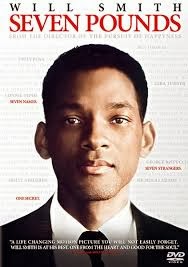
SEVEN POUNDS (Dec, 2008)
B $55M. US $70M.  WW: $165M. Dir. Gabriele Muccino.

A man, Tim Thomas (Will Smith), with a fateful secret embarks on an extraordinary journey of redemption by forever changing the lives of seven strangers. That's how the producers want you to understand this movie. The secret is that Tim caused an automotive accident that killed seven people including his wife who was the passenger in his car. Somehow Tim, as the only survivor, avoids going to prison for manslaughter--a story beat the movie never deals with.

Tim goal is to find seven people who are in life-threatening situations due to illnesses that cannot be cured, and give them something of himself so they can live. He donates bone marrow, a lung, a kidney, a liver, and his beach house to give new life to others. Then he arranges to donate his final gifts--his corneas and his heart, which ironically goes to the young woman with a fatal heart condition that he has fallen in love with. To consummate his final donations he commits suicide in such a way that his organs can be quickly harvested and transplanted.

The moral premise could be stated like this:

Hating self leads to suicide; but
Loving others (also) leads to suicide.

The movie would have worked better as a tragedy, but the producers try to make out Tim's ultimate sacrifice (of suicide) as redemptive, and self-hatred can never be redemptive.

Conclusion: False moral premise, it is contrary to how 99% of humanity is wired, and the movie (for a Will Smith vehicle) fails at the box office.

NARNIA: VOYAGE OF THE DAWN TREADER (2010)
B $115M. US $104M.  WW $416M. Dir.  Michael Apted.

Based on C.S. Lewis popular youth novels, Lucy and Edmund Pevensie return to Narnia with their cousin Eustace where they meet up with Prince Caspian for a trip across the sea aboard the royal ship The Dawn Treader. Along the way they encounter dragons, dwarves, merfolk, and a band of lost warriors before reaching the edge of the world.

So, what is the moral premise for this Christian allegory?  Well....I have no idea, at least not a single moral premise that focuses the actions of the many protagonists or a single antagonist, which can't be identified. In terms of a conflict of values which is the basis of a moral premise, there are many: Greedy vs. Generosity (Eustace); Pride vs. Humility (Susan); and then hints of issues with loyalty and being valiant. King Caspian wans to find the seven swords but there doesn't seem to be any consequence or stake if the swords are not found, and there's no urgency in the task. Thus, nothing is focused. All of the children seem to have different goals, but not coalesced under a single value. And if there's a single antagonist that obstructs the various goals, it is not identified not does it make clear what it wants. Instead there is a spell, black smoke, a dragon

CONCLUSION: While we have a high moral tale that hits a lot of good notes, there is nothing singular around which to unify the story, and there's no clear protagonist or antagonist with an agenda. This leaves the movie with a lackluster box office performance and obstructs it's true potential.


MARS NEEDS MOMS (2011)
B $175M. US $21M.  WW $39M. Dir.  Simon Wells.

A young boy named Milo gains a deeper appreciation for his mom after Martians come to Earth to take her away. On Mars the boy finds that only females run the show and the men are all castaways. There are no families, just robots that require the death of a real Earth mother, know anything about discipline and following rules. 

The box office disaster of this movie was made all the more egregious by the decision to use 3D Motion Capture, which elevated the short 80 min family film into the stratosphere of a budget. But the story did not have a large following, although it was based on a book by the same name. 

Here are some of the reasons why this movie bombed. I'll save the moral premise, story structure for the last bullet point. 
  1. What 10-12 year old boy wants to go see a movie about mom? He'd be the laughing stock of his friends.
  2. The slow economy in 2011 prevented many families from taking their whole family to new released movie unless it's something very big. MNM was hardly known.
  3. A mother's life being threatened may be too scary for little kids. MNM is PG.
  4. The frequent homage to the 60s and the hippies would be lost on the target audience of kids, and very benign to the parents of those kids, who would not have remembered the time either. It's the grandparents that lived through the 60s.
STORY STRUCTURE PROBLEMS
A story's moral premise and character arcs are tied closely together. We see the vice and virtue of the moral premise, and the physical consequences through the decisions that the character's make and the natural law consequences. The character that audiences gravitate toward and identify with, is the protagonist. As the protagonist makes the major moral decisions that turns the story one way and then another, audiences will follow the natural law consequences and see what happens. When structured right, the audience subliminally understands what the story is really about.   Assuming the consequences on a physical level agree with the common understanding of natural law, audiences will embrace the movie and the characters,... especially the main character. 
As I said, audiences look first to the protagonist for moral decisions and consequences. Audiences naturally gravitate and try to identify with the protagonist and root for him or her to make the decisions that will send us on a great adventure and learning. Those decisions and arcs describe in an existential way what the story is really about.   
So, how do you identify the protagonist? There are several ways that the audience uses to naturally identify the protagonist. Usually ALL these things need to be true for the protagonist, or mostly so, if the movie is to be a success. The protagonist is:
  1. The character who is on the screen the most.
  2. The character that demonstrates a unrelenting passion for the main goal.
  3. The character who's name or essence is found in the movie title.
  4. The character who makes the moral decisions that changes the course of the story at turning pints like the Act 1/2 Break. Decisions cannot be made by others or happenstance.
  5. The character that changes the most internally thus empowering the outward journey toward success. 
But here is what happens in Mars Needs Moms:
  1. Milo is on screen the most (fulfilled)
  2. Milo demonstrates an unrelenting passion for the main goal (fulfilled)
  3. Mom's name is in the title. But she is unconscious and off screen 95% of the movie, and she makes no decisions that change the direction of the movie. From the title we have no idea the story is about a young boy. 
  4. Milo does not make any decisions at any turning point that changes the direction of the movie. He does not even decide to go to Mars. His trip is happenstance. Gribbles and Ki, who are established as secondary characters, make all the turning point decisions (along with the antagonist, The Supervisor). Milo simply listens and reacts; he is not active. He follows directions. For example, at the perfectly placed Act 1/2 break Milo does enter a special world of where the Martian's live; and his goal is clear and passionate: He wants to rescue his mother. But this threshold crossing is NOT Milo's decision. It is Gribble's, who tricks Milo to take the lift to the Martian's living quarters (underground)and make the journey to rescue his mom. But Gribble's motivations are not in step with Milo, and Milo is a pawn. 
  5. Milo does not change after the 8 minute mark, which is his Moment of Grace (MOG). The MOG should be at the movie's mid-point (39.5 min). And at that place there is a moment where Milo realizes that his mother loves him. It's staged and cut like a Moment of Grace complete with music cue. Up to that moment you might consider that Milo is motivated out of selfish survival needs, not because he loves his mother. The problem is that this moment does not change Milo's decision making process or behavior other than to break away at a run -- and running vs. non-running is not Milo's inner problem. Milo's inner problem, "wishing he didn't have a mom" was solved 8 minutes into the movie, even before the Inciting Incident. This has the effect of a Moment of Grace and his behavior changes. But it is not the pivot pint upon which the plot is based, and it should be. Thus, Milo internal arc is flat. He does not change from 8 minutes to 81 minutes. 
  6. One last thing: Usually the antagonistic character, in this case The Supervisor on Mars, is the agent that instigates the Inciting incident, which confronts the protagonist out of the protagonist's vice or weakness of the moral premise. But while the Inciting Incident is totally initiated by The Supervisor, it has NOTHING to do with Milo's rebellious attitude. Good inciting incidents should be a call to the protagonist to change, which is first rejects, goes on a journey, almost dies, and finally brings by the elixir of truth.
Some of the results of the above problems become evident when the other characters take time to hit beats in their story line that do agree with the moral premise. Ki for instance is learning about the "love thing" and the true concept of parenting. She doesn't hate parents to begin with as The Supervisor does, but he embraces the new concept of two parents, and ends up with Gribbles who seem to be on their way back to Mars to have a family. Gribbles also arcs from disrespecting family to embracing it. At the beginning he would rather play games and watch movies like an adolescent. And he shirks his responsibility to do the right thing. At 67% in to the movie he changes, when he decides to help Milo rescue his mother and not keep rejecting the journey that will threaten Gibble's life.  
Indeed, I think Gribbles should have been made the protagonist. He has a clear arc, he has a lot of screen time, and he's interesting. But he's not introduced until 25% into the movie, far too late for the protagonist to be introduced. 
The Martians also have a story arc that follows the moral premise. 
THE MORAL PREMISE 
I think the moral premise for this story is true, but it is not consistently applied, especially in the protagonist's arc.
Disrespecting (and hating) your parents, leads to captivity and trauma; but
Respecting (and loving) your parents, leads to freedom and peace.

Essentially MARS NEEDS MOMS suffers from a lack of a roller coaster arc for the protagonist, which would have allowed the audience to identify and root for the achievement of his goal. The movie would have done better had the title been GRIBBLES and the whole story begin with him on Mars trying to find meaning to his captive life.

THE FIFTH ESTATE (2013)
Budget $28M. US $3.3M.  WW N/A. Dir. Bill Condon.

A longer analysis of THE FIFTH ESTATE can be found HERE. What follows is a summary.

A dramatic thriller based on real events that reveals the quest by super-hacker Julian Assange, to "expose the deceptions and corruptions of power that turned an Internet upstart into the 21st century's most fiercely debated organization" (producer's quote). The movie is based primarily on a book about the events by Daniel Berg, Julian Assange's compatriot who turned on Assange at the end.

There are two obvious reasons why this movie was a box office floop, in spite of the stellar production values backed by two studio powers (Dreamworks and Touchstone's Disney).  A third reason is given in the longer analysis.

1. FALSE MORAL PREMISE

This is the moral premise that the film espouses:

Keeping any secrets leads to dystopian corruption and tyranny; but
Revealing all secrets leads to utopian justice and freedom.

Although the movie portrays Assange as a manipulative megalomanic, ["a psychopathological disorder characterized by delusional fantasies or power, relevance,  or omnipotence  characterized by an inflated sense of self-esteem and overestimation of power.(1)], the movie also elevates Assange as a noble and tragic savior that we should all emulate. 

This is made clear in a final reflective dialogue scene between Daniel Berg and Guardian reporter Nick Davies, that attempts to explain why Assange, although a manipulative liar, is a hero because his end purpose was justice (under his own terms). (See longer analysis for the dialogue). 

This ending THE FIFTH ESTATE dialogue suggests the possibility of a good (although manipulative), utopia, which conveniently avoids the presence of manipulative, dystopian evil. It also excuses Assange's tyranny over those that work for him, as if such manipulation is good if one is sincere and committed. (I understand that love covers a multitude of sins, but I've never heard that sincerity does the same thing.)  Thus, Assange comes off like a I.T. Hitler... who believes that sincerity and commitment are virtues that excuse all manner of theft and lies. Why? Because the the people Assange and others were stealing from have no right to possess what they have, and Assange's lies will uncover bigger lies. Yet, the general public is aware (at least subliminally) that the ends never justify the means, and that secrets, when revealed in the raw, are easily misinterpreted and can be used for evil purposes. They are also aware that when theft is justified by each individual for their own desires, the consequence is utter chaos and anarchy, not peace and goodness. Assange's logic is no different than that of an evil tyrant who Assange is trying to take down. 

The movie also makes clear that anyone that has a lot of something (secret information or secret money) is corrupt and evil -- an false generalization. Possessions are relative. A poor person in the Chicago slums would be considered rich by standards in some other parts of the world. And audiences recognize this truth, even if they are jealous of their neighbor's stuff. 

Each  member of the audience knows they have secrets that if revealed would destroy them and their loved ones. This is not so much because of wrong actions but because the debates that occur in their heads (or in parliament) if heard in the raw, would be misconstrued, and manipulated for wrong-headed or misplaced purposes. Privately in our heads, in our homes with family members, and honest debate should allow us to consider all alternatives before acting. The cables released between government officials, while some were damaging and uncomfortable, nonetheless also reflect this debate in search of truth. The debate (even in its extreme propositions) should not be constructed as wrong, but as good. It's the outcome of the debate, the actions that should be judged.  While all actions are not good, all secrets are not evil. 

But the film portrays the opposing moral premise which rings false, and thus the audience turns away. 


2. PROTAGONIST CONFUSION. Although the filmmaker's protagonist (Assange) is passionate, active, and has a physical goal (good things for a protagonist to have), the goal is not universally accepted as a noble one. And although he is imperfect (something all protagonist should be at the beginning of even a redemptive film), he doubles down and embraces his imperfections even more, thus leaving us with a tragedy.  Tragedies never do good at the box office because people want redemption...for their own lives...as exampled in the protagonist.

Berg's character, however, does change (an aspect of a successful protagonist), and we are drawn to sympathize with Berg, and root for him to put limits on Assange. But Berg is not a proactive or even passionate character searching for a goal we can root for.  He is totally reactive to Assange and to Davies. Thus, both characters violate clear rules of acceptable protagonists, and the target audience rejects them both as unlikeable.

CONCLUSION: False moral premise, protagonist confusion.
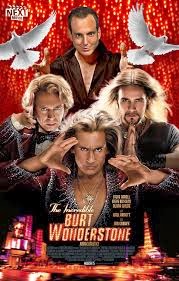

THE INCREDIBLE BURT WONDERSTONE (March 2013)
B $30M. US $24M. WW $24M. Dir. Don Scardino.

When Las Vegas superstar magicians, Burt Wonderstone's and Anton Marvelton's act and their 30-year friendship turn stale, a sadistic street showman puts them out of business. Wonderstone's chance meeting with his childhood hero at a retirement center allows him to recover his love of magic and recover his audience.

An all star cast (Steve Carell, Steve Buschemi, Olivia Wilde, Alan Arkin, and Jim Carrey) could not save this disaster of a story due to several fundamental story problems:

a. There is nothing redeeming or noble about the protagonist (Burt Wonderstone played by Steve Carell) until 60 minutes into the 100 minute story. In short we can't like him or root for him, until we've emotionally left the theater. We like him from about 60 minutes to 90 minutes, but at the end we again "wonder" why his character is redeemable. 

b. What happens at 60 minutes in is essentially a moment of grace, but structurally it's the first turning point where the protagonist makes a decision that changes the story's direction. Thus it's more like the Act 1 Climax...30 pages too late, and even if it was a Moment of Grace, it'd be 10 minutes late.  While Burt's goal is clear early on (reinvent his act and make it entertaining again...supposedly, the act has not changed in 30 years), he does not embrace this need (or goal) until the 60 minute mark....way too late...and well after the audience dislikes the megalomanic character. It's fine to start off with an arrogant character, but no later than 25% into the picture we need to have some hope that he can change. About mid point (50 minutes) into the story my wife turned to me and said, "I don't like this."

c. The antagonist, a sadistic street performer (Steve Gray, played by Jim Carey), begins attracting larger crowds that Burt and Anton, and thus creates pressure on Burt and Anton to fix their show. But Gray is not (in story structure) a real antagonist, even though there's some direct competition at a party late in the movie. The reason is that Gray is not doing magic, illusions or slight-of-hand, but catering to the macabre, grotesque tastes of what would normally be an alternative audience.

The filmmaker's assumption that Wonderstone's audience and Gray's audience are the same demographic is wrongheaded and the movie audience subliminally won't buy the incongruity nor the filmmaker's apparent disrespect for the movie audience's emotional attraction to a character. When Wonderstone is at his best he loves life and his audience. But, Gray clearly hates life and demeans his audience.

The real antagonist is Wonderstone's megalomanic fame and his consequential lost love for magic and entertainment. That is, in terms of story structure, Wonderstone and Gray are not opposites, and Gray's antics would naturally never disrupt Wonderstone if Wonderstone had an act that created wonder. The only wonder involved is on the part of the audience toward the filmmakers.

d. The above three problems shows a general disrespect by the filmmakers toward the intelligence of their audience's expectations of emotionally engaging with the characters, rooting for them, or understanding what makes a story. And if that wasn't enough, the final trick that Burt and Anton come up with, to rejuvenate their act, is dramatically disrespectful to all audiences. At first blush, the trick sounds wonderful.... make their audience disappear. But the way they do it demonstrates disrespect of any audience in three ways: (a) Burt, Anton and their crew threaten the lives of their audience by mass drugging them with a inhalant causing the audience to pass out; (b) the crews carry, drag, and toss the bodies as if they were sacks of trash; (c) the filmmakers somehow think that treating people with such arrogant disrespect is funny.

e. The above conspires (no doubt inadvertently by the filmmakers) to SHOW us that Burt really has not lost any of his arrogance toward his audience. That is, Burt's arc is not just late, but it reverses. Although the Wonderstone character's surface nature changes from a man of harsh and belligerent arrogance to one of kindness and humility, his outward actions reveal no real change. He still highly disrespects his audience.

Thus, the moral premise of this film can be summarized like this:

Disrespecting your audience through a stale show and belligerent arrogance
 leads to a cancelled act; but
Disrespecting your audience through dangerous invention and kindness
leads to renewed popularity.


Tuesday, February 11, 2014

THE FIFTH ESTATE: A Failure Analysis

THE FIFTH ESTATE (October 2013) DIR Bill Condon
Budget $28 US Gross $3.3 (No Worldwide BO Numbers)

A dramatic thriller based on real events that reveals the quest by super-hacker Julian Assange, to "expose the deceptions and corruptions of power that turned an Internet upstart into the 21st century's most fiercely debated organization" (producer's quote). The movie is based primarily on a book about the events by Daniel Berg, Julian Assange's compatriot who turned on Assange at the end.

For a movie produced by Dreamworks and distributed by Touchstone, there should have been a tighter grip on the well-known rules of successful story structure. This box office flop indicates that something was seriously wrong with the story, especially since it came from two powerhouses and the production values are very high and acting is very good. [Yes, I wish studios would follow the precepts in my book The Moral Premise. For a $20 and a five-hour investment they'd make millions if they followed the simple precepts learned through the ages.]

MORAL PREMISE
Here's the moral premise that the film espouses, followed by an explanation. I am not familiar enough with the real facts of the real story or with Wikileaks to extend this analysis to the real thing. This analysis is strictly about the movie, which embraces this moral premise statement:

Keeping any secrets leads to dystopian corruption and tyranny; but
Revealing all secrets leads to utopian justice and freedom.

 ANALYSIS
There are two obvious reasons why this movie failed, in spite of the stellar production values. No, there are a least three reasons. In order of significance (to this blog, at least), they are:

1. FALSE MORAL PREMISE

Again, here's the moral premise that the film espouses:

Keeping any secrets leads to dystopian corruption and tyranny; but
Revealing all secrets leads to utopian justice and freedom.

As explained in No. 2 below, THE FIFTH ESTATE has all the earmarks of a tragedy and yet the filmmakers try to make it out as redemptive, with Assange painted as a mad but noble hero. This never works, even when you have an A-List actor playing the lead: e.g. SEVEN POUNDS. Tragedies can have a true moral premise if the story is treated as a tragedy without an attempt at making wrong-headed behavior good. (Moral relativism lasts only so long before your face is covered in spittle.) 

The movie portrays Assange as a manipulative megalomanic, ["a psychopathological disorder characterized by delusional fantasies or power, relevance,  or omnipotence characterized by an inflated sense of self-esteem and overestimation of power (1)]. Assange's decisions and behavior are revealed as anti-social, untrustworthy, manically self-centered and manipulative. But the movie also elevates Assange as a noble and savior and suggests throughout and at the end that we should all emulate his courage. This is made clear in a final reflective dialogue scene between Daniel Berg and Guardian reporter Nick Davies. It's here that the two attempt to establish the moral ground upon which Assange and the movie are based. 
BERG: I guess everyone has secrets. Scars. Moments in time that shape them. Some we can get past. Some we can't. There was a moment when everything was possible. [Note the nod to utopian ideals, which begins this dialogue and ends with it.] We changed the world. He changed the world.   
DAVIES: But then he made it all about him.  
BERG: It always was. Only someone so obsessed with his own secrets could have come up with a way to reveal everyone else's.  
DAVIES: You know there was a time when British papers couldn't report on parliamentary debate. But then a few very brave men started printing pamphlets and leaking these debates. And, uh, well, I believe the men were hanged. But the public saw these pamphlets and demanded access and the modern fourth estate was born, from the passion and the vision of these few brave souls. 
BERG: Who were hanged.   
DAVIES: Who were hanged. And now we find ourselves in the same position. A new information revolution infinitely more powerful than the last, a fifth estate, seemingly hell-bent on destroying its predecessors. All the old models dying faster than the new can replace them.  Which is why we need more brave souls. You and Julian have charted a course through all this chaos, pointed at the truth. And yes, the tyrants of this world should beware. Knowing that now, we have the power to demand the information that one day soon will wash them all away [A final utopian nod]. 
Notice how the dialogue, which attempts to explain why Assange, although a manipulative liar, is a hero because his end purpose was justice. This reflects the utopian ideal, which conveniently avoids the ubiquitous presence of manipulative, dystopian evil. Yes, the utopian ideal that ignores evidence to the contrary has followers...clearly the filmmakers. But the general public is aware (at least subliminally) that ends never justify the means, and that secret information from news sources, especially when anonymous revealed in the raw, are easily misinterpreted, misapplied, misunderstood by the public... and can be easily used for evil purposes by opportunists. A good reporter with a trusted research staff solves these problems... or most of them.

The Natural Law of keeping secrets dictates that they must be kept unless there in injustice created by keeping it, and, then, only grave harm can be avoided only by divulging the truth. And further, to reveal a secret requires a grave and proportionate reason.

Each  member of the audience knows they (individually) have secrets that if revealed would destroy them and their loved ones, not so much because of wrong actions but because the debates that occur in their heads (or in parliament) would be misconstrued, and manipulated for wrong-headed or misplaced purposes. Privately in our heads, in our homes with family members, and honest debate should allow us to consider all alternatives before acting. The cables released by government officials, while some were uncomfortable, nonetheless reflect this debate in search of truth. The debate (even in its extreme propositions) should not be constructed as wrong, but as good. It's the outcome of the debate, the actions, that should be judged. But even then, witgout context, an accurate interpretation is difficult.  

The typical person in the audience knows that the ability of a person (as well as an institution) to keep secrets (the right of privacy), while it can be evil, can also be good. While some things done in secret are wrong, many things done in secret benefit the common good. Secrets, per se, are not evil. But that is the assumption Assange and the film make. This rings as false, and the audience turns away. 

2. PROTAGONIST CONFUSION. 

Although the filmmaker's protagonist (Assange) is passionate, active, and has a physical goal (good things for a protagonist to have), the goal (to reveal unredacted, secret government cables) is not universally accepted as a noble one. (Successful films are always about universal truths, not half-hidden or parochial truths.) Although Assange is imperfect (something all protagonist should be at the beginning of a story), he doubles down and embraces his imperfections even more, thus leaving us with a tragedy.  Tragedies rarely do good at the box office because people want stories and examples of true, sacrificial redemption. And while there is a scene wherein Assange whines about sacrificing his relationship with his son whom he hasn't seen in decades, Assange comes off more as a selfish brat who really doesn't care about his son. 

Berg's character, however, does change (a desirable aspect of a protagonist), and we are drawn to sympathize with Berg, and root for him to put limits on Assange and establish a just relationship with his girlfriend, Anker. But Berg is not a proactive or even passionate character searching for a goal we can root for.  He is mostly reactive to Assange, Davies, and Anker. Thus, both characters violate clear rules of acceptable protagonists, and the target audience rejects them both. 

3. LINEAR STORY and HOOK CONFUSION. 

The first half of the movie is difficult to follow. We're not sure what Assange wants, or what Daniel's motivations are for helping. I think the filmmakers became obsessed with the difficulty of making  a movie where something invisible (data) plays an important role. The result in a lot of fast cutting, and linear story gaps. Perhaps the filmmakers felt the audience could fill in these many gaps because of all the news coverage about the real events. But, early on, it was not clear how the traditional linear news business works, nor how Wikileaks differs. The film poorly explains these critical elements, and then spends a great deal of time revealing how sources remain anonymous. Thus, the audience is left with an anonymous story to track, rather than a linear, explicit one. This is not a moral premise issue, but it is a hook and log line issue. 

The hook behind Wikileaks, at least as first conceived, is that all sources would be anonymous and thus protected. The problem, as the film illustrates, is that there is no editing and no verification or context interpretation. Thus, the raw facts are not contaminated with false conclusions, equivocations and other linguistic fallacies that confuses the facts with truth. And this IS a moral issue. But the FIFTH ESTATE hook (the unusual way news is gathered and disseminated) is only understood if traditional news gathering and reporting is first understood. 


(1) Definition from Wikipedia.

Saturday, December 21, 2013

Gerry Mooney's Modules

Gerry Mooney - http://thegravityposter.com/
If you have attended my workshops you'll recall my reference to Natural Law and how no human can escape it, and how successful story structure is the consequence of Natural Law. One of the illustrations I use is Gerry Mooney's popular GRAVITY POSTER; (purchase it at the link under the picture at right). As I explain, your characters, like real humans, can make any choice they want, but they have no choice over the consequence of their actions.

That inescapable cause (by us) and effect (from nature) relationship is why stories work and why humor works. The laws of nature transcend our physical realm and also pervade our psychological, spiritual, emotional, and moral worlds.

The productive juxtaposition of science, religion, politics, humor, and storytelling has perhaps never been so poignant than in a series of one-frame cartoons by Mooney, which appeared in Asimov's Science Magazine back in the 80s (that's the 1980's for the vampires reading this).  In each of his 51 creations, there is, like in all stories, a physical reality that metaphors the psychological reality -- which is what each module or story is REALLY about.

Below (left) is the first in the Mooney's Module series that links to the Modules, and a second image (right) to a wonderful story about a little boy and his teacher, Sister Mary Dracula that I recently purchased and "devoured".  CLICK ON EITHER IMAGE FOR THE SERIES, OR TO PURCHASE THE GRAPHIC NOVEL.


Sunday, December 1, 2013

"Great Art From Bad People" by Nikita Mungarwadi

Patrick Fifelski (DP) & Nikita Mungarwadi (Dir) on location
Guest Essay, from Nikita Mungarwadi, writer and director whom I've had the pleasure of tutoring and working with over the past six years. Picture is of her on the set of her short film Bad Luck Bella that will premiere in Ann Arbor Dec 22, 2014.

GREAT ART FROM BAD PEOPLE


What is it about the arts that can manipulate human emotions, sending the witness into a sea of startling tears or a spiral of interminable laughter? What is it about art that inspires us, guides us, and acculturates us? Most hold true to the notion that the purpose of art is to better us and some experts claim art can “raise our moral levels”[1]. We respect the irony of art, the illusion meant to distract our attention from the real world, yet offers universal principles that can be applied to reality. We fasten ourselves so deep into art’s mirage we convince ourselves that the artists must embody and exude some kind of pure goodness. And yet contradictions are ever present. In an interview for the New York Times, Kanye West pronounced, “Great art comes from great artists.” But if we consider that Kanye West is the epitome of narcissism and controversy, it begs the question: Can great art come from bad people?

There’s no doubt that West’s brimming ego depletes his character. At the 2004 American Music Awards, West ranted to the press after country music singer Gretchen Wilson won the Best New Artist Award over him. In an interview with Jimmy Kimmel, West even dubbed himself a “creative genius.” In addition to his ego, Kanye West consistently finds himself in the center of controversy, from blatantly accusing President George W. Bush on public television of being a racist, to sporting a Confederate flag on his sleeve, to humiliating Taylor Swift at the Video Music Awards.  It was reasonable for President Barack Obama to declare Kanye West a “jackass.” But when we consider all the musician’s flaws, we cannot stray from the fact that West’s music manifests considerable talent worthy of merit. With 21 Grammy awards and five platinum solo studio albums, West is immersed in accomplishment, even if his character is far from it.

West has certainly not been the only artist to contradict his art with his character. If we take a look at the 19th century German composer, Richard Wagner, we find his opera compositions to be notably rich in their textures, harmonies, and orchestration. His concept of Gesamtkunstwerk (“total work of art”)[2] revolutionized opera and continued to influence many art forms throughout the 20th century. Apart from distinguishing himself as a powerful composer, Wagner didn’t shy from publicly expressing his obsessive anti-Semitic views. Hitler deeply admired Wagner’s work and exercised his music in Nazi propaganda – Wagner’s music eventually becoming a symbol of fascism.  

The obvious answer is, yes, bad people, or people we consider to have socially reprehensible qualities, are undoubtedly capable of creating critically acclaimed art. But can we separate the man from the music, the art from the artist, and still appreciate the art by itself? Daniel Bareboim, a Jewish conductor who admires Wagner’s music, argues that while Wagner was a raging anti-Semite, he did not compose a single note that was anti-Semitic.[3] It can be argued that the artist and the art are two separate entities, and should be evaluated individually. The artist can be condemned from an ethical viewpoint while the art can only be judged from an aesthetic angle. Sure, Orson Scott Card does not reveal his homophobia in Enders Game[4], and Dickens continued to write about healing families long after discarding his wife[5], but some art cannot truly be fully appreciated without examining the life of the creator. A notable example is Picasso, who fueled his creative output from his countless romantic relationships of which two killed themselves and another two went mad.[6]

The inquisition between great art and ethics becomes even puzzling when we consider that great art can simultaneously glorify moral injustice. D.W. Griffith’s film Birth of A Nation, is known to have revolutionized the commercial film industry with its innovative film techniques, while at the same time presenting the Ku Klux Klan as a heroic force.

Art’s purpose goes beyond mere entertainment or bettering the spectator. Art represents the human condition with all its complexities and contradictions. We make art to be human, we witness art to feel human, and we study art to understand humanity. Humans are complex characters, and great art is an extension of that complexity. Art can be analyzed exclusively from the artist, but cannot always be fully appreciated without acknowledging the artist. At the same time, great art does not always constitute morally apt ideals. Art is complex; Humans are complex. Art is ironic; Humans are ironic. Like both good and bad humans, both good and bad art is irreducibly complex, intricate, and embodies the contradictory creations of ingenuity.


[1] Williams, Stan. The Moral Premise. Studio City: Michael Wiese Productions, 2006. 19. Print.
[2] Barenboim, Daniel. "Wagner and The Jews." The New York Review of Books 60.11 (2013): 1+. Web. 1 Dec. 2013.
[3] Barenboim, Daniel. "Wagner and The Jews." The New York Review of Books 60.11 (2013): 1+. Web. 1 Dec. 2013.
[4] Lorge, Lauren. "The conundrum of good art created by bad people." The Collegian . Web. 30 Nov. 2013.
[5] Schulman, Sam. "Good Writers. Bad Men. Does It Matter?" In Character, A Journal of Everyday Virtues (2010). Web. 1 Dec. 2013.
[6] McGrath, Charles. "Good Art, Bad People." The New York Times June 2012. Web. 30 Nov. 2013.

Thursday, November 14, 2013

"The Story Diamond Won't Work For Me"

I have had the pleasure of working as a story consultant with celebrated historical romance writer TAMERA ALEXANDER over the past few years. She's mentioned in a couple earlier posts.

This week she's going over the galleys to her latest book, A BEAUTY SO RARE, which will come out in April, 2014 from Bethany House Publishers.  Tamera has a couple of book series she writing this decade, turns out about one a year, alternating between Bethany and Zondervan (Harper Collins), both Grand Rapids, MI publishers. ABSR is for Bethany and is book 2 of the Belmont mansion series. Zondervan gets the series about the Belle Meade plantation. Both estates are real places, with real historical people, in postbellum Nashville, which is where Tamera calls home.

In a couple of emails we exchanged over the last 24 hours, and then a telephone conversation, Tamera shared the following:
ABSR was, by far, the hardest book I’ve ever written...Thanks again for the brainstorming we did on the front end. One thing I learned this go round…do not work from the white board (story diamond) when trying to write. The left brain and right brain do not mix. Nearly drove me to drink. Which actually might have helped, come to think of it. : )... I was trying to follow the story diamond, filling it in, trying to figure out the Act 1, Act 2, Act 3 thing, and it did not work for me. Doesn’t mean the story diamond won’t ultimately work for me, but doing that while creating is a killer for me. Just can’t mix the two at all.
Now why would I post this criticism of something I promote—The Story Diamond, pictured at left in its recent permutation. Posts about which can be found HERE, and the actual working tool HERE?

Because Tamera's observation is instructive, and allows me to reinforce why we call writing aids like The Story Diamond an "aid" and not a "rule". Indeed, Chapter 4 of The Moral Premise, "Storytelling's Natural Law and Processes" attempts to explain how every successful writer, while they may end up at the same place, cannot use the same method. Just as every protagonist is different in terms of psychological makeup and action, so is every writer in how they must listen to their muse and get the work done.  I remind writers in my workshops that if they follow my "secrets" and suggested rules of successful writing literally, they will marginalize the story's natural dynamic, and output will be a dud. One of the reasons well-written stories connect with human beings so well is that they are all different—meaning both the stories and the humans. The Story Diamond is meant as an invisible guide, to give the writer an underlying structure, not a step-by-step rule.

FREE WILL PANTSING

Update to 13 Beat Story Structure Post

I have just revised a post that I often refer writers to study is titled Story Structure Basics - 13 Major Beats and is listed and linked at the topic of the Topics & Labels listing in the right column.

I've been meaning to do this for over a year and have grimaced each time I'm asked a question that was semantically confusing in the former post. (Not that any revision isn't also going to cause questions and a grimace.) I've also updated the diagram that goes along with the post which is here.

CLICK IMAGE to Enlarge

Sunday, November 10, 2013

Teen Community of Filmmakers

Nikita (L) & sister Monica (R)
Over the past few years I've taught a Story Symposium for a group of teens, and later helped them produce a short movie. One of my students is Nikita Mungarwadi, of whom I've written before about. The picture at right I took at her older sister's high school graduation dinner. Nikita's on the left, in dresses they purchased on a recent trip to their parent's cities in Southern India.

She asked my opinion of several of her college application essays. The one below was priceless and thought it applied to stories of all kinds. It tells one.

The application prompt is followed by her essay:

PROMPT
Essay #1 (Required for all applicants. Approximately 250 words) Everyone belongs to many different communities and/or groups defined by (among other things) shared geography, religion, ethnicity, income, cuisine, interest, race, ideology, or intellectual heritage. Choose one of the communities to which you belong, and describe that community and your place within it.

NIKITA'S ESSAY
We are a community of filmmaking teens.  A community of all Caucasians and one Indian.  A community of devout Catholics and one devout Hindu. I am the latter, yet I belong with the former. 
When I attended my first Story Symposium workshop freshman year, I was mildly surprised to find that I would be the brown sesame seed among the pot of white rice.  I was already accustomed to be the minority.  In school, I was one among the two Indians in my grade; in ballet I was the one Indian. 

I wasn’t expecting hostility, but I braced myself for the discreetness that was sure to exist.  Strangely… I got neither.  The rest of the teens completely ignored the fact that my external features were incompatible with theirs, and adopted me within their circle.

Soon, we became a cult, enthusiastically learning the craft of a perfect screenplay.  We contributed recommendations on others’ screenplay ideas while absorbing advice for our own. 

We all shared a mutual desire to become part of the channel through which we could manipulate human emotions, sending the audience into a sea of startling tears or a death of interminable laughter.  We realized that films were the illusion meant to distract people’s attention from the real world, yet offered universal principles that can be applied to reality.  The irony of filmmaking and the longing to be a part of it was what brought us together.

Even though our complexions clashed and our religious devotions disagreed, they considered me to be synonymous with themselves­­–a united community of teens indulged in fascination for the art of storytelling.

Wednesday, October 2, 2013

Antagonists, Settings, Protagonists, and Environments

Theory: In successful stories Antagonists are the product of their environment or setting, while Protagonists are the change-agents of their environment or setting. IOW: Antagonists are the out growth of their own status quo, while Protagonists challenge the status quo of others. Is that a rule that is always true of successful stories?

Saturday, September 14, 2013

The Moral Premise on Twitter

@MoralPremise is my twitter handle. While in Dallas I picked up two books in the Omni Hotel Gift Shop. 101 Things To Learn in Art School (Kit White [Art]), and 101 Things I Learned in Architecture School (Matthew Frederick) [Arch].

Flipping through the pages I found inspiration in how art and architecture apply to story structure and what I do in my consulting. So, I've started a TWEET series that will only appear @MoralPremise.

If I remember or have enough characters I'll end each with either ART or ARCH and the page number. Thus ART5 refers to page 5 . Of course I've already used TILIAS5 for this, but I'll get in the groove tomorrow.

Great little books to add to your library.

Saturday, September 7, 2013

What's a Story Producer?

You've all seen the credits at the end of a movie. In recent years they go on forever. Just by their length six-digits is likely added cost of prints and bandwidth each year. Next to the CGI department, with even their hundreds of names in movies without special effects, the next longest list belongs to producers. What the heck do they all do, you may wonder?

Let me make an important suggestion. We need a new kind of producer with one production-wide responsibility— the story.

A little background.

Most producers are nothing more than a coordinator who has a particular affinity to detail. Although due to their obsession with detail, especially those involving schedules and expenses, "nothing more" is a serious oxymoron. The proper idiom is more likely "everything plus more".  The industry's nod to this important personality disorder is to list the producer's name above the director's in the opening credits, e.g. a BRAIN GRAZER production of a RON HOWARD film. Of course they switch places at the end of the movie, where all the other producers share the spot light with Mr. Grazer.

Here is the list of Grazer and Howard's RUSH from IMBD. I'll leave the links in place.
Tobin Armbrust.... executive producer
Andrew Eaton.... producer
Eric Fellner.... producer
Brian Grazer.... producer
Jim Hajicosta.... co-producer
Todd Hallowell.... executive producer
Daniel Hetzer.... co-producer
Ron Howard.... producer
Jens Meurer.... co-producer
Peter Morgan.... producer
Kay Niessen.... co-producer
Brian Oliver.... producer
Anita Overland.... co-producer
Gernot Schaffler.... associate producer
Raj Brinder Singh.... co-executive producer
Tyler Thompson.... executive producer

My work on films over the last decade, which includes tracking their box office progress, suggests that if more attention was paid to the integrity of the story in all aspects of the filmmaking craft, movies would attract a larger audience.

I've written this before, but William Goldman was wrong when he wrote on page 39 of his famous book ADVENTURES IN THE SCREEN TRADE (p.39) that "NOBODY (sic) KNOWS ANYTHING."  (emphasis is Goldman's).  The truth is Somebody does know something. Just drive through Beverly Hills. Either they know something or they're printing money faster than the U.S. mint. In fairness, however, Goldman isn't claiming that E.P.'s are stupid. His context is that before a picture is released the E.P.'s don't really know how well the movie will be accepted by the public.

I contend they CAN know...if they follow the story principal of The Moral Premise, and if they had a Story Producer that was trained in those principals, and whose sole responsibility was to watch over every aspect of development, production, post-production and marketing. Of course, there's the assumption that the E.P. Producer, and Director will need the Story Producer's advice.

Back to Goldman. He points to the holiday release schedule for 1981-82. Of the 17 films released, ONLY ONE film did well at the box office. (Again, recall that numbers reflect connection and audience resonance, all other things being equal.)  Here's the list, box office numbers in millions from http://www.the-numbers.com.


On Golden Pond $119
Reds $50
Taps $36
Sharky's Machine $33
Neighbors $30
Modern Problems $24
Ragtime $17
Ghost Story $16
Rollover $10
Pennies from Heaven $6
Whose Life is it Anyway? $6
Heartbeeps $6
Buddy Buddy $5
Pick-up Summer $0
Four Friends $0
Clash of the Titans $0
Man of Iron $0

I admit, I have not analyzed any of these films for a true or consistently applied moral premise. But I have studied hundreds of movies since, and if the pattern holds, I would predict that ONLY GOLDEN POND possessed a true and consistent moral premise and that REDS had some inner truth going for it, but the presentation of the moral argument was not consistent. That's why a movie about two old people beat the rest of the pack.

STORY PRODUCER
Here's a description for a person on the project team that can substantially help connect stories with audiences.

The Story Producer is a co-producer who reports to the Producer and Director. The Story Producer has overall advisory responsibility for the consistent implementation of a true moral premise in all creative aspects of the project, including but not limited to the decisions and activities related to producing, writing, direction, photography, art direction, casting, scoring, effects and marketing. The Story Producer's work is based on the integration of a true and consistently applied Moral Premise as discussed in the book and blog of the same name. The Story Producer begins work during development with the writer and director to determine a true and resonating set of Story Fundamentals e.g. Hook, Log Line, Conflict of Values, Moral Premise, major plot beats for all main characters and sub-beats for minor characters including visual and aural motifs,  metaphors, script pacing, emotional roller-coast of beats, and dialogue.  The Story Producer reviews and gives notes on everything the writer generates including synopses, treatments, and final screenplay. During Production and Post-Production the Story Producer monitors all aspects of production for consistent execution of the moral premise in everything seen or heard by the potential or actual audience.


Wednesday, September 4, 2013

Hook Exercise Results

I've run this exercise before in my workshops, but rarely have I received the results that I did in Dallas at the T.D. Jakes Film Festival workshops on August 30, 2013. After several slides explaining the first Secret of Successful Stories, an Ironic Hook, I asked the participants to write down their ideas and pass them forward. Here, with some minor editing, is what came to me — grist for the story mill. I have no names, so if you turn one of these into a book or movie, be sure to give credit to the "T.D. Jakes IFFFF Moral Premise Workshop Participants"

Cancer 9-1-1
The Baby Teacher
Babies Raising Moms
Big Shoes, Little Feet
Sugar Ain't Sweet
A life insurance salesman is a serial killer
An Army Drill Sargent gets elected POTUS
Female POTUS appoints all male cabinet
Navy seal appointed commander at West Point
A bird is afraid of heights
A bear raises a boy in the wild
A Grandma becomes an astronaut
An alien becomes a civil war hero
A man takes over the world with an army of Shih Tzu
Due to climate upheaval Manhatten and Florida switch places
Skateboading park on the moon
Strong man fights army with large bone
A man can't fall
A man to lazy to cook sells his inheritance for a sandwich
The adventures of a quadriplegic world traveler
Black girl from Louisiana becomes 5-Star Chef in Italy
A beautiful white woman wakes up as a black woman the morning of wedding
A retired madam starts a church
A man wakes up from a coma as a woman
A man is unable to speak until he turns 30
A baby disarms a mad assailant.
A musical chair
A preacher is possessed by the devil
Boy with no hands plays the guitar
Preacher summoned to be a wartime spy
A dysfunctional family functions
Blind white racist falls for a black woman
Match.com pairs up a black racist with with white racist.


Tuesday, September 3, 2013

Tuesday, August 20, 2013

Story Symposium Query

Are you interested in participating in a Story Symposium that I would lead once a month, for 9 months, on Saturdays for three hours? It would include all of my various workshop content plus interactive discussions, sharing, and story critique opportunities. This new version of the symposium would be available to distance participants via WebEx, or to live participants who would come to the meeting location in Novi, MI.

From May 2010 through May 2012 I taught and facilitated, along with Jan Swedorske, a Story Symposium class in story writing (screenplays and prose) at my home in Novi. Students would come at 2 PM, and we'd be done by 5 PM. Some months the times shifted due to my travel schedule. The sessions were a mix of lecture, interactive, discussion, story sharing and critique. I presented my workshop material on various story topics, and I coached participants (as a group and privately) in the development of their own stories. Although this started out as a on-going workshop for teens involved in a Catholic Home School organization, at times welcomed adults, parents, and non-Christians to the group. The original symposium ran for two years. Recently there have been requests to run it again.

I am considering rerunning the symposium, but in a version that would only run for only 9-10 sessions during the regular school year (Sept through May) AND be available for people outside the area to participate live or (if a session is missed) to access the session file for playback. The live session would meet once a month on a Saturday for 3 hours. The "live" location would be in Novi at my home where I have easy access to electronic media and Internet transmission. If there was wider interest for the in-person live sessions than I anticipate we would meet at a larger venue.

This time there would be a cost, but as of yet I have not figured out what it would be. Distance participants would need a good internet connection for the transmission of visuals and movie clips, that you would be required to watch ahead of time.

Participants would also be required to have a copy of The Moral Premise that we would use for reading assignments. There would be additional handouts, access to a password projected website for downloading additional material, writing assignments (nothing very long as I wont' have time to read everything), one or two field trips, and a guest speaker from time-to-time. As before my opening lectures would be richly illustrated with my workshop slides and clips.

If you are interested in this (feel free to forward this to others), please write me ASAP to stan@moralpremise.com and provide me with your contact information and level of interest. There is no age or faith restriction.

stan

Monday, August 19, 2013

New Bookmark Now Availalble

Over the years of my work on many a story I've refined my "check list" of important story structural criteria. In recent workshops I've wanted to coordinate the "secrets" presented in the workshop, with the Moral Premise Bookmark, at least the check list on the BACK of the bookmark. Finally did it.

So, now (on the back) there are not 10, or 21, but 18 "Secrets of Successful Story Structure." And we all know that this is somewhat arbitrary because as you dig into a few of those so-called secrets they get bigger in terms of how they are applied. For instance, some people say that the Protagonist must be likeable. I'd say we must identify with him or her, which means we have to like them enough to follow and be intently interested in their decisions and outcomes. This is covered under item 17, and if you break that down there are over 20 techniques to help the audience identify with any and all of your characters. You don't use all of them... but the more the better the identification.

So, for what it's worth....and I figure each is worth thousands of dollars if they are understood and applied... on the left they are for FREE. AND THE LINK. (scroll to the bottom)

Your comments and improvements are always welcome.

stan


Sunday, August 18, 2013

Stan Williams to present at Rochester Writer's Conference

I was asked to present two, 75-minute workshops at the Rochester (Michigan) Writers' Conference, Oct 5, 2013, after their keynoter the year before. Here is a blurb about those talks and links to the related free workshop videos on-line.

Secrets of Successful Story Structure

Story Masters Class, Part 1 by Dr. Stan Williams
The 18 Secrets of Successful Story Structure: How successful stories of any genre connect can engage audiences while avoiding writer’s block for the author.

This workshop is based on Stan's work with novelists, producers and writers in Hollywood based on his book, The Moral Premise: Harnessing Virtue and Vice for Box Office Success. This workshop is a summary of his all day workshop and in part will cover the 2 spines present in all good stories, the 2 realms of natural law that characters can never escape, the 8 steps of story development, the 5 ingredients of a great hook and log lines, the 4 parts of the moral premise statement, the 13 basic beats of all stories, the 1 moment of grace, and 9 contributors of story thrust. Motion picture clips are used for examples. WORKSHOP

Who should attend: Narrative writers, novelists, producers, and directors of all story genres and media will find these sessions beneficial, if not foundational. This session will give you an introduction to the critical story concept of the moral premise and how it will speed along and improve the quality of your story telling through proper structure. In many ways the moral premise is a powerful muse; when used correctly it will inspire and focus your efforts, and powerfully connect you with your audience. Say “Good-bye” to writer’s block.

Current link: Lessons 2–9 at https://storycraft.stanwilliams.com 

Irony, Goals and Plots

Story Masters Class, Part 2 by Dr. Stan Williams
Irony, Goals and Plots: How to create and structure well-rounded, engaging characters, plots and subplots around a single motivational premise.

Is this well illustrated story workshop, you’ll learn the secrets of how characters transform, how goals are defined, how plots and subplots are created and how every character’s arc (regardless of their outer journey) are all related to a single internal moral premise that ties the story together around one core idea. You’ll also learn the critical important of irony and how it dramatizes every character’s storyline. We will reveal 3 paths to audience-character identification, the 3 poles of the Nicomachean Character value scale, 3 story-breaking (or beating) tools, and the 3 relationships of plot arcs, character goals, and dramatic irony. Bring your story ideas; there will be opportunity to practice some of the techniques Dr. Williams explains and get valuable feedback from him and other participants. This is the same content Dr. Williams has presented to working writers and producers in Hollywood, at film conferences around the country, and what he uses to help his story-consulting clients. WORKSHOP

Who should attend: Knowledge of the story structure secrets in Part 1 will be helpful, but not entirely necessary. Writers who want to investigate Moral Premise story structure on a deeper and more practical level, or writers who are challenged or face writer’s block are encouraged to attend.

Current link: Lessons 10 at https://storycraft.stanwilliams.com

Thursday, August 8, 2013

Stories Convince Better Than Logic

Want to be more effective communicator and persuader. Tell a story.
INNOCENCE 2
William-Adolphe Bouguereau

(November 30, 1825 – August 19, 1905)
The picture facing me when I wake each morning.
Buttressed by my comments, here are excerpts from a blog post by David Lavenda. You can find the original essay here: Once Upon A Time At The Office: 10 Storytelling Tips To Help You Be More Persuasive.

Which is easier to remember: statistics or a story? What tugs on your heart logic or a story? 
 
Robert McKee, famous Hollywood story guru, is quoted in the essay as saying:
Trying to convince people with logic is tough for two reasons. One is they are arguing with you in their heads while you are making your argument. Second, if you do succeed in persuading them, you’ve done so only on an intellectual basis. That’s not good enough, because people are not inspired to act by reason alone.
I would add that stories that make an emotional connection that evoke adrenalin which sears memories into the bran. Facts, apart from a story, can be lost in an instant because they are not personal.
But there’s more proof of storytelling's effectiveness than just anecdotal evidence. For example, studies carried out by Melanie C. Green and Timothy C. Brock at Ohio State University have empirically shown that people’s beliefs can be swayed more effectively through storytelling than through logical arguments. The researchers posit that persuasion is most effective when people are "transported" to another place using a story.
More accurately a story, told right, uses a combination of three types of Identification Techniques (physical, emotional & moral),  that place the story listener INTO the story and more significantly into one or more character's minds, where the audience participates emphatically in the journey of the character. That is a literal "transportation" and allows the audience to EXPERIENCE the situation as if present in person. In other words, the story becomes a simulation of reality.  Things are much easier to remember that way because "experience" is the best teacher.
Recently I had the opportunity to sit down to discuss this topic with Susan Fisher, a strategic communication expert and principal at First Class. “People are always telling stories; why don’t they do it at work?" asks Fisher. “It’s because they have been taught that at work you use logic and slides and statistics; this seems more professional. Telling stories seems too emotional and possibly manipulative. So people stick to facts and numbers. But the truth is that real emotions always work better, because that is the way to reach hearts and minds, and also people get to see the real you. It’s authentic.”
Here then are Fisher's top ten list of being a good storyteller at work. These are right out of the screenwriter and director's handbook for making successful motion pictures, or writing engaging novels.
  1. Plan your story starting with the takeaway message. Think about what’s important to the audience. The ending is the most important point of the story. This is the message we want to deliver, and the one that will linger with the audience.
  2. Keep your stories short for the workplace. Three to five minutes long is about what people can digest in today’s ADD world.
  3. Good stories are about challenge or conflict. Without these elements, stories aren’t very interesting. The compelling part of a story is how people deal with conflict–-so start with the people and the conflict.
  4. Think about your story like a movie. Imagine you are screenwriter with a goal to get your message across. The story has to have a beginning, middle, and end.
  5. Start with a person and his challenge, and intensify human interest by adding descriptions of time, place, and people with their emotions.
  6. Be creative. Create a storyboard; draw it out, while listening to music or reading something for inspiration. A good story always has ups and downs, so "arc" the story. Pull people along, and introduce tension, just like in a fairy tale. (“From out of nowhere, the wolf jumps onto the path…”)
  7. Intensify the story with vivid language and intonation. Tap into people’s emotions with language. Use metaphors, idioms, and parables that have emotional associations. (Note: For more on this, see Leo Widrich’s article entitled, “Which Words Matter Most When You Talk” and studies on intonation performed by Ingrid Johnsrude at Cambridge University).
  8. When using a story in a PowerPoint presentation, use appropriate graphics/pictures to convey your message. Stay away from text and complicated graphics. A single picture interlaced with emotional language will go a long way to convey your message.
  9. Most of us have not told stories in front of an audience since English class in high school. So you will need to practice. Tell your story in front of a friendly audience and get feedback. Gauge your pace, and take note of the story’s length and your use of language. It will be a bit rusty at first, but underneath it all, we are all born storytellers.
  10. The most important point is to make the switch within; because once you internalize that today’s "left-brain" communication style doesn’t work very well and you realize that stories are how people really communicate, you will find it a lot easier to proceed…because it’s authentic. And that is what really persuades.
Fisher also recommends signing up for a storytelling workshop.
Duh! I have a great suggestion....

What is Motion Picture Development?

As announced earlier I'm facilitating TD Jakes' International Faith and Family Film Festival Short Treatment Contest. (I'm also presenting two workshops at the event, August 30, 31, in Dallas.) The winner of the treatment writing contest will be offered a motion picture development deal with TD Jakes Enterprises. 

One entrant asked what "Development" entailed. Here was my response. NOTE THAT WHAT I DESCRIBE BELOW IS NOT NECESSARILY THE PATH TDJE WILL FOLLOW. ANYTHING IS POSSIBLE. WHAT'S BELOW IS INDUSTRY TYPICAL.  ALTHOUGH "TYPICAL" DOES NOT DESCRIBE THE MOTION PICTURE INDUSTRY.

=====  

Development of a motion picture can take years. The process begins with a story idea, such as the selection of a treatment that has been submitted for the IFFFF Short Treatment Contest. Development typically involves the following steps, but not necessarily in this order:

a. The writer (you) and the Executive Producer (EP, e.g. TDJE) would sign an "Option-Purchase Agreement" that would temporarily transfer ownership of the story and script (referred to an the Intellectual Property (IP), to the EP for a period of three years.  The OP Agreement is in two parts. Part A is the Agreement for the EP to try to get the story through development and into pre-production. For that the writer is paid a small fee. Part B of the Agreement for the EP to purchase all rights in perpetuity to the story, for a larger fee. The Purchase is not executed until the EP is absolutely sure the story will actually get produced, usually on the first day of principal photography.  If the story cannot be fully developed and entered into production, the ownership of the IP reverts back to the writer, and the writer keeps the option fees.  

b. There may also be an over all "Development Agreement" with the writer, wherein the writer is hired to help develop and write the story and the script. But, like the OP Agreement, signing a development agreement is no guarantee that the project will eventually get made into a movie. It is often the case that multiple writers and script story-consultant are involved. The EP pays all costs.

c. Working with a team of story experts the story idea (or original draft of the script) is "broken" or "broken down" or "beat out". That is the story is formally structured to meet the demands of a mainstream movie.

d. The story or script is then written and rewritten (over and over) to make it so good that others will want to be part of the project, and agree to "attach" themselves to the effort.

There are both technical (objective) and aesthetic (subjective) aspects to the above two steps.

e. The EP then attempts to "attach" to the project a line producer, production manager, director, and principal actors. With each attachment (a task that is subjectively dependent on the opinion and taste of the various parties) the script will go through another revision as each person that comes onto the project will make suggestions.

f. The EP will search out and attach funding from a combination of private equity, production entities (studios), and distributors. This may involve writing a business plan and creating preliminary marketing materials.  This step can be long and finding the money very elusive.

g. Along the way, all parties sign "Deal Memos" that confirm the parameters of the parties' involvement in making the picture. Deal Memos are short letters that precede formal contracts that are not signed until pre-production begins, which is the stage following development and just before production. Pre-production does not begin until all the deal memos are signed and the executive producer (and TDJE) agrees to actually make the picture. The approval to proceed with production is called a "Greenlight."

h. It is sometime during the above stages that the "Option Agreement" is executed and the actual sales of the intellectual property (the story and script) is transferred permanently to the executive producer and the writer is paid his or her purchase fee.

Yes, it can take years, and not thing is guaranteed.  Welcome to "Development Hell."