Wednesday, May 4, 2011

WRITING GOOD LOG LINES


A key ingredient of the Log Line is the Story Hook. Here's a link about Hooks. 

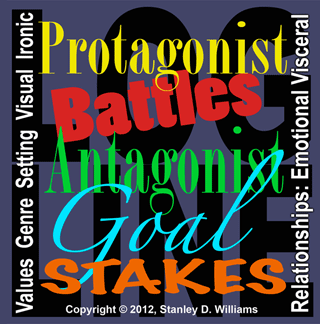
Also, another explanation of this graphic and the log line is found HERE.

=====

This is the last article you’ll ever need to read on log lines. Our goal: a strong, pithy pitch for a movie that will keep you focused as a writer and get your audience into the theater.

Because I teach, consult, write, and direct, I am always in desperate need of a good log line. If not for the story I’m currently working on, then to explain to my wife what I did all day long at home while she was off earning money to pay for our groceries. I’m always having to come up with them, or help others figure them out – the log lines, not the groceries.  So, I needed an easy to remember formula that worked. But first, I needed a motivation. Don’t we all?

WHY LOG LINES?
Originally, log lines were long thin ropes on a spool with knots tied in them that mariners unreeled behind their ships to measure their speed – in KNOTS. They counted how many evenly spaced knots passed through their hand as the sand in the hour-glass drained from the top to the bottom. The mariner’s log line was a necessity in helping them navigate their journey and not get lost. It told them how far they had gone in a certain direction and when to turn the boat to find their destination.

[The other advantage of the marina’s log line was that if the boat got lost, the sailors simply had to follow the log line back to port. As time went on, and captains become more adventurous sailing to distant lands, the log lines got pretty big. But, after a few ships sank from the enormous weight of the reels, ships never got lost again. Why? They learned their lesson and never ventured far from port.]

Now, if that last part in brackets sounds like a joke, it wasn’t intended as such for the writers reading this. It’s the lie that tells the truth -- about the importance of log lines. Log lines help us navigate our writing. They also help to steer funding and attachments to our projects. And they direct audiences to theaters. Log lines are a necessary tool that keeps us focused in writing our story, and helps convince “names” to spend their time and money to get our story made and distributed. A good log line tells us how far we need to go before we arrive at a turning point in the plot. And, if we get lost, a good log line will lead us back to the beginning where we can start again.

THREE METHODS
Below, I outlined THREE methods of writing a log line, but I favor the first, and so the examples at the end of this post use the first. Use whichever sounds the most intriguing. Different stories/genres may lend themselves to one better than another. But all three need to at least imply all the critical elements of a good log line, which are listed in the next paragraph as I also describe the first method.

THE FIRST METHOD and ELEMENTS OF A GOOD LOG LINE
Fundamentally, a good log line will be a single sentence that will includes five elements.

The subject of the sentence will describe (1) an imperfect but passionate and active PROTAGONIST. The verb will depict (2) the BATTLE. And the direct object will describe (3) an insurmountable ANTAGONIST who tries to stop the protagonist from reaching (4) a physical GOAL on account of (5) the STAKES, if the goal is not reached.

The formula graphic at the right show you one possible way of organizing the log lone sentence. Notice that the terms (i.e. placeholders) I've chosen for the formula should be replaced or implied with specific nouns and visceral terms that fit your story. You don't have to be explicit, but you do need to communicate the moral and emotional tone that causes your protagonist to leap off the page with passion. That is, the log line is better if the words chosen enhance the story's marketability by suggesting the movie’s:
  • Values
  • Genre
  • Setting
  • Visual
  • Ironic hook
  • Relationships in the balance
  • Emotional context, and
  • Visceral action.

VERB
The verb you choose to depict the struggle must be visual and active. After all this is a movie, not a play or a novel. Thus, the log line verb should be one of the following, or one like them that best suits the genre:

struggle, battle, contends, wrestles, grapples, scuffles, fights, wages war, jousts, duels, spars, scraps, opposes, takes on, clashes, quarrels, feuds, or crusades.

STRUCTURE
Now, take all those elements and put them into a compelling sentence in this order:

[protagonist]…[verb]…[antagonist]…[goal]…[stakes].

What it doesn’t sound right? Then, rewrite it. You do know what a rewrite is, don’t you? As formalistic as all this sounds, expect to rewrite your log line many, many times --- not necessarily at first, but over the time that you develop your story and script. 

MORAL PREMISE
Having written the book The Moral Premise, it’s only fitting that I reference it here. While the log line describes the PHYSICAL essence of the story, the moral premise statement describes the inner working, or the PSYCHOLOGICAL essence of the story. If you’re not familiar with the moral premise statement construction, here’s an example. Its purpose is to articulate the arc of the story from psychological value to physical consequence. For instance:

Fear leads to paralysis; but
Courage leads to action.

The log line only hints at the context of the moral premise statement. Both are necessary to write a strong story that touches both physical and psychological beats.

Again, it’s worth repeating: While the log lines tell us what the movie is about PHYSICALLY, the Moral Premise Statement  tells us what the movie is about PSYCHOLOGICALLY, that is, the Moral Premise explains the conflict of values and the character's inner motivations which incites the physical action.

Audiences leave the theater thinking well or ill of a movie based on their subconscious awareness of the moral premise’s truth and consistency. Start with a good hook, then develop a good log line that includes the hook. Then, establish a true and consistent moral premise statement. With those tools in hand you’ll be well on your way.

THE SECOND METHOD - 4 QUESTIONS AND 4 ANSWERS

My friend Jeffrey Alan Schechter makes the justifiable claim that a good log line should clearly and unambiguously answer these FOUR QUESTIONS:
  1. Who is your main character?
  2. What is he or she trying to accomplish?
  3. Who is trying to stop him or her?
  4. What happens if he or she fails?
The answers to those questions, which MUST BE embodied in the log line, are:
  1. A sympathetic character, who is
  2. trying to accomplish a compelling goal while being opposed by...
  3. a powerful and committed opponent, over
  4. life and death stakes.
You see this is very similar to the first method, so I'll stop here on this.

THE THIRD METHOD - THE STORY QUESTION LOG LINE

Another intriguing method of constructing log lines is the Story Question Log Line. It might be formulated like this:

Will an imperfect PROTAGONIST be able to BATTLE an all powerful and ubiquitous ANTAGONIST to achieve his or her IMPOSSIBLE DREAM (e.g. a PHYSICAL GOAL)?  

[Example:  Will a lonely young man be able to fight off depraved government officials and blood-thirsty scientists, who want to cut up and dissect his new girlfriend — a real mermaid?]

LOG LINES: THE BEGINNING AND THE END

Log lines, as I said above, are the place that writers start. Log lines help to focus the filmmaking team as they move through the process of writing, development, attachment, production, and then marketing. But the best log lines are usually written AFTER the movie is finished. Why? Because movies are made three times: in the writing, in the shooting, and in the finishing. And it's not until it's all over that we really know what the film is about, and what the characters are REALLY about.  At any rate, log lines are critical to understanding what makes a good story. 

EXAMPLES USING THE FIRST METHOD
Here are a few good log line examples.
•   A naïve young man battles heartless authorities to protect the life of his girlfriend when it’s revealed that she’s not human— she’s a mermaid.
•   A police chief, with a phobia for open water, battles a gigantic shark with an appetite for swimmers and boat captains, in spite of a greedy town council who demands that the beach stay open.
•   A Parisian rat teams up with a man with no talent to battle convention and the critics that anyone can cook and open their own restaurant.
•   A lawyer who loses his ability to lie for 24-hours, clashes with his ex-wife for the affection of their son and the healing of their family.
•   A young farmer from a distant planet joins the rebellion to save his home planet from the evil empire when he discovers he is a warrior with legendary psychokinesis powers.

GIVE IT TIME – BUT DON’T STOP
Nothing good comes easily. That adage begins and ends with log lines. Their importance in the movie industry (and in all storytelling efforts) cannot be overstated. The human mind requires a respite from time-to-time to reach its full potential. Within your mind is the capacity to not only write a good log line, but construct the good story that goes with it. Write hard each day. But then relax and do something that involves physical activity aside from sitting in a chair and bending over a computer. Writing is hard work -- but you need exercise, too. I spend the mornings writing. In the afternoon I chop logs, garden, sail and chase my wife around town. You’ll be surprised how your mind assimilates and solves problems when you’re not trying to force it. As your project develops never stop coming back to your log line and see if you can make it that strong, pithy pitch that will sell your story.


Dr. Stan Williams, author of The Moral Premise: Harnessing Virtue and Vice for Box Office Success, consults on story structure, screenplays and the film industry from his home in Michigan and from the road in Los Angeles. You can reach him through his website at http://www.moralpremise.com.


Copyright © 2011 Stanley D. Williams


Thursday, April 28, 2011

Sell the Story

This article which I picked up from DIY Musician, written by Scott James, originally appeared on Echoes.

In 2009, Rob Walker and Joshua Glenn tried out a little experiment. They spent $128.74 on a bunch of yard sale junk and hired professional writers to draw up interesting stories about each item. Then they put everything up on eBay with the stories that they created to see what happened.

They spent $128.74 on junk and turned that into…$3,612.51!

How does that work?

Sounds like a good question that’s worth exploring, doesn’t it?  You might find some insight from the story of a flannel ball that they sold.  A pretty worthless object, right?  Not much practical value there.  Accordingly, they originally paid $1.50 for it.  You might be surprised to know that they ended up selling the ball of flannel for $51!

How? Well it all started by imagining it as something with a story.  Something beyond just the utility value.  Check out the first paragraph of the story that was written for it by Luc Sante:

After my friend Claude had his accident I went to visit him in the hospital. When I saw him I had to cough to divert a laugh. He looked like a guy in a cartoon, his entire body wrapped in bandages. He had broken everything that could be broken, from his skull to his toes. Somehow he was conscious and could speak, although to hear him I had to put my ear right up to his mouth-hole. I thought he said “door,” so I shut it, but he was still agitated. Eventually I got it: “drawer.” The one in his bedside stand contained a single object, a ball of wrapped flannel that looked like his head, only more colorful. I went to pick it up with my fingertips, but then had to readjust. Astonishingly, the thing weighed at least five pounds. I gaped at it, but Claude was making noises. I finally understood: “Don’t unwrap it.”

Suddenly we’re not thinking about the intrinsic value of a ball of flannel, but instead we’re drawn into a story… and ultimately projecting the intrigue and emotions of the story onto the object.  What we have to realize is that people aren’t paying for objects, they’re paying for the meaning that they assign to the objects.

So when you’re pitching your CD, are you communicating that you’re just selling your CD or are you communicating the story of the blood, sweat, tears, fun, hope, dreams, inspiration, excitement, talent, heartache, challenge, and triumph that went into it? What are you saying about it on stage? What are you writing about it to your mailing list? How are you presenting it on your website? Are you telling a story or just selling an object?

Sunday, April 24, 2011

Men in Black 1 & 2: Knowing and Pretending

 This post contains comments from both MIB (1997) and MIB II (2002). After MIB III comes out, I'll add to the post again.

MEN IN BLACK (1997) 98min PG-13
Budget $90M Est
Domestic BO: $250M
Worldwide: $326M

Director: BARRY SONNENFELD
Writers: ED SOLOMON, based on a LOWELL CUNNINGHAM comic.

TOMMY LEE JONES: Agent Kay
WILL SMITH: Agent Jay (James Edwards)
RIP TORN: Chief Agent Zed
LINDA FIORENTINO: Dr. Laurel Weaver
VINCENT D'ONOFRIO: Edgar
TONY SHALHOUB: Jack Jeebs
SIOBHAN FALLON: Beatrice


IMDB LINK

Men in Black's antecedent is a 1990 comic. (The Men In Black at Wikipedia.)  Not as deep or celebrated as other well-known superheros (Superman, 1939).  In many classic super hero comics, the "super" refers generally to the good guys who

Thursday, April 21, 2011

Entertain, Educate, Elevate - Mel Gibson

If an actor is any good, they are vulnerable, on stage and off. Transparency is necessary. Friends who have been with Mel in meetings say he's always anxious, and rarely looks you in the eye. That comes off on-screen, and because of it we are able to see inside the character... and man. It helps us identify with the story, because we all feel that anxious and unsure from time to time.  It allows us to see humanity for what it really is—unsure, but trying hard to be better.

I just read a great interview with Mel conducted by DEADLINE’S ALLISON HOPE WEINER. The interview is mostly about Mel's personal life, which only concerns me as it affects his craft... the writing, directing and acting. You will note that the best artists in any discipline have raw edges. It's what allows them to get in touch with their inner being and do art. It allows us to see honestly real humanity, exposed and struggling with mortality.

Here's something Mel said in the interview that applies to this blog and the art of crafting motion picture stories. What we do is not not just about entertainment, although that is where you need to start.
"And the end of the day, it’s what did they think of that? Did they get something from it? Were they entertained? Were they educated? Were they elevated? Were they all three? You know, which is really good? Entertain, educate, elevate. I think that’s what Jodie did [in The Beaver]. If you can get all three of those, you’ve got the Trifecta going." (Mel Gibson)

Saturday, April 9, 2011

Questions Answered about RomComs

Janet asked some questions in the previous post's com box. I'll answer them here.
Janet Asks: Do all the other main characters struggle with the same MP, but in regard to their own issues?

Answer: Yes. that is how the movie can have multiple story lines but still be about one thing. the principles are the same for a novel or a screenplay.
Janet Asks: I've just bought and read The Moral Premise and learned a huge amount from it. But I'm writing a short romance novel rather than a screenplay...The type of romance novel I'm writing needs two main characters (hero and heroine) but there's no room for an additional significant secondary characters or antagonist. (Each acts as the others' antagonist along with the characters' psychological flaws.) Both hero and heroine have different lessons to learn, so I'm struggling to form the vice and virtue sides of the moral premise.

Answer: Good romantic comedies have two protagonists, the man and woman, who are the antagonists for the other. But there are other characters. Each will have a "reflection" character, and each with have a "nemesis" character. These are like the good and bad angels on their shoulders creating scenes that push the characters one way or the other. Each of these minor characters will have arcs that deal with the same moral premise as the main characters do, but obviously just not in as much depth.

When you say the hero and heroine have different lessons to learn, if those lessons are different sets of virtue and vices, then you have two different stories. Your story will connect better with audiences if the virtue and vice set are along the same continuum for both. See the posts on this blog under the topic of "values" (below and to the right under the Movies & Topics list.)

It is not always possible to squeeze a moral premise into an existing story that violates some of the natural laws of storytelling. I frequently guide students to change their story so it's about one thing, and not dilute the core psychological and moral principle which the story is REALLY about.
Janet Asks: Both characters' lives are out of balance. The heroine focuses on work and has no social life, whereas the hero has made play his priority and isn't into serous relationships. (He's successful in his work so he has no lesson to learn about needing to work harder.) She needs to learn how to have fun while he needs to learn that fun flings won't make him happy. If the story was just the heroine's, then the moral premise would be easier, e.g.: A life totally focused on work brings yearning and and sadness but balancing work with fun brings fulfillment and happiness.' But this doesn't include the hero's issues.
Answer: For this to work, you need to change elements of your story. See the posts on Nicomachean Ethics — "Mean Virtue.  If your heroine is into work and not play, then the hero would be into play and not work. Don't make them too extreme in those areas, but the bias has thrown their lives (with everything in their lives) out of balance. The purpose of the antagonist in a story is to change the protagonist by obstructing the protagonist's goal. Thus your characters are like iron-sharping-iron.  

Janet Asks: Does the the moral premise in story with two main characters (who are both heading towards a happy ending) need to incorporate both arcs?--something along the lines of: 'Both an excessively serious approach to life and an excessively playful attitude lead to unhappiness, but a healthy balance between the two leads to fulfillment and happiness.' Often in romance novels the hero and heroine have similarly opposite flaws as the ones above such as Risk/caution/ or using others/helping others, so I'd love to be able to get the moral premise right for 2 protagonists dealing with opposite issues.
Answer: Yes, you got it. This is the Nicomachean Ethic post, precisely.

Friday, April 8, 2011

The Moral Premise Book Mark & Check List


UPDATE: See the updated list of criteria published August 19, 2013, HERE.

The new, 14-pt. coated Moral Premise Bookmark with rounded corners and improved check list is now available. The bookmark will help you write stories and screenplays better.
If you'd like a "physical" Moral Premise Book Mark Check List (2.75" x 8.50", with 14pt UV coating on both sides), send me a No. 10 SASE to Moral Premise Book Mark, P.O. Box 29, Novi, MI  48376, and I'll send one to you, FREE.
When I travel to Hollywood to work on a film as a story consultant I don't always take as proactive an approach as I think would be welcome. Part of my holding back is the natural intimidation I experienced because: (a) I am not as familiar with the story as the producer and writers are, who have been discussing the project for months before I arrive. And (b) I'm just a bit star struck being in the same room with people I've only read about in the trades. 


Yet, when I analyze a successful film I'm amazed at the depth to which so much about the film consistently applies a true moral premise. For example, in THE BLIND SIDE each of the main characters (Michael, Leigh Anne, Michael's teachers, and Alton the drug boss) are involved in a multilayer retelling of Alfred, Lord Tennyson's poem THE CHARGE OF THE LIGHT BRIGADE. Each of the movie's characters test the moral premise, which is about courage and honor. That premise is made fairly explicit in the poem and in Michael's essay about the poem featured at the film's end. Such "discoveries" remind me that I need to be more proactive and bring more to the table, so that future films have the potential to entertain and enlighten audiences... and help producer's succeed at the box office... like THE BLIND SIDE has.

The book mark will thus help them and me do a better job at telling stories. Here's the check list on the back, revised April 5, 2011.

The Moral Premise Story Check List
  1. What is the conflict of values around which everything in your story revolves?
  2. What is the Protag’s main physical goal?
  3. What are the P’s secondary physical goals (e.g. personal, professional, family, and career)?
  4. How is your P morally imperfect related to each of those goals?
  5. What is P’s psychological problem (vice) that obstructs the physical goals?
  6. Toward what greater virtue or vice does the P progress?
  7. How does P show desire to change?
  8. What physical obstacles, metaphored by the psychological problem, do the characters encounter, especially the P?
  9. What story altering moral decisions does the P make at the story’s key turning points? (see other side)
  10. Do the characters’ major decisions come from the psychological motivations generated by the story’s virtue and vice?
  11. What is your story’s SINGLE Moral-Physical Premise Statement (MPPS)? Will a general audience think it’s true?
  12. Does the P’s psychological and physical arc follow the MPPS in every scene?
  13. Do all the other main characters struggle with the same MP, but in regard to their own issues?
  14. Is there a Moment of Grace (MOG) for each of the main characters?
  15. Does the P’s motivation, either side of the MOG, parallel the  the MPPS’s vice-virtue structure?
  16. How is the MP consistently applied to all other aspects of the story & movie-craft: e.g. art direction, music, songs, lens selection and position, lighting, wardrobe, blocking, marketing?
  17. Is the MP creatively but clearly stated somewhere in dialogue? Need it be?
  18. Is the truth of the MPPS tested by the characters through the story like an emotional roller coaster scene-to-scene-to-scene from beginning to end?


    Sunday, April 3, 2011

    Drama vs. Real Life

    Insight to why stories are popular; from a famous entrepreneur listening to a famous novelist.

    Dereck Sivers (founder of CD Baby) relfects on a workshop with novelist Kurt Vonnegut.

    http://sivers.org/drama


    Tuesday, March 22, 2011

    Moral Premise Screenplay Workshop

    Top 20 Secrets of Successful Movies and Stories
    MADONNA UNIVERSITY (Livonia/Detroit, MI)
    Saturday, April 2, 2011 - 9 AM to 5 PM

    presented by
    Stanley D. Williams, Ph.D.

    William Goodman was wrong: Somebody Knows Something. Come learn what every successful filmmaker knows and yet why the movies of some of the best players in Hollywood bomb. The secrets have nothing to do with star power or money. In fact, anyone can do this. But you must first know how. This workshop will SHOW you. Read what others have said.


    For detailed workshop information and registration
    
Click Here


    What You Will Learn
    At the heart of all successful stories is a True Moral Premise. That sounds soft and abstract. But we will make it clear and practical to you. Thus, in this workshop you will learn:
        1.    The 3 story elements needed in every successful hook
        2.    The 4 requirements of a high-concept log line
        3.    The 1 conflict your story can't do without
        4.    The 2 inter-dependent essences that all stories require
        5.    The 1 keystone upon which all stories are based
        6.    Why the hero must be imperfect
        7.    What the hero must always be doing
        8.    What the audience must always see
        9.    What the protagonist must realize before the goal is reached
        10.    Why the biggest obstacle for the hero is not physical
        11.    The 1 moment for each character that changes their world
        12.    The 1 four-part rule that must consistently be applied
        13.    Why speeches are sometimes necessary
        14.    The 2 choices the antagonist must make
        15.    The 4 choices the protagonist must make
        16.    How to design a scene-to-scene emotional roller coaster
        17.    The 3 major and 14 minor ways audiences identify with your characters.
        18.    How chase scenes can mean something
        19.    The 6 most popular ways to structure a story
        20.    The A-lister's Story Diamond tool for plotting
        21.    Why some A-lister movies fail
        22.    Why some Academy Best Pictures fail
        23.    Why structure never fails
        24.    Why stories need to fit structure and not the other way around.

    For a full description, outline, and sample slides of the workshop
    A new window will open. 
    Please return to this window to register.


    WHO SHOULD ATTEND?


    Narrative writers, producers, and directors of all story genres and media will find this session beneficial, if not foundational. Fans of motion pictures may also want to attend. If you're a writer this session will give you a practical understanding of the moral premise that will speed along and improve the quality of your story's structure. In many ways the moral premise is a powerful muse; when used correctly it will inspire and focus your efforts, and powerfully connect you with your audience. Say "Good-bye" to writer's block. As a fan you'll have a greater appreciation of movies, plays, and novels when you understand and see how writers and directors use the moral premise as the center and motive force of their tales.

    WHAT TO EXPECT?
    The seminar lectures will be illustrated by both computer graphics and motion clips from popular films. Dr. Williams will, for the most part, follow the structure of the book. The presentation is continually being updated with new insights thanks to the generous contribution of past session participants, bloggers, story consulting sessions, and, of course, new films. The outline on the DETAIL page, therefore, may be slightly different from one presentation to the next.

    Friday, March 11, 2011

    GADZOOKS HOOK WRITING CONTEST


    WINNER GETS 1-HR OF FREE STORY CONSULTING
    DEADLINE, Midnight, March 31, 2011.


     No one has said it too me directly, but I know one of the big weaknesses of The Moral Premise. It's that writers sometimes concentrate too much on the moral meaning of a story and not the story that gets people into the theater... the physical story... the story that begins with the (physical) hook.


    What's a hook?  It's the physical idea that makes a story engaging, and hooks both the writer and the audience to want to know what the story is about. A hook is NOT a log line. Here are notes from my writing class, actually the first step of my 8-Step Iterative Writing Process.
    1.   A Physical Premise (the Hook) is:
    ·   Otherworldly
    ·   Out of the ordinary
    ·   Intriguing
    ·   What if?
    ·   Only one hook per story all else in the story must be normal for the setting.
    Examples
    ·   A young man falls in love with a real mermaid.
    ·   A monster shark attacks a town.
    ·   A rat can cook better than a man.
    ·   A lawyer loses his ability to lie for 24-hours.
    ·   A special type of warrior uses psychokinesis in battle
    ·   A teenager takes on the Nazis

    The Contest Assignment. 

    Write a good hook, based on the etymology of the term "GADZOOKS". My students are no eligible. My past and present customers are.

    The winner, which I will pick, gets an hour of free story consulting. 

    You must post the answer in the com box of this post, and post your real name with the hook. Off line send me your email address. Stan AT moralpremise DOT com


    Retired Mac Laptops vs Windows 7

    Do you think this will work? 
    The two Mac laptops are old and retired. But I think Windows 7 might still learn a few things. I have Macs everywhere in the house, and one PC running Windows 7 for my QuickBooks accounting system. Imagine how much better QB would run on a Mac, if Intuit would hire Mac programmers. I'm still amazed at the klutzy work-arounds and inability of QB to do simple things.

    Tuesday, March 1, 2011

    Writing Lessons

    Once a month for three hours in my living room, I tutor seven motivated Catholic home school teens on screenplay story structure. The group is part of the St. Augustine Home School Enrichment experience run by Dr. Henry Russell out of Ann Arbor. The image at right is of them taking a essay exam (hey, their writers) over our first eight sessions. Ms. J.S., their sponsor and test checker, sits at the end of the table on the right.

    I really enjoy teaching them. During the week we exchange emails as they send in their iterative structural beat sheets. We're moving into the synopsis and treatment stages on some great stories. 

    Later that session I asked them for a list of writing rules that would reflect what they had learned. Here's what they said:

    1. The hook and log line must reflect the core physical conflict and imply the underlying values.

    2. There must be irony in the premise.

    3. The story must have market appeal.

    4. Audiences must identify with the protagonist's imperfect but talented characteristics.

    5. Good characterization must be exaggerated; or a character must have an exaggerated life.

    6. A writer must be organized and find the right structure for a story.

    7. The story must be about something physically and morally important to a universal audience.

    8.The physical spine should be a metaphor for the moral (or psychological spine)

    9. Write everyday.


    Reel Wisdom

    I have written that movies only connect with audiences when they impart learning about how to live life better. Audiences do not consciously walk out of theaters thinking, "Great I know how to live my life better" -- but they do like a film or not based on their subconscious recognition of life lessons portrayed in the film.

    Here is a YouTube montage of clips that point out a few of the common life-lessons, or messages, that films communicate. It's called REEL WISDOM.

    Monday, February 28, 2011

    Michigan Film Incentives - Tangibles and InTangibles

    The debate over the continuation or cancellation of the Michigan Film Incentives (that allows producers to apply for a 40-42% tax rebate on the dollars they spend in Michigan on a film) has heated up since the former president of Gateway Computer (Rick Snyder) was elected governor. In an attempt to lure business to Michigan the gov thinks it is wise to kill the incentive program in favor of a lower corporate tax rate.  That Gateway Computers moved from South Dakota (with a low corporate tax rate) to Irvine California (one of the highest and just 46 miles from Hollywood) provides an interesting and ironic interpretation. More on that at the end of this post.

    What got me into writing this morning was, however, the leading question: "Why not give a 42% incentive for all businesses?"  The answer for me is very simple, and it leads to the Gateway moving to Hollywood conclusion. Here we go.

    Why not a 42% tax incentive to all  businesses? Well, there are (at least) three (3) tangible characteristics, and two (2) powerful intangible characteristics to the MI Film Incentives that most other businesses don't have. If they do have these characteristics then perhaps they should get a similar incentive.

     TANGIBLE FILM INCENTIVE CHARACTERISTICS

    (1) Film Incentives attract cash that was previously OUTSIDE the local economy.

    (2) The cash is spent QUICKLY.

    (3) THE CASH is spent DIVERSELY (both geographically and in different industries or disciplines).

    Those three tangible characteristics immediately begin to generate tax revenue through the dozens of tax channels the state has on the books (see turbine.pdf diagram). The more NEW cash in the engine, the more NEW taxes are generated as the money is spent over-and-over.

    The tax turbine diagram is here: http://www.stanwilliams.com/turbine.pdf

    With 18 months, BEFORE the state writes the incentive check, the money likely changes hands a dozen times. And each time it changes hands it's taxed in one way or another. That the state gets back every dime in some form of tax revenue, from the dozens of taxes on the books, cannot be proven. But the Ernst and Young report points to the eventuality, even if it takes another 18 months.

    The model is that the money is generally NEW cash that was not in the MI spend cycle BEFORE producers brought it in from investors. This even works if the investor is from MI, because money spent on movies is NOT being actively cycled or taxed until the hundreds of people in the first and second spend-tier start spending it.

    The POWERFUL INTANGIBLE FILM INCENTIVE CHARACTERISTICS

    (4) The END PRODUCT.  Narrative motion pictures are the most powerful public relations device know in the history of mankind. A film Made in Michigan promotes MI through it's images and sounds on screen seen around the world for decades afterward. Made in Michigan movies (by their very presence in culture) promote not just tourism but also promote residency and business relocations.  Any business or organization (when it has the money) will turn to motion pictures to promote its ideas or products. The reason film is so powerful has a great deal to do with the characteristics of story and how ONLY STORIES are effective in passing down values from one generation to the next. As evidence of that see the three essays beginning here: http://moralpremise.blogspot.com/2008/09/why-are-stories-necessary.html

    (5) The ON-GOING PROCESS. Imbued in the storytelling is the collaboration of every discipline known to man. Motion picture development, production and distribution requires a friendly, encouraging business climate. It demands hour-by-hour innovation, through work-diversity, teamwork, art, music and a thousand other disciplines. Movie production pulls together EVERY aspect of human endeavor like no other industry in the history of mankind. Money cannot buy the positive, life-fulfilling, motivation that the process of creating a motion picture generates.

    The creative, intelligence, and innovative leadership that made California (with all it's at-times weirdness) the cultural leader of the country, and why Silicon Valley is in CA, along with Facebook, and GATEWAY COMPUTERS (Hint! Hint! Wink! Wink!),  is the result of the synergy created by the confluence of energized entrepreneurial mind-sets that are fostered through the motion picture industry. Like no other industry the film business pulls together EVERY conceivable discipline known to man and gets those diverse people to work together toward a common good, and in a quick manner. One of Tom Peter's rules for a successful business is to PROTOTYPE QUICKLY. That is exactly what the movie business does. Every movie is a prototype.

    Nearly everyone involved in the production is an independent entrepreneur, working toward a common, innovative (never-been-done-before) goal. That brain power and initiative required for motion picture production carries over into every aspect of life outside the movie set, studio, or edit salon. And it raises-up the cultural and social fabric of EVERYTHING else in the community. Money can't buy that. But it comes naturally wherever movies are made. And that's why GATEWAY moved form South Dakota to Irvine, CA. It wasn't low taxes.

    Question for Nancy Cassis and the small minds (at the Mackinaw Center) that want to count "employees" as opposed to "independent entrepreneurs":  Which would you rather have as the basis for your economy:  a bunch of employees that work 9-5 for someone else? Or A bunch of independent contractors that work 6 AM to 10 PM for themselves and with others toward an innovative and inspiring outcome? One mind set creates a labor intensive, assembly-line mentality. The other creates unstoppable innovation, new jobs, and unparalleled prosperity.

     Just remember, Gateway moved to California, just 46 miles from Hollywood.

    Stan Williams
    Michigan Producer

    Monday, February 14, 2011

    The Kickback of Grace: The Coen Brothers' TRUE GRIT

    Daniel McInerny has written a great description of the moral concepts in the Coen Brothers' TRUE GRIT, paralleling it to Catholic author Flannery O'Connor's short story "A Good Man is Hard to Find."

    He quotes something from O'Connor that I had forgotten. It's perhaps the best reason for violence in movies... assuming that the movie is about a true moral premise and not a false one. O'Conner's comment is her explanation for the violence in "A Good Man..." where The Misfit murders a whole family of Christians.  O'Conner writes:
    I suppose the reasons for the use of so much violence in modern fiction will differ with each writer who uses it, but in my own stories I have found that violence is strangely capable of returning my characters to reality and preparing them to accept their moment of grace. Their heads are so hard that almost nothing else will do the work. This idea, that reality is something to which we must be returned at considerable cost, is one which is seldom understood by the casual reader, but it is one which is implicit in the Christian view of the world.
    VIOLENCE and SEX are two topics that continue to come up as prohibitions among Christians. But it would seem that in light of O'Conner's comment, there might be a similarity. Certainly the wrongful use of either has consequences. 

    Read Dan's post HERE.

    Saturday, January 29, 2011

    Ralph McInerny and the Wisdom of Fiction

    From Daniel McInerny at his blog HIGH CONCEPTS a eulogy of this prolific father, Ralph McInerny, perhaps the most prolific Catholic author of fiction, non-fiction, and philosophy of the last few hundred years.  Click HERE for the entire post at Daniel's blog.

    =======

    In Dante and the Blessed Virgin my father articulates a truth that served as one of the most formative principles of his life as both philosopher and writer of fiction. That truth concerns what he follows Aristotle in calling “poetry,” Aristotle’s name for the genus of storytelling, of fiction. About storytelling, my father says this in Dante and the Blessed Virgin:
    We become involved in stories because their characters are in some way ourselves. They are our better or worse selves, but not too much the one way or the other. We follow an imagined version of the choices that make up any human life, choices that matter. We are what we do, and characters in a story reveal who they are by their actions and choices. In real life, bounders succeed and the innocent suffer; they do in fiction, too, but the story makes sense of that in a way real life never does. Any story worth reading again will tell us something about the human condition we recognize as true” (21).
    Read entire post.

    Monday, January 17, 2011

    Creative Thinking: Don't Edit.

    This is an insightful short talk by Malcolm Gladwelw. He talks about the creative mind, and how writers, artists, and other creative types are different from the most others. File this under the powers of observation and connection.


    Thursday, December 16, 2010

    NARNIA: THE DAWN TREADER - Without a clear hero and villain how successful will it be?

    THE CHRONICLES OF NARNIA: THE VOYAGE OF THE DAWN TREADER (2010)


    Directed by: Michael Apted
    Writers: Christoper Markus, Stephen McFeely et al based on the writings of C.S. Lewis

    Georgie Henley - LUCY PEVENSIE
    Skandar Keynes - EDMUND PEVENSIE
    Ben Barnes - CASPIAN
    Will Poulter - EUSTACE SCRUBB

    Storyline: Lucy and Edmund Pevensie return to Narnia with their cousin Eustace where they meet up with Prince Caspian for a trip across the sea aboard the royal ship The Dawn Treader. Along the way they encounter dragons, dwarfs, monsters, and a band of lost warriors before reaching the edge of the world.

    PREFACE
    I must first say that I have a great fondness for the Narnia tales and C.S. Lewis in particular. We read the Chronicles to our children several times as the grew up. I have read much of Lewis' theological material and have always recommended it. Although he is at times deep and hard to understand in a single sitting. My favorite of his  tales is his Space Triology, which may someday find its way to the screen.

    Before I get to the heart of the problem with the VDT story, here's a sidebar about the difference between allegory and myth, and why didactic presentations rarely work.  (See also: Why Story's Work, Part 1.)

    ALLEGORY NOT MYTH
    The Narnia movies have left me underwhelmed. And only when I saw the Voyage of the Dawn Treader (VDT) did it occur to me perhaps why. I had originally thought it was the presence of Aslan, showing up at the end almost like Billy Graham at the end of his association's movies, giving an invitation to become a Christian, in so many other words. At the end of VDT Aslan says to the kids on the beach who are lamenting having to return to the real world (Earth, I guess) and never seeing Aslan again. (quoting from the book, which is in the movie):
    ASLAN: But you shall meet me, dear one.
    EDMUND: Are--you there too, Sir?
    ASLAN: I am. But there I have another name. You must learn to know me by that name. This was the very reason why you were brought to Narnia, that by knowing me here for a little, you may know me better there.
    This ruined the movie for me.  It was Billy Graham. It was like plastering the "moral premise statement" on the screen in type: "Attention audience, this is what the movie is about... pay attention and go to church."  BTW: Bible devotees notice the Old Testament reference to Yahweh with Aslan's utterance, "I AM."

    What occurred immediately in my mind is how J.R.R. Tolkien disliked Jack's stories because they were like poster allegories for Christianity and not myths (like Lord of the Rings) that could exist on their own merit. (see second comment below)

    So, it is perhaps upon that foundation that I became aware of the real story structure problem that at least exists in VDT, and which explains why the movie is not doing what it could be doing had they fixed the structural issues. This all has to do with the audience connecting with the characters. Or, to utter it in other words: identifying with and becoming a part of the story symptomatically - imbued - being "in the scene" emotionally.

    NARNIA VS. HOLLY & IVY
    Stan Williams, Rumer Godden, Trudy Williams (1985, NY)
    Narnia VDT will be popular, but mostly by virtue of the capital it has created as a series of children story books, which are far different than a mainstream movie. Indeed I am still working on a script based on famous Scottish author Rumer Godden's THE STORY OF HOLLY AND IVY (SOHI). Back in 1985 I owned the theatrical rights to the story for a year or so, met Rumer with my daughter Trudy (who was instrumental in getting Godden to pay attention to our petition), also took a meeting with Kermit Love (the puppet master of Sesame Street after which Kermit the Frog is named - that's Trudy with Kermit and his creation SNUGGLES  in his NY studio), and with Bill Wiitala and James Leach wrote a screenplay. We even got as far as pitching it to Disney.

    Trudy with Kermit Love (d. 2008)
    Trudy with the SNUGGLES.
    A day after watching Narnia: VDT with my story students, I happened to be reviewing Kermit's notes on our then current SOHI screenplay, and juxtaposed his comments next to a couple of letters I had received from Mrs. Godden. Both had their opinion of what the movie version of SOHI should be in terms of characters. Ms. Godden was begging that the story be told straight ahead like a good children story without all the plotting so evident in movies. That was the "charm of children stories, they're not complex," she argued. But Kermit, being in the movie and television business for some time, saw it differently. His notes points out that SOHI has no over arching antagonist that prevents from Holly finding her "Grandmother's" home.  Yes, there is Abracadabra the Toy Store owl. But he only operates in the toy store, at night, and then only ineffectively -- i.e. small role. Kermit was right. And that is something that must be fixed if we're ever going to make a movie of SOHI. Kermit also points out that the main character is a little girl, the clear protagonist, but that there is not a leading starring role that can pre-load the project to attack financing.


    BACK TO VDT
    Kermit's concern over the the SOHI are similar to what I see is the problem with VDT, AT LEAST IN THE MOVIE VERSION.  But my prediction is that word of mouth promotion will be moderate. The reasons are here: (forgive me for not elaborating)

    Edmund wants the power, but Caspian the better swordman.
    PROTAGONST? There is no clear or single imperfect but striving protagonist that dominates the screen time, passion for the goal, or is a person we're deeply attracted to. And the stakes for not reaching the goal are uninspiring, if they are mentioned at all.  King Caspian wants to find the seven swords and the seven Lords, but it's never a do or die mission for him. Indeed Narnia is at peace and everything seems to be going fine. This voyage is a last campaign promise but with no clear urgency. Lucy and Edmund show up, but they're not sure, for some time, why they were brought back to Narnia, and they never have the goal that Caspian owns. Indeed what Lucy and Edmund's goal seems to be (from fade up and black) is to go to and live in Narnia. But while there, Lucy and Edmund are support players to Caspian who has to live with what happens. Lucy and Edmund do not have anything invested long term. They are there for a holiday, almost. Then there's Eustace. Now, Eustace has an arc (perhaps the only one)
    Reepicheep and Eustace working together at last.
    from being bratty and mean to being respectful and friendly. Eustace also has a clear Moment of Grace when his greed turns him into a dragon and he changes his attitude. But Eustace does nothing until 2/3 through the movie to endear us to him, he does not dominate the story, he makes no moral decision at critical turning points, and and he has nothing invested in achieving the end goal. He is the only one, however, that has a clear, passionate goal -- to go back home. But no one is driving the story, except the author. Caspian, Lucy, Reepiceep, Edmund, and Eustace are, in some regard, co-protagonists, but the classic structure of a story that engages an audience is missing. And then there is this...

    Is this a book we should be reading?
    ANTAGONIST? There is no clear personified antagonist. Yes, there are obstacles, but they are not always the result of a single force that is obstructing their goal. Yes, there is the Green Mist that influences the crew with thoughts of envy, pride, greed, power, and other evil things, and yes each temptation does slow down or threaten to throw the mission into chaos. But each of these, until the final battle, is dispatched with barely a struggle, albeit Eustace struggles more than most although being a dragon does have it's virtues. We also have no clear idea WHY the evil mist does what it does. "Good" antagonists possess a motivation that they believe is virtuous; there's a logic to their deeds. But not in VDT -- the evil is just there.  And finally, we have the sea monster for the closing act. It's a mighty fight, requires everyone to work together, but from whence did this monster come morally? What is its goal? Is it just confused and wanting attention?

    NEXT TIME
    On the beach before the effects crew arrives.
    Those are the serious problems with VDT as a stand-alone movie. I think it works okay as a childrens' story and as a chapter in the larger Narnia epic. But the problem of adapting a novel and making it work for the big screen is clearly evident here. What's the solution. right now, I don't know. But if Doug Gresham and Walden want to hire me for the next episode I'm available. The problem is that there is a need for both Gresham and Walden to stay true to the source material. That is their goal. And as long as they keep true to that goal, the movies may be less than fully realized. To fully realize The Chronicles as mainstream movies, with on-going success, requires that the basics of movie stories be observed. Adaption means adapting it to the medium, not just making pictures and recording sound, but changing the structure of the story as well.

    BTW: the acting, photography, and effects are terrific.

    THE MORAL PREMISE
    I am at a loss on this. It seems everything is in play. Edmund wants power, but quickly understands his place under King Caspian. Lucy wants to be beautiful like Susan, but quickly burns the spell that allows it.  Eustace is greedy, and at a MOG becomes a dragon, which changes his attitude. (This had the most potential, also because the story is told by Eustace. But the movie's goal and Eustace's goal are not aligned until way too late.  Caspian and Reepicheep seemingly have no vice (although in the book Caspian struggles with pride and selfishness -- and adventures of his own with little thought of his kingdom). There is a moral story going on between Eustace and Reepicheep -- as Reepicheep helps Eustace understand friendship, loyalty, and what it means to be valiant. But their tag team match has little to do with the major spine of the movie -- to find the lost Lords and swords -- although their teamwork at the end helps the Treader accomplish the goal -- and it is Eustace that finds the last sword and places it on the table.

    The net result is a lack of focus. As I illustrate many times in my book,  THE MORAL PREMISE, unless the movie is about one true thing at a psychological or moral level, and unless that one thing is consistently portrayed in every one of the main character arcs, the movie will never do well at the box office. Narnia VDT fits that bill, unfortunately.  It fails to connect. The business it does do will be spending the capital purchased by the popularity of the books. But as a movie, it falls flat.  See any number of other posts herein, on other movies, where this isn't true.

    Monday, December 6, 2010

    THE KARATE KID (2010) - Can a Kid "Get" any Respect?

    All photographs and clip in this blog are Copyrighted by Columbia/Sony. They are used in this blog under the educational use provision. 

    Directed by: Harald Zwart
    Written by: Christopher Murphey (screenplay), Robert Mark Kamen (story)
    Revisions (uncredited: Mike Rich, Mike Soccio, Will Smith)

    CAST

    DRE PARKER (Jaden Smith)
    MR. HAN (Jackie Chan)
    SHERRY PARKER (Taraji P. Henson)
    MEI YING (Wenwen Han)
    MASTER LI (Rongguang Yu)
    CHENG (Zhenwei Wang)

    Training a top the Great Wall of China.
    STORY LINE (Columbia Pictures)

    12-year-old Dre Parker could've been the most popular kid in Detroit, but his mother's latest career move has landed him in China. Dre immediately falls for his classmate Mei Ying - and the feeling is mutual - but cultural differences make such a friendship impossible. Even worse, Dre's feelings make an enemy of the class bully, Cheng. In the land of kung fu, Dre knows only a little karate, and Cheng puts "the karate kid" on the floor with ease. With no friends in a strange land, Dre has nowhere to turn but maintenance man Mr. Han, who is secretly a master of kung fu. As Han teaches Dre that kung fu is not about punches and parries, but maturity and calm, Dre realizes that facing down the bullies will be the fight of his life.

    BOX OFFICE

    As the subtitle of The Moral Premise expresses, (Harnessing Virtue and Vice for Box Office Success) a movie's financial success is tied directly to a consistent application of a true moral premise, which gives the character's purposeful motivation in all the

    Friday, December 3, 2010

    Log Line Hell and Purgatory .. Rarely Heaven

    Good log lines require a lot of work and rewriting. Start with a fresh eraser. When you get them right thy're a treat. Reading one is like watching a whole movie in 5 seconds -- provided your imagination is up and running. In the middle of this post I'll give you my latest formula for a good log line, and some great examples I just came across. 


    But first, I must lament the dearth of good examples. Last night I was perusing InkTip's December 2010 magazine of log lines and associated pitches -- seemingly hundreds of them. Just reading a hundred log lines in a few hours in stimulating, if not instructive. But the lesson is usually, and sadly, what NOT to do. Some are bazaar. Take Example No. 1
    THE THIRD SECRET (Harold Zapata) Imagine Hell in all its fury unleashed on Earth. A young professor of paranormal theistic anomalies suffering a crisis of faith becomes involved in the quest to uncover and stem the last of three mythic secrets hidden deep inside the Vatican Riserva, after the assistant to the Pope is murdered through stigmata by a ghoul-like-child.
    What we have here is unimaginable. Now the writer may think "unimaginable" is a good thing. But if a producer can't imagine it visually in his head, it might as well not have been written. Here we have more. First, I can't imagine Hell. Indeed I don't want to. I'd like to avoid all visions of it. And frankly I oftentimes think that Hell is the latest headline of something that's happening on Earth. The latest, for me, was the story of a mother and father who are asking the public via their Facebook page to vote as to whether or not to abort their child. That's all the Hell I want to imagine for today, thank you.

    But the big problem with Example No. 1 is that is attempts to pour several apoplectic movies into one under the misunderstanding the more is better. Here's my summary of what's in Example No. 1:
    • Movie 1: Hell unleashed on Earth. 
    • Movie 2: A professor of paranormal theistic anomalies (period). And isn't that redundant "paranormal - anomalies" and contradictory "professor - theistic". Sorry, but I can't imagine what either of those are.
    • Movie 3: Professor suffering a crisis of faith. Does your typical university professor have any faith to be involved in a crisis about it? Still can't imagine it.
    • Movie 4: Anyone trying to uncover a deeply hidden Vatican secret. What does it mean to "stem... a secret." I can't imagine what that means.
    • Movie 5: The Pope's secretary is murdered. (Ah, that's intriguing.)
    • Movie 6: Anyone dying by stigmata. Actually anyone WITH stigmata for real. 
    • Movie 7: A ghoul-like-child. 
    Now when you put all of that together there's no foundation for the audience to know where reality is. It seems like anything is possible, with no real tie-in to the lives of the people in the audience -- unless it's an audience of paranormal-theistic anomaly professors who look like ghoulish children with stigmatas, all out to murder the pope. With such an audience, this just might catch on.

    Example No. 2
    THE OAK TREES EVER (Aragon Olano) - Romance.  Two people from two different worlds desperately hold on to one love that blossomed between two mysterious oak tress.
    My imagination is still challenged. What in the "world" is this about? Who's the protagonist? Who's the antagonist? What is the goal? Is this the story of two aliens sent to Earth as punishment for their carnal activities but are caught in a flood and must breed between two oak trees wrapped in Christmas tree lights? Anybody have a hint? Anybody? Anybody at all!?

    Example No. 3
    There were several like this. So general it could apply to nearly every movie, novel, and comic book ever written:
    AND DARKNESS FELL (Phillip Frydendall) Four antagonistic humans are thrust into a fact-paced journey through time. Not all will survive as they become entrenched in the chaos and woe of mankind's history and that of the universe - past, present and future - amid the onslaught of demonic forces attempting to usurp humanity.
    I don't know about you, but that one wraps up the whole log line industry.  I mean, what doesn't it include with a line like "past, present and future...usurping humanity."

    LOG LINE CRITERIA

    A good log line does many things. It focuses and inspires the writer, it attracts producers and money, and it sells the intended audience. It may change over time, but it becomes the driving force of the physical story, i.e. the log line is the physical premise.  [Meanwhile the Moral Premise drives the psychological thread of the story. Put them together in a Moral-Physical Premise Statement.... but that's another of a dozen posts, herein.]

    From my workshop here's what it takes... and then some examples. A good log line is:
    • Based on a SINGLE PHYSICAL HOOK that is otherworldly, out of the ordinary, and intriguing. You only get ONE HOOK PER STORY and everything else has to mind-meld with reality.
    • The subject is an IMPERFECT but PASSIONATE PROTAGONIST
    • The verb defines an INTENSE or INTRIGUING STRUGGLE
    • The direct object  is an UNRELENTING and STRONG ANTAGONIST
    • The qualifying prepositional phrases establish the protagonist's GOAL and the STAKES.
    To add frosting to your log line, it should:
    • Imply (not state) GENRE and SETTING
    • Infuse IRONY between protagonist and goal
    • Inspire the reader to VISUALLY IMAGINE the story
    • Instantly demonstrate MARKETABILITY
    • Indicate that the protagonist is on the OFFENSE and not passive.
    Now how about some good log lines from the same INK TIP Magazine? I think these fulfill the above criteria very well... and are all movies I'd like to see.
    THE MOTHERLOAD (Joan Macbeth) - A woman, estranged from her family for years, reluctantly agrees to drive her recently widowed mother across the country, only to discover her mother has Alzheimer's.
    There were too many examples where the mafia or the Russians are the bad guys. We need new good bad guys, but this one sounded less pretentious and actually human.
    SAYING HELLO TO THE DEVIL (B.J. Williams) - A hit man, seeking to absolve this haunted past, wages war against the Russian Mafia in hopes of saving the life of a nine-year-old girl they hired him to kill.
    This next one I'm going to edit a bit. It reminds me of the jewelry commercials on YouTube featuring a "dog house":
    HUBBY CAMP (Ocean Palmer) - Three irritated wives trick their husbands into attending a remote martial correctional facility that specializes in intense remediation in order to reshape underachieving and disappointing husbands.
    This next one is slated as a comedy, but it sounds more like a wonderfully redemptive drama. I'm going to edit it a tad as well.
    SO YOU WANT TO BE FAMOUS (Don Aldrich) - An aspiring but not very good actress in L.A. contends with her retired live-in grandmother, a retired Broadway superstar, to help underprivileged students of the performing arts.
    Still editing... here's a comedy.
    CINDERS (Carolfrances Likins) - Cinders refuses to go to the ball - she'd rather stay behind with her tattered friends and scheme the overthrow of the kingdom - but her fairy godmother arrives with other plans.
    And finally my favorite, becasue of the clear metaphor, the sign of a good film although it again uses the trite backdrop of the mob.
    THE JANITOR (Matthew Blackburn) - A man escapes his past life as hired mob muscle, keeps a low profile as a high school janitor, and takes an opportunity to redeem himself by mentoring a young girl. But when drugs run rampant in the school, [and the girl's life is threatened], this janitor must clean up.